


For most first-time French Riviera travelers, Nice Côte d’Azur Airport (NCE) is the gateway to sun, sea, and a string of legendary coastal towns. As France’s busiest airport outside Paris and the natural hub for destinations like Cannes, Antibes, Monaco, and Saint-Paul-de-Vence, it is compact but busy, especially from May to October. This guide walks you through what to expect in 2026, from navigating Terminals 1 and 2 to choosing the right transport, hotel, parking, and car rental, with concrete examples to make your arrival and departure smoother.
Get the latest updates straight to your inbox!
Understanding Nice Côte d’Azur Airport: Layout and Terminals
Nice Côte d’Azur Airport sits at the western edge of Nice, right on the Mediterranean, with runways built partly on reclaimed land. It has two main terminals, Terminal 1 and Terminal 2, aligned roughly west to east along the Promenade des Anglais. Most first-time visitors will only use one terminal per trip, but it helps to understand the layout because airline allocations and walking routes have been evolving as Terminal 2 continues to expand in 2025 and 2026.
Terminal 1 is the older, more compact building and handles a mix of carriers, including some legacy and seasonal airlines. It has a more traditional feel, with check-in counters on the departures level and baggage claim below. Terminal 2 is larger, newer, and where most traffic is now concentrated, including Air France, easyJet and an increasing number of long-haul and European carriers. A recent extension has added new boarding lounges and more gates, which means that even if you flew into Terminal 1 a few years ago, your 2026 experience may now be centered on Terminal 2.
The distance between Terminals 1 and 2 is walkable for most travelers, roughly 600 meters, but the airport recommends using the free tram or shuttle if you have luggage or are short on time. From a practical point of view, this means you should always double-check which terminal your airline uses before you arrive. For example, during spring 2026 several carriers, including parts of easyJet’s operation and some North American airlines, were switched into Terminal 2 check-in zones after the extension opened, so habits from previous trips may no longer apply.
Both terminals offer standard facilities such as currency exchange booths, ATMs, pharmacies, and duty-free shops, but the selection and opening hours vary with the season. In peak summer, most outlets open early in the morning and stay active until late evening; in January or February, you may find fewer food options airside in the quieter parts of the day. Build in a little extra time if you are traveling in low season and want to eat or shop before your flight.
Arrivals: From Plane Door to Promenade
After landing, passport control for non-Schengen passengers is usually the main bottleneck. In busy July and August afternoons, queues can build, especially after multiple UK or long-haul arrivals. Recent digital systems have improved flow, but it is still wise to expect 20 to 45 minutes from plane door to baggage claim at peak times, and significantly less during quieter midweek mornings in spring or autumn. Schengen arrivals generally move faster, with many passengers at the baggage carousel within 15 to 20 minutes.
Baggage claim areas in both terminals are straightforward: carousels are clearly numbered and screens show the matching flight numbers. Staff from handling companies circulate during busy periods, but travelers should be ready for occasional delays if there are thunderstorms over the Mediterranean or congestion at Paris Charles de Gaulle causing late inbound aircraft. Oversized or special items like sports equipment are usually delivered to a separate oversize luggage point in the same hall, so watch the monitors closely.
Once you collect your bags, you emerge into the public arrivals halls where you will find rental car desks, hotel and tourism information stands, and ground transport signage pointing to trams, buses, and taxis. The arrivals areas are compact compared with giant hubs like Paris or Frankfurt, so even first-timers tend to orient themselves quickly. A simple rule: if you are heading into central Nice or along the coast without a car, follow signs for the tram; if you are picking up a rental car, follow signs for the Car Rental Center near Terminal 2 or the car park shuttles.
Currency exchange counters exist, but many travelers prefer to withdraw euros from ATMs belonging to large French banks located in the arrivals halls or just outside. Using a standard debit card at one of these machines can be cheaper than exchanging large amounts of cash at a bureau, especially for North American visitors. Contactless payment is widely accepted across Nice and the Riviera, including on public transport, so having a card or phone wallet set up often matters more than carrying big sums of cash.
Ground Transport: Getting from the Airport to the Riviera
The signature advantage of Nice Airport is its easy public transport. Tram Line 2 runs directly from both Terminal 1 and Terminal 2 into central Nice. In 2026, a standard single urban ticket for the Lignes d’Azur network typically costs around 1.70 euros, and that fare covers the tram from the airport to city stops like Jean Médecin or Garibaldi, as well as transfers to other trams or buses within the time limit on the ticket. This makes the tram far cheaper than any special airport express product that might appear on ticket machines.
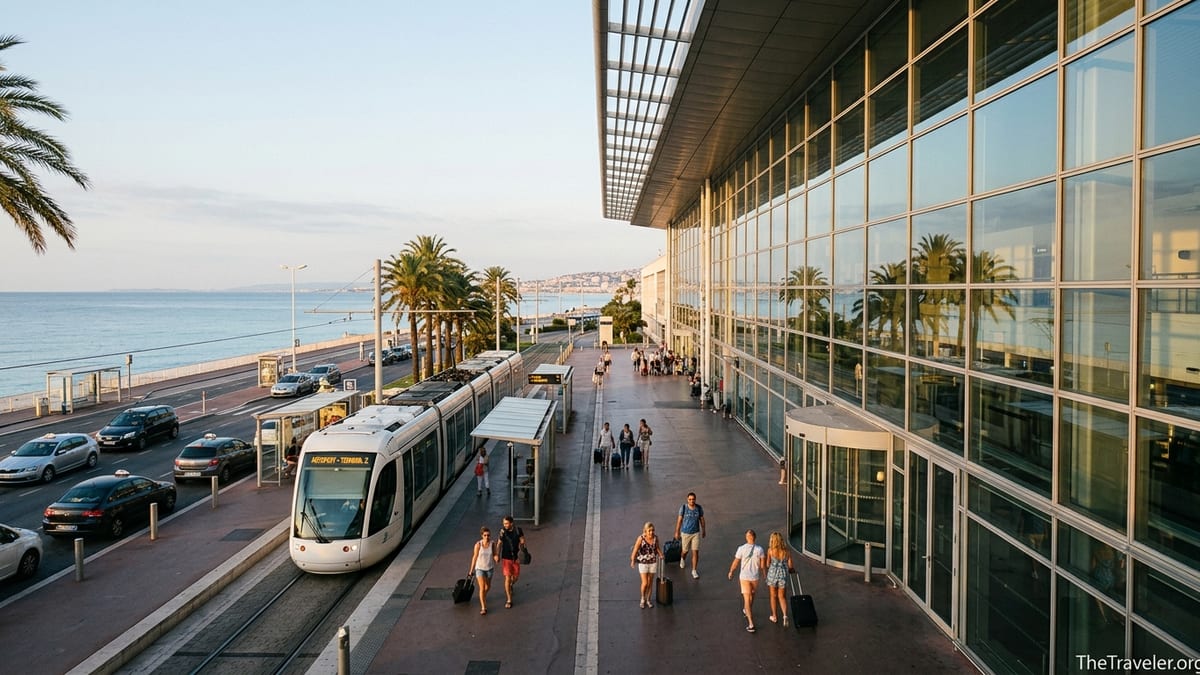
At each terminal, the tram platforms are just outside the building, clearly signposted with the number 2 and destination names such as Port Lympia. Rolling luggage can be wheeled directly onto the low-floor trams, and there are designated spaces for suitcases near the doors. Trams run frequently throughout the day, with intervals often around 8 to 10 minutes, although late-night service becomes less frequent. For many travelers staying near the Promenade des Anglais or in central districts like Carré d’Or or Old Town, the door-to-door journey often takes 25 to 35 minutes, depending on walking distance at the city end.
Traditional taxis wait outside each arrivals terminal at signed ranks. Fares are regulated and there is usually a fixed price for trips between Nice Airport and central Nice, which in recent years has been in the rough range of 30 to 35 euros, depending on time of day and any adjustments to official tariffs. Ride-hailing services operate in the region as well, but pickup locations may be slightly away from the main taxi ranks, sometimes in designated app-based transport zones in the car parks. For couples or small groups with heavy bags arriving late at night, the extra cost of a taxi compared with the tram is often worthwhile.
If you are heading beyond Nice, dedicated coach services and regional buses depart from stops near Terminal 2’s bus station and from Terminal 1’s ground transport area. For example, airport buses run to Cannes and Antibes along the coast, with typical journey times of about 45 minutes to an hour to Cannes depending on traffic. For Monaco and Menton, you can either take a regional bus or ride the tram to the Nice Saint-Augustin or city train stations, then connect to frequent TER regional trains hugging the shoreline. This combination is popular in summer, when the views from the train over Villefranche-sur-Mer and Eze-sur-Mer are part of the trip’s charm.
Parking at Nice Airport: Short Stays, Long Stays, and Kiss & Fly
For travelers driving to the airport, Nice Côte d’Azur offers several parking zones around both terminals, each tailored to how long you plan to leave your car. Near Terminal 1, you will find car parks such as P2 and P3 for short stays and quick access, plus Kiss & Fly areas where you can drop passengers close to the departures level. Around Terminal 2, car parks like P5 and premium facilities such as G2 sit within a very short walk of the terminal building, making them convenient for business travelers or anyone with limited mobility.
Further from the terminals, long-stay car parks like P4, P6, P8, or P9 are designed for multi-day or week-long trips. These lots are typically connected to the terminals by a free, fully electric shuttle service that runs roughly every 15 minutes from early morning, around 4:30, until the last flights around 1:30 in the morning. For example, a family from Provence driving in for a week in Greece might park in P8 and rely on the shuttle with their luggage and stroller, saving money compared with leaving the car in the closest premium car park.
Parking prices change periodically and often vary depending on how far in advance you book. Travelers who reserve online before arrival can often secure a better daily rate than simply driving up to the barrier, particularly in peak summer when proximity parking frequently sells out. In 2026, typical pre-booked long-stay rates for a week can be significantly lower than short-stay pricing, so it is worth checking official tariff brochures or the airport’s booking portal a few weeks ahead of your trip.
For ultra-short stops, such as dropping off a friend for an early morning Air France flight, the Kiss & Fly zones are usually the most efficient option. These areas allow a brief grace period to stop near the terminal; staying longer than the allowed time triggers normal parking charges. Local residents who use the airport regularly often combine short-term parking in P2 or P5 with a quick coffee in the departures hall while seeing off relatives, especially outside the busiest midday wave.
Car Rental and Driving the French Riviera
Nice Airport is a major car rental hub, with a dedicated Car Rental Center located near Terminal 2, behind car park P5. International brands such as Hertz, Avis, Enterprise, Europcar, and Sixt operate desks there, alongside French operators. While some counters exist in Terminal 1, most collections and returns are funneled to the Car Rental Center, which is reached either on foot from Terminal 2 or via a signed shuttle or tram link from Terminal 1. This centralization allows easier vehicle storage and quicker turnaround of cars during the busy summer season.
In practice, renting a compact or subcompact car is sufficient for most Riviera itineraries, especially if you plan to drive into hill towns with narrow streets like Eze Village or Saint-Paul-de-Vence. A typical summer weekly rental for a small manual car booked in advance can be relatively affordable, whereas premium SUVs and automatic transmission cars are scarcer and can be much more expensive. North American travelers unfamiliar with manual gearboxes should reserve an automatic well ahead of time, particularly for July and August dates.
Leaving the airport by car, you quickly join the A8 motorway, which runs east toward Monaco and the Italian border and west toward Antibes, Cannes, and Saint-Raphaël. The motorway is tolled, with charges collected either by card, cash, or a télépéage transponder. Alternatively, you can choose the slower but more scenic coastal routes, such as the lower Corniche road toward Villefranche and Monaco or the Promenade des Anglais into central Nice. First-time visitors often appreciate using a navigation app to manage complex junctions around the airport interchange and to avoid inadvertently entering bus lanes along the seafront.
Parking in central Nice and resort towns can be tight in peak season, so build that into your planning. Many travelers take a hybrid approach: they rent a car from the airport for a few days to explore the hinterland and then return it early, switching to trams and trains for the remainder of their stay. For example, a couple might spend three days driving to hilltop villages, Grasse’s perfume factories, and the coastal roads, then drop the car back at the airport and use the tram to reach a hotel in Old Nice, avoiding urban parking headaches.
Lounges, Services, and Airport Comfort
Nice Côte d’Azur Airport offers several lounges across its terminals. While precise lineups and access rules can change, you can generally expect at least one independent lounge and one or more airline or alliance lounges in each active pier of Terminal 2, plus smaller facilities in Terminal 1. These lounges are used by airlines such as Air France and various European carriers for business-class and elite-status passengers. Some independent lounges also accept day passes or memberships from common lounge networks, although capacity restrictions during summer peaks are common.
Facilities in these lounges typically include comfortable seating, Wi‑Fi, light snacks such as pastries, salads, and cold cuts, and a self-service bar with wine, beer, and soft drinks. Shower facilities may be available in selected lounges, which can be useful for travelers connecting from long-haul overnight flights. For example, a traveler arriving from Montreal and connecting onto a short hop to Corsica might spend an hour in a Terminal 2 lounge to freshen up, charge devices, and have coffee before boarding the next flight.
Outside the lounges, both terminals offer a mix of cafes, grab-and-go food counters, and sit-down restaurants. Common options include French bakery chains, Mediterranean-style bistros with salads and hot dishes, and global staples like coffee bars serving espresso and pastries. Prices for coffee and sandwiches are higher than in the city, but many travelers still prefer to eat airside to avoid risking delays at security. Duty-free shops stock French wines, Provençal rosé, perfumes, and cosmetics brands, which are popular last-minute gifts for travelers heading home.
Families will find baby-changing rooms and play areas, although these spaces can feel small in high season. Free Wi‑Fi is available throughout the terminals, and many seating areas include power outlets or USB ports, though not on every seat. Travelers with reduced mobility should arrange assistance in advance through their airline, which then coordinates with the airport’s specialized staff to provide wheelchairs or escort services from check-in through security and boarding.
Hotels at and Near Nice Airport
While there is no hotel physically attached to the terminal buildings in the way some larger hubs have, several hotels sit within easy walking distance or a very short shuttle ride. On the airport side of the main road, properties such as Novotel Suites Nice Airport and OKKO Hotels Nice Aéroport are popular with early-morning and late-night passengers, often just a few minutes’ walk from Terminal 1 or a quick hop on the tram to Terminal 2. Rooms are typically modern, with soundproofing to reduce aircraft noise, making them suitable for quick overnight stays between flights.
Across the Var River, near the Cap 3000 shopping center in Saint-Laurent-du-Var, you will find additional hotels like Novotel Nice Aéroport Cap 3000 and ibis Styles Nice Cap 3000 Airport. These are roughly five to ten minutes by shuttle, taxi, or even on foot in some cases, and they place you close not only to the airport but also to a sizeable shopping mall and a stretch of beach. For example, a traveler landing in the evening might stay at a hotel near Cap 3000, have dinner in one of the mall’s restaurants, and enjoy a quick seaside walk before an early flight out the next morning.
Within Nice itself, the tram connection means you can also use central hotels as practical “airport hotels” if your flight times are not at awkward hours. Many visitors choose accommodations near tram stops like Jean Médecin or Masséna in order to enjoy the nightlife and dining of central Nice before a morning departure. In this case, the journey can be as simple as a 5 to 10 minute walk from the hotel to the tram stop, followed by a 25‑minute ride to the terminals.
When comparing options, consider not just the nightly rate but also the cost and hassle of early-morning transport. A budget-friendly hotel in central Nice may become less attractive if you need a 5:30 taxi in high season, while a slightly more expensive airport-side hotel that you can reach on foot or by free shuttle can make a 7:00 departure much less stressful.
Departures: Check-in, Security, and Boarding Tips
For flights within the Schengen area, arriving at the airport around 1.5 to 2 hours before departure is usually adequate outside of the absolute summer peaks. For non-Schengen flights, flights with checked baggage, or travel at the height of July and August or during large events such as the Cannes Film Festival or Monaco Grand Prix, planning 2.5 to 3 hours gives a safer margin. Airlines sometimes send email or app notifications recommending earlier check-in for specific busy days, so keep an eye on pre-departure messages.
Check-in zones in both terminals are labeled by letters and are visible as soon as you enter the departures halls. Many airlines now encourage online check-in and self-service bag tag printing, with staffed counters reserved for special cases and baggage drop. In Terminal 2, the new extension has added more check-in desks and security lanes, which has helped relieve some of the congestion that used to occur when several large aircraft were scheduled in close succession.
Security screening at Nice follows standard European rules: liquids must be in containers of 100 milliliters or less and placed in a single clear bag, and laptops and large electronics are typically removed from carry-on bags unless specific scanners allow otherwise. In peak times, queues can snake back from the screening area, but they usually move steadily. Families with small children and travelers with reduced mobility may be directed to dedicated lanes. Once airside, allow time to walk to your gate, particularly in Terminal 2 where the newer boarding areas can be a moderate walk from central shops and restaurants.
Boarding processes vary by airline, but low-cost carriers such as easyJet often use a zone or group system and may rely on both jet bridges and remote stands connected by buses. If you know you prefer to board early to secure overhead bin space, it can be worth purchasing priority boarding on your ticket. On hot summer days, crew often encourage passengers waiting on outdoor staircases or in bus queues to use hats and water bottles, as the tarmac areas can be significantly warmer than the terminal interiors.
French Riviera Travel Tips for First-Timers
Once you leave the airport, your French Riviera experience depends heavily on where you base yourself and how you move around. For a first visit, many travelers choose to stay in Nice itself, using it as a hub for day trips. From Nice, you can take TER trains east to Villefranche-sur-Mer, Eze-sur-Mer, Monaco, and Menton, or west to Antibes and Cannes. These trains are frequent in the daytime and relatively affordable, making them an attractive alternative to driving and parking in crowded resort centers.
Public transport within Nice is straightforward: tram lines cover most tourist areas, including connections to the airport, and city buses reach beaches and hill districts. A visitor arriving on a Sunday afternoon, for example, might ride the tram from Terminal 2 to Jean Médecin, walk 10 minutes to a boutique hotel near the Promenade des Anglais, then take a short evening stroll on the pebble beach before dinner in the Old Town. The next day, the same traveler could use the tram and train combination to visit Antibes’ old harbor or the Picasso Museum, all without renting a car.
For those who do rent a car, timing and route planning can make the difference between a relaxed drive and a stressful one. Morning rush hour on the A8 and along the seafront around Nice can be busy, especially on weekdays, and late Saturday afternoons in summer often see heavy return traffic from the beaches. Starting day trips early, parking in structured garages at town entrances, and walking into historic centers usually leads to a more pleasant experience. For instance, in Saint-Paul-de-Vence, many visitors park in the main lot below the ramparts and walk up into the medieval streets rather than trying to squeeze closer with their vehicle.
Seasonality also matters. In high summer, from late June through August, coastal towns and beaches are crowded, hotel prices are high, and restaurant reservations are recommended, especially on weekends. In shoulder seasons like May, early June, September, and early October, the weather can still be warm enough for outdoor dining and sea views, but crowds are more manageable and accommodation is usually cheaper. Regardless of season, travelers should pack comfortable walking shoes and light layers, since evenings by the water can be breezy even on warm days.
FAQ
Q1. Which terminal will my flight use at Nice Côte d’Azur Airport?
Airline allocations change, but many European and domestic flights now use Terminal 2, while some airlines and seasonal services operate from Terminal 1. Always check your booking or airline app shortly before travel, as several carriers have moved into the expanded Terminal 2 in 2025 and 2026.
Q2. How do I get from Nice Airport to central Nice using public transport?
The easiest option is Tram Line 2, which serves both Terminal 1 and Terminal 2 and runs to central stops such as Jean Médecin and Port Lympia. A standard city ticket, usually around 1.70 euros, covers the airport-to-city trip and allows transfers to other trams or buses within the validity period.
Q3. Is taking a taxi from the airport to Nice city center expensive?
Taxis operate with regulated fares, and there is typically a fixed price for trips between the airport and central Nice, roughly in the 30 to 35 euro range in recent years. This is more expensive than the tram but can be convenient late at night, in bad weather, or if you have heavy luggage.
Q4. Where can I rent a car at Nice Airport?
Most major rental companies are based at the Car Rental Center near Terminal 2, behind car park P5. After landing, follow signs for car rental in your arrivals hall; you may take a short shuttle or tram connection to the Car Rental Center depending on which terminal you arrive at.
Q5. Are there hotels within walking distance of Nice Airport?
Yes. Several hotels, such as Novotel Suites Nice Airport and OKKO Hotels Nice Aéroport, are within a few minutes’ walk of Terminal 1 or a brief tram ride from Terminal 2. Other options like Novotel Nice Aéroport Cap 3000 and ibis Styles Nice Cap 3000 Airport are a short shuttle or taxi ride away near the Cap 3000 shopping center.
Q6. How early should I arrive at the airport before my flight?
For Schengen flights with hand luggage only, 1.5 to 2 hours before departure is usually sufficient outside peak summer. For non-Schengen flights, checked baggage, or travel during busy periods like late July, August, or major events, plan on 2.5 to 3 hours to allow for check-in, security, and potential queues.
Q7. Is parking available for a week-long trip, and how does it work?
Yes. Long-stay car parks such as P4, P6, P8, and P9 are designed for multi-day or week-long parking and are connected to the terminals by free electric shuttles. Booking online in advance often secures better rates than driving up on the day, especially in summer.
Q8. Does Nice Airport have lounges I can access without a business-class ticket?
Several lounges at Nice Airport offer paid access or accept membership programs in addition to airline status passengers. Availability and entry conditions vary by lounge and season, so it is wise to check current access rules and, when possible, reserve a spot if you are traveling at a very busy time.
Q9. What is the easiest way to reach Cannes, Antibes, or Monaco from the airport?
For Cannes and Antibes, dedicated airport coaches and regional buses run along the coast, or you can take a short tram ride to a nearby train station and connect to a TER regional train. For Monaco, many travelers take the tram to Nice Saint-Augustin or a central station, then board a TER train east along the coast, which typically offers faster and more reliable travel than driving in heavy traffic.
Q10. Is it worth renting a car for a first visit to the French Riviera?
Renting a car can be worthwhile if you plan to explore hilltop villages, inland towns, or remote coastal spots not well served by public transport. However, for itineraries focused on Nice, Antibes, Cannes, Monaco, and Menton, many first-time visitors manage comfortably using trams, trains, and buses, sometimes renting a car only for one or two specific day trips.