


Planning a French Riviera escape is the easy part. Deciding how to arrive is where it gets complicated. Between Nice Côte d’Azur Airport, Cannes Mandelieu Airport and Monaco Heliport, travelers have very different options for reaching Cannes, Nice, Antibes, Monaco and the surrounding resorts. The right choice can save you an hour in traffic, hundreds of euros in transfers, or deliver a seamless jet-to-yacht arrival worthy of a movie star. This guide breaks down how each arrival point really works in 2026, with concrete examples and typical costs so you can match the right gateway to your style of Riviera trip.
Get the latest updates straight to your inbox!
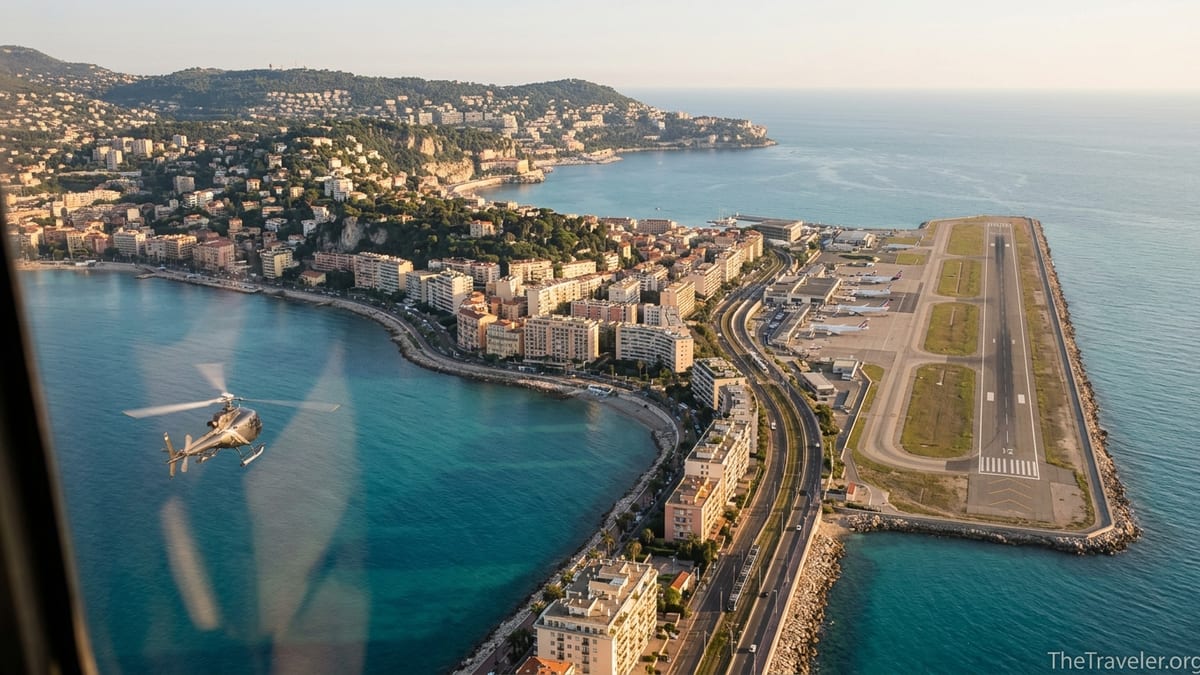
Overview: Three Very Different Gateways to the French Riviera
Although they share the same coastline, Nice Côte d’Azur Airport, Cannes Mandelieu and Monaco Heliport serve very different types of trips. Nice is the main international hub with regular airline flights from across Europe, the Middle East and North America, handling everything from low-cost carriers to long-haul widebodies. It is where most visitors land, whether they are spending three days in Nice or a week split between Cannes and Monaco. In practical terms, if you are flying scheduled commercial airlines, you will almost certainly arrive at Nice.
Cannes Mandelieu, about 5 kilometers west of Cannes, is a specialist business and general aviation airport that ranks among the busiest business aviation fields in France. It is designed around private jets and high-end general aviation rather than classic scheduled flights, with dedicated terminals, hangars and quick turnarounds for aircraft owners, charter customers and air-taxi users. For a group chartering a light jet from London or Geneva directly into Cannes, Mandelieu can eliminate the coastal highway transfer from Nice altogether.
Monaco Heliport is something else again: a compact heliport set on the seafront at Fontvieille that links Monaco directly with Nice Airport and, on demand, with other Riviera destinations. Helicopter companies operate frequent shuttles between Nice and Monaco, typically taking around 7 minutes of flight time, turning what can be an hour-plus road journey in summer into a brief hop with sweeping views of the Mediterranean. For high-end travelers, it is often treated as an extension of the First or Business Class journey rather than a separate transfer.
Choosing between these three gateways is less about aviation preferences and more about the specifics of your itinerary: where you are staying, when you are traveling, how much luggage you carry and whether time, comfort or cost matters most. A family visiting Antibes in October will make very different choices from a group arriving by yacht in Monaco during the Grand Prix.
Nice Côte d’Azur Airport: Best All-Rounder for Most Travelers
Nice Côte d’Azur Airport functions as the Riviera’s main front door. It has two terminals, a wide range of airlines and a constantly improving ground transport network. For travelers heading to Nice city itself, or to nearby Antibes and even Monaco, it balances convenience, price and choice in a way neither Cannes Mandelieu nor Monaco Heliport can match for most trips.
From Nice Airport into Nice city, the tram is the simplest and cheapest option. Tram Line 2 runs from both terminals into central Nice in around 25 to 30 minutes, with tickets typically costing just a few euros per person. For a couple staying in a hotel near Place Masséna and carrying rolling suitcases, the tram can be more comfortable than fighting for taxis in peak season. A taxi from the airport to central Nice is usually posted at a flat rate in the low 30 euro range for 2026, which can be good value for a family of four compared with multiple tram tickets.
For destinations further along the coast, such as Antibes, Cannes and Monaco, ground options from Nice Airport range from local trains to express buses, taxis, ride-hailing and pre-booked private transfers. A government-approved taxi from Nice Airport is advertised around 72 euros to Antibes, 85 euros to Cannes and around 95 euros to Monaco, excluding supplements, as of 2026. These prices are fixed from the airport, which avoids disputes over meters on congested days. By comparison, a pre-booked private transfer for Nice to Cannes often sits in the 70 to 90 euro band for a standard sedan, giving you a named driver in arrivals and a fixed fare even if the autoroute slows to a crawl.
Public transport remains the budget-conscious option. Many visitors ride the tram one stop to Nice Saint-Augustin station and connect to regional TER trains for Antibes, Cannes or Monaco, usually paying under 15 euros per person even in high season. This combination is particularly attractive for solo travelers or small groups with light luggage, such as a couple spending five nights in Antibes and planning day trips by train to Cannes and Monaco. The key drawback is complexity late at night, when tram frequencies drop and connections become less forgiving.
Cannes Mandelieu: Direct Jet Access for Cannes, Mougins & Saint-Tropez
Cannes Mandelieu Airport is built around the needs of business aviation and private flyers. Aircraft movements are dominated by general, business and leisure aviation rather than holiday charter traffic, and the facilities are clearly geared towards discretion and speed. Private jet passengers typically clear formalities in a dedicated terminal, walk a short distance to their waiting car and can be on La Croisette in less than 20 minutes when traffic co-operates.
In practical terms, Cannes Mandelieu shines for travelers whose final destination lies between Cannes, Mandelieu and the inland villages such as Mougins, Valbonne or Grasse, or for those heading west along the coast toward Saint-Raphaël and Saint-Tropez. For example, a group chartering a midsize jet from London Farnborough directly to Cannes Mandelieu for the film festival may land mid-morning, pass through the terminal in minutes and be on the steps of the Palais des Festivals shortly afterward. The same group, if they routed via Nice, would face at least 40 to 60 minutes on the autoroute, often longer when festival traffic builds.
The catch is access. Regular scheduled airline services remain limited or non-existent for most markets, so using Cannes Mandelieu usually requires chartering or owning an aircraft, or flying a smaller air-taxi service that can land there. That instantly moves it out of reach for many travelers. Costs can vary widely depending on route and aircraft type, but even a relatively short charter from Geneva or Zurich can amount to several thousand euros one-way. That said, for a family of six staying in a villa above Cannes in mid-July, the per-person cost of a shared jet charter might be comparable to six Business Class tickets plus transfer time saved.
For those who do fly into Cannes Mandelieu, onward transfers are straightforward. Taxis wait outside the general aviation terminal, and the drive to central Cannes can be as short as ten minutes outside rush hours. Private car services are common, and some luxury hotels in Cannes will dispatch their own vehicles directly to the plane. For travelers staying in Antibes or Monaco, however, Cannes Mandelieu is rarely a sensible choice: they would still face a 40-minute or longer drive back along the coast to reach those resorts, negating the point of landing closer to Cannes.
Monaco Heliport: Time-Saving Luxury for Monaco & High-End Itineraries
Monaco Heliport occupies a tight footprint on the reclaimed land of Fontvieille, but it plays an outsized role in high-end Riviera travel. Helicopter operators such as Monacair and other carriers operate frequent shuttles between Nice Airport and Monaco, typically advertised at about 7 minutes of flight time. Flights run throughout the day, with increased frequencies around major events such as the Monaco Grand Prix and the Yacht Show, turning the heliport into a busy sky gateway.
In 2026, one-way helicopter seats between Nice and Monaco often start around 195 euros per person on shared services and rise for private charters. Some operators bundle in added benefits, such as lounge access in Nice Airport terminals and complimentary car shuttles within Monaco from the heliport to hotels like the Hôtel de Paris, Fairmont Monte Carlo or Port Hercules marinas. A couple arriving from Dubai in Business Class on a long-haul flight, then transferring directly by helicopter to a suite in Monte Carlo, can complete the entire journey from aircraft door to hotel in under an hour in light traffic.
The helicopter option becomes particularly attractive when road congestion is extreme. On a normal weekday, a taxi from Nice Airport to Monaco might cover the 30 or so kilometers in 35 to 50 minutes via the autoroute, but on race weekend it can easily stretch past 90 minutes. A posted flat taxi fare of around 95 euros from the airport to Monaco looks far less appealing when combined with the stress of delays and potential difficulty in getting cars into or out of the principality’s restricted zones. By contrast, a seven-minute flight and a waiting shuttle to your yacht in Port Hercule can feel like money well spent for time-sensitive arrivals.
That said, Monaco Heliport is not just for the ultra-wealthy. Occasionally, travelers pair a helicopter in one direction with a train or express bus in the other, using the helicopter as a memorable splurge. For instance, a couple on a special anniversary trip might arrive by helicopter from Nice to Monaco, enjoy a weekend at a seafront hotel and then return to Nice city by regional train for a final night before flying home. For most visitors staying in Nice, Antibes or Cannes, however, using Monaco Heliport as an arrival point would be inefficient unless they have a very specific helicopter charter routing in mind.
Transfer Times & Real-World Costs: What You Are Likely to Pay
Understanding how these gateways compare in terms of pure logistics helps clarify which option makes sense. Consider a typical July Saturday afternoon, when coastal traffic is heavy and most flights are full. A family of four with two suitcases each lands at Nice on a midday flight from London. They are staying in a seafront hotel in Antibes. Their choices might include a fixed-price taxi at around 72 euros door to door, a pre-booked private transfer for perhaps 80 to 90 euros, or a tram plus regional train combination costing well under 40 euros total but requiring platform changes and some walking. For them, Nice Airport remains clearly the best arrival point; flying into Cannes Mandelieu would both cost much more and still require a transfer east to Antibes.
Contrast that with a small group of executives heading to back-to-back meetings in Monaco and then aboard a yacht in Port Hercule. They are arriving midday on a transatlantic service into Nice and need to be at a harbor-side lunch within an hour of landing. While a fixed taxi fare of roughly 95 euros seems reasonable, the risk of congestion on the autoroute, especially if there has been an accident or if Grand Prix preparations are affecting traffic, could derail their timetable. For this profile, a helicopter transfer at approximately 195 euros per person becomes a practical business cost. Ten minutes after clearing immigration they can be in a dedicated helicopter lounge, airborne soon after, and at Monaco Heliport with a driver waiting.
For high-season Cannes visitors, time and stress also weigh heavily. A mid-range private transfer from Nice Airport to Cannes often prices in the 70 to 100 euro band for a sedan, rising for larger vehicles. In heavy traffic it may take an hour or more along the A8 motorway and coastal roads. A traveler flying privately into Cannes Mandelieu cuts that down significantly, but at the cost of a private jet charter that can run many thousands of euros one-way from major European capitals. Some operators offer helicopter transfers from Nice to Cannes and even Saint-Tropez, often priced similarly per seat to the Monaco shuttle, but in practice these are more niche than the Monaco route.
One subtle cost factor is baggage. Families loaded with beach gear, strollers and multiple checked bags are generally better served by a direct transfer from Nice Airport than by trying to navigate trams and trains. Helicopters also have strict luggage weight and size limits. A couple traveling light for a weekend at the Hôtel Hermitage might be fine with two carry-on suitcases and a helicopter ride, but a group arriving for a week aboard a yacht with multiple large cases may need ground transport or split loads, pushing the effective cost higher.
Which Arrival Works Best for Nice, Cannes, Antibes & Monaco?
For travelers whose primary base is Nice itself, Nice Côte d’Azur Airport is overwhelmingly the best arrival choice. The tram links the terminals directly to the city, taxis are regulated with posted flat fares, and ride-hailing services operate with pick-up points just outside the terminals. Whether you are staying in an Old Town apartment, a Promenade des Anglais hotel or a boutique property in the Musicians’ Quarter, the combination of speed, price and simplicity from Nice’s own airport is hard to beat. Monaco Heliport and Cannes Mandelieu simply do not offer a meaningful advantage if your nights are spent in Nice.
For Cannes, the choice becomes more nuanced. If you are flying commercial from abroad or other parts of Europe, you will almost always arrive at Nice and transfer by road or rail. The train from Nice Saint-Augustin to Cannes is inexpensive and reasonably quick, especially outside rush hours, and many budget-conscious travelers use this route. However, if you are arriving by private jet or charter for a festival, trade show or luxury villa stay, Cannes Mandelieu offers a dramatically more convenient arrival. Ten or fifteen minutes from touchdown to your hotel on La Croisette is realistic in good conditions, especially with a pre-arranged car.
Antibes sits in the middle. From Nice Airport, Antibes is a straightforward 20 to 30 minute drive in normal traffic, slightly longer when the coastal road is busy. A fixed taxi fare in the low 70 euro range or a pre-booked transfer makes it a comfortable and predictable journey. For independent travelers, the tram plus train option keeps costs down while still getting you to Antibes station in under an hour. In most cases, neither Cannes Mandelieu nor Monaco Heliport offers a better solution for people actually staying in Antibes, unless a private pilot specifically chooses Mandelieu for aircraft handling reasons.
Monaco is where the choices really show. Budget-minded visitors staying in mid-range hotels along Boulevard des Moulins often arrive via Nice Airport, then connect by express bus or regional train, keeping the total door-to-door cost modest. Business travelers facing tight schedules, guests of major events or high-end leisure visitors frequently pay for helicopter transfers to Monaco Heliport, prioritizing time and comfort over price. For them, Nice Airport plus Monaco Heliport is really a combined system: long-haul flights into Nice, helicopters up to Monaco, and courtesy shuttles to hotels and marinas.
How Trip Style, Season & Events Change the “Best” Choice
The French Riviera changes character dramatically between a quiet January weekend and the overlapping festivals and races of late May and June. Your ideal arrival point can also change with the calendar. In low season, traffic from Nice Airport to Cannes or Monaco is often light, making even taxi or private car transfers predictable and relatively quick. In these months, the convenience premium of a helicopter or a private jet into Cannes Mandelieu shrinks. A couple visiting in February for a quiet stay in Menton or a winter culinary break in Nice can safely plan around regular road transfers.
In high season, and especially around major events, the calculus shifts. During the Cannes Film Festival, MIPIM or the Monaco Grand Prix, regional traffic can become extremely congested. Stories of travelers taking well over an hour to reach Cannes from Nice in mid-afternoon during the festival, or of gridlock on the A8 near Monaco on race weekend, are common. For producers, investors or VIP guests with limited time on the ground, the premium for a helicopter or business jet feels more justifiable than for a leisure traveler on a ten-day holiday.
Trip style matters as well. Families on week-long villa stays in Mougins or Valbonne might be happy to accept a 45-minute private transfer from Nice Airport in exchange for lower airfare and more flexible flight times. A honeymoon couple staying three nights in Monaco and three nights in Saint-Jean-Cap-Ferrat might choose to arrive via helicopter into Monaco for the wow factor, then leave by car to Nice for their flight home. Yacht charters departing from Port Vauban in Antibes might favor Nice Airport plus a short transfer, whereas charters based in Cannes or La Napoule could find direct arrival into Cannes Mandelieu more aligned with the yacht’s schedule.
Even the time of day affects the choice. Late-night arrivals have fewer public transport options, making taxis or pre-booked transfers the default from Nice Airport. Helicopter services generally stop operating in the late evening, so a midnight arrival from London to Nice leaves you with road transfers only. Conversely, early morning departures from Nice can special-order early helicopter shuttles from Monaco to catch first-wave long-haul flights, allowing Monaco-based guests to sleep in their own suites until shortly before check-in time at the airport.
The Takeaway
There is no single “best” arrival point for the French Riviera, only better or worse fits for specific trips. Nice Côte d’Azur Airport is the all-rounder that works for almost everyone, combining international connectivity, extensive ground transport and a logical path to Nice, Antibes, Cannes and Monaco. If you are flying on regular airlines, staying in mainstream hotels and watching your budget, it is very likely the smartest and simplest place to land.
Cannes Mandelieu Airport comes into its own when you are flying privately and focusing your time around Cannes and the western Riviera. It cuts transfer times dramatically for La Croisette, nearby villas and inland hill towns, but only if you are willing and able to charter a jet or fly on a small aircraft that can use its facilities. For travelers bound to Antibes, Nice or Monaco on regular tickets, it rarely makes sense as an arrival point.
Monaco Heliport remains the ultimate time-saver and status symbol rather than a mass-market gateway. For those attending the Grand Prix, arriving on a superyacht or racing between meetings, a seven-minute helicopter ride from Nice can be priceless. For many others, it is an appealing but optional splurge, best used one way on a special trip rather than as a default mode of transport.
To choose the right arrival, start with three questions: where are you sleeping most nights, how tight is your schedule, and how much flexibility do you have in your budget. Answer honestly, and the choice between Nice, Cannes Mandelieu and Monaco Heliport usually becomes obvious.
FAQ
Q1. If I am staying in central Nice, which arrival should I choose?
For almost all visitors staying in central Nice, Nice Côte d’Azur Airport is the best choice. The tram links the terminals directly to the city in about 25 to 30 minutes, taxis have flat rates into town, and using Cannes Mandelieu or Monaco Heliport would only add unnecessary complexity and cost.
Q2. Is a helicopter from Nice Airport to Monaco worth the price?
It can be, depending on your priorities. If you value time and comfort, are arriving during a busy period like the Monaco Grand Prix, or simply want a memorable arrival to a luxury hotel or yacht, paying around 195 euros per person for a seven-minute flight can be reasonable. If you are traveling on a tighter budget or have flexible timing, the train or express bus from Nice to Monaco is much cheaper and still relatively quick.
Q3. When does it make sense to use Cannes Mandelieu instead of Nice Airport?
Cannes Mandelieu makes sense mainly if you are flying by private jet or charter and plan to spend most of your time in or around Cannes, Mougins, Mandelieu or Saint-Raphaël. In that case, the short transfer from the airport to La Croisette or nearby villas can save significant time. For travelers on regular airline tickets or those staying in Nice, Antibes or Monaco, Nice Airport remains the more logical arrival point.
Q4. How long does it take to get from Nice Airport to Cannes by car?
In light traffic, the drive from Nice Airport to Cannes typically takes about 40 minutes via the motorway. In high summer or during major events like the Cannes Film Festival, the journey can stretch beyond an hour. This is why some high-end visitors consider private transfers or helicopters, but for most travelers a pre-booked car or taxi from Nice is still the standard solution.
Q5. What is the cheapest way to reach Antibes from Nice Airport?
The cheapest commonly used option is to take the tram from Nice Airport to Nice Saint-Augustin station and then a regional TER train to Antibes, usually costing well under 15 euros per person. This works best if you are traveling light and comfortable with changes. If you have lots of luggage or arrive late at night, a fixed-fare taxi or pre-booked private transfer from Nice Airport to Antibes is more convenient, though more expensive.
Q6. Can I use Monaco Heliport if I am not staying in Monaco?
You can, but it is rarely practical. Helicopter transfers from Nice Airport to Monaco are designed primarily for travelers staying in Monaco or embarking on yachts in its port. If your hotel is in Nice, Antibes or Cannes, you would be backtracking by landing at the heliport and then arranging additional ground transport, which adds cost and complexity without saving time.
Q7. Are there regular airline flights into Cannes Mandelieu?
As of 2026, Cannes Mandelieu is focused on general and business aviation rather than standard scheduled airline services. Most visitors on conventional airline tickets will arrive at Nice Côte d’Azur instead. To use Cannes Mandelieu you typically need to charter or own an aircraft, or book a specialized air-taxi service capable of operating there.
Q8. How far is Monaco Heliport from Monaco’s main hotels and the casino area?
Monaco Heliport is in the Fontvieille district, a short drive from central Monte Carlo. Many helicopter companies include complimentary car transfers from the heliport to major hotels and marinas, so you can usually expect to be at places like the casino area, Port Hercule or Boulevard des Moulins within about ten minutes of landing, traffic permitting.
Q9. Is Uber available from Nice Airport to Cannes, Antibes and Monaco?
Ride-hailing services like Uber do operate around Nice Airport, but availability can vary by time of day and season, and surge pricing can make them unpredictable in peak periods. For longer trips like Nice to Cannes, Antibes or Monaco, many travelers prefer fixed-price taxis from the airport rank or pre-booked private transfers, which provide clarity on cost even if traffic is heavy.
Q10. For a luxury trip visiting both Cannes and Monaco, how should I plan my arrivals?
One popular pattern is to fly into Nice Airport, take a private car or helicopter to Monaco for the first part of the stay, then move along the coast by car to Cannes. Some high-end visitors charter a jet into Cannes Mandelieu for the Cannes segment, then use a helicopter connection via Nice to reach Monaco. In most cases, though, using Nice Airport as your main international arrival and combining it with a mix of cars, trains and potentially one helicopter leg offers a good balance of efficiency, comfort and cost.