


More news on this day
Nine people remain in critical condition after a London-bound commuter train crash near Bedford killed a driver and left scores injured, in one of Britain’s most serious rail incidents in recent years.
Get the latest news straight to your inbox!
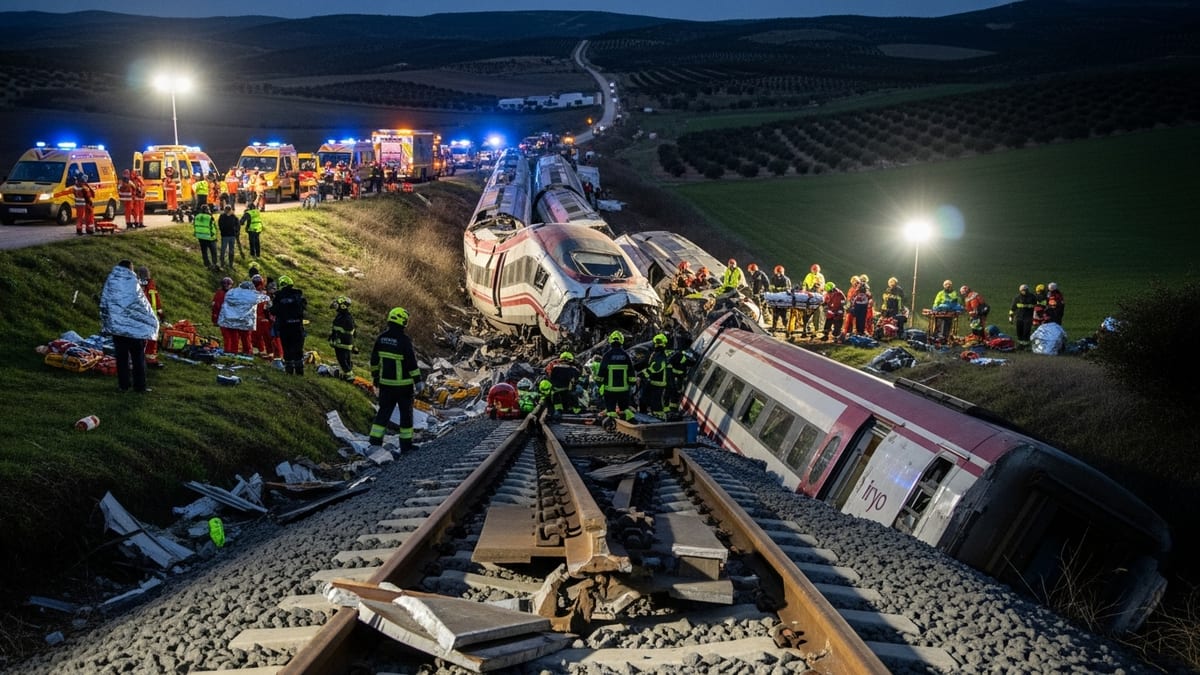
Fatal collision on busy London corridor
Publicly available reports indicate that the collision occurred on Friday afternoon near Bedford, around 90 kilometres north of London, on one of the country’s busiest intercity corridors. Two southbound East Midlands Railway services heading for London St Pancras were travelling on the same line when one train struck the rear of another, killing the driver of the moving train.
Initial accounts from rail operators and transport police describe a high-impact rear-end crash that left carriages crumpled and debris scattered along the embankment. Images shared by passengers and local media showed crunched metal at the front of the leading unit, shattered windows and twisted couplers between vehicles.
Despite the severity of the impact, much of the passenger accommodation remained structurally intact, a detail noted by commentators familiar with modern crashworthiness standards. However, the front cab area, where the driver was located, appears to have absorbed the worst of the force, underscoring the human toll of the crash.
The section of line where the collision happened forms part of the Midland Main Line, a strategic artery linking the East Midlands with the capital. Disruption spread quickly across services in and out of London as the route was closed to allow rescue work and early examination of the scene.
Casualties mount as investigations begin
According to published coverage, more than 80 people required hospital treatment after the incident, with approximately 28 still in hospital the following day. Of those, nine are reported to be in critical condition, described in several accounts as fighting for their lives as medical teams work to stabilise severe trauma injuries.
Overall casualty figures vary slightly between early dispatches, but multiple outlets converge on a picture of around 89 to 100 injured in total, ranging from minor cuts and shock to broken limbs, head injuries and other serious conditions. Emergency services deployed a substantial response, with paramedics, fire crews and specialist rescue teams working into the evening to extract passengers and triage the wounded.
Passengers’ descriptions collected by broadcasters and newspapers point to chaotic scenes immediately after the collision. People were thrown from seats, luggage rained down from overhead racks and some travellers struggled to move in crushed or darkened carriages. Others described a rapid, coordinated effort among fellow passengers to assist the injured before professional responders arrived.
Hospitals across the region activated major incident protocols, reallocating staff and resources to cope with the sudden influx of patients. Regional health services reported a mix of life-threatening injuries, serious but stable cases and a larger group treated for more minor harm and psychological shock.
Focus on signalling, speed and train spacing
Specialist rail accident investigators and British Transport Police teams are now examining data recorders, signalling logs and trackside equipment to determine how two London-bound trains came to occupy the same stretch of line at the same time. Publicly available briefings suggest particular attention on signal aspects, braking performance and any potential issues with communication between the signalling centre and the trains.
Experts quoted in media analysis note that rear-end collisions on modern British railways are rare, due in part to multiple layers of protection such as track circuits, signal interlocking and on-board safety systems designed to prevent trains from closing too tightly on one another. Investigators are expected to consider whether any technical malfunction, human error or unusual operating circumstance allowed those defences to be breached.
The condition of the track, recent maintenance records and the performance of the trains themselves will also come under scrutiny. Both services were reported to be operated by East Midlands Railway using modern rolling stock that should incorporate energy-absorbing crumple zones, designed to protect passenger compartments in exactly this kind of impact.
While no early assessment can be definitive, rail analysts cited in coverage suggest that recovering data from the trains’ on-board recorders will be central to reconstructing events in the minutes leading up to the crash, including speed, braking commands and any alarms or warnings triggered in the cab.
Passengers face disruption as route remains constrained
In the immediate aftermath, the line between Bedford and London faced significant disruption, with services cancelled, diverted or heavily delayed. Thousands of passengers heading into and out of the capital during the Friday evening peak were forced to seek alternative routes, connecting via other main lines or using road transport.
Rail operators issued broad “do not travel” advisories for sections of the Midland Main Line while engineers assessed track damage, checked overhead line equipment and arranged the removal of the stricken trains. Recovery operations are expected to continue over several days, with residual delays and reduced capacity likely to persist while temporary speed restrictions and engineering checks remain in place.
For travellers from cities such as Nottingham, Leicester and Derby, the accident has severed a key link to London, highlighting the vulnerability of busy, largely two-track routes when an incident blocks both directions. Passenger groups quoted in coverage have called for clear, timely information and robust ticket acceptance on alternative routes during the disruption.
Tourism and business travel are also affected, as the line connects not only regional centres but also important hubs for visitors heading to and from London. Travel advisers are recommending that passengers build in extra time, check service updates frequently and consider flexible booking options while the rail network absorbs the impact of the crash.
Renewed scrutiny of Britain’s rail safety record
The crash has drawn national attention partly because Britain’s mainline network has recorded relatively few fatal train collisions in recent decades compared with earlier eras. Commentators note that, aside from isolated incidents, the country’s overall rail safety record has been considered among the strongest in Europe.
Nevertheless, the severity of the Bedford collision, the death of a driver and the high number of critical injuries are already prompting questions about whether existing safeguards are sufficient on intensively used commuter and intercity corridors. Public debate is likely to focus on whether further investment is needed in advanced train protection systems, upgraded signalling and additional fail-safes that can intervene even when human error occurs.
Unions representing drivers and other rail staff have expressed condolences and highlighted longstanding concerns around workloads, route familiarity, rostering and the pace of technological change. Passenger advocacy organisations, meanwhile, are pressing for a transparent investigation whose findings are made swiftly available, along with clear recommendations to prevent similar incidents.
For now, attention remains on those still in hospital, particularly the nine individuals reported to be fighting for life. As investigators piece together what happened on the track outside Bedford, the crash is already reshaping conversations about risk, resilience and passenger safety on one of Europe’s busiest rail networks.