


More news on this day
Downing Street is standing by the head of the UK’s air traffic control provider after a major technical failure triggered more than 2,000 flight cancellations, leaving tens of thousands of passengers facing disruption and prompting fierce criticism from airlines.
Get the latest news straight to your inbox!
Government signals support amid mounting scrutiny
Publicly available information indicates that No 10 has confirmed it still has confidence in Martin Rolfe, chief executive of air traffic control provider NATS, even as UK airports work through a second day of severe disruption. The backing comes after a system failure on Tuesday led to widespread delays and cancellations at key hubs including Heathrow, Gatwick, Manchester and Stansted.
According to published coverage, Rolfe has been given one week to deliver an internal report explaining the root cause of the technical glitch that forced controllers to impose traffic restrictions. The government’s stance effectively buys NATS leadership time to complete that investigation while pressure grows from airlines and passengers for clearer answers.
Reports indicate that the outage has already prompted questions in Westminster about the resilience of the UK’s air traffic infrastructure and the adequacy of regulatory oversight. While cybersecurity concerns were initially raised, NATS has ruled out a cyber attack as the cause of the incident and described it as a technical issue within its flight data processing systems.
The government’s decision to reiterate confidence in Rolfe suggests a desire to avoid immediate upheaval at the top of a system that manages millions of flights a year. At the same time, officials have signalled that NATS will be expected to provide a detailed account of what went wrong and how a repeat can be prevented.
Airlines decry ‘avoidable’ meltdown and demand accountability
Major carriers have reacted sharply to the failure, arguing that repeated disruptions linked to UK air traffic control are no longer acceptable. Coverage in national media shows that several airlines have described the latest incident as “shocking” and “avoidable,” and have called for structural changes at NATS, including suggestions from some quarters that senior management should step aside.
Ryanair, which has previously clashed with NATS over earlier outages, is among those publicly criticising the organisation, saying the lack of a robust back-up left airlines and passengers exposed. Other carriers, including British Airways and easyJet, have highlighted the knock-on complexity of rebooking passengers and repositioning aircraft when large portions of the UK network are suddenly constrained.
Airlines argue that aviation businesses and their customers ultimately bear the financial and reputational costs of failures in a monopoly air traffic system they do not control. Industry estimates cited in recent analysis suggest the disruption could cost airlines and the wider aviation sector tens of millions of pounds once compensation, crew and hotel costs, fuel, and lost revenue are tallied.
Consumer groups have echoed concerns about accountability and transparency, indicating that passengers often struggle to understand their rights when cancellations are attributed to air traffic control issues, which can fall into complex regulatory categories for compensation.
Scale of disruption: more than 2,000 flights affected
Data from aviation analytics firms and airport operators shows the scale of the disruption that unfolded after Tuesday’s outage. Over the course of two days, more than 2,000 flights to and from UK airports were cancelled, with hundreds more delayed as airlines worked to recover schedules and aircraft were left out of position across Europe.
Heathrow and Gatwick, the country’s two busiest hubs, have been among the hardest hit, with some services suspended even after the core technical problem was resolved so that terminals and airfields could manage congestion. Regional airports including Manchester and Stansted have also reported significant cancellations and extended queues as passengers attempt to rebook.
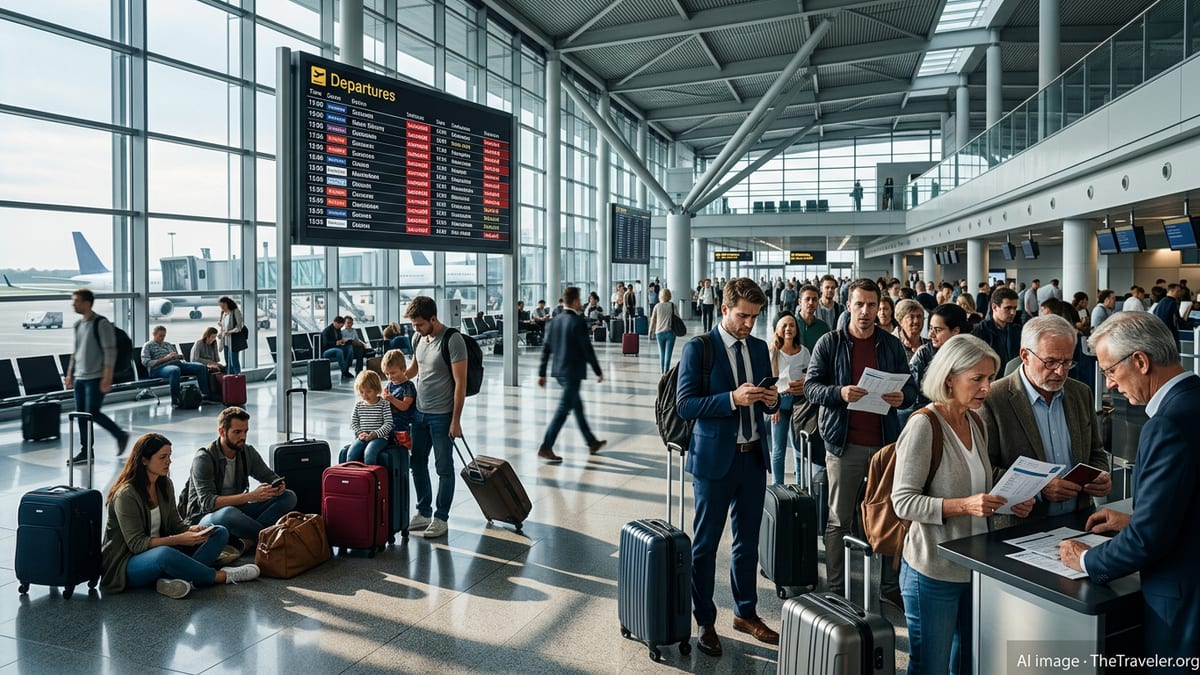
Reports indicate that tens of thousands of travellers have faced missed holidays, broken connections and overnight stays in airports and surrounding hotels, with social media filled with images of crowded terminals and long lines at airline service desks. Some passengers returning to the UK have described being stranded at overseas airports as carriers struggled to find available slots into constrained British airspace.
While NATS has said that normal operations are gradually resuming, airlines and airports have warned that residual disruption may continue for several days. Crews and aircraft need to be brought back into their usual rotations, meaning further short-notice schedule changes remain possible even after the immediate technical problem is fixed.
What went wrong in the NATS system
Detailed technical findings are not yet public, but initial explanations from NATS and media analysis suggest that the problem originated in its flight planning and data processing systems. These systems collect and interpret flight plans filed by airlines and then feed information to controllers, who use them to safely sequence traffic in and out of UK airspace.
When the fault occurred, reports indicate that NATS responded by imposing traffic flow restrictions rather than closing airspace outright, significantly reducing the number of aircraft permitted to take off and land. This safety-first posture limited the risk of conflicting information reaching controllers but had the immediate side effect of dramatically cutting capacity at already busy airports.
Experts cited in published commentary note that modern air traffic networks are highly automated but still depend on complex, interlinked software that must communicate seamlessly with European partners. Even minor anomalies in data inputs can trigger cascading issues if systems are not able to fail safely and revert to robust back-up modes without major capacity losses.
NATS has said it is examining why its redundancy arrangements did not allow a quicker recovery and why the glitch appeared to have such prolonged effects compared with previous disruptions. The one-week deadline from government for an initial report is expected to focus on these questions, as well as on whether investment or architectural changes are needed.
Passenger impact and what travellers should do next
For passengers caught up in the disruption, the immediate challenge has been securing alternative travel while navigating varying airline policies on refunds, rebooking and accommodation. Airports and carriers have urged travellers to check flight status online before heading to terminals, as same-day cancellations and gate changes remain possible.
Travel rights organisations highlight that compensation rules in the UK and EU can treat air traffic control failures differently from airline-driven disruptions such as crew shortages or technical issues within an airline’s own fleet. In some cases, passengers may be entitled to meals, accommodation and rerouting but not to cash compensation if the disruption is classified as outside the airline’s control.
Analysts suggest that the latest incident could revive debate over whether large-scale outages at critical aviation infrastructure should continue to be treated as extraordinary events or whether stronger obligations should apply, given the known systemic risks. Airlines, regulators and NATS are likely to face fresh scrutiny over how contingency plans are communicated to the travelling public.
In the meantime, consumer advice widely shared by travel experts is for passengers to keep records of boarding passes, booking confirmations and any written notifications of cancellation or delay, which can be essential when pursuing claims. Travellers are also encouraged to seek written clarification from their airline on whether a disruption is being classified as an air traffic control issue or an airline operational problem, as this can materially affect available remedies.
Guardian: NATS boss given one week to deliver report into UK flight chaos
The Independent: Flight chaos and airline backlash over NATS failure
Sky News: Airlines demand change after UK air traffic control failure
Alliance News: UK backs air traffic control chief amid travel chaos