


More news on this day
Flights across some of the busiest airports in the United States were thrown into disarray on Monday, September 21, when a Federal Aviation Administration ground stop across multiple Northeast hubs triggered hours of delays, diversions and cancellations for travelers at the height of the evening rush.
Get the latest news straight to your inbox!
Technical failure at key air traffic facility ripples across region
Published coverage indicates that the disruption began late Monday morning after a technical problem at an air traffic control facility serving the Northeast severed critical communications and radar links used to manage flights into and out of major hubs. Reports describe the issue as tied to a damaged telecom or fiber line associated with radar and radio circuits, interrupting the flow of instructions between controllers and aircraft in one of the country’s most congested corridors.
According to national news outlets and Federal Aviation Administration status summaries cited in that coverage, the outage affected traffic bound for Newark Liberty International Airport, Philadelphia International Airport, New York’s LaGuardia Airport, John F. Kennedy International Airport and the general aviation field at Teterboro in New Jersey. Flights already in the air were rerouted or held in airborne holding patterns, while departures on the ground were paused as controllers worked with reduced tools.
By midafternoon, the situation had escalated into formal ground stop programs at several of these airports, temporarily halting inbound flights while capacity was sharply curtailed. The move effectively pushed the bottleneck out across the national network, with departures from cities as far away as Orlando and Chicago held at their origin gates until the Northeast facilities could accept new arrivals again.
Transportation Department updates and live flight-tracking data referenced in media reports show that repair crews restored the damaged telecommunications lines by Monday evening, allowing the FAA to begin lifting the strictest ground stop orders. Even as those restrictions eased, however, operations did not immediately return to normal, and airlines were still working well into the night to move stranded passengers and aircraft.
Major New York and Philadelphia hubs hardest hit
The impact was felt most acutely at the big New York area airports and in Philadelphia, which together handle hundreds of thousands of passengers on a typical weekday. Publicly available flight statistics compiled from airport dashboards and airline data and cited in news reports indicated that Newark Liberty saw more than 600 cancellations on Monday alone, with LaGuardia, JFK and Philadelphia together adding hundreds more cancellations and multi-hour delays.
At the height of the disruption on Monday afternoon, the FAA’s National Airspace System status page, as described in transportation coverage, listed ground stops or severe arrival delays for New York’s three main commercial airports and Philadelphia, along with extended average delays at Boston Logan as that airport absorbed diversions from the New York area. Reagan National Airport near Washington was also briefly placed under a volume-related ground stop as the ripple effects spread along the East Coast.
Even after the primary outage was addressed, FAA delay programs continued at some airports into the evening to meter the flow of arrivals while controllers worked through a backlog of aircraft. Transportation reporters noted that by around 7 p.m. Eastern time, average delays at Philadelphia had eased significantly, while LaGuardia and JFK were still showing around an hour of average delay for many departures and arrivals.
The concentration of problems at these hubs amplified the effect on travelers far beyond the Northeast. Because Newark, JFK and Philadelphia serve as key connecting points for major U.S. and international airlines, the ground stops disrupted itineraries across the country and on transatlantic routes, leaving travelers stranded far from the airports where the technical failure occurred.
Travelers face missed connections, diversions and overnight stays
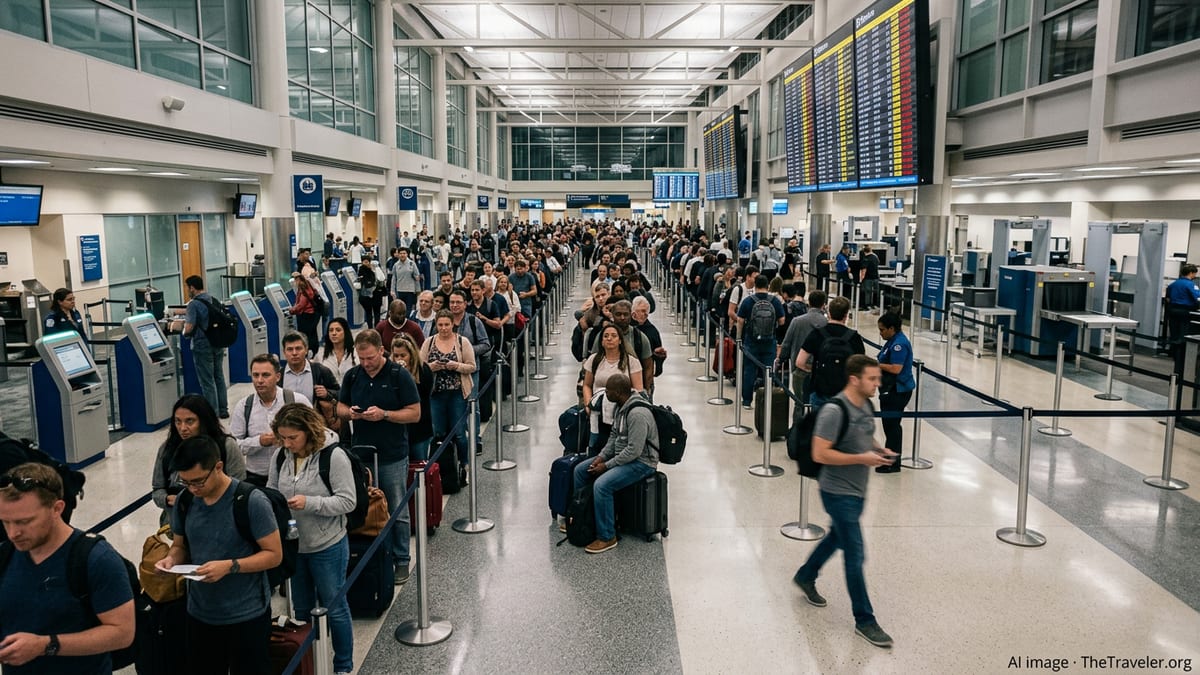
For passengers, the operational details translated into a day of long lines, crowded terminals and fluid schedules. Social media posts and first-hand accounts compiled in local and national coverage describe travelers held on board aircraft for hours, others sent back to gates multiple times as departure estimates slid, and many more rebooked onto late-night or next-day flights as seats disappeared.
Reports from New York and New Jersey described a surge of diversions into Boston Logan and other regional airports as controllers worked to reduce congestion near the affected facilities. That in turn led to surface congestion and additional ground delays in those diversion airports, compounding the challenge for crews and airport staff trying to accommodate unplanned arrivals and tired passengers.
Airlines responded by waiving some change fees and fare differences on affected routes, according to carrier alerts referenced in travel-industry reporting, allowing passengers booked through the most-affected hubs to shift travel dates or routings without financial penalties. Even with those policies, many travelers found that alternative itineraries involved overnight stays, lengthy detours through unaffected hubs, or downgraded seating as remaining inventory filled.
Hotel demand around core Northeast airports appeared to spike on Monday evening based on availability searches cited in consumer travel coverage, with higher prices and limited last-minute rooms near some terminals. Travelers arriving late or missing their final connections were encouraged in those reports to look beyond traditional airport hotels to downtown properties reachable by public transit when possible.
Residual delays continue as system works through backlog
By early Tuesday, September 22, publicly accessible FAA status information showed that the specific equipment outage in the Northeast had been addressed and that formal ground stop programs at the New York and Philadelphia airports were no longer active. Instead, delay programs at other airports, including a weather-related ground stop at Dallas Fort Worth International Airport, had taken over as primary constraints on the system.
Even so, travel-news analysis noted that the disruption was still visible in the airline schedules as residual delays and scattered cancellations linked back to aircraft and crew that had been out of position after Monday’s events. That pattern is typical after a large-scale interruption, with irregular operations sometimes lingering for 24 hours or more as airlines and airports work flight by flight to restore normal rotations.
For travelers with flights touching the Northeast on Tuesday, multiple outlets advised checking flight status frequently through airline apps or airport websites, paying particular attention to aircraft origin cities that were heavily affected by Monday’s difficulties. A plane arriving late from Newark or Philadelphia, for example, could continue to generate delays even on flights far from the East Coast.
Some carriers also urged customers, through public advisories noted in media coverage, to consider carry-on baggage only if possible when rebooking, in order to simplify tight connections and reduce the risk of checked luggage becoming separated during further schedule adjustments.
What the ground stop reveals about Northeast airspace pressures
While investigations into the precise chain of events are still unfolding, aviation and transportation analysts quoted in published reports stressed that the outage and resulting ground stops highlighted both the vulnerability and complexity of the air traffic system that supports the Northeast corridor. The affected region already operates with slim margins because of dense airspace, chronic staffing challenges at key control facilities, and heavy airline schedules.
Documents published in recent Federal Register notices and FAA policy papers, referenced in that coverage, have for several years described persistent staffing constraints at the New York Terminal Radar Approach Control facility and associated centers, plus the need for temporary slot relief and scheduling limits at congested hubs like Newark, JFK and LaGuardia. Those same documents outline infrastructure projects intended to modernize communications and radar systems, work that can itself introduce additional risk if telecom lines or equipment are disrupted during construction.
The latest incident has prompted renewed attention in industry commentary to the importance of redundancy in critical circuits and clear contingency plans for rerouting traffic when systems fail. Analysts cited by major outlets also point to the wider challenge of balancing continued passenger demand and airline scheduling growth with the capacity of air traffic control and airport infrastructure, particularly in weather-prone and densely populated regions such as the Northeast.
For travelers, the episode serves as a reminder that even on clear-weather days, disruptions far from their departure gate can have an immediate impact on their plans. Travel experts contributing to ongoing coverage recommend simple protective steps on busy travel days, such as booking earlier flights when possible, building in additional connection time through Northeast hubs, and monitoring both airline and FAA status information when storms or infrastructure issues begin to appear in the news.