


More news on this day
A widespread ground stop across several major Northeast airports on Monday, September 21, 2026, triggered hours of cascading delays and cancellations for travelers from New York and Philadelphia to Boston and beyond, after a critical fiber-optic line was accidentally severed during construction in New Jersey.
Get the latest news straight to your inbox!
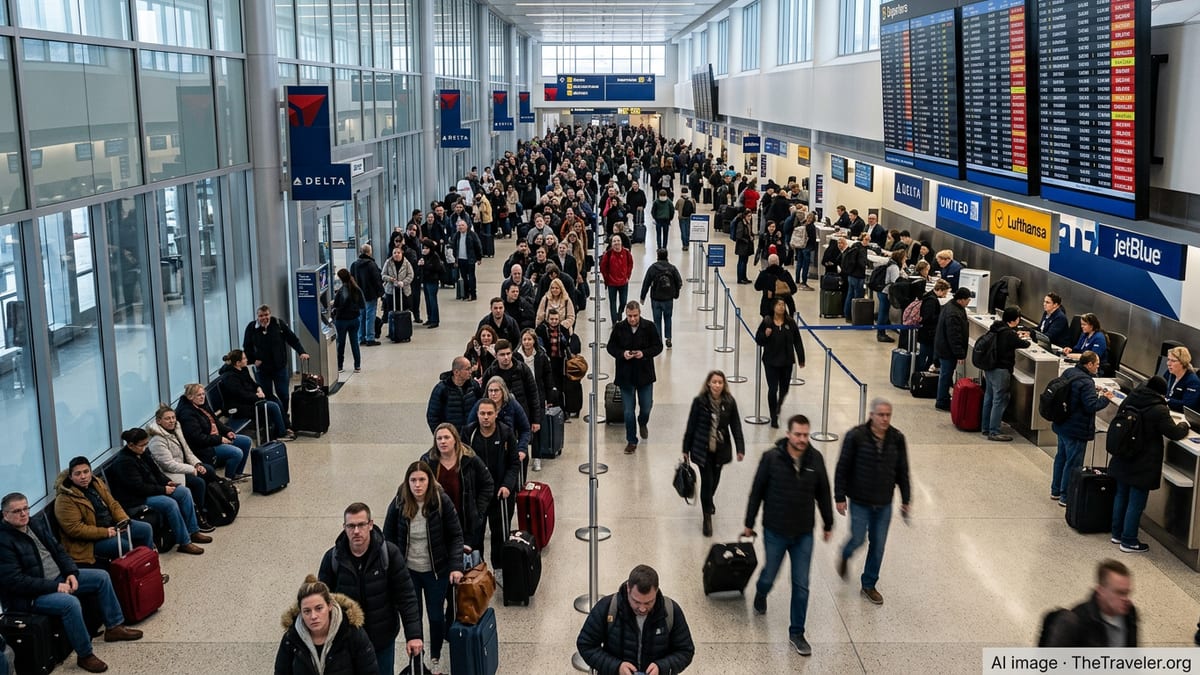
Equipment outage halts departures at key hubs
Publicly available FAA status information and multiple news reports indicate that departures were halted at Newark Liberty International, New York Kennedy, LaGuardia, Philadelphia International and Teterboro on Monday following what the agency described as an equipment outage affecting air traffic systems. The outage originated at a facility tied to the New York and Philadelphia control environment, where both a primary data circuit and a backup fiber cable failed.
Coverage from national and local outlets states that the backup fiber line was cut accidentally by a construction crew working on rail infrastructure in New Jersey, interrupting communications needed to safely manage high volumes of traffic in some of the country’s most congested airspace. Aviation industry analysis describes the event as a dual failure, in which the loss of both the main circuit and the backup forced regulators to halt flights until data flows could be restored.
According to summaries of FAA operational data, ground stops first appeared for Newark, Teterboro and Philadelphia, and were later extended to include Kennedy and LaGuardia, temporarily freezing much of the New York region’s departures and dramatically reducing arrivals. Regional airports such as Portland International Jetport in Maine and Bradley International in Connecticut reported knock-on cancellations and delays as their flights to the affected hubs were held or scrubbed.
Widespread delays and cancellations for passengers
Flight-tracking tallies compiled from airline and airport boards on Monday pointed to hundreds of delays and cancellations across the Northeast as the ground stop took hold. Reports from major outlets note that traffic into and out of New York and Philadelphia slowed to a crawl through the afternoon, with some individual flights held on the ground for hours or diverted to alternate airports such as Boston Logan while controllers worked around the outage.
By early evening, coverage from network affiliates in New York described extensive disruptions at Newark, Kennedy and LaGuardia, including long lines at check in and security, crowded gate areas and aircraft waiting for new departure slots. At Portland International Jetport, more than a dozen flights linked to New York and Philadelphia were listed as delayed or canceled once the affected hubs went into ground stop status, compounding the disruption for smaller-market travelers.
Social media posts and passenger accounts collected by travel and aviation communities showed aircraft being turned back to gates after boarding, missed connections on transcontinental and transatlantic itineraries, and last minute rebookings through alternate hubs such as Chicago, Atlanta, Houston and Dallas. In New England, some travelers bound for the New York area found themselves arriving in Boston instead and then scrambling for rail or rental car options to complete their journeys.
Operations resume but ripple effects continue
By Monday evening, transportation officials using public channels reported that key telecom lines had been repaired and that airport operations in the Northeast were resuming. Local broadcasters in New York and Philadelphia subsequently reported that the FAA had lifted the ground stops for Newark, Kennedy, LaGuardia, Teterboro and Philadelphia, allowing departures and arrivals to ramp back up.
Even after the technical fix, residual impacts continued into Tuesday, September 22. Flight status tools drawing on FAA and airline data showed that while no new Northeast equipment-related ground stops were in effect, schedules remained out of position due to aircraft and crew being stranded at the wrong airports the previous day. Separate ground delay and ground stop programs appeared for other regions, including weather related restrictions at Dallas Fort Worth, illustrating how quickly one day of disruption can roll into the next for travelers.
Regional coverage from airports such as Bradley International in Connecticut noted that while operations were largely back on schedule by Tuesday morning, some passengers were still rebooking trips that had been canceled on Monday. Travel industry reporting also highlighted that airlines were issuing limited waivers for customers affected by the air traffic outage, allowing some to change plans without additional fees, subject to route and date restrictions.
Why a single fiber cut can disrupt an entire corridor
Aviation specialists point out in published analysis that the New York area’s terminal control facilities handle some of the most complex airspace in the world, with dense layers of departures and arrivals to multiple major airports sharing overlapping routes. When the systems feeding surveillance and communications data to these facilities lose redundancy, regulators typically move quickly to slow or halt traffic in order to preserve safety margins.
Reports summarizing the incident describe how the combination of a primary data circuit failure and a severed backup fiber link effectively removed the extra layer of protection built into the network. Until engineers could reroute or replace those connections, the FAA’s traffic management tools had less reliable information with which to space aircraft, making a broad ground stop across several airports the most conservative available response.
The episode also comes against the backdrop of ongoing efforts to modernize air traffic control infrastructure in the United States. Publicly available government documentation has highlighted both the need for upgraded systems in the Northeast corridor and the operational strain created by high demand at airports such as Newark, Kennedy and LaGuardia, where chronic congestion means even brief interruptions can cascade into major disruptions for airlines and passengers.
What travelers should do after a Northeast ground stop
Travel advisories from airlines and aviation-focused outlets consistently emphasize that a ground stop does not mean every flight is canceled, but it often results in long, unpredictable holds and missed connections. After Monday’s outage, many carriers urged passengers to monitor their flight status through airline apps or websites before leaving for the airport and to pay close attention to rebooking instructions where waivers were made available.
Independent trackers built on FAA National Airspace System data suggest that the most reliable approach for travelers is to check with their airline first and then cross reference that information with national ground stop and delay program summaries. These resources can show whether an airport specific ground stop is in place at the time a flight is scheduled to depart, and whether the cause is weather, volume management or an equipment issue such as this week’s fiber cut.
For upcoming trips through the New York, Philadelphia or Boston areas, travel planners note that residual delays are likely to ease over the next day as aircraft and crews return to normal rotations. However, given the continued sensitivity of the Northeast corridor to outages and volume spikes, many frequent travelers continue to build in extra connection time when routing through these hubs, particularly during peak afternoon and evening periods.