


More news on this day
Flight operations across several major Northeast airports resumed Monday evening after a failure in an air-traffic-control telecommunications circuit and a damaged backup connection triggered a cascading disruption that rippled through the region’s busiest hubs.
Get the latest news straight to your inbox!
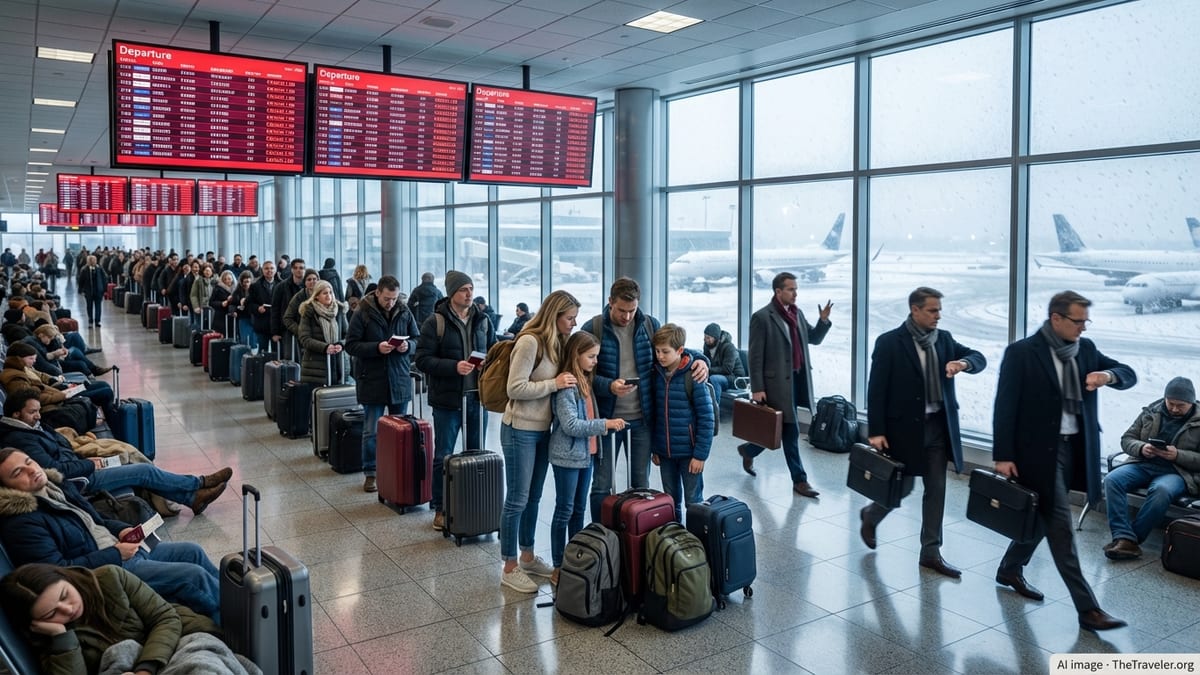
What happened and why the backup did not catch it
Published coverage indicates the disruption began Monday morning, September 21, 2026, when a primary telecommunications circuit serving the Philadelphia Terminal Radar Approach Control (TRACON) failed. That facility plays a critical role in sequencing and separating arrivals and departures in congested Northeast airspace, including traffic associated with Newark Liberty International Airport and Philadelphia International Airport.
When systems attempted to shift to the backup pathway, reporting indicates the backup fiber connection was also unavailable because a fiber-optic line had been cut in New Jersey. The break was described in multiple reports as occurring on a stretch between Newark and New Brunswick, leaving controllers without normal communications and radar display capabilities until a workable connection could be restored.
The competing attributions over who cut the fiber line added to the confusion for travelers, with some published accounts pointing to an Amtrak construction crew and others pointing to a New Jersey Transit-related contractor activity in the same corridor. What remained consistent across coverage was the functional outcome: a primary failure followed by a backup pathway that was not usable at the moment it was needed.
Airports and airlines affected across the Northeast corridor
The outage’s immediate impact was concentrated at the region’s core hubs: Newark, Philadelphia, and the New York City airports. Reports described ground stops and sharp reductions in arrival rates as airlines and air traffic managers worked to keep aircraft safely spaced while key systems were degraded.
Knock-on effects spread beyond the initial airports because the Northeast corridor is tightly interconnected, with aircraft, crews, and gates rotating between the New York area, Philadelphia, Boston, and onward to other parts of the U.S. Published reporting noted diversions and secondary delays at Boston Logan as inbound flights were rerouted or held, compounding disruption for travelers whose trips did not start in New York or Philadelphia.
Philadelphia International Airport also saw a significant operational hit, with reports indicating more than 200 cancellations affecting flights in and out of the airport during the disruption window. Even after ground stops expire, airline schedules typically remain unstable for hours as carriers reposition aircraft and crews and deal with missed connections.
When operations resumed and what “resuming” means for passengers
By Monday evening, September 21, published coverage indicated telecommunications repairs were completed and flight operations were resuming across the region. That shift generally means air-traffic restrictions can be eased and airlines can begin rebuilding schedules, rather than an immediate return to on-time performance.
Travelers often experience the lag in two ways: outbound departures can remain delayed while arriving aircraft and crews work their way back into position, and inbound flights can be held for gate availability as earlier cancellations disrupt planned turnarounds. The result is that a late-day restart can still translate into overnight irregular operations and next-day ripple effects, particularly at capacity-constrained hubs.
Airlines and airports typically advise passengers to rely on airline rebooking tools and to verify flight status before departing for the airport during recovery periods. Published reporting also emphasized that the Northeast’s density makes it especially vulnerable to “network math” problems, where a disruption at one control facility triggers mismatches across multiple airports’ arrival and departure banks.
Why the incident renewed scrutiny of aging infrastructure
The outage reopened a familiar question for U.S. air travel: how resilient the National Airspace System is when a high-importance node experiences both a primary failure and an ineffective backup. Publicly available information shows the FAA has been working on telecom and radar-display modernization and on adding redundancy, including measures related to Philadelphia TRACON and its connections supporting Newark-area operations.
Published coverage noted that the technical problems were linked to the same Philadelphia-area FAA facility associated with earlier disruptions affecting Newark in the prior year. That historical context has sharpened attention on whether critical links are sufficiently diversified, geographically protected, and routinely validated under real-world conditions.
The incident also underscored the vulnerability of infrastructure that runs alongside heavily worked transportation rights-of-way. When communications lines share corridors with rail or other construction activity, even careful work can introduce risk, and a rare sequence of events can produce a disproportionate impact if the system depends on that corridor for backup pathways.
What travelers can expect next at Northeast hubs
For the next several days, passengers flying through Newark, JFK, LaGuardia, and Philadelphia should anticipate a period of schedule normalization rather than an instant reset. Delays can persist as airlines rebuild aircraft rotations and crews recover from duty-time limits and misconnects, particularly on routes that rely on frequent short-haul turns.
Travelers with connections through the region may see rebookings that shift them to later departures, alternate airports, or different routings if seat inventory tightens. During recovery windows, same-day standby options and confirmed changes can become limited on peak departures, especially for flights timed around business travel peaks.
The immediate operational takeaway is straightforward: even after flights begin moving, the most reliable indicator of a smooth trip is a current airline-issued status update shortly before leaving home. In the Northeast, where airspace is already complex and tightly scheduled, a single failure at a key control facility can keep influencing the network long after the technical repair is completed.