


More news on this day
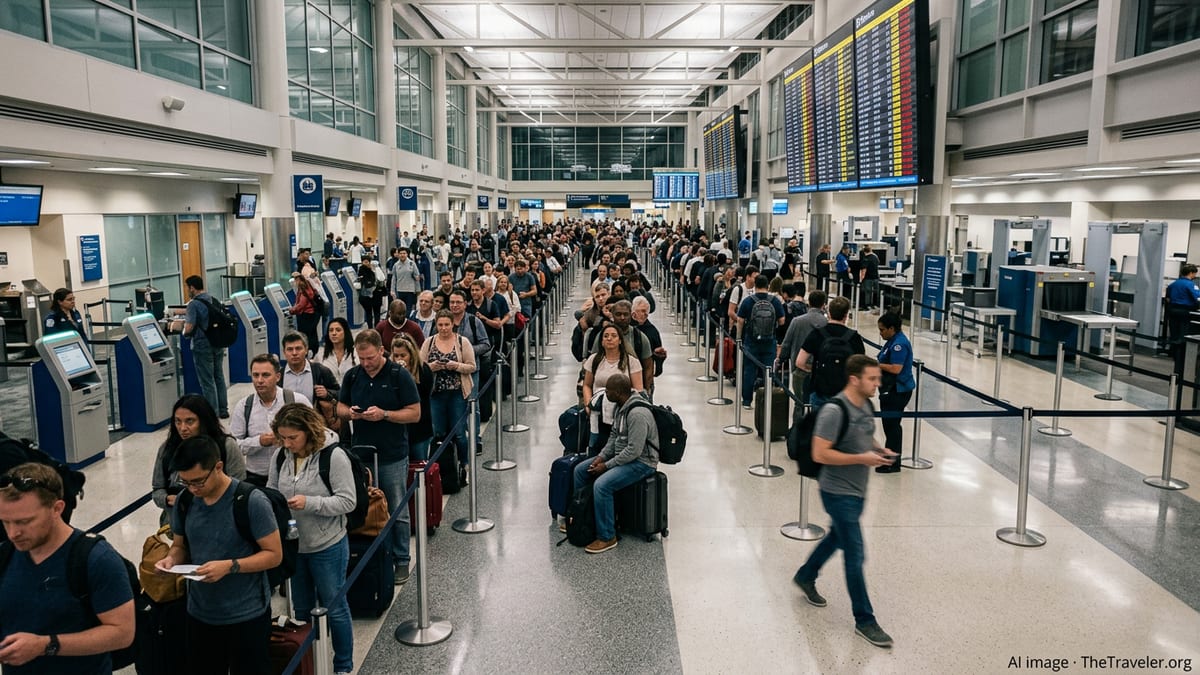
Flight cancellations and long delays spread across the U.S. Northeast after a key Federal Aviation Administration air-traffic facility in Philadelphia suffered a communications failure that disrupted operations at multiple major airports, including Philadelphia International and Newark Liberty, with ripple effects reaching New York and Boston.
Get the latest news straight to your inbox!
What went wrong at the Philadelphia FAA facility
Published coverage indicates the disruption began on Monday, September 21, 2026, when a primary telecommunications circuit failed at the Philadelphia Terminal Radar Approach Control facility, commonly referred to as Philadelphia TRACON. The TRACON manages arriving and departing air traffic for a dense slice of Northeast airspace, and it plays an outsize role in keeping traffic flowing into airports including Philadelphia (PHL) and Newark (EWR).
Reports also indicate that when the system attempted to transition to a backup connection, the backup fiber line was unavailable because it had been cut. Several outlets described the fiber damage as tied to construction activity in New Jersey, with the resulting loss of reliable communications forcing traffic-management restrictions while the problem was repaired.
The disruption underscored how a failure at a single, heavily relied-upon facility can cascade quickly in the Northeast corridor, where airports run tight schedules and aircraft routinely rotate through multiple cities in a single day.
Ground stops, halted arrivals, and a fast-moving domino effect
As the outage unfolded, FAA traffic-management actions quickly translated into travelers’ most visible symptom: ground stops and halted arrivals. Published accounts described inbound flights being held at their departure airports or rerouted, while airports in the New York-Philadelphia orbit grappled with restricted capacity.
In Newark, the outage’s impact was especially acute. Public flight-tracking coverage described a near-standstill for commercial arrivals for much of the day, contributing to extensive diversions and knock-on delays across airline networks that depend on Newark as a major hub for connecting itineraries.
Coverage also pointed to compounding pressure at nearby airports as delayed and diverted aircraft tried to find alternates and as airlines repositioned crews and aircraft. Even when a ground stop lifts, the backlog can take many hours to clear because departures, arrivals, gates, baggage systems, and crews must be reset in a coordinated way.
Cancellations and delays surge across the Northeast network
Flight-tracking tallies cited by multiple news organizations showed hundreds of cancellations at individual airports and thousands of delays nationally as the Northeast disruption propagated through the day. The sharp increase reflected both the immediate stoppages and the secondary effect of aircraft and crews being out of position for later flights.
Philadelphia International Airport’s schedule was heavily affected, with published coverage citing significant counts of delays and cancellations during the outage window. Newark Liberty also faced widespread disruptions, while New York-area airports and Boston Logan experienced spillover as traffic management measures adjusted for the constrained airspace and diverted flights.
For travelers, the practical consequence was that even flights that were not directly bound for Philadelphia or Newark could be delayed if their aircraft was coming from, going to, or was scheduled to pass through affected airspace. Because airlines schedule aircraft utilization tightly, a single missed turn can force multiple downstream cancellations late into the evening.
Operations resumed, but travelers faced a long recovery
By Monday evening, published coverage indicated that repairs to telecommunications lines allowed airport operations in the region to resume. However, resumption does not mean normal conditions, particularly after hours of disruption at airports operating near capacity.
Many passengers arriving at airports after the immediate failure window still encountered crowded terminals, rolling delays, and limited rebooking options. When cancellations climb, open seats on later flights become scarce quickly, and re-accommodation can push into the following day, especially for itineraries involving regional jets and frequent shuttle-style departures.
Travelers with Tuesday, September 22, 2026 departures were urged in multiple reports to check their flight status before leaving for the airport. Even if a particular flight is showing “on time,” late aircraft, crew legality limits, and gate constraints can still trigger last-minute changes after an incident of this scale.
What travelers can do right now in the Northeast corridor
For passengers booked to or through Philadelphia (PHL), Newark (EWR), New York-area airports, or Boston (BOS), the most effective near-term strategy is to monitor airline apps for gate, aircraft, and crew updates and to confirm whether an inbound aircraft is arriving as scheduled. Those details often signal trouble earlier than a posted departure time.
When rebooking becomes necessary, published coverage suggests focusing on practical alternatives that reduce dependency on a single constrained hub. That can include switching to a different Northeast airport within reasonable ground-travel distance, or taking a later nonstop rather than a connection that relies on multiple on-time segments.
Passengers already at the airport should be prepared for extended wait times at customer-service desks and consider using digital self-service tools first. During corridor-wide disruptions, airline phone lines and counters can become overwhelmed, and the quickest path to an acceptable itinerary is often the earliest successful rebooking attempt rather than waiting for conditions to fully normalize.