


More news on this day
Dutch rail operator NS is tightening its on-board house rules so that luggage and handbags can no longer occupy train seats at any time, even in nearly empty carriages, in a move aimed at relieving crowding and reducing conflicts between passengers.
Get the latest news straight to your inbox!
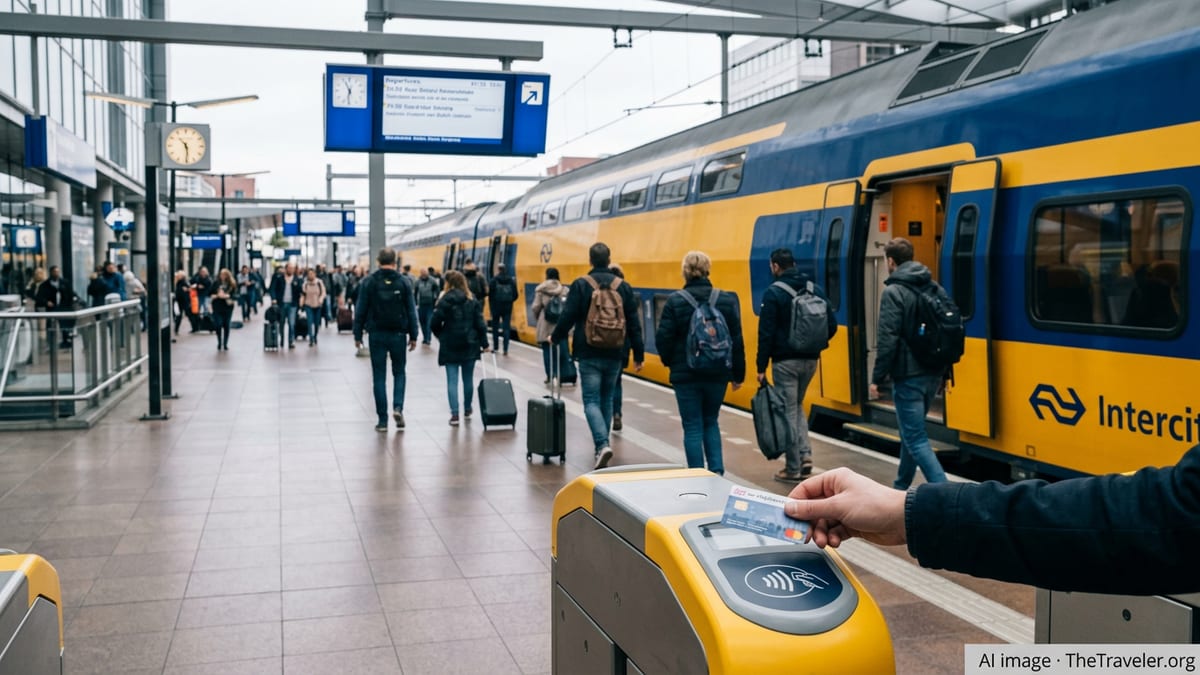
New rule turns empty seats into passenger-only space
According to recent reports in Dutch media, NS has amended its conditions of carriage to specify that seats are intended exclusively for passengers and may not be used for bags, suitcases or other hand luggage. The adjustment closes a long-standing grey area, under which placing a bag on a seat was tolerated provided that another traveler could take the space on request.
The new approach means that luggage must now be stored on a passenger’s lap, on overhead racks or in designated luggage areas, regardless of how busy the service is. Coverage of the change notes that the company has framed the measure as a clarification of existing etiquette rather than an entirely new obligation, bringing written rules into line with how NS says it wants people to behave on board.
While the updated wording sits within broader general terms for the transport of passengers and hand luggage, the practical effect is highly visible: a seat with a bag on it is formally no longer allowed, even on quieter off-peak journeys or late-night trains where spare capacity is plentiful.
NS has, in parallel, kept in place existing size and safety limits on carry-on items, which require that hand luggage does not block aisles or doors and can be stowed without hindering other travelers or staff moving through the train.
From social friction to written policy
The decision follows years of public debate in the Netherlands about space on busy trains, where travelers have often complained about having to ask fellow passengers to move bags from seats. Dutch outlets report that NS has cited feedback suggesting that many people are increasingly reluctant to confront others about the issue, even when trains are crowded.
By removing the conditional element that a bag only needs to be cleared when someone explicitly requests the seat, NS is seeking to normalize the idea that every free seat should be immediately available to sit on. The train operator has presented the change as part of a broader effort to make on-board travel feel more predictable and less confrontational, particularly during peak hours when standing passengers are common.
Published commentary on the policy notes that the updated rule interacts with other capacity measures already under way, including the introduction of new rolling stock with more seats and extra luggage racks, and efforts to improve punctuality so that passengers are less concentrated on a handful of delayed services.
The luggage-on-seats clarification, framed as a behavioral rule rather than a technical safety measure, underlines how rail operators are turning to soft policy tools as they try to manage crowding without radically overhauling timetables or pricing.
Enforcement focused on nudging, not penalties
Reports indicate that NS is not introducing fines or other automatic penalties specifically for placing luggage on seats. Conductors are expected to continue focusing on ticket checks and safety, with the new rule serving primarily as a basis for reminders and gentle interventions when they encounter bags occupying seats.
This means that, in practice, enforcement is likely to rely heavily on social pressure and clear communication in on-board announcements, signage and digital channels. Travelers can expect to see more explicit references to luggage etiquette in NS house rules and travel tips, reinforcing the message that seats are not to be used as makeshift storage space.
Observers point out that this approach mirrors other behavioral campaigns on Dutch public transport, such as appeals to keep feet off seats and to give priority seating to passengers with reduced mobility. By codifying expectations rather than immediately escalating to sanctions, NS appears to be betting that most travelers will adjust their habits voluntarily.
However, the absence of explicit penalties may also test how consistently the new standard is followed during quieter periods, when some passengers may be tempted to treat adjacent seats as extra storage despite the written rules.
Reactions from travelers and consumer bodies
Early reaction from passengers, as reflected in Dutch news coverage and public commentary, has been mixed. Some travelers welcome the clearer rule as overdue, arguing that it is unreasonable for bags to occupy scarce seating when people are standing, especially on overburdened commuter corridors.
Others question the necessity of applying the prohibition even in empty or near-empty carriages, seeing it as unnecessary micro-management of behavior that was rarely problematic outside rush hour. For tourists and long-distance travelers carrying bulky luggage, comments highlight concerns about limited rack space in some older trains and the perceived risk of theft when bags are stored at a distance from their owners.
Under Dutch public transport regulations, changes of this kind are typically reviewed by the national passenger advocacy body Locov. Media reports state that NS has submitted its proposed adjustment for advisory consideration, a step that allows consumer organizations to scrutinize potential impacts on comfort, accessibility and perceived fairness.
The advisory process does not prevent operators from updating house rules, but it does provide a formal channel for feedback, which could lead to refinements in how the ban on luggage on seats is communicated or phased in.
What the new rule means for visitors and daily commuters
For international visitors and infrequent users of the Dutch rail network, the tightened luggage rule is unlikely to change ticketing or boarding procedures but may alter how they plan their packing and transfers. Travel advice now commonly emphasizes the importance of using overhead racks and end-of-carriage luggage spaces, as well as keeping valuable items within sight.
Tourists arriving with large suitcases are encouraged, in publicly available guidance, to make use of station luggage lockers when spending a day in cities such as Amsterdam or Utrecht, which can reduce the need to move heavy bags through crowded trains at all. NS and other travel information providers have in recent years expanded online explanations of where lockers are available and how they can be used during stopovers.
For daily commuters, the most immediate effect is cultural rather than procedural. On busy Intercity and Sprinter services, passengers who previously used adjacent seats for backpacks or work bags are now clearly expected to free the space at all times. This is particularly relevant for employees who use trains as mobile workplaces and may be accustomed to spreading laptops and documents across multiple seats.
As the rule beds in, observers will be watching whether the visible absence of bags on seats leads to a measurable improvement in perceived capacity and comfort, or whether it simply shifts pressure to overhead racks and vestibule areas. Either way, the change underscores a broader trend in European rail travel, where operators are seeking to reconcile growing passenger numbers with finite rolling stock by tightening expectations around how every seat and square meter of space is used.