


On paper, Ocean Grove looks like the quietest kind of Jersey Shore escape: a noncommercial boardwalk, no bars, and streets lined with porches instead of nightclubs. Many visitors show up expecting a simple, sleepy beach town where not much happens beyond waves and sunsets. Spend a weekend here, though, and a different picture emerges. Ocean Grove, tucked between buzzy Asbury Park and family-friendly Bradley Beach, has a deep spiritual history, an unusual urban design, and daily life shaped by rules and traditions that give the town a character all its own.
Get the latest updates straight to your inbox!
From Camp Meeting To Seaside Neighborhood
Ocean Grove’s quiet surface makes more sense when you know how it started. In 1869, a group of Methodist ministers created the Ocean Grove Camp Meeting Association and bought this stretch of shore as a religious retreat, laying out a town where worship, rest and ocean air went hand in hand. Instead of a boardwalk packed with rides and bars, they built a Great Auditorium for preaching and music, ringed by streets of tents and modest cottages. That DNA is still visible today in the way the town feels more like a retreat center that evolved into a neighborhood than a typical resort that grew around a pier.
Walk a few blocks inland from the beach and you move through that history in real time. Streets radiate toward the Great Auditorium, a soaring wooden structure that still anchors the summer calendar with concerts, organ recitals and religious services. Around it, narrow lanes are lined with gingerbread-trimmed houses barely an arm’s length apart, many of them originally built as simple seasonal lodgings for worshipers who had graduated from canvas tents. Visitors who assumed they were booking just another Shore cottage often find themselves staying inside a preserved chapter of 19th century American religious life.
The town’s layout and ownership structure also set it apart. Ocean Grove sits within Neptune Township, but much of the land is owned on long-term leases by the Camp Meeting Association rather than fee simple by homeowners. That unusual arrangement, combined with its historic designation, helps explain why development pressure has not reshaped Ocean Grove into something louder and glossier. You feel that restraint the minute you arrive and realize there is no neon, no arcades, and almost no chain storefronts.
Victorian Storybook Streets Instead Of Boardwalk Glare
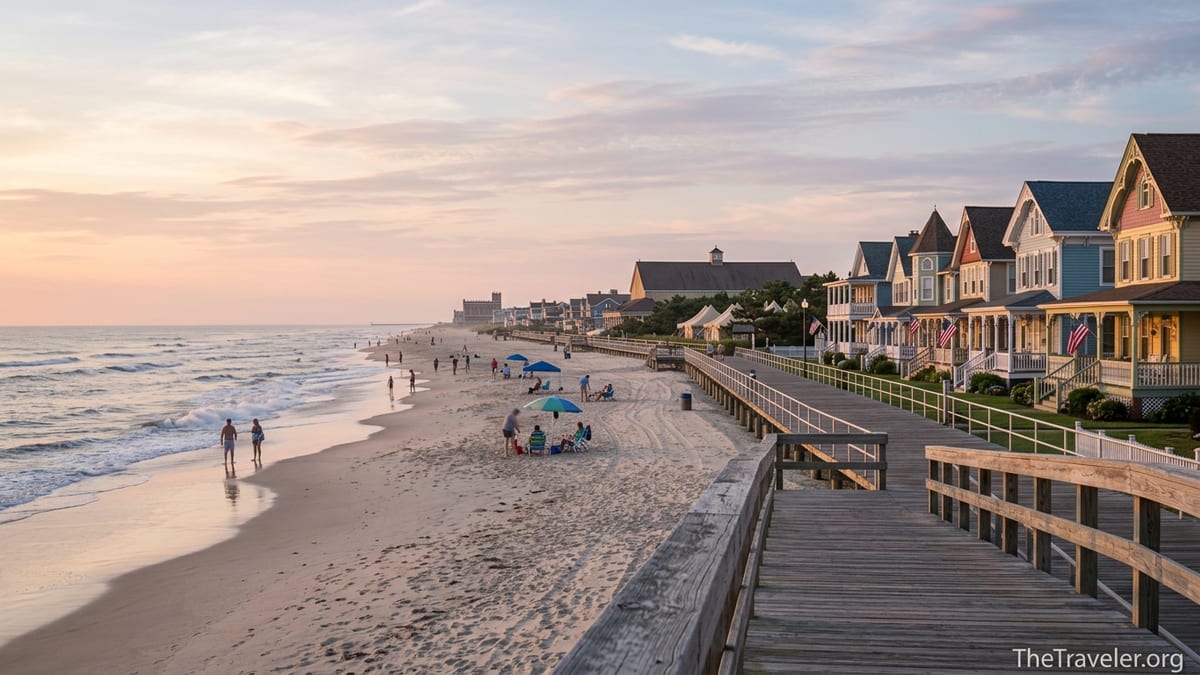
Most travelers first fall for Ocean Grove on its side streets rather than its sand. The town is famous for having one of the largest, most intact collections of Victorian and early 20th century architecture in the United States, with blocks of bay-windowed cottages, delicate spindlework, and boldly painted trim. In summer, many porches bloom with overflowing planters and hanging ferns, and American flags share railing space with wind chimes and wicker rockers. It feels more like strolling a preserved resort village in Cape May or a New England camp meeting ground than a typical New Jersey beach block.
Because the boardwalk is strictly noncommercial, the visual drama shifts inland. Instead of T-shirt stands and funnel cake, you find pastel inns like The Shawmont House, The Melrose, and The Ocean Plaza rising just a house or two back from the ocean. A visitor arriving in July might check into a simple room with a shared porch for around 250 to 350 dollars a night, then realize their “hotel street” is also a lived-in neighborhood where owners sit outside chatting with neighbors at dusk. That blending of hospitality and hometown is one of the subtle ways Ocean Grove’s character comes across.
On Main Avenue, the Victorian look meets daily life. Cafes and small shops occupy ground floors of older buildings, with lace curtains and transom windows hinting at the age of the structures. You can grab morning coffee at a local bakery, browse an antique shop where the owner can tell you how the town has changed since the 1970s, and pick up beach snacks at a corner market, all within a few blocks. Nothing here feels master-planned for tourism; it feels like a long-standing community that happens to welcome visitors.
Tent City: The Summer Neighborhood Everyone Talks About
Nothing surprises first-time visitors more than Ocean Grove’s Tent City. Each summer, a grid of wood platforms and canvas-sided tents springs up in the blocks around the Great Auditorium, forming a compact district where families live in what look like oversized camping setups trimmed with bunting and flower boxes. These are not casual pop-up campsites. Many tent licenses have been passed down through generations, and there are long waiting lists for the chance to spend Memorial Day to Labor Day under canvas.
Walk through on a summer evening and you see why Tent City has such a hold on people. Porch lights glow under striped awnings, neighbors chat across the narrow walkways, and the sound of the Auditorium’s pipe organ or a visiting choir can drift between the canvas walls. A visitor who thought Ocean Grove was simply a quiet place to spread a towel on the sand suddenly finds themselves in a living historical neighborhood where 19th century camp meeting life is still part of daily reality. It feels closer to a European holiday colony or an old-fashioned bungalow court than to anything else on the Jersey Shore.
Tent life also shapes the town’s atmosphere. Because the dwellings are compact and close together, it is hard for loud nightlife or rowdy parties to take root without quickly affecting everyone. Families with small children, retirees, and longtime churchgoers dominate the population in this corner of town, reinforcing norms of early nights, respectful noise levels and a certain old-fashioned courtesy. Even visitors staying in nearby inns tend to unconsciously adopt those rhythms, choosing after-dinner strolls and ice cream over bar hopping.
A Quiet Beach With Firm Rules And Modern Twists
Ocean Grove’s beach initially looks like a classic, low-key stretch of Jersey Shore: wide sand, patterned rows of umbrellas, and lifeguard stands spaced along the waterline. The experience feels different, though, once you step onto the noncommercial boardwalk. There are no games, no music pumping from bars, and no funnel cake aroma drifting out of stalls. Instead, you might see a handful of benches filled with locals chatting, a modest pavilion, and people carrying beach chairs rather than shopping bags. Many visitors who arrived expecting a more typical boardwalk scene are surprised at how much they welcome the quiet after a day or two.
Beach access comes with its own character-defining quirks. Ocean Grove requires daily or seasonal badges during the main season, roughly from Memorial Day through early September. In recent years, a seasonal adult badge has been just over 100 dollars, with discounted early-bird pricing by late spring and reduced rates for seniors and teens, while daily badges typically fall in the low teens per person. For a family of four planning a week at the beach, that structure often makes a season badge worth considering if they will return later in the summer, and it subtly encourages repeat visits over one-off day trips.
The rules on the sand reflect the town’s roots. Alcohol is prohibited on the beach and boardwalk, and loud music and smoking are tightly controlled. Dogs are kept off the main summer beach but are more visible during the shoulder seasons. In the past, the Camp Meeting Association famously closed beach entrances on Sunday mornings, which reinforced the town’s reputation as a devout, somewhat insular place. Recent state rulings have pushed Ocean Grove to allow seven-day beach access during the season, and visitors arriving in 2026 will find Sunday hours that now more closely resemble other towns. Even so, the expectation of a calmer, less party-oriented shoreline remains firmly in place.
Faith, Community And Culture Intertwined
Unlike many shore towns where churches sit quietly on side streets, religious life is part of what visitors actively notice in Ocean Grove. The Great Auditorium looms behind the dunes, and its summer schedule is heavy with Sunday services, hymn sings and programs run by the Camp Meeting Association. Even travelers with no religious background often find themselves drawn in by a free choir concert or organ recital, mixing with congregants who have been coming for decades. It is entirely possible to visit Ocean Grove as a secular vacationer, but it is harder to ignore the spiritual texture of the town than in most beach destinations.
At the same time, Ocean Grove has spent years learning how to hold multiple identities at once. The town has long attracted artists, LGBTQ homeowners and second-home buyers who were priced out of Asbury Park next door. A walk down Heck Avenue on a summer afternoon might take you past a Bible study group on one porch and a Pride flag hanging from the Victorian railings of a restored cottage on the next. That coexistence is part of what gives Ocean Grove more character than the phrase “quiet beach town” suggests. The conversations you overhear in line at the bakery or outside the Historical Society museum are just as likely to be about Broadway shows, local zoning disputes or the latest Asbury music festival as about Sunday sermons.
Community traditions also play a big role. Events like the Fourth of July parade, summer craft shows on Pilgrim Pathway, and evening “porch music” sessions where local musicians perform informally on residential stoops all knit visitors and residents together. A family staying in a rental on Clark Avenue might discover that their block has an annual potluck, with long tables set up in the street and everyone invited, whether they have owned their place for 30 years or just arrived for a week.
Asbury Park Next Door: Contrast Within Walking Distance
One of the biggest surprises for first-time visitors is how close Ocean Grove sits to the hustle of Asbury Park. From the southern end of Asbury’s boardwalk, a short pedestrian bridge over Wesley Lake brings you onto Ocean Grove’s much quieter oceanfront. Beachgoers who park in Asbury for a day of music, bars and restaurant-hopping often find themselves wandering south, crossing the small canal, and realizing they have stepped into an entirely different mood without ever getting back in the car.
For Ocean Grove visitors, that contrast is a major part of the appeal. You might spend the day under an umbrella on Ocean Grove’s beach, retreat to a shady porch with a book in the late afternoon, then stroll back across the bridge after sunset for a concert at the Stone Pony or a show at Asbury Lanes. Dinner might be a quiet early meal of seafood in Ocean Grove, followed by cocktails at a rooftop bar in Asbury. The ability to access that nightlife while sleeping in a town where traffic dwindles after dark and street noise rarely intrudes past 10 p.m. is one of the reasons many travelers choose Ocean Grove over Asbury Park itself when booking lodging.
Budget-conscious travelers also use the two-town dynamic to their advantage. In peak August weekends, waterfront hotels in Asbury Park can easily reach 400 to 600 dollars per night or more. By comparison, a modest Victorian guesthouse in Ocean Grove set a block or two back from the water may fall in the 225 to 350 dollar range, sometimes including a basic continental breakfast and beach badges. That price difference, multiplied over a four- or five-night stay, often covers dinners out, parking, and show tickets, making Ocean Grove a smart base for travelers who want the region’s culture without its steepest room rates.
Everyday Practicalities: Parking, Eating And Getting Around
Part of Ocean Grove’s character is how practical details shape daily rhythms. Parking, for instance, is free but limited on narrow residential streets. On summer Saturdays, especially around holiday weekends, guests who roll into town around midday often find themselves circling a few blocks before landing a space several streets inland. Some inns offer a small number of off-street spots; others provide detailed arrival instructions suggesting you come earlier in the morning or after dinner to avoid the peak crunch. Once parked, many visitors simply leave their car in place for the duration of their stay and explore on foot.
Food options are modest but growing. Along Main Avenue, you will find small breakfast cafes, a couple of pizza places, casual American eateries, ice cream counters, and a few more polished restaurants with tablecloths and reservations. Most are independently owned, with menus that lean toward straightforward comfort food: omelets and pancakes in the morning, sandwiches and salads at lunch, and seafood, pasta or steak at dinner. For more experimental or late-night dining, Asbury Park is just a 10 to 15 minute walk across the bridge, where ramen shops, small-plate wine bars and live-music venues cluster around Cookman Avenue and the waterfront.
Getting here without a car is very doable by regional standards. New Jersey Transit’s North Jersey Coast Line stops at Asbury Park station, roughly a mile from central Ocean Grove. From there, many visitors roll a small suitcase across the pedestrian bridge and through quiet residential blocks, or take a short rideshare. Once you are settled, Ocean Grove’s compact grid, level terrain and slower traffic make walking the simplest way to get around. Bicycles are common for quick runs to the bakery or grocery store, although riders should pay attention to local rules about where and when bikes are allowed on the boardwalk and promenades.
The Takeaway
Ocean Grove’s reputation as a quiet beach town is not wrong, but it is incomplete. Beneath the calm boardwalk and low-key streets lies a layered place where religious retreat history, Victorian urban design, and contemporary Jersey Shore life all intersect. Many visitors arrive expecting little more than a peaceful stretch of sand and an early bedtime. They leave having walked under canvas awnings in Tent City, listened to a massive pipe organ ring out over town, shared porch conversations with neighbors they met that morning, and crossed a narrow bridge to dance at a rock show next door.
What sets Ocean Grove apart is how those pieces fit together without losing the town’s essential stillness. It is a place where you can watch sunrise over the Atlantic with only a handful of other early risers, then spend the afternoon dipping into a museum talk, a craft fair, or a stroll through streets that feel paused in another era. For travelers who crave both rest and a sense of place, that combination can be more compelling than any thrill ride or bar-lined boardwalk. Ocean Grove has more character than its quiet reputation suggests, and for many visitors, that discovery is what turns a first visit into a long-running tradition.
FAQ
Q1. Is Ocean Grove really that different from other Jersey Shore towns?
Yes. The noncommercial boardwalk, historic Victorian streets, active religious life and summer Tent City community make Ocean Grove feel more like a preserved retreat than a typical resort, even though it shares the same coastline.
Q2. Can I visit Ocean Grove if I am not religious?
Absolutely. Many visitors come purely for the beach, architecture and quiet atmosphere. Religious services and events are present but optional, and secular travelers are common.
Q3. How expensive are beach badges in Ocean Grove?
Expect seasonal adult badges to cost just over 100 dollars in recent years, with slightly lower early-bird prices and discounted rates for seniors and teens, while daily badges usually fall in the low teens.
Q4. Are there bars or liquor stores in Ocean Grove?
No. Ocean Grove does not have bars or liquor stores, and alcohol is not sold on the boardwalk. Visitors looking for nightlife or drinks usually walk to neighboring Asbury Park or Bradley Beach.
Q5. What is Tent City, and can I stay in a tent?
Tent City is a seasonal neighborhood of canvas tents on wooden platforms near the Great Auditorium, occupied by families who rent them for the entire summer. Space is limited and demand is high, so most short-term visitors stay in inns, guesthouses or rentals instead.
Q6. How does Ocean Grove compare to staying in Asbury Park?
Ocean Grove is quieter, more residential and generally a bit cheaper for lodging, while Asbury Park offers a denser mix of restaurants, bars, music venues and hotels. Many travelers stay in Ocean Grove for peace and walk to Asbury for entertainment.
Q7. Is parking difficult in Ocean Grove during summer?
Parking on residential streets is free but tight on peak summer weekends, especially close to the beach. Arriving early, parking a few blocks inland and leaving your car in place is often the easiest approach.
Q8. What kind of accommodations are available in Ocean Grove?
The town leans heavily toward Victorian-style inns, small hotels, bed-and-breakfasts and porch-fronted rentals. Most are in historic buildings, and many are just a short walk from the beach and Main Avenue.
Q9. Is Ocean Grove family-friendly?
Yes. The calm beach, noncommercial boardwalk, early-night culture and lack of bars make it popular with families who want a lower-key environment while still being close to livelier neighboring towns.
Q10. When is the best time of year to visit Ocean Grove?
Late June through early September offers full beach operations, Tent City life and the busiest event calendar. May, early June and September bring milder crowds, generally lower rates and a more relaxed version of the same atmosphere.