


I meant to spend a couple of hours on Suomenlinna, ticking off a UNESCO World Heritage Site between a Helsinki brunch and an evening sauna. Instead, I stepped off the 15 minute ferry and did not leave until the last glow drained from the Baltic sky. Suomenlinna is that kind of place: it looks like a simple sea fortress on the map, but on the ground it unfolds into lanes, cafés, rocky shorelines, museums and island neighborhoods that quietly steal your entire day.
Get the latest updates straight to your inbox!
Arriving By Ferry: When “A Quick Hop” Becomes Part of the Experience
The day began at Helsinki’s Market Square, where the Suomenlinna ferry leaves from the pier in front of the Presidential Palace. The HSL ferry is part of the city’s public transport system, which means the same AB ticket you use for a tram ride also takes you across the water. As of mid 2026, an adult AB single ticket costs a little over 3 euros and is valid for about an hour and a half, enough time to go out and back if you are determined to keep it brief. The crossing is only about 15 minutes, but it sets the tone: trams rattling on the shore, gulls circling, and the low, grass topped ramparts of the fortress slowly taking shape ahead.
On the morning I went, the deck was lined with commuters and parents pushing strollers, not just visitors. Around 800 people live on Suomenlinna year round, and several hundred more work there, so you quickly realize you are heading into a living district of Helsinki rather than a fenced off museum. That mix changes the feel of the crossing. People with supermarket bags and school backpacks stand beside travelers with cameras and daypacks, and you begin to understand why the timetable runs from early morning until after midnight. Many visitors step off planning to wander for an hour or two before dinner back in the city. I did the same. Then I saw the first sign pointing toward the “blue route” walking path and realized how much there was to explore.
Before you even leave the pier you are tempted to slow down. The Jetty Barracks building, right by the main quay, holds the Suomenlinna Visitor Centre, a café, and a restaurant with copper brewing vats that glow in the morning light. It is the sort of place where you tell yourself you will grab a coffee on the way back but inevitably end up sitting down immediately with a cinnamon bun, watching the ferries come and go. Those small choices are how a tidy schedule starts to unravel in the best possible way.
Following the Blue Route Through Centuries of History
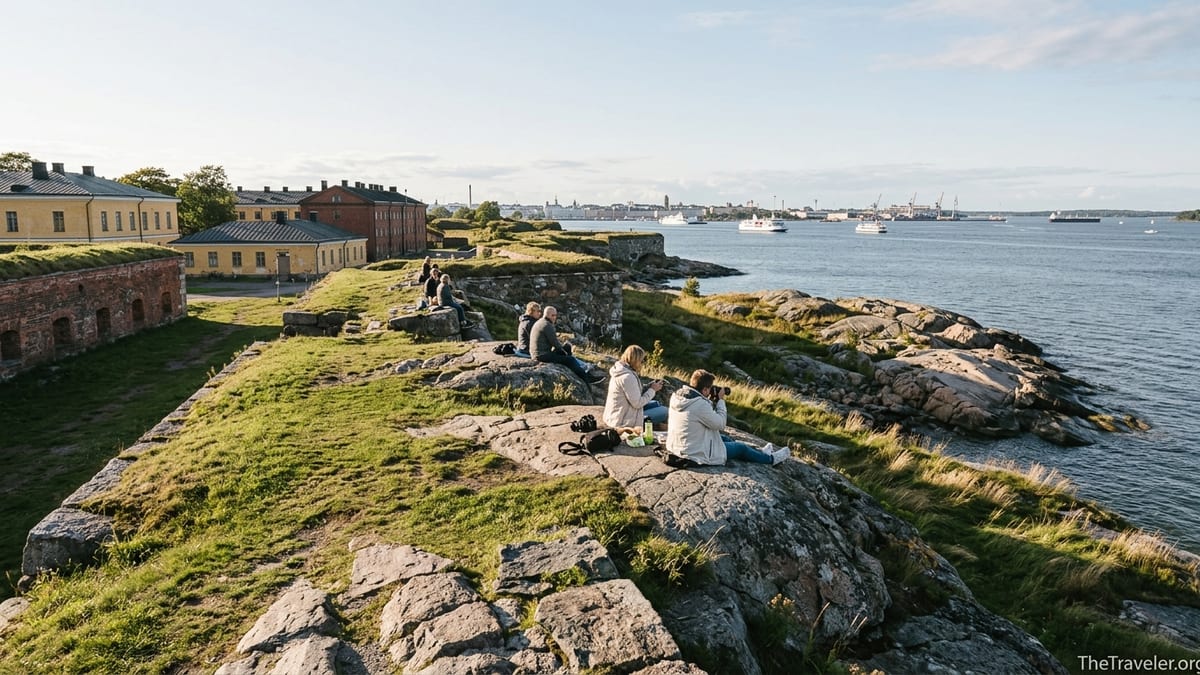
Suomenlinna was begun in the 18th century when Finland was still under Swedish rule, built across several islands to protect the approaches to Helsinki. Today it is one of Finland’s first UNESCO World Heritage Sites, recognized for its bastion style sea defenses that snake across the rock like low, grass covered walls. On the ground, the easiest way to understand the layout is to follow the signposted blue route, a roughly one and a half hour walk that runs from the main quay through courtyards, tunnels and coastal paths to the King’s Gate at the far end of the fortress.
I started out assuming I would walk the route briskly. Instead I was distracted within minutes. Near the Visitor Centre you pass old stone warehouses and yellow barracks buildings turned into studios, galleries and small shops. A side path leads past the Suomenlinna Church, whose tower doubles as a lighthouse and still guides ships through the nearby channel. On a weekday morning you might see school groups gathering here, teachers corralling children in reflective vests before heading off to learn about fortifications and coastal life. The island is a regular field trip destination for Helsinki schools, which says something about how woven into local life this fortress has become.
Farther along, the trail reaches the Great Courtyard, once the administrative heart of the fortress. On one side lies the low stone building that houses the Ehrensvärd Museum in summer, dedicated to Augustin Ehrensvärd, the Swedish military architect who oversaw much of the construction. I ducked inside for a look at portraits, old maps and a model of the fortress. The museum itself is small, but it adds faces and stories to the stone walls outside. Combined tickets are often sold that include the main Suomenlinna Museum near the quay as well as the Military Museum exhibitions elsewhere on the island, so it is easy to stitch indoor visits into your wandering without queueing multiple times.
Clifftop Paths, Hidden Beaches and Picnic Rocks
The further you follow the blue route, the more the island feels like a coastal park layered over a garrison. South of the Great Courtyard the path climbs onto the ramparts, then drops toward low cliffs and rounded rocks that tilt into the sea. On my visit, locals had claimed the flattest outcrops as picnic spots. A couple in wool sweaters sat with a thermos of coffee and a paper bag from a central Helsinki bakery. Nearby, a group of friends had set out supermarket rye bread, cheese and berries, using an upturned backpack as a table. None of them seemed in a hurry to go anywhere, and watching them, I felt my idea of “just a few hours” soften.
There are tiny, almost hidden beaches among the rocks where families paddle in summer. The Baltic water is chilly for much of the year, but on a warm August afternoon you will see children in inflatable armbands splashing while parents sit on the grass bank above, keeping half an eye on them and half an eye on the ferries gliding past. Travelers who arrive with lunch from the city quickly realize they could easily spend half a day here alone. You do not have to bring much: a simple picnic from a Helsinki supermarket often costs less than a single café meal and can be spread out on the stones facing the open sea.
In cooler seasons, the shore still holds people. In late autumn, when the wind has an edge, dog walkers follow the same paths, hands in pockets, their dogs zigzagging through the low, wind bent bushes. In winter, snow can smooth some of the rough surfaces, and the sea between the islands shifts from black to slate grey, but the fortress never really closes. The walking routes remain, and the soundscape changes from gulls and chatter to boots on packed snow and the hum of the ferry arriving through the mist. That year round openness is part of why so many visitors find themselves staying longer than they planned. You realize you could come in almost any weather and still find a mood that matches the island.
Museums, Tunnels and Submarine Vesikko
By midday I had intended to be back in central Helsinki. Instead, I found myself buying a combined museum ticket at the Suomenlinna Museum near the main quay. Even if you are not usually a museum person, this one is worth an hour. Inside, exhibits outline the long arc of the fortress, from its Swedish origins through the Russian era and then the period after Finnish independence. A short film runs on a loop, giving a concise overview that makes the earthworks and walls around you feel less anonymous. It is the kind of context that turns a simple walk into a story driven visit.
From there I continued toward the Military Museum’s Manege and Artillery Manege, housed in old brick buildings along the route. The exhibitions trace the history of Finland’s defense forces and the wars of the 20th century, with uniforms, photographs and everyday objects that belonged to soldiers. The connection between this modern history and the older bastions outside is subtle but powerful. You are reminded that this was not just a picturesque outpost but a serious military installation in regular use well into the 20th century.
Down by the water, one of the most striking sights is the submarine Vesikko, a compact Finnish submarine from the 1930s that now rests on supports by the shore. In summer it opens as a museum, and visitors can duck through its narrow hatches to see just how confined life on board must have been. Children treat it like an adventure playground, but adults often come out talking softly about the claustrophobia and the reality of submarine warfare. It is an unexpected encounter on what many assume will be a simple fortress walk.
Between museum visits, you constantly pass through vaulted stone tunnels and under low archways that frame the sea. Some are lit only by slivers of daylight from the ends, and walking through them you feel how defensive design shaped every movement on the island. Even if you decide to pay for only one museum, the built environment itself is a free open air exhibition, one reason Suomenlinna can be an excellent value day out. There is no admission fee for the fortress itself, just the cost of the ferry and any museums or tours you choose.
Cafés, Breweries and Island Life
Food is one of the best excuses to linger. By early afternoon hundreds of day trippers converge on Suomenlinna’s cafés and restaurants. Near the main quay, a popular stop is the brewery restaurant inside the old Jetty Barracks, where copper tanks are visible behind the bar and the menu leans on Finnish comfort dishes. On a chilly day, a bowl of salmon soup with rye bread and a local beer can easily eat up an hour. Prices are in line with Helsinki standards, so budget minded travelers often mix one café meal with a picnic on the rocks or a takeaway coffee from a kiosk.
Elsewhere on the islands you find smaller spots: a café in a former guardhouse, a bakery that opens seasonally, and a deli with takeaway sandwiches and pastries. On my visit I stepped into a tiny café facing a sheltered yard and ended up chatting with a barista who commutes from the mainland most days. She described how winter on Suomenlinna feels far quieter, when daylight is brief and snow muffles the sound of footsteps. Yet even then, residents walk their dogs, children sled down small hills between the ramparts, and the grocery shop at the heart of the island stays open, selling basics for those who live there.
Seeing the residential side of Suomenlinna shifts your perspective. Wooden houses painted in mustard yellow, pale green and red brown line narrow lanes where bicycles lean against fences. Laundry hangs between trees in summer, and small playgrounds sit beside defensive walls. For many visitors, this is when the island stops being just a sightseeing target and starts to feel like a place you could imagine staying, at least for a season. You notice small details: a child’s drawing in a window, a potted herb garden balanced on a stone step, a cat sunning itself on an old cannon. Each one makes it harder to simply tick the fortress off your list and catch the next ferry home.
Practical Tips When Your “Short Visit” Turns Into a Full Day
By late afternoon, my original plan was a distant memory. Instead of rushing back to Helsinki for museum visits in town, I checked the ferry timetable and realized they run into the night, which made it easy to relax into an unplanned full day. If you come in summer, departures are usually frequent, often several an hour at peak times, so there is rarely pressure to catch a specific boat. In winter the schedule is a little lighter, but there is still at least roughly one ferry an hour, enough to enjoy a dusk walk without worrying about being stranded.
Because the island is larger than it looks and the surfaces are uneven, comfortable shoes are important. Paths range from cobblestones and packed earth to rocky slopes, and many visitors underestimate the amount of walking involved. Even the basic blue route can feel like a proper hike if you stop for museums and cafés along the way. Layers are also essential. The breeze across the channels can feel much cooler than conditions in central Helsinki, and the weather can change quickly, especially in shoulder seasons. A light waterproof jacket or windbreaker and a hat can make the difference between cutting your trip short and happily lingering on the ramparts to watch ships pass.
Budget wise, Suomenlinna can be tailored to almost any traveler. A minimalist day might involve just the cost of the public transport ticket, a packed lunch and free walking around the fortifications. A more in depth visit could include admission to several museums, a guided walking tour starting from the Visitor Centre, and a sit down meal. Guided tours are especially helpful if you want a structured explanation of the various eras of the fortress, and they typically last around an hour, leaving plenty of time for independent wandering afterward. Either way, it is wise to assume you might stay longer than planned and avoid scheduling tight appointments back in the city for the same afternoon.
Staying for Sunset and the Last Ferry Back
The real reason I ended up staying all day was the evening light. In late spring and summer, Helsinki enjoys long, lingering twilights, and Suomenlinna is perfectly placed to catch them. Around eight or nine in the evening, the low sun slants across the grass covered ramparts, turning them a deep gold. The stone walls, which can appear stern at midday, soften in this light, and the water between the islands picks up pastel reflections from the sky. Locals drift back toward the shore after work, some with small portable grills, others simply with a beer and a friend.
I found a rock above the shoreline facing the open sea and watched ferries to Tallinn and Stockholm pass in the distance, their hulls lit up against the darkening horizon. Behind me, a family packed up their picnic, carefully gathering children’s toys and neatly folding a blanket that had been spread on the grass since early afternoon. A passing runner in a bright jacket nodded hello, clearly on a familiar route. It struck me how normal this evening scene must be for those who live here, and how extraordinary it felt to someone arriving for the first time on a casual day trip.
The decision to catch “just one more” ferry later than planned is an easy one. As the streetlights flicker on and the lamps aboard the ferry glow on the water, you naturally wait to see how the colors will shift, how the view of Helsinki’s skyline will change with each passing half hour. When I finally boarded a ferry back to the city, the Market Square were quiet, stalls packed away, and trams sliding by with their interior lights reflected in the harbor. I realized I had been gone more than nine hours, though it had felt like far less.
FAQ
Q1: How long should I plan to spend on Suomenlinna?
Most travelers should plan at least four to five hours, which allows time for the basic walking route, one or two museums, and a café stop. Many visitors, like I did, end up staying most of the day, especially in summer when the evenings are light.
Q2: How do I get to Suomenlinna from central Helsinki?
Take the HSL ferry from Market Square in front of the Presidential Palace. The ride takes about 15 minutes and is covered by a standard AB public transport ticket that you validate before boarding.
Q3: Do I need to pay an entrance fee for the fortress?
No, there is no general entrance fee for Suomenlinna. You pay only for the ferry ticket and any optional services, such as museum admissions, guided tours, food and drinks.
Q4: Is Suomenlinna worth visiting in winter?
Yes. While some seasonal cafés and attractions close, the regular ferry operates year round and key museums usually keep winter hours. The atmosphere is quieter, and walking the snowy ramparts with views of the frozen or dark Baltic can be memorable.
Q5: Are there places to eat on the island, or should I bring my own food?
There are several cafés, a brewery restaurant and a small grocery shop on the island, especially near the main quay and in the central residential area. Prices are similar to Helsinki city levels, so budget travelers often combine a café coffee with a simple picnic brought from the mainland.
Q6: Is the walking route suitable for children and older travelers?
The main paths are generally easy, but surfaces can be uneven, with cobblestones, slopes and steps. Families with children regularly visit, and strollers are common near the quay, though some outer ramparts and tunnels are more challenging for those with limited mobility.
Q7: Which museums on Suomenlinna are the most important to see?
The Suomenlinna Museum near the main quay is a good starting point for an overview of the fortress. Many visitors also enjoy the Military Museum exhibitions and, in summer, going inside the submarine Vesikko or visiting the Ehrensvärd Museum in the Great Courtyard.
Q8: Can I swim at Suomenlinna?
There are small beaches and rocky coves where locals swim in summer, though the Baltic water is usually cool. If you choose to swim, do so only in designated or obviously used areas, keep an eye on currents and boat traffic, and respect any safety signs.
Q9: Is it possible to stay overnight on Suomenlinna?
There are guesthouses and accommodation options on the islands, often in converted historic buildings, though availability can be limited in peak seasons. Many visitors stay in central Helsinki and visit Suomenlinna as a day trip, returning by ferry in the evening.
Q10: Do I need to book a guided tour in advance?
In high season, scheduled walking tours usually depart from the Visitor Centre, and you can often join on the day if there is space. In busy summer weeks or for special themed tours, booking ahead is recommended, especially for groups that want a specific language or time.