


I arrived at ABBA The Museum in Stockholm as a casual listener at best. I knew “Dancing Queen,” had seen Mamma Mia! on a plane, and could probably hum the chorus of “Mamma Mia,” but that was the extent of my fandom. Yet a couple of hours later, I walked out genuinely impressed, emotionally moved in moments, and convinced that this is one of Stockholm’s most cleverly designed museums, even if pop music is not usually your thing.
Get the latest updates straight to your inbox!
Finding the Museum and Deciding if It Is Worth It
ABBA The Museum sits on Djurgården, Stockholm’s museum island, at Djurgårdsvägen 68, near big-hitters like the Vasa Museum and Skansen. That location already makes it easy to fold into a day of sightseeing, even if you are not structuring a whole trip around ABBA. From central Stockholm, it is about a 10 to 15 minute tram ride on line 7 from Sergels Torg or a short bus ride, followed by a two minute walk along the waterfront. In summer, many visitors arrive by the small Djurgården ferries that shuttle back and forth from the old town area, which turns the approach into a scenic mini harbor cruise rather than just transport.
Tickets are not cheap by museum standards, especially if you are traveling as a couple or family. As of 2026, a standard adult ticket typically runs in the range that makes you pause and compare it against other attractions in the city. Children, students and seniors usually get a reduced rate, and there are timed entry slots that you select when booking in advance. The price puts it closer to a major theme attraction than a small gallery, which is why many non-fans hesitate. However, once you are inside, it becomes clear that this is designed as an immersive experience with extensive technology, not just a few costumes in glass cases.
Timed tickets mean you are assigned an entry window, which helps keep the galleries comfortable even in peak months. When I visited on a busy afternoon, there was a short queue outside but it moved quickly as staff scanned pre-booked tickets and directed walk-up visitors to the next available slot. Plan for around 1.5 to 2 hours inside if you are a casual visitor, and up to three hours if you like to linger, watch every video, and try all the interactive booths. Crucially, the museum is cashless, so have a card or mobile payment ready at the entrance and in the shop.
For travelers deciding whether it is worth the money, it can help to think of ABBA The Museum not as a traditional museum but as a self-contained experience. If you already expect to spend on other ticketed attractions in Stockholm, this fits naturally into that set, especially because everything from signage to the audio guide is offered in multiple languages, making it easy to follow even if English or Swedish is not your first language.
First Impressions: More Immersive Experience Than Static Shrine
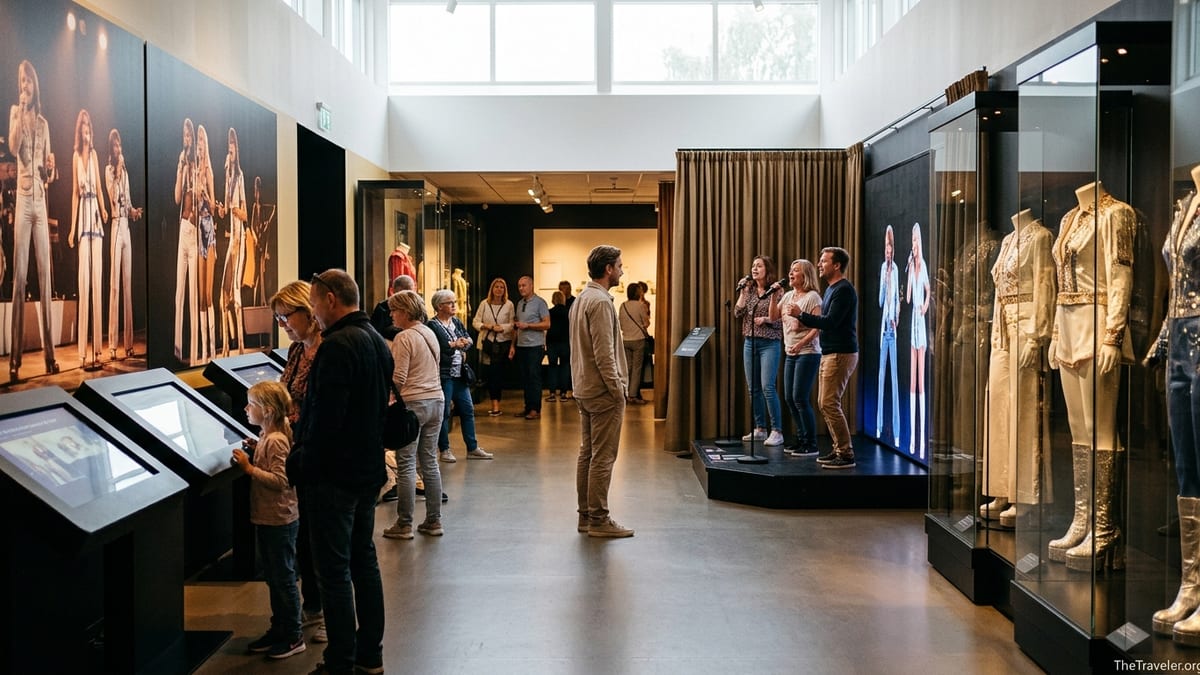
From the first corridor, it is obvious that ABBA The Museum is crafted to be immersive. Instead of walking into a silent hall, you step into a soundscape of music, crowd noise from old concerts, and snippets of interviews. Large wall graphics show the band at different phases of their career, and touchscreens invite you to tap into timelines, anecdotes and behind-the-scenes details. Even if you do not know the group’s full backstory, it immediately feels like you are entering a narrative rather than a collection of random memorabilia.
The exhibition is laid out as a journey, starting with Swedish folkpark culture and the members’ pre-ABBA careers, then moving through Eurovision, global fame, and finally what happened after the group stopped recording together. Real-world props anchor each phase. In one room, there are recreations of modest 1970s interiors with brown sofas and patterned wallpaper, the sort of domestic detail that makes the story feel grounded rather than glamorous from the start. For someone who did not grow up with their music, these period rooms were more about understanding a slice of Swedish and European life during the 1970s than about celebrity worship.
Even at this early stage, interactive elements break down the distance between visitor and exhibit. You can pick up old-style telephones to hear excerpts from radio interviews or flip through virtual scrapbooks of handwritten lyrics. Wall texts are short, clear, and translated into English, which keeps things accessible even if you are breezing through without the audio guide. Because ABBA’s story is told in chronological order, you never feel lost, even if you only know a couple of the big hits.
Importantly, the design avoids feeling like a commercial for the band’s brand. While the gift shop is as enthusiastic as you would expect, the exhibition spaces themselves give time to the personal tensions, business decisions and quiet periods as well as the highs. As a result, I found myself not just learning about a famous pop act, but about how creativity, business and technology interacted in the pop world of the 1970s and 1980s.
Highlights That Surprised a Non-Fan
Several specific experiences stand out as memorable even if you walked in indifferent to ABBA. One is Benny’s self-playing piano, which is networked to a piano in his home. When he plays there, visitors sometimes hear the same notes play inside the museum a short time later. Seeing the glossy instrument sitting alone in a corner, then suddenly springing to life, is an oddly intimate connection between present-day Stockholm and the band’s living members. Even when it is not playing live, the concept itself is a clever way of reminding visitors that this is a story that continues rather than a sealed-off past.
The recreation of the Polar Studio, where ABBA recorded some of their hits, is another strong moment. Here you can step into a control room, gaze at mixing consoles, and watch short films about how the tracks were built up layer by layer. For anyone with a casual interest in how records were made before laptops and bedroom studios took over, this is a fascinating slice of music production history. It also helps explain why some of the songs sound as polished as they do, even decades later.
Further along, the “Waterloo” section is designed to look like Brighton in 1974, when ABBA won the Eurovision Song Contest. There are costumes, press clippings and staging recreations, but what impressed me most were the personal artifacts: hotel keys, travel paraphernalia, and fan letters. Those small items capture the surreal mix of normal touring life and overnight global attention better than a wall of framed platinum records ever could.
Perhaps the most unexpectedly moving element for a non-fan is the attention given to the “After ABBA” years. The museum devotes space to each member’s later projects, collaborations and personal paths. Exhibits here are more reflective, with slower pacing, comfortable seating and more text. It is in this section that ABBA The Museum feels less like a pop-culture attraction and more like a thoughtful biography of four working musicians who navigated fame and its aftermath.
The Interactive Side: Singing, Dancing and Becoming the Fifth Member
Even if you rarely sing in public, it is hard not to get drawn into the interactive stations. Scattered through the museum are booths where you can record yourself singing along to hits like “Mamma Mia” or “Dancing Queen,” DJ-style consoles where you can isolate vocals and instruments from multitrack recordings, and staging spaces where you can stand on a small platform and be digitally projected alongside holographic versions of the band. For ABBA devotees, these are the ultimate fan moments. For the rest of us, they are playful and surprisingly disarming.
Many of these interactions are linked to your ticket. When you scan it at a booth, the system saves your performances and scores, so you can later access them online. It is a clever way to extend the visit beyond the museum walls and to turn shy attempts at karaoke into souvenirs. Watching visitors from a dozen countries laugh at their own performances, then cheer on strangers, I realized that this was less about ABBA specifically and more about the universal joy of singing famous songs badly but enthusiastically in public.
Importantly, you are never forced to participate. You can simply stand back and watch others take their turn. In one corner, for instance, a young couple spent a full ten minutes re-recording the same chorus until they were happy with their harmonies, while a family from Germany filmed grandparents dancing with grandchildren on the digital stage. There is as much entertainment in people-watching as in performing yourself.
These interactive elements also make the museum particularly good for mixed-interest groups. If one person in your party is a superfan and another is indifferent, the latter can still find a lot to enjoy by experimenting with sound mixing, exploring how the costumes were designed, or simply soaking up the party-like atmosphere in the “Gold Room” filled with glittering stage outfits.
Practicalities: When to Go, How Long to Stay, and What It Costs in Real Terms
ABBA The Museum operates with varying opening hours depending on the season, with longer hours in summer and shorter days in the darker months. At the time of writing in 2026, it is common to see morning to late-afternoon or early-evening openings on weekdays and slightly extended hours on weekends, but visitors should always verify current times just before their trip. Because entry is via timed slots, it is wise to book ahead for popular periods like June through August and during school holidays.
In price terms, it helps to compare the visit to other Stockholm attractions. While actual figures change and promotions come and go, ABBA The Museum typically sits in the same general cost bracket as the Vasa Museum when you include an audio guide, or slightly above some of the city’s art museums. For a family of four, visiting in peak season with audio guides can feel like a significant outlay. However, when you factor in that many visitors spend two full hours inside, the cost per hour ends up comparable to a cinema ticket in a major European or North American city, but with a much richer cultural and interactive return.
To get the most value from your visit, consider arriving early in the day or in the last slots of the afternoon. Mornings tend to attract organized tour groups, but crowding spreads out fairly quickly thanks to the museum’s one-way flow. Midday sees the densest foot traffic. If your schedule allows, shoulder seasons like late April or early October can bring a better balance of smaller crowds and still-decent weather on Djurgården.
As for extras, many visitors opt for the audio guide, which is available in a wide range of languages including Swedish, English, German, French, Spanish, Italian, Dutch and others. For English and Swedish, the narration features the band members themselves telling parts of their story, which adds a layer of authenticity. There is usually a small additional charge for the audio guide, but for non-fans it can be especially valuable, filling in background context that lifelong listeners might already know.
Combining the ABBA Museum With the Rest of Djurgården
One of the advantages of visiting ABBA The Museum as a casual listener is that you can make it part of a wider day on Djurgården rather than your sole focus. After leaving the museum, you are within a few minutes’ walk of the Vasa Museum, where a 17th-century warship dominates a vast hall, or Skansen, the open-air museum and zoo that presents centuries of Swedish rural life alongside Nordic animals. This proximity makes it easy to build a day that balances pop culture with history and nature.
A common itinerary is to start with ABBA The Museum in the late morning, grab lunch in the Pop House complex or at one of the nearby cafes facing the harbor, then spend the afternoon at the Vasa Museum. In summer, outdoor seating fills quickly, but the atmosphere turns the whole waterfront into a relaxed gathering place. In winter, when daylight is short, it can make sense to reverse the order and tackle ABBA The Museum later, taking advantage of its interior lighting and upbeat mood as a counterpoint to dark afternoons.
If you are staying nearby, the Pop House Hotel sits in the same building as the museum. Some visitors choose to base themselves here for a night or two, which can be convenient if you have early or late entry slots or if you are combining ABBA The Museum with the Avicii Experience and other music-related attractions in central Stockholm. For most travelers, however, there is no real need to stay on-site, since public transport back to the central station, Södermalm or the old town is straightforward well into the evening.
For families, Djurgården is particularly appealing because children can burn off energy between museums in the leafy parks and waterfront paths. Even if only one person in the group is ABBA-curious, the island itself justifies the ferry ride, so the museum never feels like a detour undertaken solely for a single fan.
Souvenirs, Food and the Subtle Power of Nostalgia
Like many high-profile attractions, ABBA The Museum exits through a gift shop that is both tempting and expensive. Here you will find everything from vinyl reissues and CDs to replica tour T-shirts, glittery jackets, mugs, keychains and board games. Prices are broadly in line with other Scandinavian design and museum shops, which is to say not cheap for visitors coming from lower-cost countries. It is worth setting a soft budget before you start browsing, especially if you are traveling with teenagers who may suddenly decide they need a gold-sequined backpack.
Food options in the building and immediate area follow the usual Stockholm pattern: sandwiches, salads, coffee and pastries, plus some hot dishes that nod to Swedish home cooking. Expect to pay roughly what you would at a mid-range city cafe. If you are watching your spending, a popular strategy is to grab a takeaway coffee and snack, then sit on a bench facing the water just outside the museum. In summer, this becomes an impromptu picnic spot with views of ferries, kayaks and the skyline.
What lingers after you leave, though, is less the merchandise and more the carefully curated nostalgia. Even as a non-fan, I found myself replaying fragments of songs in my head as I walked along the harbor and noticing how many boat tours and buskers relied on the same handful of ABBA tracks to set a mood. The museum does a strong job of situating the band in Sweden’s broader cultural story, so that you begin to see their influence in places you might not have noticed before, from souvenir shops in Gamla Stan to karaoke bars in Södermalm.
By the time I got back to my hotel that evening, I had added a handful of tracks to a streaming playlist and started reading more about the band’s studio innovations. It was not a conversion to fandom in the traditional sense, but a new level of appreciation triggered by a museum that managed to balance entertainment, emotion and education in a surprisingly deft way.
The Takeaway
ABBA The Museum is very clearly designed with fans in mind, and for die-hard admirers it is undoubtedly a pilgrimage site. Yet my visit as a casual listener proved that you do not need to arrive in sequins to walk out satisfied. The combination of smart storytelling, interactive exhibits and thoughtful attention to the band members’ lives before and after their peak years makes it rewarding even for those who only know a couple of hits.
As a travel experience, it checks multiple boxes: it is easy to reach from central Stockholm, it fits neatly into a broader day on Djurgården alongside other major attractions, and it offers enough immersion to justify the relatively high ticket price. The way it uses technology to pull visitors into the narrative, from self-playing pianos to performance booths, sets a standard that many other music museums could learn from.
If you are planning a trip to Stockholm and weighing up what to include, ABBA The Museum deserves serious consideration even if your usual playlists skew far from 1970s Swedish pop. Go with an open mind, a willingness to tap your foot to a few familiar choruses, and perhaps an extra few minutes budgeted at the end for people-watching in the gift shop. You may find, as I did, that you leave not only humming “Dancing Queen” but thinking more deeply about how a small group of musicians from a northern capital helped shape global pop culture.
FAQ
Q1. Do I need to be an ABBA fan to enjoy ABBA The Museum?
Not at all. The museum is structured as an engaging story about creativity, performance and Swedish pop culture, with enough context and interactive exhibits to captivate visitors who only know a song or two.
Q2. How much time should I plan for a visit?
Most casual visitors spend about 1.5 to 2 hours inside. Dedicated fans who watch all the films, listen to every audio clip and try every interactive station may want up to three hours.
Q3. Is it necessary to book tickets in advance?
Advance booking is strongly recommended, especially in summer, on weekends and during school holidays, because entry is managed through timed slots to control crowding.
Q4. Are there long lines at the museum?
At busy times there can be short lines outside as staff check timed tickets, but these usually move quickly. Inside, the one-way layout spreads visitors out, so most exhibits remain comfortably accessible.
Q5. Is the audio guide worth getting?
For non-fans, the audio guide adds valuable background and personal stories from the band members in multiple languages. It is a small extra cost that can significantly deepen the experience.
Q6. Can children enjoy ABBA The Museum?
Yes. Children often gravitate to the singing booths, virtual stage performances and colorful costume displays. The interactive elements make the visit more like a playful experience than a traditional museum tour.
Q7. Is the museum accessible for visitors with limited mobility?
The museum is housed in a modern building with lifts and clear signage, and the exhibition spaces are designed to be wheelchair friendly. As with any attraction, it is wise to confirm current accessibility details before visiting.
Q8. What is the best time of day to visit?
Early morning and late-afternoon time slots tend to be quieter than the middle of the day. Visiting in shoulder seasons like spring and autumn can also mean fewer crowds than in peak summer.
Q9. Can I take photos inside ABBA The Museum?
Photography for personal use is generally allowed in most areas, and many visitors take pictures with the recreated sets and costumes. Flash and tripods may be restricted in some sections, so always follow posted signs and staff guidance.
Q10. Is there anything else nearby I should combine with my visit?
Yes. The museum is on Djurgården, close to the Vasa Museum, Skansen and other major sights. Many visitors pair ABBA The Museum with at least one of these attractions and a walk along the island’s scenic waterfront.