


More news on this day
More than 1,379 flights within, into or out of the United States were delayed and at least 161 were canceled during a single day of widespread travel disruption, highlighting how quickly bad weather and operational bottlenecks can ripple through an already stretched aviation network.
Get the latest news straight to your inbox!
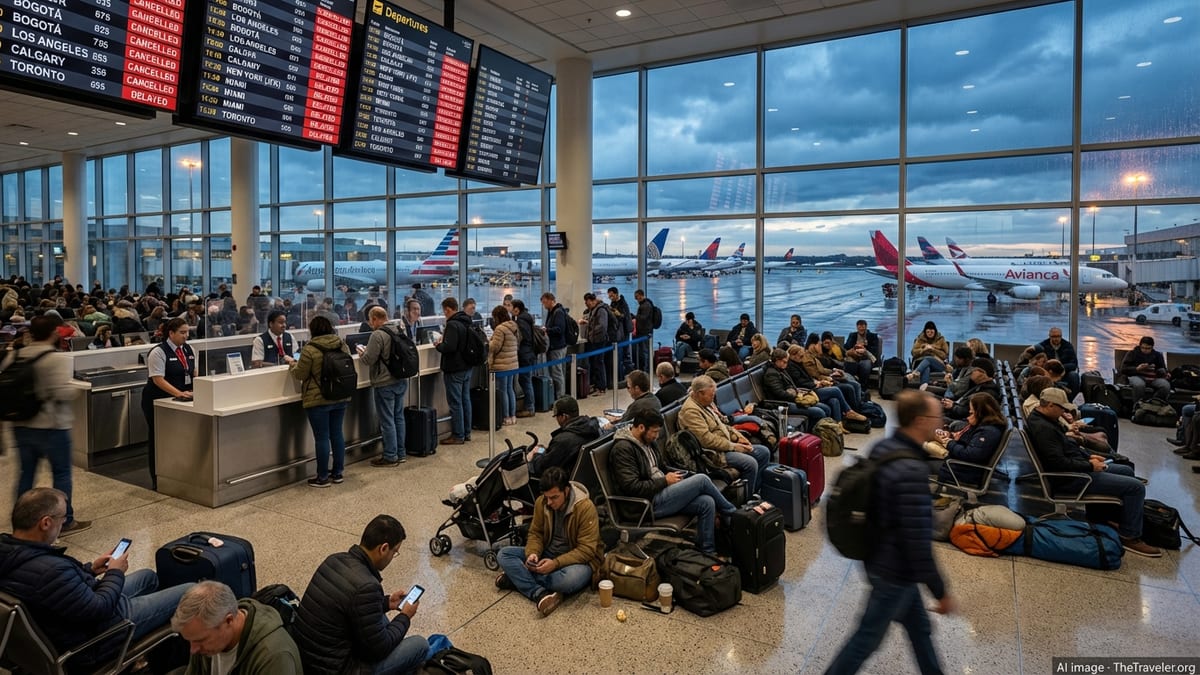
Flight delays mount across major U.S. hubs
Real-time tracking data from FlightAware shows that total delays within, into or out of the United States climbed above 1,379 on the affected day, with cancellations topping 160, as thunderstorms and traffic management programs slowed operations at some of the country’s busiest airports.
Published coverage of recent disruption days points to large clusters of delays at major hubs including Chicago O’Hare, New York area airports and Boston Logan, where a combination of storms and congestion left aircraft waiting for departure slots and arriving flights holding for gates.
Separate reporting on similar recent events indicates that single-day disruptions of this scale are no longer rare outliers. On multiple days this summer, delay counts have exceeded 1,300 while cancellations have moved past 150 nationwide, underscoring the limited margin for error in peak travel periods.
For travelers, the numbers translate into missed connections, extended tarmac waits and overnight airport stays, particularly when delays accumulate late in the day and available spare aircraft and crews are already fully utilized.
Weather, staffing and airspace constraints converge
Analysis of recent disruption patterns shows that severe weather remains the primary trigger for large delay spikes, but it rarely acts alone. Thunderstorms over key corridors in the Midwest and Northeast can force air traffic managers to slow the overall flow of aircraft, creating bottlenecks far from the actual storms.
Reports from recent events in the New York region describe delays driven by a combination of low visibility, convective weather and reduced staffing levels in air traffic control facilities. When staffing is constrained, capacity must be reduced for safety, increasing the likelihood that even moderate storms will lead to widespread schedule problems.
The structure of the U.S. hub-and-spoke system adds another layer of vulnerability. A ground stop at one major hub can immediately affect downline flights as aircraft and crews fail to reach their next scheduled legs, amplifying what began as a short localized disruption into an all-day national challenge.
Industry data and government analyses also indicate that tight airline schedules, limited spare aircraft and ongoing training pipelines for pilots and controllers leave the system less able to absorb shocks than before the pandemic.
Which airports and airlines feel the greatest impact
Recent coverage of comparable disruption days shows that the largest U.S. hubs tend to top the daily delay and cancellation tables when severe weather coincides with peak traffic. Chicago O’Hare, New York’s LaGuardia and Newark, and Boston Logan have all recently reported dozens to hundreds of delayed departures and arrivals during single-day events.
Flight tracking data for those days shows that regional airports can also be hit hard, especially when they rely heavily on a single carrier. Smaller New England and Midwestern airports have recorded some of the highest cancellation percentages during storms, as airlines prioritize limited aircraft for larger hubs.
Operational impact varies by airline depending on network structure. Carriers with dense connecting banks at a few hubs can experience cascading disruptions as missed inbound flights break carefully timed schedules. Point-to-point carriers are not immune but may have more flexibility to reposition aircraft when individual routes are affected.
Government statistics compiled by the Bureau of Transportation Statistics indicate that a small but persistent share of flights are canceled each month in the United States, with a significantly larger share arriving late. Single disruptive days like the one that generated more than 1,379 delays and over 160 cancellations tend to push those averages higher.
What travelers can do when disruption hits
Consumer guidance drawn from airline policies, government resources and travel advisories highlights several steps passengers can take when confronted with widespread delays and cancellations. Travelers are urged to monitor flight status closely through airline apps and websites, which typically update faster than airport departure boards.
When a flight is canceled, passengers are generally entitled to a refund if they choose not to travel, according to publicly available information from the U.S. Department of Transportation. Many airlines also offer same-day rebooking on the next available flight, though options may be limited during severe disruptions.
The Department of Transportation’s Airline Cancellation and Delay Dashboard allows travelers to compare what major U.S. carriers commit to provide in the event of controllable delays, including meal vouchers, hotel accommodation and ground transportation, and can help passengers understand what support to expect before they head to the airport.
Travel specialists also suggest building in longer connection times during storm-prone seasons, taking earlier departures when possible and keeping essential items such as medication, chargers and a change of clothes in carry-on bags in case checked luggage is delayed.
Aviation system faces ongoing resilience questions
Policy analyses from congressional research services and consumer advocacy groups highlight that repeated disruption days with more than a thousand delays and hundreds of cancellations raise broader questions about the resilience of the U.S. aviation system.
Recent reports emphasize that weather-related disruptions are unavoidable but argue that better crew planning, more robust technology systems and ongoing investment in air traffic control infrastructure could reduce the scale of knock-on effects when storms hit.
Government data released over the past two years shows that delays and cancellations surged during the travel rebound and remain elevated compared with pre-pandemic norms in some peak periods. While airlines and federal agencies have taken steps to add staffing and upgrade systems, the frequency of large disruption days indicates that vulnerabilities persist.
For now, passengers confronting headlines citing more than 1,379 delays and over 160 cancellations on a single day are likely to continue bearing much of the practical burden of an aviation network that is still seeking a more stable balance between demand, capacity and resilience.
FlightAware live delay and cancellation statistics
Yahoo Travel coverage of recent U.S. flight disruptions
U.S. DOT Airline Cancellation and Delay Dashboard
Bureau of Transportation Statistics on-time performance data