


North Jersey’s story is usually told in superlatives. Visitors gravitate to Hoboken’s waterfront, Jersey City’s skyline, and the outlet malls clustered along the Turnpike. Yet in the spaces between those big-name stops are quieter places that locals hesitate to mention, partly out of affection and partly because they are so easy to miss. Marsh walks hide behind warehouse parks, a national historical park sits in the middle of a working-class city, and intimate nature preserves cling to the Palisades above the Hudson. Spend a weekend chasing these overlooked corners and you will come away with a different picture of North Jersey entirely.
Get the latest updates straight to your inbox!
The Meadowlands Marshes Beyond the Stadiums
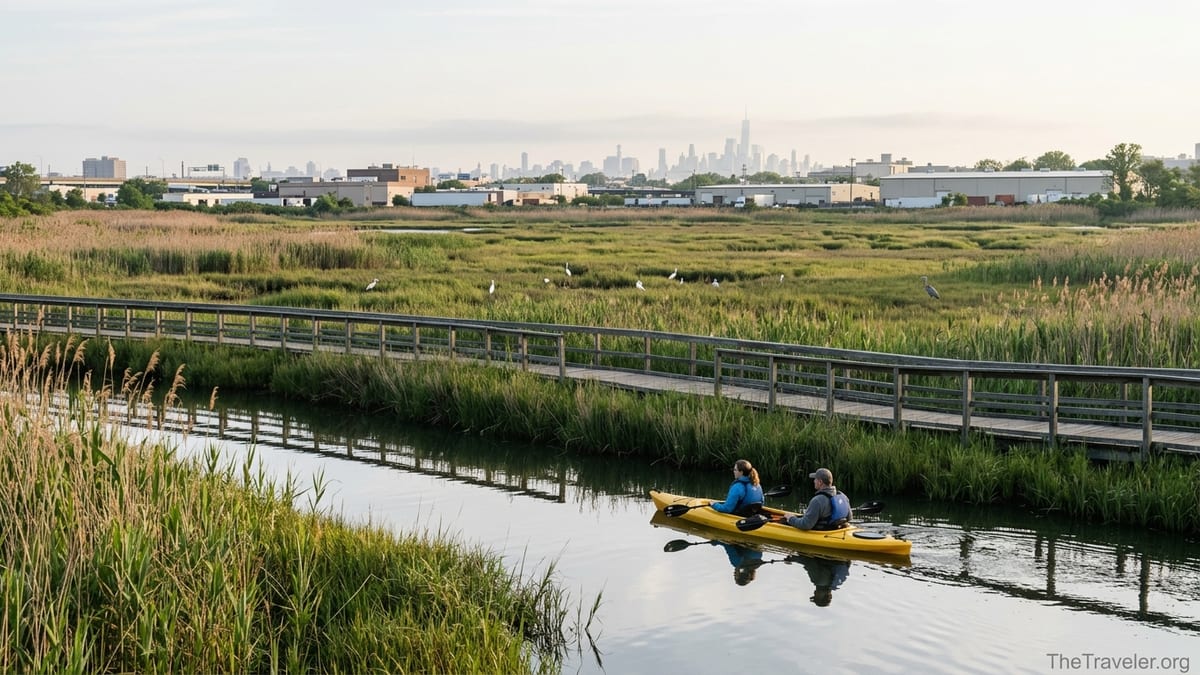
For many travelers, the Meadowlands is a blur of billboards, parking lots, and the stadium complex glimpsed from the highway or the train into Manhattan. Step off that main artery, though, and you find a surprisingly rich landscape of tidal creeks, spartina marsh, and long views of Manhattan that almost no out-of-towner ever seeks out. Places like Laurel Hill County Park in Secaucus and River Barge Park in Carlstadt give direct access to the Hackensack River and its wetlands, with launch ramps, boardwalks, and shoreline trails tucked almost out of sight of the Turnpike.
Hackensack Riverkeeper operates seasonal eco-cruises and guided paddling tours here, typically from May through mid-October, that take visitors deep into the Sawmill Creek Wildlife Management Area and neighboring marshes. A two-hour pontoon boat trip through these channels costs roughly what you might spend on a single cocktail in Midtown and offers osprey, egrets, and even the chance to see a bald eagle if you are lucky. Kayak rentals are similarly modest, often in the range of a casual dinner out, and put you almost at eye level with the reeds and the subtle tides that shape the estuary.
What surprises first-time visitors most is how quiet it can be once you slip behind the low islands of phragmites grass. The sound of traffic drops away, herons stalk the shallows, and the industrial skyline becomes a distant backdrop rather than the main event. On late-summer moonlight tours, paddlers watch the sun sink behind the warehouses and the full moon rise over the Manhattan skyline, a juxtaposition that feels distinctly New Jersey. It is a landscape of contrasts, and precisely because it sits in the shadows of the stadiums, most people never imagine that this kind of low-key wildness is here.
If you plan to explore, pair a morning or evening paddle with a simple picnic along the riverfront at Laurel Hill County Park or a walk through DeKorte Park in nearby Lyndhurst, where a network of short trails and viewing platforms gives a different angle on the same wetlands. None of these spots are glamorous in the usual tourism sense, but that is part of their charm. They are places where North Jersey residents go to walk the dog, test a new camera lens on distant shorebirds, or clear their head after work, and that everyday intimacy is exactly what many visitors are looking for without knowing it.
Paterson’s Great Falls and the Industrial Canyon
Paterson’s Great Falls is a 77-foot waterfall on the Passaic River, thundering through a basalt gorge in the middle of a dense, working city. It has the kind of force and drama that would be a major attraction almost anywhere else, yet it remains oddly under the radar for many visitors who know North Jersey only as a pass-through to New York. The site and surrounding district form Paterson Great Falls National Historical Park, administered by the National Park Service, but there is no conventional visitor center yet and information is scattered, which may contribute to its low profile among casual travelers.
Walk onto one of the pedestrian bridges that span the chasm and you can feel the spray and the rumble beneath your feet. Interpretive signs around the rim explain how Alexander Hamilton pushed for the falls to power one of the nation’s first planned industrial cities, driving the mills and factories that made Paterson a center for textiles, locomotives, and later aircraft engines. What you see now is both a natural spectacle and a surprisingly intact industrial landscape, with remnants of raceways, brick mill buildings, and viaducts lining the gorge.
Most visitors park, take a quick photo of the water, and move on. The overlooked pleasure is slowing down. A circuit of Overlook Park, the historic district streets, and the riverside paths reveals layers of immigrant history in a compact area. Local delis a few blocks from the falls serve generous sandwiches and empanadas for far less than you would pay in a waterfront neighborhood. On a weekday morning you might share the view with only a few other people: a dog walker cutting through the park, a couple of teenagers leaning on the rail, and occasionally a ranger leading a small group along the overlooks.
Practicalities here are straightforward. The grounds are generally open daylight hours, and there is no fee to see the falls. Facilities remain basic while a new visitor center is under development, so plan accordingly and bring water and comfortable footwear. Pair a stop at the falls with a short visit to the Paterson Museum nearby, housed in a former locomotive works, to see the machinery and textiles that turned the raw power of the Passaic into something much larger. The combination offers a perspective on American industry that you rarely get in better-known urban destinations.
Tenafly Nature Center and the Quiet Palisades
Travelers who rush to the well-publicized Palisades Interstate Park overlook drives often miss smaller preserves that sit just a bit inland. Tenafly Nature Center, perched atop the Palisades in eastern Bergen County, is one such place. Covering nearly 400 acres of forest and wetlands, with more than seven miles of trails and a central pond, it feels far removed from the highways and riverfront condo towers below. Yet it sits only a short drive from the George Washington Bridge, which makes its relative anonymity among visitors all the more striking.
The trails here wind through mixed hardwood forest, past streams and glacial erratics, with modest elevation changes that make them accessible to most walkers. In spring, you can catch carpets of wildflowers like trout lily and spring beauty along the paths, while summer brings dense green shade and the sound of insects and birds layered over one another. Around Pfister’s Pond, boardwalk sections and viewing platforms offer quiet spots to watch turtles sunning on logs or dragonflies skimming the water surface.
Unlike the more heavily marketed cliff-top viewpoints, Tenafly Nature Center runs low-key public programs that draw mostly local families and school groups: maple sugaring days in late winter, guided bird walks during migration seasons, and seasonal night hikes that introduce visitors to owls and nocturnal animals. The suggested donations or modest program fees are typically less than what you might spend on parking at a busier attraction, and the groups are small enough that you can ask questions and linger without feeling rushed.
For an easy day trip, you can combine a morning hike at the center with a short drive to one of the official Palisades Interstate Park overlooks to take in the panoramic view of the Hudson River and Manhattan skyline. The contrast is striking: crowded viewpoints with food trucks and tour buses, followed by nearly empty forest trails just a few minutes inland. Returning to the nature center’s trailhead at dusk, with crickets starting to sing and the last light filtering through the trees, you may forget entirely that New York City is less than ten miles away.
Teaneck Creek Conservancy and Art in the Wetlands
Teaneck Creek Conservancy is what happens when a forgotten corner of suburban woodland and wetland becomes a canvas for both ecological restoration and community art. Once choked by dumping and invasive plants, this 46-acre eco-art park in Bergen County now features about a mile and a half of groomed trails, outdoor classrooms, and a scattering of sculptures and installations integrated into the landscape. Many visitors to the area have never heard of it, despite driving past the general vicinity on the interstate countless times.
Walking the Red, Blue, or Green trails, you encounter mosaics set into embankments, carved wooden figures tucked between trees, and subtle land art that only reveals itself when you slow down. Signage along the paths explains how the conservancy has been replanting native species and stabilizing the creek banks, turning what was once a neglected drainage corridor into habitat for birds, amphibians, and pollinators. The result is not pristine wilderness but an intimate, evolving backyard for the surrounding communities.
Because it sits adjacent to residential neighborhoods and a busy roadway, Teaneck Creek tends to feel like a local secret. On a weekday afternoon, you might see a parent pushing a stroller, a retiree sketching in a notebook on a bench, or a small group of students following a guide on a field trip. There are no ticket booths or long queues; entry is typically free, supported by donations and partnerships. For travelers used to more overtly packaged attractions, the informality here can be refreshing.
Pairing a visit to the conservancy with a meal in Teaneck’s diverse dining scene, from kosher bakeries to Caribbean and Middle Eastern restaurants along Cedar Lane and Queen Anne Road, makes for a satisfying half-day excursion. You can spend an hour or two ambling the trails and then refuel at a neighborhood spot where menus and conversations unfold in multiple languages. It is a small, very North Jersey way of experiencing how culture and nature overlap.
South Mountain’s Fairy Trail and the Reservation Beyond
South Mountain Reservation, a large swath of preserved forest astride Essex County’s ridge, is hardly unknown to local hikers and dog walkers. Yet within this expanse lies a whimsical side path that most regional visitors have never heard of: the South Mountain Fairy Trail. This half-mile loop, starting near the Locust Grove parking area in Millburn, is dotted with small, handcrafted “fairy houses” tucked into tree roots, stumps, and rock crevices. Families with young children treat it as a kind of forest scavenger hunt, but outside that community, it remains curiously under-publicized.
The houses, built from natural materials like bark, twigs, and stones, range from simple doorways at the base of a tree to elaborate multi-story constructions with ladders and porches, all scaled for imaginary occupants. Volunteers and artists maintain and rebuild these structures over time, so the trail feels different with every visit. For travelers, it offers a rare chance to experience a truly grassroots attraction: no admission fees, no gift shop, just a gentle loop through the woods that tells you something about local creativity and stewardship.
The other overlooked aspect of South Mountain is just how wild parts of the reservation can feel once you leave the main picnic areas and overlooks. Longer trails follow streams, wind past small waterfalls, and climb to ridge-top viewpoints, offering hours of hiking within sight of suburban neighborhoods. On quieter weekdays, you can walk for long stretches encountering only a few other people, which can be surprising given how densely populated the surrounding towns are. Parking is free in several lots, though it fills quickly on sunny weekends, so early arrival is wise.
A practical way to enjoy the area is to start early at the Fairy Trail, continue on a longer loop deeper into the reservation, and then descend into Millburn or Maplewood for a late lunch in one of their compact downtowns. Train connections from New York make these towns convenient bases even for visitors without a car, and the blend of small independent shops, bakeries, and cafes gives the day a rhythm that feels more like a European village outing than a typical American suburb.
Hacklebarney State Park and the Black River Gorge
Push west from the main commuter corridor into Morris County and you reach a different North Jersey, one of rolling hills, farms, and cold rivers slicing through narrow gorges. Hacklebarney State Park, near Long Valley and Chester, is a prime example, yet it is still overshadowed by better-known hiking areas closer to New York. Covering close to a thousand acres, the park centers on the Black River, which cuts through a rocky ravine shaded by hemlock, oak, and maple.
Trails here are relatively short in mileage but rich in atmosphere, with stone steps, footbridges, and multiple vantage points over cascades and rapids. The state stocks the river with trout in season, and anglers pick their way along the banks to favorite pools. In autumn, the combination of rushing water and turning foliage is quietly spectacular, drawing mostly local families and hikers who know to arrive early on peak weekends. On weekdays or in shoulder seasons, you can have some sections nearly to yourself, hearing little more than the river and occasional calls of songbirds.
One reason Hacklebarney remains under the radar is its distance from public transportation and the lack of flashy visitor facilities. There is no elaborate lodge or restaurant inside the park, just picnic areas, restrooms, and trailheads. Most visitors bring their own snacks or pick up sandwiches and baked goods from nearby farm markets and roadside stands. Parking is typically free or covered by a modest state park fee structure, which keeps costs low for a full day outdoors.
A classic way to experience the area is to hike the riverside loops in the morning, then continue into Chester to browse its small main street of antique shops, cafes, and country stores. In season, local orchards offer pick-your-own apples or peaches, and farm stands sell cider and baked goods that taste especially good after a few hours on the trail. It is a North Jersey day trip that rarely appears on glossy brochures, yet it captures a pastoral side of the region that surprises many first-time visitors.
The Takeaway
Ask someone who only knows North Jersey through its highways and commuter trains, and you might hear about traffic, shopping malls, and a view of Manhattan that you barely have time to photograph before the train plunges into the tunnel. Spend even a couple of days seeking out the kinds of places described above, and a different region emerges. It is a patchwork of marshes and mill towns, art-filled wetlands and family-built fairy houses, trout streams and forested ridges, threaded through with everyday neighborhoods where the line between resident and visitor is pleasantly blurred.
None of these destinations are glamorous in the conventional sense, and that is exactly why they remain overlooked. They do not shout for attention with giant billboards or choreographed social media campaigns. Instead, they reward unhurried wandering, curiosity, and a willingness to look twice at the spaces between headline attractions. For travelers who value texture and surprise over checklists, North Jersey’s “missing” places may turn out to be the most memorable of all.
FAQ
Q1. Is it practical to visit these North Jersey spots without a car?
Public transportation can get you close to some places, such as Paterson, South Mountain Reservation, and certain Meadowlands access points, but schedules and last-mile connections vary. For full flexibility, especially for Hacklebarney State Park and more remote trailheads, having a car or arranging a rideshare for key legs of the journey is usually the most practical approach.
Q2. When is the best time of year to explore the Meadowlands marshes?
Late spring through early fall is ideal for paddling and boat tours in the Meadowlands. Water levels and wildlife activity are typically good from May into October, and some operators run special sunset or full-moon trips in summer. Shoulder seasons can be cooler and quieter, while winter trips are limited and best suited to well-prepared birders.
Q3. Do I need to book Meadowlands eco-cruises or kayak tours in advance?
Advance reservations are strongly recommended, especially for weekend and evening trips, as boat capacities are limited and popular dates often sell out. Same-day walk-up spots are occasionally available on quieter weekdays, but planning ahead gives you a better choice of departure times and allows operators to confirm weather conditions.
Q4. Is Paterson Great Falls safe to visit for solo travelers?
Paterson Great Falls National Historical Park sees a steady flow of local visitors, school groups, and tourists during daylight hours, and the overlooks and main paths are generally comfortable for solo travelers who take normal urban precautions. As in any city, it is sensible to stay in well-used areas, keep valuables discreet, and plan your route and parking in advance so you are not wandering unfamiliar streets after dark.
Q5. Are Tenafly Nature Center and Teaneck Creek Conservancy suitable for children?
Both sites are well suited to families, with relatively short, clearly marked trails and opportunities for hands-on learning. Tenafly Nature Center offers structured programs like maple sugaring and guided walks that work well for school-age children, while Teaneck Creek’s art installations and gentle paths appeal to a range of ages. Strollers may be more comfortable on wider, smoother sections rather than narrow or rooty side trails.
Q6. How difficult are the hikes in South Mountain Reservation and Hacklebarney State Park?
Both areas offer a mix of easy and moderate trails. The Fairy Trail in South Mountain is short and mostly gentle, while longer loops in the reservation involve modest climbs and rockier terrain. At Hacklebarney, riverside paths include stone steps and uneven surfaces that require basic fitness and attention but are manageable for most hikers wearing proper footwear. Neither area demands technical hiking skills, but sturdy shoes and a realistic sense of your limits are important.
Q7. Do I need to worry about parking fees at these lesser-known spots?
Parking policies vary. Many county parks and preserves, such as Teaneck Creek Conservancy and some South Mountain lots, offer free parking, while certain state parks, including Hacklebarney, may charge modest seasonal fees or require a state park pass on busy days. Urban sites like Paterson Great Falls rely on street parking or municipal lots nearby, which may have meters or time limits. Checking current information from park or town websites before you go helps avoid surprises.
Q8. What should I pack for a day exploring these areas?
For most of these destinations, basic day-hike essentials are sufficient: comfortable walking shoes, weather-appropriate layers, a refillable water bottle, sun protection, and snacks or a simple picnic. In marshy areas like the Meadowlands, insect repellent and a lightweight windbreaker can make time on the water more comfortable. If you are planning to participate in a guided tour, operators often provide safety gear such as life jackets, but it is wise to confirm in advance.
Q9. Are there guided options if I am not comfortable exploring on my own?
Yes. In addition to Meadowlands eco-cruises and paddle tours, several of these sites offer seasonal guided walks and educational programs. Tenafly Nature Center and Teaneck Creek Conservancy host naturalist-led outings, while South Mountain Reservation periodically features volunteer-led hikes and special events. Joining a guided activity can be a good way to get oriented before returning on your own.
Q10. How can I make sure my visit benefits these lesser-known places?
You can support these sites by following Leave No Trace principles, staying on marked trails, carrying out your trash, and respecting wildlife and artwork. Consider making a small donation to conservancies and friends groups, participating in volunteer days if your schedule allows, and patronizing nearby local businesses for meals and supplies. Sharing thoughtful recommendations with friends while avoiding exact directions to fragile spots helps keep these places both loved and protected.