


The Spanish islands fall into two distinct climate worlds. The Balearic Islands in the western Mediterranean have warm to hot summers, cooler and wetter winters, and a clearly defined high season in July and August. The Canary Islands, off the coast of North Africa, enjoy a milder, more stable subtropical climate that supports tourism throughout the year. Understanding how weather, crowds and prices shift by season in each archipelago is the key to choosing not only when to go, but also whether the Balearics or the Canaries are the better fit for your trip.
Get the latest updates straight to your inbox!
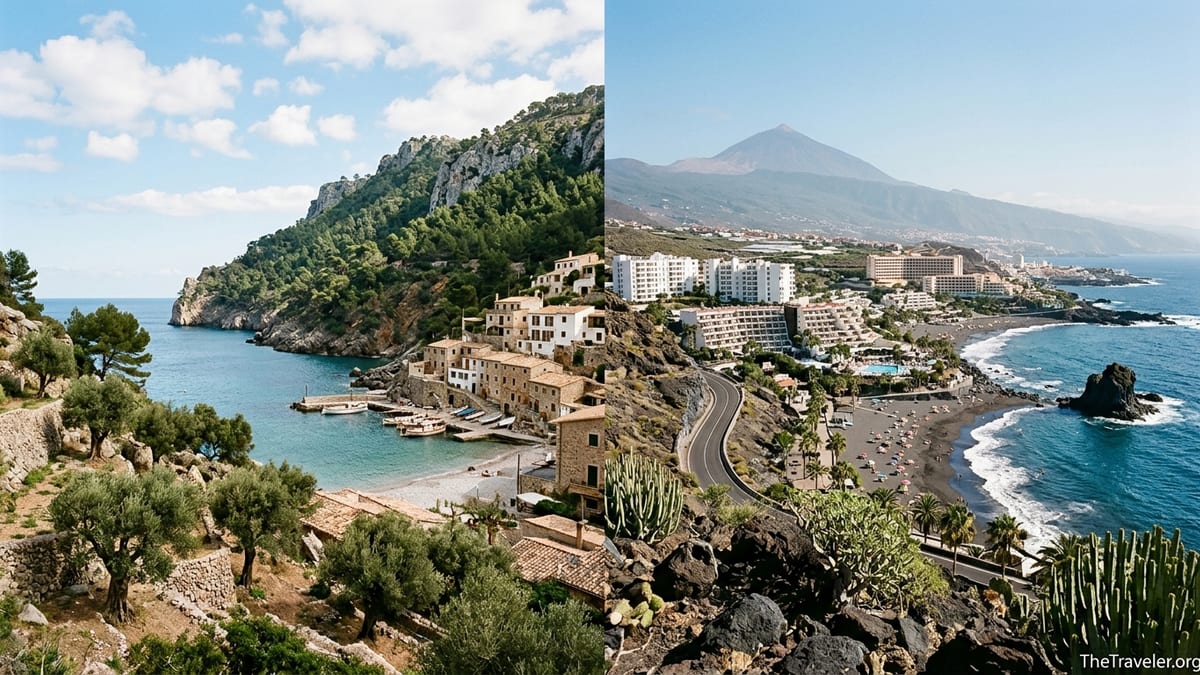
Balearics vs Canaries: Climate Basics and What They Mean for Timing
Climate data from Spain’s meteorological service, AEMET, shows Palma de Mallorca with typical January averages around 15 to 16 degrees Celsius during the day and about 8 to 9 degrees at night, with autumn and winter bringing the highest rainfall. By August, average daytime highs climb to around 30 to 31 degrees and nights stay in the low twenties, with sea temperatures often around the mid‑20s. These figures, based on updated climate normals published through 2026 for Palma’s coastal and airport stations, illustrate the textbook Mediterranean pattern of dry, hot summers and cooler, wetter winters.
In the Canary Islands, climate normals for Tenerife South Airport and Gran Canaria Airport show a much narrower annual temperature range. Daytime highs typically sit around 20 to 22 degrees in January, rising to roughly 27 to 29 degrees at the height of summer, while night‑time lows hover mostly between 15 and 22 degrees depending on the month. Average rainfall totals are low, with very few wet days between late spring and early autumn. This confirms the Canaries’ reputation for gentle winter sun and relatively stable conditions year round.
Recent tourism and hotel occupancy data for 2025 and early 2026 underline how that climate difference plays out in travel patterns. The Balearics still concentrate most international stays in late spring, summer and early autumn, with very low volumes in November through March. By contrast, the Canary Islands register strong visitor numbers in winter as well as summer, and national statistics highlight the archipelago as Spain’s leading region for hotel overnight stays in 2025, with a pronounced winter peak.
For trip planning, that means you can think of the Balearics as a classic April to October destination, where the feel of the islands changes dramatically between May and August, while the Canaries behave far more like a year‑round resort region. The rest of this guide breaks down what that looks like in practice by season, and how it affects prices, crowds and activities.
Spring: Shoulder Season Sweet Spot for Many Travelers
From March to May, daytime temperatures in Palma de Mallorca typically climb from the mid teens to the low twenties, with sea temperatures lagging behind, generally staying below comfortable swimming levels until late May or early June. Rainfall decreases compared with winter, but April can still see unsettled spells. In the Canary Islands, spring brings daytime highs around 22 to 25 degrees on the main south coasts of Tenerife and Gran Canaria, with relatively low rainfall and sea temperatures that are cooler than summer but usually swimmable for many visitors.
Tourism statistics show that Balearic visitor numbers ramp up sharply from April into May and June, but occupancy and flight loads remain lower than the summer peak. Local officials have underlined in 2026 that shoulder and low‑season visits, particularly from the domestic market between November and March, are slowly growing but still do not match summer volumes. In the Canaries, airline capacity and hotel stays remain strong in late winter and early spring, reflecting the islands’ role as a major winter‑sun escape for northern Europe, but demand gradually smooths out into a long shoulder season by May.
Prices in spring respond accordingly. Sample searches in November 2026 suggest that a mid‑range hotel or apartment in Palma or on nearby beaches might range from roughly 90 to 150 euros per night in April, rising as May progresses, while similar accommodation on Tenerife’s or Gran Canaria’s south coasts in April often falls in the 110 to 180 euro range. These are indicative brackets only and vary widely by exact location, property type and booking lead time, but they capture the pattern of slightly softer prices than in high summer or peak winter weeks.
Spring is one of the best times for hiking in both archipelagos. In Mallorca’s Serra de Tramuntana, typically accessible routes at mid elevations see mild daytime temperatures and greener landscapes after winter rains. On Tenerife, trails around Teide National Park often offer clear visibility, although high‑altitude sections can still see snow or ice, and authorities may close paths or limit access around the summit for safety or conservation reasons. Local park and environment departments regularly update closures and restrictions, so travelers should always re‑check shortly before their travel dates.
Summer: Peak Heat, Peak Crowds in the Balearics
Summer in the Balearic Islands, particularly late June through August, brings consistently hot and dry weather. AEMET climate normals for Palma show average daytime highs near or above 30 degrees in July and August and very low rainfall, with sea temperatures around 25 to 26 degrees. Heatwaves can push daytime temperatures higher across the islands, and regional authorities have issued periodic heat advisories in recent years, with associated wildfire risk in some rural and forested areas.
In the Canary Islands, coastal temperatures in July and August are usually warm rather than extreme. Tenerife South and Gran Canaria Airport records show average highs often in the upper twenties, with warm nights and very little rainfall. Sea temperatures are close to their annual maximum, creating excellent conditions for beach holidays. However, the strong trade winds that shape the archipelago’s climate can intensify in summer, which benefits wind and kite surfing on islands like Fuerteventura but can make some exposed beaches feel breezier and certain Atlantic crossings choppier.
Tourism data for 2024 and 2025 confirm that July and August remain the core peak season months in the Balearics, when international arrivals and overnight stays reach their highest levels and many resorts operate at or near full occupancy. News reports in 2026 highlight that attempts to stretch the season have not significantly altered this concentration among foreign markets. In the Canaries, summer is busy but often less extreme than the northern‑European winter school holidays period; the archipelago records sustained high hotel stays throughout the year with especially strong figures in the cooler months.
Prices reflect these patterns. For a typical week in late July 2026, snapshot searches suggest that a mid‑range hotel on Mallorca’s main resort coasts can cost 200 to 350 euros per night, sometimes higher for seafront properties, while comparable accommodation in south Tenerife or Gran Canaria may range from roughly 170 to 300 euros per night. Flight prices from major European markets spike around school holidays in July and August, especially for weekend departures. Travelers who are price sensitive but tied to school schedules may wish to focus on the first half of June or early September, when conditions are still summery but rates can be noticeably lower than in late July or early August.
Autumn: Warm Seas, Changeable Skies and Softer Prices
September and October bring a gradual cool‑down in both archipelagos, but sea temperatures remain warm, particularly in the Balearics. Climate summaries for Palma de Mallorca show average daytime highs stepping down from the high twenties in September to the low twenties by late October, with sea temperatures still around the mid‑20s in early autumn. This period can also mark the wettest part of the year for the Balearics, with occasional heavy showers or storms, although many days remain sunny and settled.
In the Canary Islands, September often feels like an extension of summer, with daytime highs in the mid to upper twenties on south‑facing coasts. By November, temperatures cool slightly but still compare favorably with much of mainland Europe, and rainfall, while somewhat higher than in early summer, usually remains moderate at coastal resorts. Atlantic swells can increase in late autumn, improving surf conditions on some exposed coasts while occasionally leading to rougher seas for inter‑island ferry crossings.
From a crowd perspective, September is still busy in the Balearics, particularly on Mallorca, Ibiza and Menorca, but occupancy rates begin to ease compared with August. October sees a further drop in visitor numbers, even though conditions can be attractive for those who prefer warm days and cooler nights rather than peak heat. Officials and hoteliers have reported gradual growth in shoulder‑season tourism, with more visitors choosing late season to avoid the busiest summer weeks. In the Canaries, autumn acts as a ramp into the winter high season, with airline capacity and bookings rising as northern Europe cools.
Prices usually moderate as autumn progresses. Indicative checks in November 2026 show that a week in October on Mallorca can cost 25 to 40 percent less for comparable accommodation than a stay in late July, especially when booked several months in advance. In the Canaries, October and early November often sit between summer and winter price points, making them appealing for travelers seeking a balance of value and good weather. However, late October school holidays in some origin markets can temporarily push up both flight and hotel prices on certain islands.
Winter: Quiet Mediterranean vs Year‑Round Canary Sunshine
Winter transforms the feel of the Balearic Islands. In Palma, AEMET climate normals show January daytime highs around the mid‑teens and night‑time lows around 8 or 9 degrees, with more frequent rain and shorter days. Sea temperatures cool into the mid to high teens, which many travelers find too chilly for long swims, though coastal walks and terrace cafés can still be pleasant on sunny days. Many resort‑oriented businesses reduce hours or close entirely between November and March, especially outside Palma and a few larger towns.
The Canary Islands, in contrast, emerge as one of Europe’s most reliable winter‑sun destinations. Tenerife South and Gran Canaria typically see daytime highs of 20 to 22 degrees even in January, with mild nights and generally low rainfall. National tourism statistics for 2025 identify the Canaries as Spain’s leading region for hotel overnight stays, with winter months contributing heavily. Air‑seat capacity data for winter 2023 and 2024 also shows strong winter schedules from key markets such as the United Kingdom, Germany and Scandinavia.
That popularity comes at a price. From December through March, particularly over the Christmas and New Year period and during northern‑European half‑term breaks, hotel and apartment rates on Tenerife, Gran Canaria, Lanzarote and Fuerteventura often reach their annual peaks. A sample comparison suggests that a mid‑range week in January on Tenerife’s south coast might be 20 to 30 percent more expensive than an equivalent stay in May, while winter prices in quiet Balearic resorts can be significantly lower than in summer, albeit with cooler, more changeable weather and a reduced range of open facilities.
Winter also brings some practical considerations. Atlantic storms can occasionally disrupt inter‑island ferry services in the Canaries, leading to delays or cancellations, and hikers planning high‑altitude routes around Mount Teide or Gran Canaria’s central massif may encounter snow or ice, with authorities temporarily closing trails or roads. In the Balearics, windy or wet spells are more frequent, and while serious disruptions are less common, travelers should still allow some flexibility in winter itineraries, especially for outdoor activities.
Activities by Season: Hiking, Surfing, Wildlife and Protected Areas
For hiking, the shoulder seasons of March to early June and late September to November are generally the most comfortable in both archipelagos. In the Serra de Tramuntana on Mallorca, regional authorities and park managers promote spring and autumn as ideal times, when temperatures are milder and vegetation more lush, although heavy rain episodes can temporarily close certain paths or increase rockfall risk. On Tenerife, the Teide National Park administration regularly issues updates on route conditions, and high‑elevation trails may close due to snow, ice or conservation measures, especially in winter and early spring.
Surfing and wind sports follow different rhythms. Fuerteventura and Lanzarote are known for year‑round wind and waves, with particularly reliable conditions for windsurfing and kite‑surfing in the summer months when the trade winds are strongest along certain coasts. Winter tends to bring larger Atlantic swells to exposed shorelines, which can suit experienced surfers. Local surf schools and water‑sports centers provide seasonal guidance and safety advice, and their recommendations should take precedence over any general pattern described here.
Whale and dolphin watching is an established activity in parts of the Canaries, especially in the strait between Tenerife and La Gomera, where several resident species are present year round. Local operators and regional authorities publish codes of conduct and, at times, seasonal restrictions or zone limitations to protect marine life. While there is no narrow viewing “season”, calmer seas in late spring and summer often make outings more comfortable. Travelers should always choose licensed operators and verify the latest rules shortly before booking.
Both archipelagos also contain protected beaches, marine reserves and nesting areas where access may be restricted or regulated at certain times of year. Examples include dune systems and bird habitats on islands such as Formentera, Menorca or parts of Fuerteventura. Regulations can change from season to season as conservation needs evolve, so it is essential to check recent information from local councils or environment departments about any permits, visitor caps or time‑of‑day limitations that may apply.
School Holidays, Festivals and How They Shape Prices
School holidays in key origin markets such as Spain, the United Kingdom, Germany and France play a major role in determining peak prices in both the Balearics and the Canaries. July and August remain the core family holiday months for the Balearic Islands, aligning with long school breaks and pushing both flight and hotel rates to their highest levels. Easter, which can fall from late March to April, often produces a sharp but shorter spike in demand, affecting both archipelagos, particularly when school calendars line up with public holidays.
In the Canary Islands, winter school breaks in northern Europe, especially around Christmas and February half‑term, bring strong demand on top of the archipelago’s baseline winter‑sun appeal. This concentrates some of the highest annual airfares and accommodation rates into a small number of weeks between December and March. Travelers with flexible dates can achieve substantial savings by avoiding those specific holiday windows, even if they travel in the same month.
Festivals and events also influence seasonal patterns, though they rarely reshape the overall climate‑driven curve. In the Balearics, traditional celebrations such as Sant Joan in late June on Menorca or large summer music festivals on Ibiza and Mallorca can significantly increase demand and prices for a few days or a week, especially in and around host towns. In the Canaries, carnival season in February, particularly in Santa Cruz de Tenerife and Las Palmas de Gran Canaria, draws large crowds, filling hotels and apartments and creating a brief price surge that sits on top of the already popular winter season.
These events are recurring and form part of the islands’ annual cultural calendar, but details such as exact dates, routes and associated restrictions often change slightly each year. Travelers who wish to attend should verify current year programs and plan bookings well in advance, while those who prefer quieter visits might aim to avoid these peak festival periods or stay in less affected areas.
Planning and Booking: How Far Ahead and What Trade‑Offs
Booking patterns from major accommodation platforms and reports from Spanish tourism bodies suggest that for peak summer weeks in the Balearics and peak winter weeks in the Canaries, popular mid‑range and upscale properties often fill several months ahead. For stays in late July or early August on Mallorca or Ibiza, or for Christmas and New Year on Tenerife or Gran Canaria, travelers seeking specific hotels or family‑sized apartments should ideally plan at least four to six months in advance. Shoulder‑season trips in April, May, late September or October can often be arranged with shorter notice, though early booking still tends to secure better prices and choice.
Each season involves clear trade‑offs. Spring and late autumn in both archipelagos usually bring lower prices and more comfortable daytime temperatures for hiking and sightseeing, but the sea can feel cool in the Balearics until late May and again from late October. High summer in the Balearics guarantees hot weather and lively nightlife but can make midday sightseeing uncomfortable and pushes many travelers to plan around early morning or evening activities. Winter in the Canaries offers reliable warmth and sun compared with mainland Europe, but seas and winds can be rougher at times, and the premium for travel around festive dates is substantial.
Travelers should also factor in climate‑related risks that vary by year. Recent summers across southern Europe have seen periods of extreme heat and increased wildfire danger, affecting some Mediterranean islands. At the same time, occasional winter storms in the Atlantic have disrupted ferry schedules in the Canaries and produced short‑lived coastal flooding or strong wind warnings. Official meteorological and civil protection channels provide the most reliable, up‑to‑date alerts, and itineraries that allow some flexibility for outdoor activities are advisable.
Finally, it is important to treat all climate and price ranges as broad guides rather than guarantees. AEMET climate normals and 1991–2020 averages, which underpin most current summaries as of late 2026, describe typical conditions but do not rule out unseasonal cold snaps, heatwaves or storms. Likewise, accommodation and flight prices fluctuate daily in response to demand and availability. Travelers should always re‑check conditions and costs close to their travel date, using the seasonal frameworks outlined here as a starting point rather than a fixed rulebook.
Which Months Suit Which Traveler: Scenario‑Based Suggestions
For budget‑conscious beach holidays, the best windows in the Balearics are usually late May to mid June and late September, when the sea is warm enough for comfortable swimming, many services are open, but prices and crowds are below peak July and August levels. In the Canaries, May, June and October often offer a similar sweet spot of good weather and slightly softer prices compared with midwinter, particularly outside school holiday weeks.
For hiking and mild temperatures, both archipelagos shine in spring and autumn. March to early June and late September to November generally bring cooler daytime highs and clearer skies. This is ideal for covering longer routes in Mallorca’s Serra de Tramuntana, exploring inland Menorca, or tackling sections of Tenerife’s and Gran Canaria’s highlands. Travelers intent on very high‑altitude routes, especially around Teide, should build in flexibility to account for possible closures and quickly changing conditions.
For nightlife‑focused stays, particularly those centered on beach clubs and large venues, the Balearics are at their liveliest from June through early September, with Ibiza and parts of Mallorca drawing international crowds and headlining acts. Prices for accommodation and event tickets align with this demand. The Canaries, while also hosting festivals and a solid bar and club scene in major resorts, feel more evenly paced across the year, with winter and summer both lively but less dominated by a short, intense peak.
For reliable winter sun and a broad choice of open resorts, the Canary Islands are the safer bet between November and March, especially for travelers from colder climates seeking outdoor pool time and light clothing. Those who value warmer seas and classic Mediterranean summer vibes, and who do not mind higher prices or crowds, may find their ideal window in the Balearics from late June to early September. Ultimately, the best time to visit depends not only on when the weather is “best”, but on how you balance budget, activity plans and appetite for busy or quieter islands. Using the seasonal patterns outlined here as a framework, flexible travelers can usually find a satisfying compromise between the Balearic and Canary Islands at almost any time of year.