


I arrived at Fundació Joan Miró on a bright Barcelona morning expecting a pleasant hour or two of color and abstraction before heading back down Montjuïc for tapas. I left three hours later with the uneasy feeling that modern art was no longer an optional extra in my travels but something closer to a language I had finally started to understand. The museum did not just teach me about Joan Miró. It changed the way I look at white space, primary colors, and even the sky above the city.
Get the latest updates straight to your inbox!
A Museum in the Sky Above Barcelona
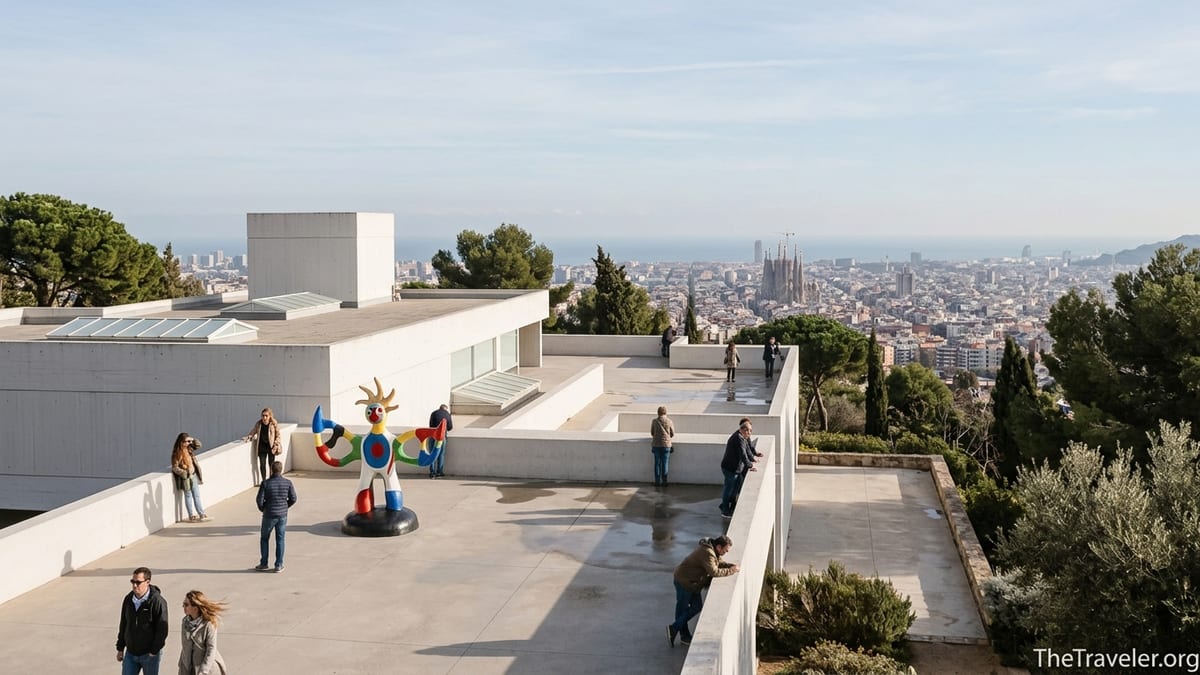
Fundació Joan Miró sits partway up Montjuïc, the broad hill that rises behind Barcelona’s waterfront. The building, designed by Miró’s friend Josep Lluís Sert, is all pale concrete, square courtyards and skylights that pull Mediterranean light deep into the galleries. From the terraces you see the dense Eixample grid stretching to the sea, the Sagrada Família spires needling the horizon, cable cars sliding overhead. It feels less like walking into a museum and more like stepping into an observatory for color and form.
Reaching the foundation is its own small journey. You can ride the funicular from Paral·lel metro, then a city bus up toward Parc de Montjuïc, or hop on a red-route tourist bus that stops almost directly in front of the entrance. On the day I visited, a family with strollers, an older couple with folding walking sticks, and a group of art students all spilled out at the same stop, proof that this is not a niche space for experts. It is deliberately accessible, in both geography and spirit.
Inside, everything feels open. High ceilings, cream walls, and long sightlines between rooms echo the curves and dots of Miró’s canvases. The foundation now cares for many thousands of works and archival pieces, but only a carefully chosen selection is on display at any one time, arranged so that the paintings breathe. It is a crucial lesson for anyone used to blockbuster museums: sometimes seeing less, more clearly, is what really changes you.
Even practical details contribute to the mood shift. A standard adult ticket is priced in the low-teens in euros, while students and seniors pay less, and children under a certain age often enter free or at symbolic cost. Instead of a paywall atmosphere, the ticket desk feels like a gate to a public garden, gently encouraging you to come in and stay a while rather than rush through to “get your money’s worth.”
Meeting Miró as a Person, Not Just a Style
I had always filed Miró away as “the one with the playful squiggles,” somewhere between the Surrealists and the graphic language of mid-century posters. The permanent collection rewires that impression almost immediately. Early rooms show figurative works rooted in Catalan rural life, painted when Miró still felt in dialogue with the earth of Mont-roig del Camp rather than the cosmos. You sense a young artist wrestling with farmhouses, ladders, and animals, trying to compress memory and landscape into a single frame.
Moving forward, the galleries avoid a rigid march of years. Instead, works are grouped to highlight materials and motifs. There are canvases where constellations of dots and circles float in fields of color, next to rougher pieces where scratched lines cut into thick paint or nontraditional materials. The emphasis is on Miró’s process of stripping elements away, then putting them back in a new order. Labels and wall texts speak less about art-history jargon and more about his obsessions: the sun and moon, Catalan identity, the terror of approaching war, the pull between sky and soil.
One room in particular made Miró feel disarmingly human. Sketches and preparatory drawings reveal how many failed lines and alternate compositions sit behind a seemingly effortless finished work. Many of these fragile sheets are part of a vast holdings of drawings and studies that the foundation preserves. Seeing rows of ink marks that stop and start, loops corrected, stars redrawn, I stopped thinking of modern art as improvisation and started to see the discipline behind each stroke.
The biographical threads running through the museum matter, too. Photographs of Miró in his studio, notes about his friendships with poets and architects, and reminders of the political upheavals he lived through give emotional weight to the abstraction on the walls. By the time you reach the later pieces, the idea that these are just whimsical doodles is impossible to sustain.
Three Works That Reshaped How I Read Modern Art
It was not the overall collection alone that shifted my understanding, but encounters with specific works that lingered in my mind long after leaving. One of them is a painting that confronts the brutality of the 1930s with shocking directness. A man and woman stand before a vile heap, their bodies distorted, their sexuality twisted into something anxious and grotesque. Created in the tense years before the Spanish Civil War, it has been described as a key warning image, and the foundation holds the canvas in its permanent collection. Faced with it in person, what looks chaotic in reproduction becomes alarmingly deliberate: the smear of color between figures, the clawed hands, the tight crop that denies any escape.
Nearby, you might find works from the “constellation” period, small paintings where delicate forms float against saturated blue or brown grounds. They sometimes take their cue from celestial phenomena, building a grammar of circles, lines, and biomorphic shapes. Seeing them after the earlier political paintings, you realize these are not escapist fantasies but meditations on the same world, translated into a cosmic language. The foundation’s curators lean into this tension, pairing canvases so your eye jumps from a tiny star to a thick, anxious line across the room.
A large tapestry designed by Miró and executed with textile collaborators provided another turning point. From across the hall it reads as a bold, playful composition. Up close, strands of wool, knots, and rough edges reveal a work that is as much sculpture as image. For travelers who think of modern art as purely visual, this textile assault on the senses challenges the notion of a painting as something that must be flat and untouchable. The foundation’s commitment to these “sobreteixims” and tapestries extends Miró’s language into three dimensions.
Finally, drawings and studies connected to the series often called “The Navigator’s Hope” demonstrate how Miró responded to the late 1960s and early 1970s with works that are at once formal experiments and veiled commentaries on global unrest. Knowing that many of these canvases now live in Barcelona, and seeing related works in the galleries, made me recognize how modern art can encode historical anxiety inside seemingly abstract forms. The lesson for travelers is clear: when you stand before an abstract work, you are often face to face with specific fears and events distilled into shape and color.
The Building That Teaches You How to Look
Many museums claim to integrate architecture and art, but at Fundació Joan Miró this is not a slogan. Sert’s design is integral to how you learn to see. Cubes of space interlock under a flat roof pierced by light wells. Sun spills onto white walls, then glances off polished floors onto the undersides of concrete beams. As you move, sightlines cross: a window frames a patch of pines outside, a low wall cuts a painting in half from a distance, a stairwell leads your gaze to the sky.
In recent years the foundation has opened more of its outdoor spaces to visitors, including landscaped areas that were part of the original garden design on Montjuïc. Wandering out from the galleries into these terraces, I was struck by how Miró’s sculptural forms echo the cypress trees and stone benches. A bronze piece on one terrace converses silently with the city skyline, turning Barcelona itself into part of the installation. The effect is subtle but powerful: you begin to read the city through Miró’s vocabulary of dots, lines and voids.
The galleries themselves are not packed floor to ceiling. Instead, each room gives you physical space to step back, approach, and circle a work. One large hall might hold only a few canvases and a sculpture, trusting the viewer to fill the “empty” zones with their own movement and thoughts. I realized this mirrored what Miró does on canvas. He uses blank areas not as laziness but as active forces. After an hour inside Sert’s building, white space in any painting feels charged rather than empty.
There is a quiet generosity in how the building handles visitors. Benches are placed near windows and major works. Labels are readable without crowding. Even when tour groups pass through, you can usually claim a corner of the room to yourself. For travelers used to shuffling shoulder to shoulder past famous paintings elsewhere in Europe, the chance to have a private conversation with a Miró canvas is a luxury that changes how deeply you absorb the work.
From Confusion to Conversation: Learning to “Read” Miró
Before visiting, I often approached modern art with a kind of defensive skepticism. In front of a seemingly simple Miró reproduction, I would silently wonder if the artist was getting away with something. Fundació Joan Miró dismantled that suspicion, not through theory-heavy panels, but by structuring the visit as a slow-building tutorial in how to read his language.
Early rooms ease you in with more recognizable figures and landscapes, then gradually introduce the stripped-down signs that will dominate later work. Dots become stars, lines become paths, blobs of color become moons, eyes, or birds depending on their context. By the time you reach the bold late paintings and sculptures, the vocabulary feels familiar, even if the sentences are still open to interpretation. The shift is almost physical. I caught myself leaning in to trace brushstrokes with my eyes, then stepping back to see how those marks played against the vast emptiness around them.
Audio guides, when you choose to use them, focus less on explaining “what this means” and more on pointing out how Miró constructs tension: a heavy patch of black balanced by a small yellow dot, a delicate line suddenly interrupted, a shape pushed almost off the canvas. Wall texts occasionally quote Miró’s own words about wanting to create “a painting that is like a spark,” or about looking at earth and sky rather than the picturesque “landscape.” These phrases echo as you move through the rooms. Modern art ceases to be a riddle to solve and becomes a conversation to participate in.
Back outside, the effect lingers. Leaving the foundation, I noticed how the red of a passing city bus cut through the grey of a stone wall, how laundry flapping on a balcony drew a vertical line against the horizontal lines of the buildings. The city looked fractionally more alive, as if someone had tweaked the contrast on my perception. That, more than any single painting, is the gift Fundació Joan Miró offers travelers.
Planning Your Visit: Practical Tips and Realistic Expectations
On a practical level, visiting Fundació Joan Miró is closer to an afternoon commitment than a quick stop. Even a brisk circuit of the main collection and temporary exhibition will likely take at least ninety minutes. Add time for the sculpture terraces, the bookshop, and a pause at the café overlooking the pines, and you are realistically looking at two to three hours. My strongest recommendation is to plan the museum as the central element of a half day on Montjuïc rather than a box to tick between other obligations.
Opening hours can vary slightly between summer and winter seasons and around holidays, but the foundation typically opens midmorning and closes in the early evening, with one day a week when it is shut altogether. Checking the specific schedule before you ride up the hill is wise, especially if you are coordinating with other Montjuïc sites like the Olympic Stadium or the Castell. Buying tickets online in advance is increasingly the norm in Barcelona, but it is often still possible to walk up and buy the standard adult ticket on site outside the very busiest holiday weeks.
Budget-conscious travelers should compare options such as a dedicated single-entry ticket, a museum pass that includes several major Barcelona institutions, or a citywide card that bundles public transportation with cultural attractions. The foundation is frequently part of these combined offers, which can bring the effective price per museum down if you plan to visit multiple sites. Students, young people up to their mid-twenties, and visitors over 65 usually benefit from discounted rates, so it is worth carrying ID.
Facilities are solid but not flashy. There are lockers for bags, ramps and elevators that make the building broadly accessible, and staff used to helping visitors in multiple languages. Families with children will find that the open spaces and bold colors keep younger visitors engaged, especially if you build in time at the interactive or workshop areas when available. Modern art here is not treated as something fragile you must tiptoe around, but as a living language that kids and adults alike can start to speak.
The Takeaway
By the time I descended Montjuïc in the late afternoon, Fundació Joan Miró had quietly rearranged my mental map of Barcelona and of modern art. What I had thought of as a niche museum turned out to be one of the city’s clearest windows into the 20th century: its hopes, terrors, and cosmic dreams. The building itself became a teacher, showing me how light, space, and silence shape what we see. Specific works, from a devastating prewar canvas to a rough-edged tapestry, proved that abstraction can carry emotional weight as heavy as any realistic scene.
For travelers who have ever stood in front of a modern painting and felt excluded, this museum offers an invitation rather than a test. It lets you walk with Miró from earthbound farms to star-filled skies, from political dread to playful experimentation, without requiring you to memorize theory. When you leave, the reward is not just a handful of favorite works, but a new attentiveness to the colors and shapes of the world outside. Modern art stops being an optional extra and becomes a tool for seeing, one that fits easily into your hand every time you travel.
FAQ
Q1. How long should I plan to spend at Fundació Joan Miró?
Most visitors are comfortable with two to three hours, which allows time for the permanent collection, any temporary exhibition, the outdoor terraces, and a short café break.
Q2. Is Fundació Joan Miró suitable for visitors who do not usually like modern art?
Yes. The collection is arranged to ease you into Miró’s language step by step, with clear explanations and plenty of space to look, making it a very welcoming introduction to modern art.
Q3. Do I need to book tickets in advance?
Advance booking is recommended during peak seasons and holiday periods, but outside those times it is often possible to buy tickets directly at the museum without long waits.
Q4. What is the best way to get there using public transport?
You can combine the metro to Paral·lel with the Montjuïc funicular, then take a local bus up toward Parc de Montjuïc, or use a tourist bus route that stops near the foundation’s entrance.
Q5. Are there discounts for students or seniors?
Yes. Students and visitors over 65 typically benefit from reduced admission prices, so bringing a valid student card or ID can lower the cost of entry.
Q6. Can I take photographs inside the museum?
Non-flash photography is generally permitted in many parts of the collection for personal use, but some temporary exhibitions or specific works may have restrictions, so always check onsite signs.
Q7. Is the museum accessible for visitors with limited mobility?
The building incorporates ramps, elevators, and level pathways, and staff are accustomed to assisting visitors with reduced mobility, making it a broadly accessible experience.
Q8. Are there activities for children and families?
Yes. The foundation often runs family-focused workshops and provides kid-friendly materials, and the bold colors and open spaces help keep younger visitors engaged throughout the visit.
Q9. What should I not miss if I have limited time?
If you are short on time, prioritize the main Miró painting galleries, at least one space with his tapestries or sculptures, and a quick walk onto the terraces for views over Barcelona.
Q10. Can I combine a visit to Fundació Joan Miró with other Montjuïc attractions?
Absolutely. Many travelers pair the museum with nearby sights such as the Olympic area, Montjuïc Castle, or the botanical gardens, creating a full half day or day on the hill.