


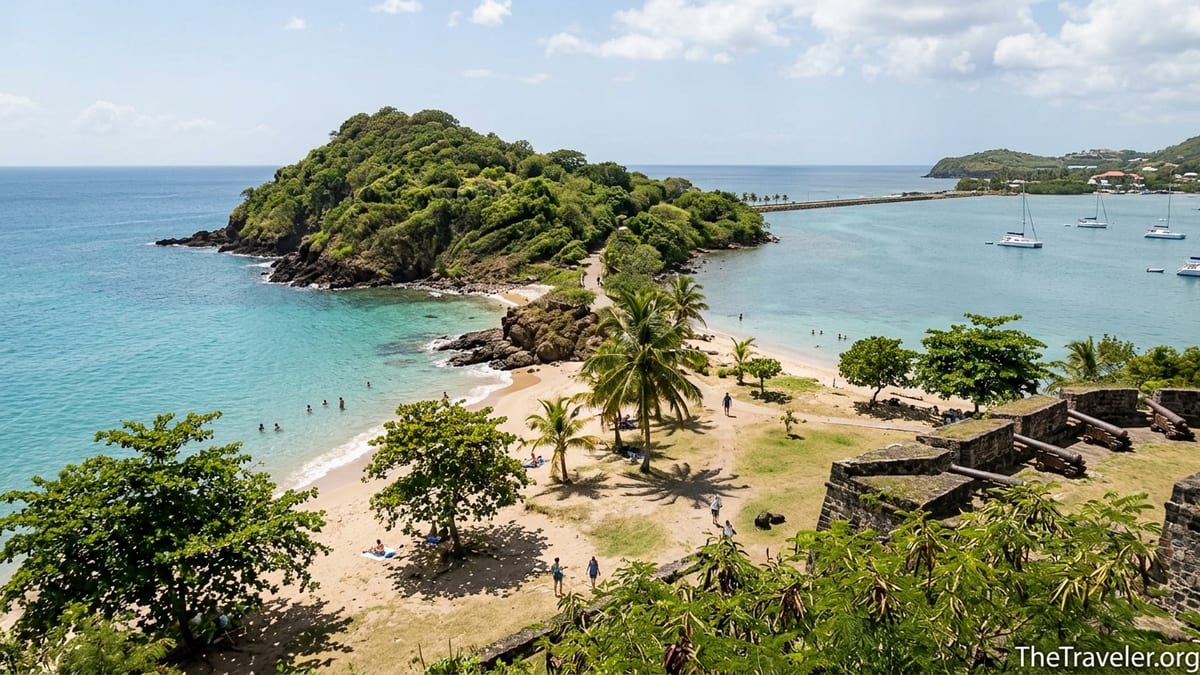
Pigeon Island National Landmark in Saint Lucia is one of the Caribbean’s most atmospheric historic sites, combining 18th century military ruins, forested hiking trails, and quiet beaches in a compact peninsula. Understanding the current entrance fees, opening hours, last entry rules, and tour options will help you make the most of your visit and avoid surprises at the gate.
Get the latest updates straight to your inbox!
Where Pigeon Island Is and Why Fees Matter
Pigeon Island National Landmark sits at the northern tip of Saint Lucia, just across the water from the resorts of Rodney Bay and Gros Islet. Once a separate island, it is now connected to the mainland by a man made causeway and managed by the Saint Lucia National Trust as a protected historic and natural site. For most visitors, access is via a short taxi ride from Rodney Bay hotels or a 15 to 20 minute walk from nearby beachfront resorts.
Unlike a public beach, Pigeon Island is a designated national landmark with controlled entry. That means you pay an admission fee at a staffed gate, similar to a small national park or historic fort. The fee funds trail maintenance, conservation, security, and upkeep of buildings such as Fort Rodney and the small on site museum. Because the landmark is relatively compact and easy to explore in a half day, knowing what your admission covers helps you decide whether to spend a full day on site or combine it with beach time or a sunset cruise.
It is also important to distinguish Pigeon Island National Landmark in Saint Lucia from Pigeon Island National Park off Nilaveli on Sri Lanka’s east coast. Both charge entry, but they are entirely different destinations in different parts of the world, with separate ticket systems. This guide focuses on the Saint Lucia landmark, which is the one most commonly included on Caribbean cruise itineraries and resort excursions.
Given that you might visit as a couple, part of a family group, or during a shore excursion with limited hours on land, transparent information on entrance fees, children’s rates, payment options, and last entry times can make the difference between a relaxed visit and a rushed or even missed experience.
Current Entrance Fees and Children’s Rates
At the time of writing in August 2026, walk up entrance fees for Pigeon Island National Landmark remain modest compared with many Caribbean attractions. Recent visitors consistently report a standard entry charge of about 10 US dollars per adult when paying in US currency, with the equivalent accepted in Eastern Caribbean dollars at the posted rate at the gate. Several reviewers mention paying around 10 dollars per person for independent visits involving a hike up to Fort Rodney and time on the beaches.
Children are typically charged a lower rate than adults, although the exact discount can vary slightly depending on the age bracket set by the site at the time of your visit. In practice, families report paying a reduced fee for school age children and, in many cases, no fee for very young children. Because policies can change, families with more than one child should budget close to adult pricing and then treat any reduction at the gate as a bonus.
If you book Pigeon Island as part of an organized excursion through a resort or cruise line, your ticket price may be bundled into the excursion cost. For example, a half day “Pigeon Island and Beach” tour sold through a Rodney Bay hotel might advertise a single per person price that includes transport, guide, and landmark entry. In that scenario you will not pay again at the gate, but you will still pass through the same entrance and benefit from the same access to trails, beaches, and facilities.
It is worth noting that prices are subject to periodic review by the Saint Lucia National Trust and the Ministry of Finance. While no significant public increase has been announced for 2026, small adjustments can occur year to year. For budget planning, treat 10 dollars per adult and a slightly lower children’s rate as a realistic, conservative estimate and carry a bit of extra cash in case of minor changes.
Opening Hours, Last Entry, and Best Times to Visit
Pigeon Island National Landmark operates on a clear daytime schedule. Officially, the site is open daily from 9:30 a.m. to 5:00 p.m., with last entry at 4:15 p.m. This means the gate staff will typically stop selling tickets around 4:15 p.m., and visitors already inside are expected to begin making their way out by closing time. The same hours apply on weekends and public holidays unless a special event or maintenance closure has been announced in advance.
In practice, if your goal is to hike up to Fort Rodney and Signal Peak for views across Rodney Bay and, on clear days, to Martinique, you will want to arrive significantly earlier than the last entry time. A comfortable loop that includes time on both beaches, a slow climb to the fort, photo stops at the cannons, and a pause for a drink or snack can easily fill three to four hours. For most visitors, entering between 9:30 a.m. and 2:00 p.m. offers the best balance of cooler temperatures and unhurried exploration.
Morning visits are particularly attractive for hikers. Arriving at opening time allows you to walk the steeper sections of the trail before the midday heat sets in, then spend the warmer hours down on the sand or in the shade. Guests staying at nearby properties like The Landings Resort often describe strolling over around 9:30 a.m., paying the entrance fee, hiking up to Fort Rodney by mid morning, and then descending to the beaches for swimming before returning to their hotel for lunch.
If you are visiting on a cruise ship day and your port call is short, pay close attention to both your ship’s all aboard time and the landmark’s last entry. For example, if your ship departs at 5:30 p.m. and you must be back on board by 4:30 p.m., planning to arrive at Pigeon Island no later than 1:00 p.m. will leave enough time for the entry process, the uphill walk, and some beach relaxation while still allowing for the return transfer to port and potential traffic around Gros Islet.
How to Pay: Cash, Cards, and Organized Tours
The main entrance kiosk at Pigeon Island National Landmark accepts both cash and card payments, but reliability of card processing can vary depending on network connectivity on a given day. Several recent visitors note that while card terminals are present, they chose to pay 10 dollars per adult in cash to speed up the process and avoid any issues with overseas bank approvals. As a result, it is sensible to arrive with sufficient cash in either US dollars or Eastern Caribbean dollars to cover your group’s admission.
Card acceptance is most useful for travelers who do not want to carry much cash to the beach or who are visiting as part of a longer Caribbean itinerary and are trying to manage multiple currencies. If you intend to use a card, keep a small reserve of cash as a backup. In the event the terminal is offline, gate staff will expect cash on the spot, and there are no ATMs inside the landmark itself.
Many visitors experience Pigeon Island through an organized activity rather than as independent walk ups. For example, a local tour operator based in Rodney Bay might sell a “Hike Pigeon Island and Beach Picnic” package that includes round trip minibus transport, entry fees, and a guide who explains the island’s history from the days of Admiral Rodney to more recent cultural events. Similarly, some cruise lines offer shore excursions where the landmark fee is pre paid as part of your ticket, and you simply follow the guide through the group entrance.
If you have booked a package, confirm with your tour provider whether the Pigeon Island entrance fee is included or must be paid separately. In most cases it will be included, but occasionally a resort shuttle or taxi driver will offer transport only, expecting you to handle the ticket at the gate. To avoid confusion, ask specifically whether “the landmark admission ticket” is part of your quoted price before departure.
What Your Admission Includes (and What It Does Not)
The standard entrance fee to Pigeon Island National Landmark grants you general access to the peninsula’s historic and natural features during opening hours. This includes the forested walking trails, the climb up to Fort Rodney with its stone ramparts and cannons, the higher Signal Peak viewpoint, the two main beaches suitable for swimming and snorkeling, the picnic lawns dotted with coconut and sea almond trees, and basic facilities such as showers and toilets.
Admission also includes access to the small on site interpretation center and mini museum when it is open, usually on weekdays. Here you can see displays and maps that explain how Pigeon Island functioned as a British naval lookout point in the 18th century and how the causeway changed the island’s environment after it was built in the 1970s. For travelers who enjoy context, half an hour in the museum before or after walking the trails can enrich the experience of climbing past the ruins.
What your ticket does not include are optional extras and third party services within the landmark. For example, you will pay separately if you wish to rent sun loungers or beach chairs on the sand. Several recent visitors mention paying around 3 US dollars per lounger for the day, in cash, directly to the concession. Similarly, food and drinks purchased at the on site restaurant or snack outlets, as well as souvenirs from the Trust Island Life shop, are not covered by the entry fee.
Guided tours inside the landmark, where a Saint Lucia National Trust guide leads you around the historic ruins and viewpoints at set times, are also priced separately from standard admission. If you prefer a structured introduction to the site’s history rather than self guided wandering, you can book one of these tours in advance through the Trust. In that case, your payment will often bundle the tour fee with the landmark entry in a single transaction.
Guided Tours, Events, and Possible Closures
Pigeon Island National Landmark regularly offers guided tours led by experienced Saint Lucia National Trust guides. These tours often run around mid morning and mid afternoon, roughly at 10:00 a.m. and 3:00 p.m., though exact times can change depending on staffing, demand, and private bookings. On a typical day, a guide will take a small group from the main entrance up through the lower ruins, explain the island’s strategic role in the battles between the British and French, and then continue to Fort Rodney and Signal Peak for panoramic views.
To secure a place on a guided tour, advance booking is recommended, particularly during high season from December through April when cruise ship calls are frequent. The Saint Lucia National Trust allows visitors to reserve places via their main office or booking channels, and some hotel concierge desks in Rodney Bay can arrange this on your behalf. The guided tour fee is an additional cost on top of the basic entrance price, although combined tickets are usually handled smoothly by the same staff at the gate on arrival.
The landmark also serves as a venue for special events, including cultural festivals, concerts, and occasionally private functions. High profile events can affect public access. For example, on a concert day the site might close early to regular visitors to allow stage setup, or certain lawns may be cordoned off while the historic core and main trails remain open. Large island wide events may also prompt adjusted hours or temporary closures for safety and logistics.
Because closures can be event specific and sometimes announced at short notice, it is wise to ask your hotel or tour operator to check the latest information the day before your planned visit, especially if you only have one free day in the north of Saint Lucia. If you arrive to find a partial closure, staff at the gate usually explain which areas are accessible and whether the normal entrance fee still applies or has been adjusted.
Planning Tips for Families and Independent Travelers
For families, one of the biggest practical considerations is how much walking children can comfortably manage. From the entrance to the top of Fort Rodney involves a moderately steep but short climb that most school age children can handle, especially with breaks for views. Families often split their time between exploring the ruins and relaxing on the beaches, which breaks up the walking and makes a half day visit manageable even for younger kids. Bringing plenty of water, sunscreen, and sun hats is essential, as shade can be limited on the exposed upper paths.
If you are visiting with toddlers or very young children, factor in that strollers are difficult to push on the steeper, rocky sections. One common approach is to enjoy the lower lawns, museum, and beaches and skip the higher viewpoints, or to have one adult hike to the fort while the other stays at the beach with the child. Since children’s tickets are discounted and under a certain age may enter free, the financial impact of this flexibility is relatively small.
Independent travelers who prefer to arrive on their own rather than with a group can do so easily. Taxis from Rodney Bay or Gros Islet will drop you at the entrance gate, where you pay the standard fee and receive a paper ticket or wristband. Many independent visitors spend two to three hours on site and then either walk back along the causeway to nearby resorts or arrange for their taxi to return at a set time. Because the site closes at 5:00 p.m., planning an afternoon visit that ends at sunset on nearby Reduit Beach can be a relaxing way to structure the day.
Finally, remember that the Caribbean sun can be intense even outside the hottest months. If you plan to photograph the views from Signal Peak or the fort, bring a hat and consider visiting early or late in the day for softer light and more comfortable temperatures. Light hiking shoes or sturdy sandals with grip will make the rocky paths safer than thin flip flops, especially after a brief rain shower when stones can become slick.
The Takeaway
Pigeon Island National Landmark offers one of the most rewarding half day excursions in northern Saint Lucia, blending layered history with accessible hiking and beach time. With a clear understanding of the entrance fee, children’s discounts, and what your ticket includes, you can arrive prepared and spend more time enjoying the views and less time puzzling over logistics at the gate.
In practical terms, budgeting around 10 US dollars per adult for admission, allowing at least three hours inside the landmark, and planning to enter well before the 4:15 p.m. last entry time will suit most travelers. Bringing sufficient cash in US or Eastern Caribbean dollars, checking ahead for any special events or closures, and deciding whether you want a guided tour or self guided exploration will help tailor the visit to your interests and energy levels.
Whether you come to stand among the cannons of Fort Rodney, watch yachts glide across Rodney Bay from Signal Peak, or simply relax on the quiet beaches under the shade of sea almond trees, Pigeon Island rewards a small amount of advance planning with a rich and memorable experience.
FAQ
Q1. How much is the entrance fee for Pigeon Island National Landmark?
The most commonly reported entrance fee is about 10 US dollars per adult when paying in US currency, with roughly equivalent prices in Eastern Caribbean dollars.
Q2. Are there discounted tickets for children?
Yes, children generally pay a reduced rate compared with adults, and very young children may enter free, although exact age brackets can change over time.
Q3. What are the opening hours and last entry time?
The landmark is typically open daily from 9:30 a.m. to 5:00 p.m., with last entry around 4:15 p.m. Visitors inside are expected to leave by closing time.
Q4. Can I pay the entrance fee by credit card?
The gate usually has a card terminal, but connectivity can be unreliable, so it is wise to bring enough cash in US or Eastern Caribbean dollars as a backup.
Q5. Is a guided tour included in the ticket price?
No, standard admission covers access to trails, beaches, and historic sites. Guided tours with a Saint Lucia National Trust guide are available at an additional cost.
Q6. What does my ticket include once I am inside?
Your ticket includes access to hiking trails, Fort Rodney, Signal Peak, the beaches, picnic lawns, basic facilities, and the small museum when it is open.
Q7. Are sun loungers and beach chairs covered by the entrance fee?
No, sun loungers and similar beach amenities are rented separately from independent vendors inside the landmark and are paid for directly in cash.
Q8. Can I visit Pigeon Island as part of a cruise ship excursion?
Yes, many cruise lines and local operators offer Pigeon Island excursions. In those cases, the landmark entrance fee is usually included in the excursion price.
Q9. Are there any days when Pigeon Island is closed?
The landmark is generally open daily, but hours may change or parts of the site may close temporarily for special events, concerts, or maintenance work.
Q10. How much time should I plan for a visit?
Most visitors find that two to four hours is enough to hike to Fort Rodney, enjoy the views, spend time on the beaches, and visit the small museum.