


In the volcanic landscapes west of Naples, the Campi Flegrei hide two of Italy’s most atmospheric ancient sites: the cavernous Roman cistern of Piscina Mirabilis and the sprawling Baiae Archaeological Park, with its terraced villas, bath complexes and even a submerged “underwater Pompeii.” Both are extraordinary, yet they deliver very different kinds of impact. If you have only a day in the area, which site is likely to leave the bigger impression?
Get the latest updates straight to your inbox!
Setting the Stage: Two Very Different Ancient Worlds
Although Piscina Mirabilis and Baiae Archaeological Park lie only a few kilometers apart in the coastal towns of Bacoli and Baia, they tell distinct chapters of the same Roman story. Piscina Mirabilis is a single, monumental underground cistern, carved into the tufa hillside above the Bay of Naples. It once stored drinking water for the Roman fleet based at the naval port of Misenum and is widely described as the largest and most monumental Roman drinking-water cistern ever built, with a capacity of roughly 12,000 cubic meters. Walking into it feels less like visiting an archaeological “site” and more like stepping into a stone cathedral of water.
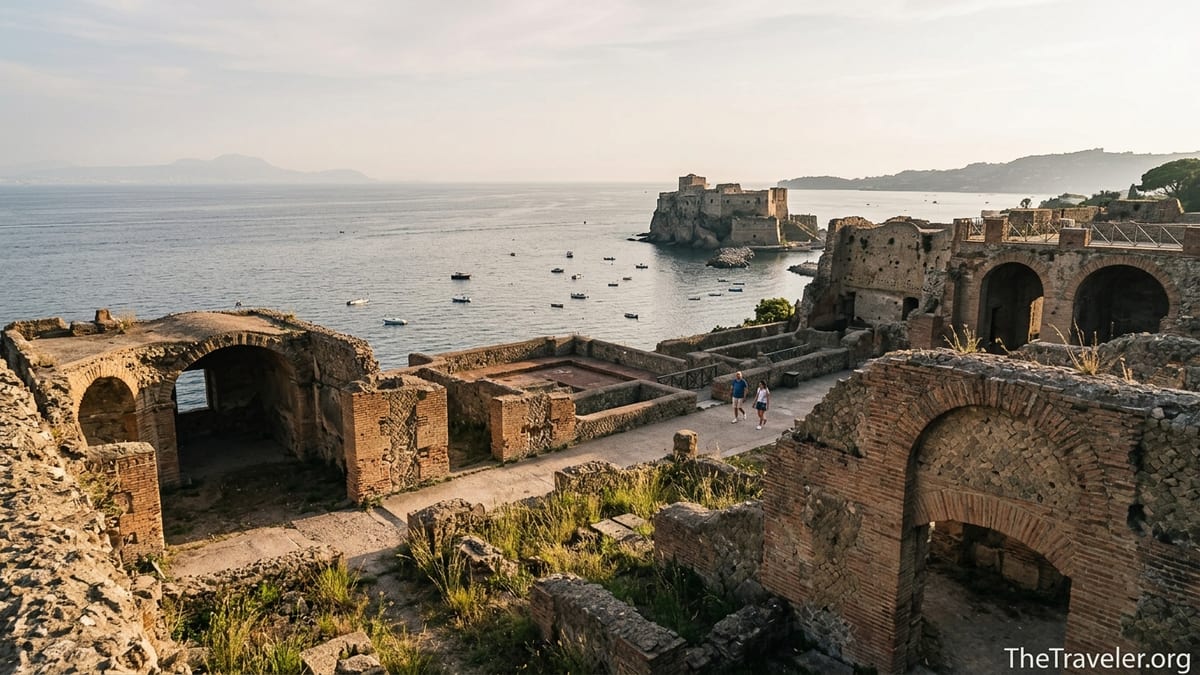
Baiae Archaeological Park, by contrast, is a vast patchwork of ruins spread across hillside terraces and the sea itself. The land portion, known as the Parco archeologico delle Terme di Baia, preserves the remains of luxurious seaside villas and thermal bath complexes where Rome’s elite once escaped to gossip, plot and indulge. Offshore, the Underwater Archaeological Park of Baia protects a sunken district of the ancient resort, now lying at depths of around 5 to 13 meters beneath the waves and explored by snorkelers and divers who glide over mosaics, columns and replica statues resting on the seabed.
For the modern traveler, this means a choice between an intense, almost introspective encounter with Roman engineering at Piscina Mirabilis, and a more varied, day-long experience of architecture, landscape and underwater exploration at Baiae. Deciding which is more impressive depends heavily on what kind of impact you are seeking.
Atmosphere and First Impressions
The way each site reveals itself shapes the visitor experience from the first step. At Piscina Mirabilis, you typically enter via a small, nondescript doorway in a quiet residential street in Bacoli. After a short descent down stone stairs, the space suddenly opens into an immense hall approximately 70 meters long and 25 meters wide, divided by a forest of 48 tall pillars. Shafts of light pour in from roof openings, catching dust motes and streaking across damp stone. Echoes from footsteps and voices bounce off the vaulted ceilings, amplifying the sense of being inside an underground basilica. Many visitors report that this abrupt, theatrical reveal is one of the most haunting experiences of their trip to Campania.
Baiae Archaeological Park offers a more gradual, panoramic impact. Approaching the terrestrial park, you see tiers of ruins climbing the hillside, with views stretching across the bay to the Aragonese Castle of Baia, modern Pozzuoli and, on clear days, as far as Capri. Once inside, the impression builds as you move from one terrace to another: circular domed halls traditionally nicknamed “temples,” grand staircases, hot and cold rooms of thermal baths, fragments of colored marble floors. There is a constant interplay between human-built structures and the volcanic landscape beneath them, from fumarolic vents in the surrounding area to the evidence of bradyseism, the slow rising and sinking of the land that partly submerged ancient Baiae.
For travelers who value raw atmosphere and a single, unforgettable visual moment, Piscina Mirabilis often has the edge. For those who prefer expansive vistas and the feeling of wandering a ruined resort town, Baiae’s park can be more immediately satisfying.
History and Storytelling Power
Both sites pack a historical punch, but they communicate that history in different ways. Piscina Mirabilis is essentially one enormous structure, yet its story connects directly to the logistical backbone of the Roman Empire. Fed by the Augustan aqueduct from the Apennine springs, the cistern stored water for thousands of sailors stationed at Misenum, then the main naval base of the western Mediterranean. Standing among the pillars, you can imagine the reservoir periodically drained and cleaned, crews moving through the dim interior with oil lamps, maintaining the infrastructure that allowed Rome’s fleets to project power across the sea.
Interpretation on site can be limited, although small signs and local guides often explain the basic function and dimensions. Travelers who have done a bit of reading in advance usually find the experience richer. Some local tour operators and guesthouses in Bacoli offer combined walking tours that tie Piscina Mirabilis to other water-related sites nearby, such as ancient cisterns and segments of the aqueduct, helping visitors grasp the scale of Roman hydraulic engineering in the region.
At Baiae Archaeological Park, the narrative revolves less around engineering and more around lifestyle and politics. Ancient Baiae was famed as a playground of the Roman aristocracy, frequented by figures such as Julius Caesar and Nero. The multi-level bath complexes, private sea-view dining rooms and elaborate garden terraces all speak of a place built for pleasure, intrigue and display. Modern interpretive panels in Italian and English guide visitors through specific structures, identifying caldaria and frigidaria in the thermal complexes, pointing out where enormous domes once stood, and explaining how rising sea levels and volcanic subsidence gradually swallowed parts of the town.
This makes Baiae particularly engaging for travelers who like to imagine daily life in the Roman world. You do not need much prior knowledge: the combination of signage, preserved architecture and sea views provides an intuitive sense of how luxurious and precarious life here must have felt.
Accessibility, Logistics and Ticket Costs
Practicalities can strongly influence which site leaves the better overall impression, especially for travelers basing themselves in Naples. Reaching both Bacoli and Baia typically involves a regional train to Pozzuoli followed by a local bus or taxi, or a direct bus from Naples if schedules align. Many visitors also choose to rent a car for a day to explore multiple sites around the Campi Flegrei, including the Flavian Amphitheater in Pozzuoli and the acropolis at Cuma.
Piscina Mirabilis is located in a residential part of Bacoli and historically has had limited, often seasonal opening hours. As of mid 2026, visits typically require checking local tourism portals or contacting the municipality or licensed guides in advance, since access can be by timed entry or guided visit only, and hours sometimes change on short notice. Entry fees are modest compared with major attractions, often in the single-digit euro range per person, or included in small-group tours that might cost from roughly 25 to 50 euros per person for a half-day including other local sites. Because access is through a staircase and the interior floor can be uneven and damp, it is not well suited to travelers with mobility challenges.
Baiae Archaeological Park, by contrast, is fully integrated into the Parco Archeologico dei Campi Flegrei, managed by Italy’s Ministry of Culture. As of recent official information, a standard ticket for the Terme di Baia park is typically under 10 euros. The park also participates in a combined “Circuito Flegreo” pass, roughly 10 euros full price for three consecutive days, which grants access to multiple sites including the Baia park, the Archaeological Museum of Campi Flegrei in the Aragonese Castle, the Cuma archaeological area and the Flavian Amphitheater in Pozzuoli. For value-seekers planning to visit at least two of these places, this pass significantly improves the cost-to-impact ratio.
The underwater section of Baiae must be arranged separately with licensed operators, many of whom are based along the nearby shoreline. A guided snorkeling tour usually costs somewhere in the 35 to 60 euro range per person depending on duration and equipment, while a scuba dive for certified divers often falls between about 70 and 110 euros, including gear rental. For many travelers, this is the most expensive part of a Campi Flegrei day trip, but also the most memorable.
What You Actually See on Site
When comparing impact, it helps to look at the concrete elements each place offers. Inside Piscina Mirabilis, the main sights are structural: the soaring columns, barrel vaults, sediment-stained walls and the play of light and shadow from the roof openings. There are no statues, mosaics or decorative frescoes in situ. The floor is often slightly damp, with shallow puddles after rain that create mirror-like reflections of the pillars. Photographers in particular love the repetition of lines and the way human figures look tiny against the monumental scale. A typical visit might last 20 to 40 minutes; even a very slow wander rarely exceeds an hour, as the space is confined and its power comes less from variety than from immersion in a single overwhelming volume.
Baiae’s terrestrial park, on the other hand, offers a series of distinct architectural experiences. One terrace may feature the remains of a large circular hall often called the “Temple of Venus,” with radial rooms and traces of once-glittering marble revetment. Another area contains recognizable bathing suites: small rooms with suspensurae, the brick pilae that once supported underfloor heating systems, and niches in the walls that held statues. A stroll might take you past collapsed barrel vaults, fragments of stucco decoration, and long staircases that once connected private villas to lower sea-level gardens, now partly underwater. The variety means many travelers spend between 1.5 and 3 hours inside the park alone, not counting museum visits or underwater activities.
Offshore, the Underwater Archaeological Park of Baia presents yet another layer of experience. Snorkelers and divers glide over preserved portions of streets, columns, sections of villa perimeters and patterned floor mosaics, including black and white geometric designs that are startlingly crisp in clear conditions. Many of the statues visible underwater are modern replicas, while original sculptures found here are displayed in the Archaeological Museum of Campi Flegrei in the Aragonese Castle above. Still, the combined effect of ancient stonework, seagrass meadows and natural sunlight filtering through the water creates a surreal feeling of floating through a drowned neighborhood.
Visitor Experience: Crowds, Comfort and Seasonality
In terms of visitor comfort, Piscina Mirabilis offers a mixed picture. On the positive side, it tends to attract far fewer people than better-known sites such as Pompeii or Herculaneum. Even in high summer, you may share the cistern with only a handful of other travelers or a small tour group, which intensifies the sense of discovery. The underground setting stays noticeably cooler than the outside air, a welcome relief on hot days in July and August. However, the entrance area is simple, with minimal facilities close by, and you will need to plan restroom and refreshment breaks elsewhere in Bacoli, such as along the waterfront or near the town center.
Baiae Archaeological Park receives more visitors overall, but still far fewer than headline sites along the Bay of Naples. In shoulder seasons like April, May, late September and October, it is possible to wander for long stretches almost alone, especially in the higher terraces. The trade-off is exposure: much of the park is fully open to the sun, and in summer months the stone can radiate heat. Bringing water, a hat and sunscreen is essential. The park entrance area offers basic ticketing and usually access to restrooms, and the nearby town of Baia and the marina have cafés, gelaterias and restaurants for a post-visit meal.
Seasonality plays a more complex role for the underwater park. Calm seas and good visibility are more common from late spring through early autumn, though exact conditions vary with weather. Dive operators may reduce or pause trips during winter or rough seas. For snorkelers and divers, visiting between roughly June and early October often yields the best experience, while land-based visits to Baiae and Piscina Mirabilis are pleasant from early spring to late autumn, avoiding only the most intense midday heat of high summer where possible.
Who Will Be More Impressed by Each Site
Not every traveler is looking for the same kind of impact, and understanding the strengths of each site can help match them to different travel styles. Piscina Mirabilis tends to resonate most with visitors who appreciate engineering, minimalism and contemplative spaces. Architects, photographers and travelers who enjoy exploring off-the-beaten-path locations often describe it as the highlight of their time in the Campi Flegrei. Because the site is compact and focused, it also works well for those who tire quickly of large ruins but still want one powerful, unusual ancient experience.
Baiae Archaeological Park, by contrast, is ideal for travelers who enjoy variety and narrative. History enthusiasts can spend hours tracing the outlines of villas and reconstructing how the Romans used each space. Families often appreciate that children can roam relatively freely along paths and terraces, turning the visit into a mini adventure with changing viewpoints and features. Active travelers who add a snorkeling or diving trip to the underwater park gain a sense of having “discovered” a lost city beneath the waves, something that feels very different from walking through a land-based ruin.
Time and budget also matter. If you only have half a day, lack a car and prefer a single, undemanding highlight, Piscina Mirabilis can be deeply rewarding despite its small footprint, especially when paired with a casual lunch along the Bacoli waterfront. If you have a full day and can invest in both park tickets and an underwater excursion, Baiae offers a more layered experience that many travelers rank alongside Pompeii and Herculaneum in terms of lasting memories.
The Takeaway
So which ancient site leaves the bigger impression: Piscina Mirabilis or Baiae Archaeological Park? In purely emotional terms, many visitors find that the first glimpse of Piscina Mirabilis, with its towering columns and shafts of light in a cavernous underground hall, is more immediately jaw-dropping. It is a singular, almost otherworldly encounter with Roman engineering, and because relatively few tourists make it there, it retains a potent sense of discovery.
Yet if “bigger impression” is measured over the course of a full day, Baiae Archaeological Park often wins. The combination of terraced bath complexes, sweeping coastal views, the nearby archaeological museum in the Aragonese Castle and the option to swim or dive through a submerged quarter of the ancient resort creates a richly layered experience that keeps unfolding. The site tells a wider story of luxury, geology and time, from the high politics of Roman elites to the slow sinking of the shoreline under volcanic forces.
For travelers able to do both, the ideal approach is to treat them as complementary rather than competing: start with the cool, silent grandeur of Piscina Mirabilis in the morning, then move on to the sunlit terraces and underwater ruins of Baiae in the afternoon. If you must choose one, opt for Piscina Mirabilis if you are drawn to monumental structures and quiet, atmospheric spaces, and choose Baiae if you prefer variety, views and the chance to float above Roman mosaics in the clear waters of the Tyrrhenian Sea.
FAQ
Q1. Is Piscina Mirabilis or Baiae easier to visit from Naples without a car?
Both are reachable by public transport, usually via train to Pozzuoli and then a local bus or taxi, but Baiae’s archaeological park tends to have more predictable hours and clearer visitor information, making it somewhat easier for first-time visitors relying only on public transport.
Q2. Which site is better if I only have two or three hours?
If your time is very limited, Piscina Mirabilis offers a powerful experience in a short visit, often under an hour, leaving time for a stroll or meal in Bacoli, while Baiae’s park rewards a longer wander and may feel rushed in under two hours.
Q3. Do I need to book in advance for Piscina Mirabilis?
Because opening hours can change and access is sometimes organized through guided visits or time slots, it is wise to check current information shortly before your trip, and consider contacting local tourism offices or guides to confirm if reservations are needed on your chosen day.
Q4. Can non-divers experience the underwater ruins at Baiae?
Yes, several licensed operators offer guided snorkeling trips that do not require scuba certification, providing flotation equipment and masks so that even beginners can drift above mosaics, columns and submerged structures in shallow water.
Q5. Is either site suitable for travelers with limited mobility?
Piscina Mirabilis involves descending and climbing a staircase and walking on uneven, sometimes damp flooring, which can be challenging, while Baiae’s park has sloping paths and terraces with steps; travelers with mobility concerns may wish to consult the park in advance and focus on the more accessible upper areas.
Q6. How do the costs compare between the two sites?
Piscina Mirabilis typically has a modest standalone entry fee or is included in small guided tours, whereas Baiae’s park is covered by an inexpensive official ticket and can be part of a combined pass, though adding a snorkeling or diving excursion at Baiae significantly increases the overall cost.
Q7. Which site is better for photography?
Piscina Mirabilis excels for atmospheric interior shots with repeating columns, light beams and reflections, while Baiae offers sweeping coastal panoramas, varied ruins and, for those with underwater housings or operator-provided cameras, unique images of submerged Roman remains.
Q8. Are there good places to eat nearby after visiting?
Yes, Bacoli’s waterfront has cafés, pizzerias and seafood restaurants within a short drive or walk from Piscina Mirabilis, and the marina area around Baia likewise offers several options for coffee, gelato and sit-down meals overlooking the harbor.
Q9. Is it safe to visit given the volcanic activity in the Campi Flegrei?
The area is closely monitored by Italian authorities and visits proceed under official safety guidelines; travelers should simply verify current advisories from local or national sources before traveling, just as they would when visiting other volcanically active regions.
Q10. If I am already visiting Pompeii and Herculaneum, is it still worth adding one of these sites?
Yes, both Piscina Mirabilis and Baiae show different aspects of Roman life than the buried cities: Piscina highlights large-scale water engineering, while Baiae focuses on elite leisure culture and the interplay between archaeology and an active volcanic landscape, making them rewarding additions to a broader Bay of Naples itinerary.