


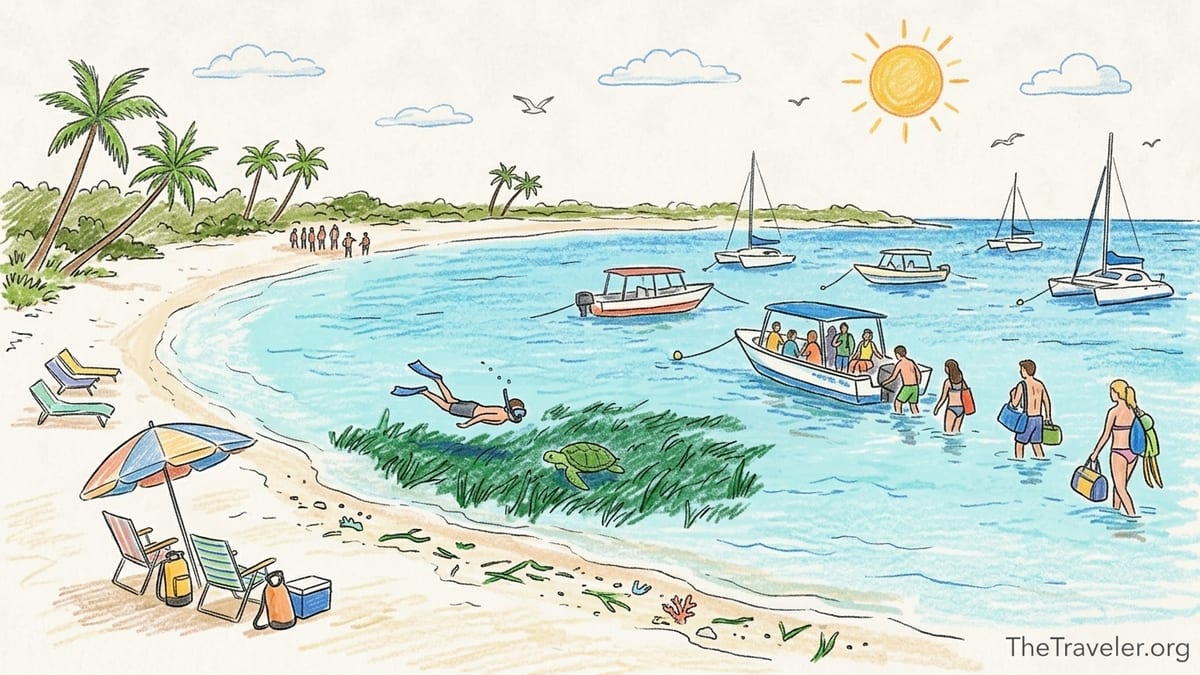
I stepped off the water taxi into the shallows of Playa Tortuga on Culebrita with my dry bag held high and no dock in sight. The captain had cut the engine inside the broad turquoise bay, dropped anchor just offshore, and pointed us toward a curve of white sand that looked almost unreal. In that moment it became clear: this was not a resort beach. It was a wild landing on a small cay inside the Culebra National Wildlife Refuge, famous for sea turtles and clear water, and we were going to experience it on nature’s terms, without facilities, walkways, or guarantees of wildlife.
Get the latest updates straight to your inbox!
Getting There: The Final Approach Into Playa Tortuga
Reaching Playa Tortuga starts long before your feet touch the sand. From the main island of Culebra, I joined a small-group water taxi that specializes in day trips to Culebrita, the uninhabited cay east of Culebra proper. Operators such as H2O Water Taxi, Gammy’s Water Tours and Sea Culebra now market Tortuga Beach as the centerpiece of a Culebrita visit, often packaging it as a five to six hour outing with beach chairs, umbrellas and basic snorkel gear included. Recent travelers report prices in the ballpark of 50 to 75 dollars per person for bare-bones water taxis from Culebra, and higher for full catamaran excursions from Fajardo or Ceiba that include lunch and open bar.
On the day I went, the captain timed our departure for mid-morning to avoid the roughest seas in the Luis Peña Channel. The ride from Culebra town to Culebrita took roughly 25 to 30 minutes in moderate chop. As we rounded the western tip of Culebrita and slipped into Bahia Tortuga, the mood on the boat changed. The water turned a calmer, almost milky turquoise, and Playa Tortuga’s long arc of pale sand came into view, backed by low scrub and a few leaning palms. Boats were already anchored in a loose line, bow pointing toward shore, with maybe a dozen people visible on the beach.
There is no pier here. Our captain anchored in about three to four meters of water, swung the bow toward the beach, and explained that we would wade ashore. He passed down dry bags, small coolers and beach chairs one by one. The last step from the swim ladder was a shock of clear, cool water at hip depth. Within a few seconds the sand under my feet changed from rippled, shell-flecked patches to a fine, almost powdery texture as I walked toward shore.
Because Culebrita lies inside the Culebra National Wildlife Refuge, access is by private or chartered boat only. There is no ferry, no scheduled public transport and no camping allowed. The refuge allows public use on Culebrita and nearby Luis Peña but keeps many other cays closed to protect sensitive habitats. That means every person you see on Playa Tortuga has arrived by boat and will leave the same way, which shapes the crowd patterns and the feel of the place throughout the day.
First Impressions: Sand Underfoot, Shade Onshore
My first impression of Playa Tortuga came through my feet. Once I stepped out of the shallows and onto dry sand, I realized just how soft this beach is. The sand here is a very pale, almost white beige, made up of finely broken coral and shell fragments. It is far softer than the coarser, more golden sand you feel on some mainland Puerto Rico beaches. Walking barefoot, my heels sank a few centimeters with each step, giving that slow, cushiony feel that makes even a short stroll feel leisurely.
Closer to the waterline, the sand is more compact. Small pieces of coral, sea grass and occasional shells are scattered in a narrow band, but it never felt sharp or uncomfortable underfoot. A few patches of dried seagrass accumulated along the high-tide line, evidence of the seagrass meadows offshore that feed the turtles this bay is known for. If you walk toward either end of the beach, the sand becomes slightly more mixed with small pebbles and larger shell fragments, though it stays easily walkable barefoot.
Shade on Playa Tortuga is precious. Along the central stretch of the beach, there are only a handful of low trees and palms close enough to the sand to cast meaningful shade around midday, and several were already claimed by early arrivals when we landed. Our captain set up collapsible umbrellas behind the main cluster of towels to create a base camp. Without that shade, spending several hours here would mean continuous exposure to sun reflected off both water and pale sand.
Behind the upper beach, sparse coastal vegetation and low shrubs give way to sandy paths leading inland toward the lighthouse trail and the so-called “jacuzzi” tide pools on the opposite side of the cay. Those paths provide brief shade as you walk, but the main swimming and landing area itself is mostly open. If your operator does not provide umbrellas, expect to create your own shade with a beach tent or to retreat periodically to the boat.
Water Depth, Swimming Feel, And Where The Boats Sit
From the sand to about 15 or 20 meters out, Playa Tortuga offers one of the most forgiving entry zones I have experienced in the Caribbean. The nearshore bottom slopes gradually, with knee-deep water extending five to ten meters from the high-tide line depending on the tide. At about waist depth the bottom is still soft sand with some scattered seagrass sprigs, and the visibility on my visit was well over 15 meters. Children in life jackets splashed comfortably in the first few meters of shallows while adults floated just beyond them.
By the time you reach chest to shoulder depth for an average adult, you are approaching the zone where most water taxis and small catamarans anchor. On my visit, the captains generally kept their boats in roughly three to four meters of water, far enough off the beach to avoid crowding swimmers but close enough that guests who were comfortable in the water could swim back and forth. One of the water taxi crews ran a small, tethered float that skittish swimmers could hold while shuttling from boat to beach.
Swimming here feels like being inside a sheltered pool with a living floor. Bahia Tortuga is oriented and shaped in a way that reduces large swell under typical conditions, so the surface chop inside the bay is usually limited to small wind waves. On our day, the breeze ruffled the surface but never created strong currents along the beach. I could swim parallel to shore with almost no sideways drift and float effortlessly over changing bands of seagrass and sand. Several times I stopped moving altogether and simply hung there, suspended in clear water while small schools of fish passed below.
Anchoring practices matter here because the bay’s seagrass beds are important habitat for green sea turtles. Some tour operators now use mooring lines when available or try to drop anchors in sandy patches to minimize damage to seagrass. The refuge and conservation groups have flagged boat groundings and anchor scars as ongoing concerns. As a guest, you will not be placing the anchor yourself, but choosing operators who talk openly about respecting seagrass and turtles, and who do not ask you to stand on coral or seagrass, is one way to support better habits in the bay.
Snorkeling From The Main Landing Area
Most visitors think of Playa Tortuga primarily as a lounging beach, but I began snorkeling right from the main landing zone where our boat dropped us. With my mask and fins on, I slipped into the water just off our beach base and kicked out slowly toward the line of anchored boats. The first few meters were almost entirely sand, with scattered tufts of short seagrass. Visibility was high enough that I could easily see the shadow of each boat hull above and the pale patchwork of sand and grass below.
As I moved farther from shore, the bottom shifted into more consistent seagrass beds. These meadows are what give the bay its turtle reputation. The grass swayed in the gentle surge like a field of underwater wheat, and small fish hovered in the blades. I kept my fins high, focusing on a slow, horizontal kick so I would not dig into the grass. Our guide had been explicit about this on the boat: do not stand in seagrass, do not chase turtles, and do not reach out to touch anything larger than you.
To one side of the main landing area, closer to the rocky edges of the bay, the seagrass gave way to more mixed bottom with patches of hard substrate and low coral heads. Here the snorkeling became more colorful. I spotted blue tangs, parrotfish, a small barracuda and clusters of sergeant majors. A few kids on our boat preferred this area because they could see “reef” instead of just grass, even though the real importance of Playa Tortuga lies in its role as a turtle feeding ground rather than as a dramatic coral garden.
Several excursions from Fajardo and Ceiba split their day between a reef snorkel stop elsewhere in Culebra’s marine reserves and a relaxed swim or snorkel session at Playa Tortuga. That means if you are booked on a full-day catamaran tour, Playa Tortuga often functions as the mellow, second half of the day, where you can choose between snorkeling, floating with a drink, or simply stretching out on the sand for a nap.
Sea Turtles: What I Actually Saw In The Water
The question everyone asked on the boat ride out was the same: will we see turtles. The honest answer is that sightings are possible but never guaranteed. According to the U.S. Fish & Wildlife Service, the Culebra National Wildlife Refuge protects important nesting and feeding habitat for endangered hawksbill and green sea turtles across Culebra’s beaches and seagrass beds, including those around Culebrita. That ecological importance is real, but it does not translate into a scheduled wildlife encounter.
When I finally saw my first turtle at Playa Tortuga, it happened without any buildup. I was drifting over a dense seagrass patch in three to four meters of water when a green turtle glided into view below me, already busy grazing. Its shell matched the deep olive of the grass, and I might have missed it if a guide from another boat had not raised a hand, palm down, and signaled for everyone nearby to float still. The turtle rose slowly toward the surface, paused just below me for a breath, and then descended again to continue feeding. The entire interaction lasted maybe 30 seconds.
Later, during another snorkel session, I saw two more turtles at a distance, both moving along the edge of a seagrass band toward the center of the bay. Other guests on nearby boats reported seeing none at all that day, even though we had all spent roughly the same amount of time in the water. On a different week, a review from another traveler described having “five or six sea turtles coming up for air” in the late afternoon calm, while one of the captains mentioned occasional days when conditions, boat traffic or simple chance meant he saw no turtles with his guests.
What became clear is that your chances improve if you treat turtles as a bonus rather than a checklist item and if you spend unhurried time floating quietly above seagrass rather than darting from place to place. Guides increasingly emphasize a hands-off approach: stay several meters away, keep your fins high, never attempt to touch or feed turtles, and move slowly. Playa Tortuga is a feeding ground inside a protected refuge, not an amusement park, and the wellbeing of those endangered hawksbill and green turtles comes before visitor excitement.
Hours On A Beach With No Facilities
One of the defining realities of Playa Tortuga is the complete lack of built facilities. There are no bathrooms, kiosks, lifeguards, showers, or trash cans on Culebrita. On my visit, the last restroom stop was at the Culebra dock just before boarding the water taxi. The moment we stepped onto the beach, our group accepted that we were in a place where whatever we brought was all we would have for the next four to five hours.
That absence shapes the rhythm of the day. People hydrate carefully, pace their drinks and snacks, and find semi-private thickets behind the dune vegetation when nature inevitably calls. Operators explicitly warn about this beforehand, and some recent guests on organized tours have emphasized in their comments how important it is to plan around the lack of restrooms. For families with small children or travelers with medical needs, this can be the deciding factor between loving the experience and feeling stressed the entire time.
The upside is a beach experience that feels uncommercial in a way that is increasingly rare. No one approached us trying to sell snorkeling tours, coconut drinks or bracelets. There was no music except what drifted over the water from a few boats. The only regular sounds were waves on the sand, the low thud of boats swinging on their anchors, and occasional laughter from groups in the shallows. Over the course of several hours, I saw people settle into a quiet rotation: swim, rest in the shade, walk the beach, swim again, then perhaps take the trail toward the lighthouse or the tide pools before returning for one last float in the bay.
Still, going facility-free requires preparation. I brought a large bottle of water, a smaller sports drink, high-SPF reef-safe sunscreen, a wide-brim hat, snacks that would not melt in the heat and a lightweight sarong that doubled as a towel and sun cover. Our captain supplied a cooler with ice, simple sandwiches and fresh fruit, but those items disappeared quickly in the midday heat. By the time the boat horn sounded to gather everyone for the ride back, I understood why guides insist that Culebrita is beautiful but not for travelers expecting resort infrastructure.
Leaving Belongings On A Wild Beach
With no kiosks, lockers or formal ranger presence on the sand, where you leave your belongings at Playa Tortuga becomes a practical question. On arrival, our group established a shared base on the upper part of the beach, just beyond the damp line left by the morning tide. The captain planted two small umbrellas there and suggested we cluster our towels, backpacks and dry bags in their shade, creating a visible “island” of gear that would stay above any midday tide push.
Throughout the day, people naturally took turns staying closer to the pile. When half the group went snorkeling, a few others lingered under the umbrellas reading, napping, or simply watching the bay. There was no formal rotation, just an unspoken agreement that it felt better to have eyes on the bags while the rest of us were in the water. This is common practice on many Culebra-area beaches: petty theft is not rampant, but smart travelers avoid leaving high-value items unattended.
I kept my passport, main cash and cards in a waterproof pouch that stayed either on my body or in a small dry bag clipped to a chair within our group area. My phone traveled inside a budget waterproof case on a lanyard when I snorkeled and lived in the shade the rest of the time. Other guests took different approaches, from leaving everything on the boat and swimming ashore with only a towel to bringing minimal gear and accepting that a bit of sand and salt might end up on their belongings.
Because Playa Tortuga functions as a sort of temporary village formed by small groups from different boats, a sense of shared responsibility tends to emerge. Captains know one another, and many run the same routes day after day. That said, basic common sense applies. I would not lay a stack of high-end camera bodies or loose cash on a towel and disappear for two hours. A combination of group awareness, strategic packing and keeping true essentials on your person makes it easy to relax here without worrying constantly about your things.
The Feel Of The Day: Crowds, Quiet Moments, And Weather
The character of Playa Tortuga shifts hour by hour. When we arrived mid-morning, there were perhaps four other boats in the bay. By late morning, around what felt like the busiest point of the day, I counted roughly a dozen vessels: a couple of larger catamarans from the main island of Puerto Rico, several mid-sized center-console boats, and a handful of smaller water taxis from Culebra. That translated to somewhere between 60 and 100 people spread along a remarkably long beach, enough to feel lively but far from packed.
Most groups naturally clustered near where their boats anchored. This left long stretches of sand between pockets of people, especially toward the eastern and western ends of the bay. Walking ten minutes down the beach in either direction brought me into spots where I could stand alone with nothing but footprints around me. At those edges, the sounds of conversation fell away and the dominant sensation was simply wind on skin and the repetitive crash and hiss of small waves on sand.
Weather dictates much of the experience. On calmer days, the bay is glassy, and boats anchor slightly closer together. When winds pick up, captains may choose to anchor farther out or even change which side of the cay they use, but Playa Tortuga remains the primary draw in settled conditions. Seasonal changes in sea state and sargassum can also influence where offshore tours from Fajardo or Ceiba choose to land; in some recent cases, operators have shifted from Flamenco Beach on Culebra to Playa Tortuga on Culebrita when conditions on Flamenco were less favorable.
By mid-afternoon on my visit, a gradual exodus began. The bigger catamarans fired up their engines first, lifting anchors and threading out of the bay. Smaller boats followed, and with each departure the beach grew quieter. Our captain intentionally scheduled our return on the later side, giving us a final hour with only two other boats in the cove. This was when Playa Tortuga felt most like a refuge beach: long stretches of empty sand, low sun slanting across the water, and, for a few lucky snorkelers drifting quietly over the grass, another chance to glimpse turtles heading toward deeper water.
The Takeaway
At the end of the day, what struck me most about Playa Tortuga on Culebrita was how clearly it belonged to the refuge rather than to tourism. The U.S. Fish & Wildlife Service manages the Culebra National Wildlife Refuge as critical habitat for species like hawksbill and green sea turtles, coastal birds and rare reptiles, and Playa Tortuga’s seagrass beds and surrounding beaches form part of that living network. Local captains and water-taxi operators have, in turn, made this bay the emotional centerpiece of their Culebrita trips, selling it accurately as one of the most beautiful beaches in the region while learning, sometimes slowly, how to operate within the needs of a protected area.
If you arrive expecting a curated, resort-style experience with facilities, shops and guaranteed wildlife, you will be disappointed. What you actually find at Playa Tortuga is soft white sand that squeaks underfoot, calm clear water that invites long, lazy swims, and a bay where turtles may or may not glide below you as you float over seagrass. Hours here are shaped by simple rhythms: the sound of waves, the movement of boats on their anchors, the passing of clouds that briefly soften the sun. You carry in what you need, carry out what you brought, and share the beach with whoever arrives by boat that day.
The real reward is the feeling you take home when the water taxi finally pulls away and the beach shrinks behind you. For a few hours, you stepped into a quieter zone of the Caribbean, one where the absence of infrastructure and the possibility, not promise, of seeing turtles kept the focus squarely on the place itself. Playa Tortuga is not easy to reach, and it asks you to adapt to its terms, but for travelers willing to do that, it offers one of the most memorable beach landings in Puerto Rico.
FAQ
Q1. How do you get to Playa Tortuga on Culebrita?
Most visitors reach Playa Tortuga by booking a water taxi or boat tour from Culebra, or a full-day catamaran trip from Fajardo or Ceiba that includes a stop at Culebrita.
Q2. Are there bathrooms or facilities at Playa Tortuga?
No. There are no restrooms, shops, lifeguards, trash cans or built facilities on Culebrita, so you must plan ahead and be fully self-sufficient for several hours.
Q3. Is Playa Tortuga good for beginner swimmers and children?
The beach has a gentle, sandy entry and usually calm water inside the bay, which many families find suitable, but children and weaker swimmers should always use flotation and stay close to adults.
Q4. Can you snorkel directly from the main beach area?
Yes. You can swim out from the main landing area into shallow seagrass beds and mixed bottom, where you will see fish and may have a chance of spotting sea turtles.
Q5. Are you guaranteed to see sea turtles at Playa Tortuga?
No. Playa Tortuga lies in important turtle feeding habitat and sightings are common, but sea turtles are wild animals, so encounters are never guaranteed on any given visit.
Q6. What should you bring for a day at Playa Tortuga?
Bring plenty of water, reef-safe sunscreen, sun protection, snacks, a towel or sarong, any medications you need, and a waterproof way to carry essentials like cash and a phone.
Q7. Is it safe to leave belongings on the beach while you swim?
Most groups create a shared base area under umbrellas and take turns staying nearby, but you should keep passports, main cash and electronics with you or secured on the boat.
Q8. Are there shaded areas on the beach?
Natural shade is limited to a few small trees along the upper beach, so many visitors rely on umbrellas or small beach tents provided by their tour operator or brought from Culebra.
Q9. Can you buy food or drinks on Culebrita?
No. There are no vendors on Culebrita. Some tours include lunch and drinks, but otherwise you must bring all food and beverages with you and pack out your trash.
Q10. Do you need special permission to visit Culebrita?
Individual visitors do not usually need special permits when arriving with licensed operators, but the island is part of the Culebra National Wildlife Refuge and subject to refuge rules that protect wildlife and habitats.