


More news on this day
Poland has become one of the first Schengen states to fully activate Europe’s new biometric Entry/Exit System at all border crossings, marking a significant tightening of digital screening for millions of non-EU travelers from countries including the United Kingdom, Canada, Brazil, Mexico and India.
Get the latest news straight to your inbox!
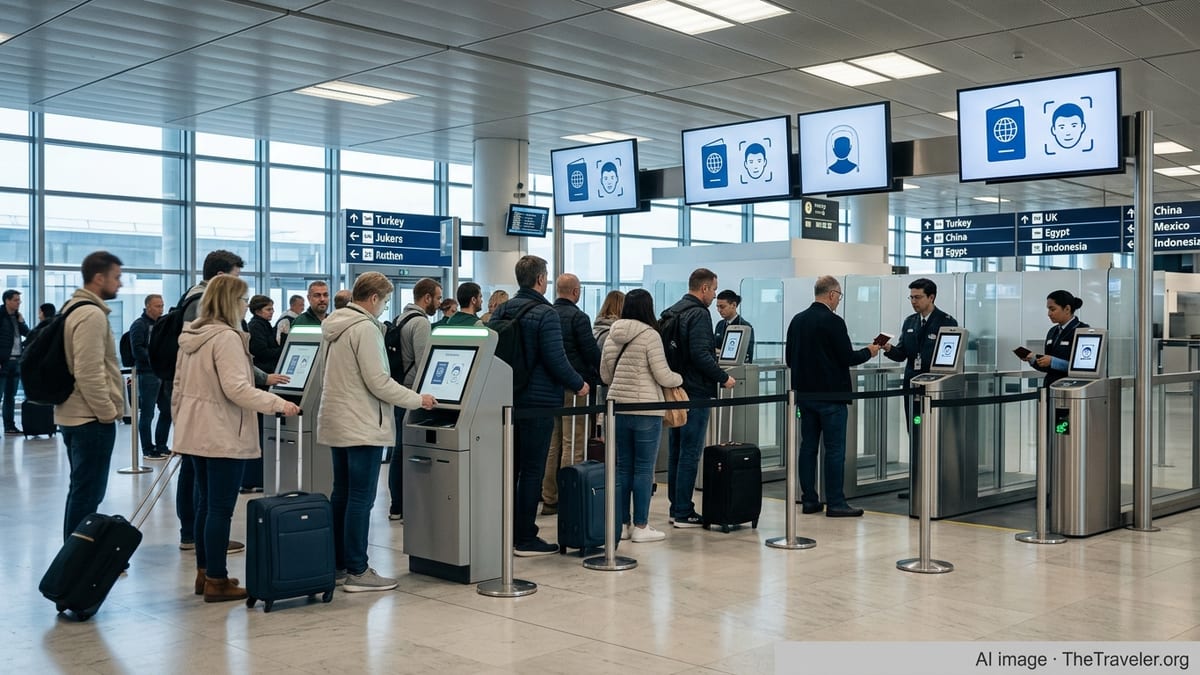
Poland’s Nationwide Rollout Caps Europe’s Shift To Biometric Borders
Publicly available information from Polish government channels and regional media indicates that, as of 10 April 2026, the Entry/Exit System is operational at all Polish air, land and sea borders. The move follows an 18‑month transition that began with pilot deployment at Warsaw Chopin Airport in late 2025 and places Poland in the vanguard of countries applying the new rules across the Schengen area.
The Entry/Exit System is a large-scale EU information platform designed to register non-EU nationals each time they cross the external borders of 29 participating European states, replacing manual passport stamps with electronic records. The system captures biographic data alongside fingerprints and facial images at the first encounter, then uses those records for subsequent crossings within a defined period.
European Commission briefings describe the technology as a way to strengthen border security while automating the enforcement of the long-standing 90‑days‑in‑any‑180‑day limit on short stays. It also creates a shared database that can be accessed by border agencies across the Schengen zone, allowing travel histories to be checked more quickly when a traveler moves between member countries.
Poland’s full activation means that travelers entering the Schengen area for the first time through Polish airports or land crossings will now go through the new biometric process, joining a growing list of states such as Italy, Denmark, Iceland, Germany, France and Hungary that have progressively switched their border booths to the digital scheme since its phased launch in October 2025.
Who Is Affected: UK, Canada, Brazil, Mexico, India And Other Visa‑Exempt Travelers
The new controls do not introduce a visa requirement, but they do fundamentally change how journeys are recorded for non-EU visitors. The system applies to so‑called “third‑country nationals” coming for short stays who previously received a simple passport stamp, including tourists and business travelers from the United Kingdom, Canada, Brazil, Mexico, India and dozens of other visa‑exempt countries.
For these travelers, the first entry to a Schengen external border under the new regime typically involves a one‑off biometric enrolment process. Border officers collect four fingerprints and a facial image, which are then stored together with passport details in the central database. Subsequent crossings within the data retention period are expected to be faster, as the system can verify the traveler against existing records.
Travel industry analyses in outlets such as Forbes and The Independent have highlighted that British travelers are among the largest groups affected, given the scale of UK leisure and business travel to destinations like France, Spain, Italy and, increasingly, Poland. Visitors from large markets including Canada and Brazil are expected to encounter similar procedures at automated gates or staffed booths when entering through participating airports and seaports.
Nationals of countries that already require a Schengen visa will also see their movements digitized, though many of their fingerprints are already collected during the visa application process. The Entry/Exit System adds automated recording of the exact date and border crossing point of each entry and exit, allowing authorities to detect overstays in real time rather than relying on manual checks of passport stamps.
Operational Impact: Longer Queues Now, Faster Crossings Later
While EU institutions promote the new system as a way to speed up border checks over the long term, early reports from airports where the technology has been piloted point to an initial period of disruption. Travel advisories and first‑hand accounts from Warsaw and other hubs describe significantly longer queues at non‑EU lines as staff guide passengers through fingerprint and facial capture for the first time.
The European Commission has acknowledged this adjustment phase and launched an information campaign using posters, videos and online materials to prepare travelers for the change. Carriers and travel agencies have been encouraged to inform passengers in advance that they may need extra time at departure or arrival, particularly during the first months of full implementation and at peak holiday periods.
Border experts note that the system is designed to deliver benefits once most frequent travelers have enrolled and as automated gates become more widely available. At that point, many non‑EU nationals with a valid biometric record could see faster processing, since their details will already be pre‑registered and verified by the system before they reach the front of the queue.
In Poland’s case, the country’s position on key overland routes between Western Europe and Ukraine, Belarus and the Baltic states adds an extra layer of complexity. The new digital checks now sit alongside heightened physical security measures that Poland has introduced on parts of its eastern frontier in recent years, creating a dense web of both electronic and on‑the‑ground controls.
Part Of A Broader European Tightening Of Schengen Travel
Poland’s move fits into a wider European trend of tightening border management within the Schengen framework. Alongside states such as Italy, Denmark, Iceland, Germany, France and Hungary, Poland has periodically reintroduced temporary internal border checks in response to migration pressures and regional security concerns, even as the core principle of passport‑free movement within Schengen formally remains.
The Entry/Exit System adds a new external layer to that trend by giving national authorities a shared digital tool to track who enters and leaves the bloc. According to published European Parliament and Council documents, the system is meant to reduce identity fraud, improve the detection of people travelling on fraudulent documents and provide more reliable statistics on irregular migration.
Analysts point out that the new database also aligns Europe more closely with long‑standing practices in countries such as the United States and, more recently, the United Kingdom, which have developed their own electronic travel authorisation and border data systems. The EU’s version, however, is being rolled out simultaneously across more than two dozen countries that share a common travel area, a scale that has contributed to repeated technical and political delays.
For travelers, the main immediate consequence is a more structured and traceable record of every crossing into and out of the Schengen zone. This is expected to limit the scope for informally extending stays beyond 90 days in any 180‑day period by moving in and out of different member states, since all entries and exits are now recorded in one shared system.
Next Steps: ETIAS Travel Clearance On The Horizon
The biometric border database is only one part of a broader overhaul of how non‑EU visitors access the Schengen area. EU communications and specialist immigration law briefings indicate that, once the Entry/Exit System is fully stable, it is expected to be followed by the long‑planned European Travel Information and Authorisation System, or ETIAS.
ETIAS will function in a manner similar to the United States ESTA or the UK Electronic Travel Authorisation, requiring visa‑exempt travelers from countries such as the UK, Canada, Brazil, Mexico and many others to apply online in advance of their trip, pay a small fee and receive a digital clearance linked to their passport. Current planning documents suggest that ETIAS will start no earlier than late 2026, at least six months after the biometric system is fully operational.
Travel industry observers note that, taken together, these changes amount to the most far‑reaching transformation of Europe’s external borders in decades. For now, the key immediate shift is the move from ink stamps to a biometric database at Schengen frontiers, with Poland’s rapid and comprehensive adoption underscoring how quickly the new model is becoming the norm across much of the continent.