


Schooling is a decisive factor for many families assessing a move to Portugal. The choice between public, private and international schools determines not only children’s educational trajectory but also integration prospects, language acquisition speed and long-term relocation viability. This briefing compares Portuguese public and private options from an expat perspective, highlighting structures, language realities, academic expectations and typical costs to support informed decision making.
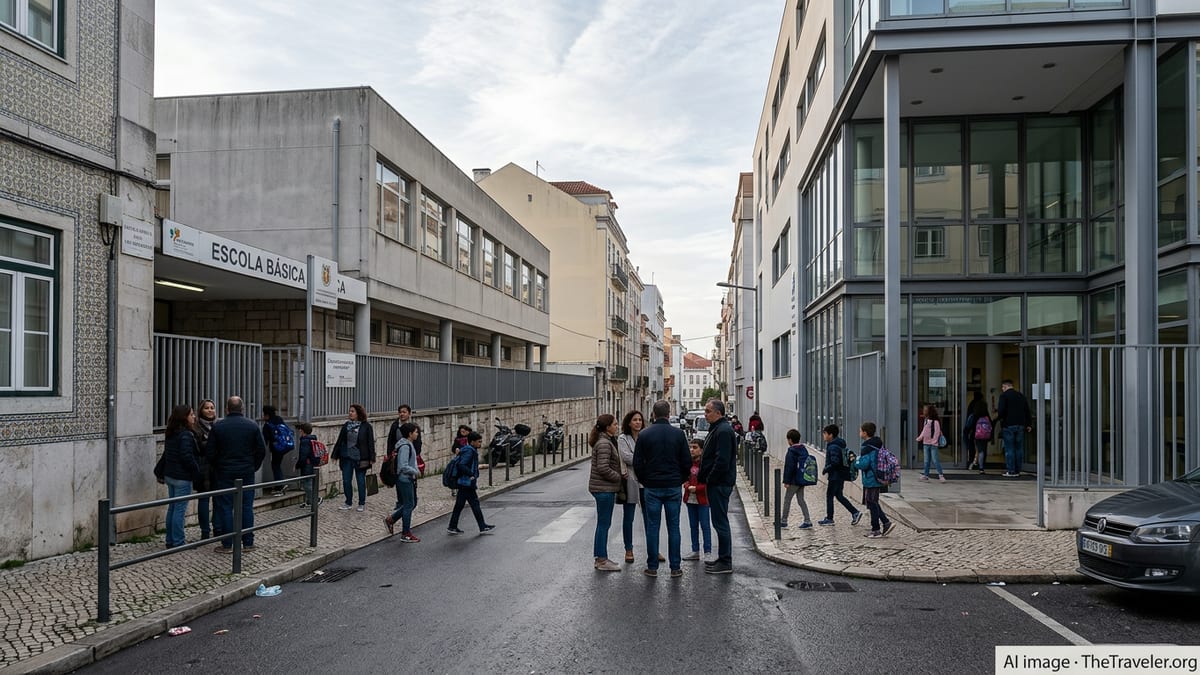
Structure of the Portuguese School System Relevant to Expats
Portugal’s school system is divided into pre-school (ages 3 to 5, optional), basic education (ages 6 to 15, grades 1 to 9) and secondary education (ages 15 to 18, grades 10 to 12). Compulsory education runs from age 6 to 18, regardless of nationality or residence status. Public schools follow a unified national curriculum overseen by the Ministry of Education, while private and international schools may offer national, foreign or international curricula, but still operate under Portuguese regulatory oversight for accreditation and exams in the national stream.
Public education is the default pathway for most Portuguese families and educates the majority of students. Recent Ministry of Education data for the 2023/24 year indicate approximately 1.27 million pupils in the public network compared with roughly 0.33 million in the private network, underlining public schools as the core of the system. Government dependent private schools, which receive subsidies in exchange for following the national curriculum and fee caps, sit between fully public and fully independent private institutions and can be relevant in areas with limited public capacity.
For expats, the main structural question is whether the child will follow the Portuguese curriculum in Portuguese (typically via public or national private schools) or a foreign curriculum such as British, American, French or International Baccalaureate, delivered in English or another language in international schools. This structural choice strongly determines future higher education options, language proficiency outcomes and the degree of integration into Portuguese society.
International schools are concentrated in Lisbon, Porto and the Algarve, with a smaller presence in other regions and Madeira. Availability is more limited in interior regions, where public schools and a small number of Catholic or other private schools dominate. Families relocating outside major metropolitan areas often find the practical choice narrows significantly toward public education, unless willing to commute long distances.
Language of Instruction and Integration Considerations
Language is often the most decisive differentiator between public and private options for foreign families. Public schools teach almost entirely in Portuguese, with foreign language subjects such as English, French or Spanish introduced progressively from primary level. While some public schools offer “Portuguese as a non native language” support classes for foreign students, availability depends on local demand and staffing, and implementation quality varies across regions.
Non Portuguese speaking children entering the public system at later grades, particularly from grade 5 onward, can struggle to access the curriculum until they reach intermediate language proficiency. Anecdotal evidence from expat communities suggests that while some schools provide strong support, others lack structured programs, leaving children reliant on informal help and self study. This risk is highest for academically demanding secondary cycles where subject specific vocabulary becomes complex.
Private and international schools often deliver instruction primarily in English or another major foreign language while offering Portuguese as a subject. International schools using British, American or IB curricula typically run bilingual or multilingual environments where children can continue learning in their strongest language while gradually acquiring Portuguese. For newly arrived expats without prior Portuguese exposure, this can significantly reduce transition stress and academic disruption, especially for older students.
However, reliance on non public international schools can slow deep integration into Portuguese society. Children may form peer groups primarily composed of other expatriates and higher income local families, with less exposure to the linguistic and social diversity of the wider population. Conversely, public schools immerse students in Portuguese from day one, accelerating fluency and cultural understanding but at the cost of a steeper initial adjustment curve.
Academic Standards, Class Sizes and Learning Environment
Public schools in Portugal broadly follow consistent academic standards due to the national curriculum and centralized assessment system. National exams play a key role at the end of secondary education and are required for access to Portuguese universities. Public schools therefore align teaching closely with these benchmarks. International comparative assessments such as PISA place Portugal around the OECD average or slightly above in reading, mathematics and science, indicating that academically, public schools are generally solid by European standards.
Class sizes in public schools tend to be larger, commonly in the mid to upper twenties, particularly in urban centers where demand is strong. This can limit individualized attention, especially for students still acquiring Portuguese. The physical condition of public school buildings is mixed: some campuses have been modernized, while others retain older infrastructure with fewer amenities, though safety and basic equipment are regulated nationally.
Private national schools and international schools often market smaller class sizes, typically in the low to mid twenties or below, depending on fee level and segment. They may offer more modern facilities, better equipped science labs, sports infrastructure and arts resources. Many private schools emphasize additional extracurricular offerings, individualized learning plans and university counseling, positioning themselves for families targeting competitive international higher education destinations.
It is important to note that “private” does not automatically imply superior academic outcomes. Analyses of national exam data have shown cases where internal grades in some private schools are higher than external exam results, suggesting grade inflation in certain institutions. Expats should assess specific schools using objective measures such as external exam performance, alumni university destinations and inspection reports, rather than assuming uniform quality differences between sectors.
Cost Profiles: Public, Private and International Options
Public primary and secondary education in Portugal is tuition free for residents. Families are responsible for some ancillary costs such as school materials, meals and transport, although low income households may receive subsidies. This makes public schooling an extremely low direct cost option compared with many expat destinations. For families moving from high fee countries, the marginal cost of using the public system can be negligible in household budgets.
National private schools not positioned as international institutions typically charge significantly lower fees than full scale international schools. Recent guidance from relocation and education advisory firms indicates that mainstream private schools may charge in the region of roughly 400 to 500 euros per month at basic and secondary levels outside the most premium segment, implying annual costs in the 4,000 to 6,000 euro range per child, depending on location and services included. These schools generally follow the Portuguese curriculum, teach in Portuguese and cater primarily to local families seeking smaller classes or particular pedagogical approaches.
International schools in Lisbon, Porto and the Algarve operate at substantially higher price points. Synthesizing fee data from school publications and recent market reviews, typical tuition bands for international schools fall approximately between 8,000 and 22,000 euros per year, rising with grade level and prestige. For example, widely cited fee ranges for well known Lisbon area schools show lower primary grades starting around 8,000 to 12,000 euros annually, with upper secondary and IB Diploma years often reaching or exceeding 18,000 to 20,000 euros. One mid to upper market international school near Lisbon publishes annual fees for early years around 12,000 euros and higher grades above that, while some American curriculum or boarding options can sit at the top of the range.
These headline tuition figures usually exclude registration or enrollment charges, which can add several hundred to a few thousand euros per child on a one off basis, as well as extras such as uniforms, transportation, lunches, equipment and activity fees. For a two child expat family, the difference between choosing public schools and premium international schools can easily reach 30,000 to 40,000 euros per year in gross education expenses, making school choice a central financial factor in relocation planning.
Admissions, Waiting Lists and Geographic Variations
Public school enrollment is governed by residency based catchment areas, with allocation rules favoring children whose registered address falls within a school’s zone. In many municipalities, especially around Lisbon, Porto and popular coastal regions, certain public schools are oversubscribed and families may not secure their first choice within the catchment. Nonetheless, the system is designed to guarantee a place in some public school for all compulsory age children, even if not at a preferred campus.
Private and international schools control their own admissions processes and can refuse applicants. Popular international schools in Lisbon and the Algarve frequently operate with waiting lists, particularly for key entry years such as kindergarten, grade 1 and the middle school transition. It is not unusual for families to be advised to apply up to a year in advance, undergo entrance assessments and pay non refundable registration fees to secure a place.
Availability differs sharply by region. In central Lisbon, Cascais, Oeiras and parts of the Algarve, families can choose among multiple international and private schools within reasonable commuting distances, although traffic at peak hours can significantly lengthen school runs. By contrast, in smaller towns and inland districts, options may be limited to one or two public schools and possibly a local Catholic or other private school following the national curriculum in Portuguese. In these settings, the practical choice for non Portuguese speaking expat children often becomes either rapid immersion in public education or relocation to a different region with more schooling options.
Nursery and pre school access can also be constrained. Public pre school from age 3 is increasingly widespread but not universal in capacity, leading to waiting lists in growing urban municipalities. Private nurseries and kindergartens bridge this gap but come with monthly fees. Families with very young children should analyze both availability and commute patterns as part of broader neighborhood selection.
Special Needs, Support Services and Pastoral Care
Portugal has a legal framework for inclusive education that places most children with special educational needs in mainstream classrooms with support. Public schools provide special education teachers, psychologists and support staff based on assessed needs and available resources. In practice, the breadth and depth of support vary considerably between schools and regions, and waiting times for evaluations can be long, particularly in areas with high demand and limited specialist staff.
For expat families with children who have diagnosed learning differences, autism spectrum conditions or other needs, public schools can sometimes be stretched in their capacity to deliver intensive individualized support, especially when combined with initial language barriers. Families often supplement public provision with private therapies, which represent an additional cost factor. Some private and international schools market stronger learning support departments, but admission may be contingent on the school’s assessment of its ability to meet the child’s needs, and fees can rise with the level of support required.
Pastoral care cultures also differ. Many international schools put significant emphasis on structured wellbeing programs, counseling, anti bullying policies and university guidance offices, aligned with Anglo American educational norms. Public schools provide pastoral support, but service levels depend on staff workloads and budgets. For older expat students planning international university pathways, the presence of experienced college counselors in private or international schools can be a meaningful differentiator.
Expats should engage early with prospective schools about specific support requirements, request documentation of existing programs and consider trial days where possible. A realistic assessment of how language learning, academic demands and any special needs interact within each school’s support capacity is critical to avoiding destabilizing mid cycle transfers.
Strategic Pathways: Which Sector Fits Which Expat Profile
No single sector is universally “better” for expats in Portugal; suitability depends on children’s ages, language background, mobility horizon and family budget. For families planning a long term relocation with young children, public schools can be highly attractive. Early immersion from primary level often results in strong Portuguese fluency, deep local integration and negligible tuition costs, provided parents are comfortable supporting initial language acquisition at home and accept some variation in infrastructure quality.
For families arriving with older children, especially in lower or upper secondary cycles, and limited Portuguese knowledge, private international schools tend to offer the least disruptive academic transition. Continuity in language of instruction and curriculum alignment with home or future destination countries can protect exam outcomes and university options. The trade off is a high and escalating cost base, along with potentially weaker integration into everyday Portuguese life.
National private schools can provide a middle route for certain profiles. They may deliver smaller classes and more flexible approaches than public schools while still operating in Portuguese and charging notably lower fees than international schools. For bilingual or Portuguese speaking expat families, or for those based outside Lisbon and the Algarve, such schools can combine academic rigor with a more local social milieu and moderate financial commitment.
Hybrid strategies are also common. Some families place children into international schools for the first one to three years after arrival to stabilize learning during initial adaptation, then transition them into public or national private schools once functional Portuguese is acquired. Others start in public pre school and early basic education before switching to an international environment for upper secondary and university preparation. Each path carries distinct timing and transition risks that should be weighed against children’s resilience and educational goals.
The Takeaway
The choice between Portuguese public, private and international schools is a core component of relocation feasibility for families. Public schools offer low cost access to a reasonably strong national education system and powerful integration benefits, but require readiness to tackle a Portuguese language environment and accept variable infrastructure and class sizes. National private schools sit between sectors, blending aspects of both, while international schools prioritize continuity of language and curriculum for a significant financial premium.
Decision grade evaluation should focus on concrete local options rather than abstract sector stereotypes. Key variables include children’s ages and language skills, anticipated duration of stay, university destination plans, budget tolerance for multi year tuition commitments and the specific quality of schools within commuting distance of potential housing. With careful assessment of these factors, most expat families can identify a schooling pathway in Portugal that aligns with both educational ambitions and broader relocation objectives.
FAQ
Q1. Can non Portuguese speaking children attend public schools in Portugal?
Yes. Public schools must accept resident children regardless of nationality or language. However, classes are taught in Portuguese, and while some schools offer structured Portuguese as a non native language support, availability and intensity vary, so newly arrived students may face a steep initial learning curve.
Q2. How much do private and international schools in Portugal typically cost?
National private schools often charge in the approximate range of 4,000 to 6,000 euros per year per child, while international schools usually range from about 8,000 up to around 20,000 euros or more annually, depending on grade level and school prestige, plus registration fees and extras.
Q3. Are Portuguese public schools good enough to get into international universities?
Yes. Many graduates of Portuguese public schools access universities across Europe and beyond. The national curriculum is academically demanding at secondary level. For applications to English speaking universities, students may need additional standardized tests and proof of English proficiency, but the core academic preparation can be strong.
Q4. Do international schools in Portugal follow the Portuguese curriculum?
Some international schools offer dual pathways combining the Portuguese curriculum with foreign or IB programs, but many focus on British, American or International Baccalaureate curricula. Families should confirm whether a school provides recognition for Portuguese university entry if that is a potential objective.
Q5. Is it difficult to move a child from an international school to a public school later?
Transition is possible but requires planning. A child educated in English may need time to adjust to full Portuguese instruction and may need equivalence assessments. Moving before key exam years and ensuring intermediate Portuguese proficiency can reduce disruption.
Q6. Are there enough international school places in Lisbon and the Algarve?
Demand in these regions is high and popular schools often operate waiting lists, especially for early years and primary grades. Securing a place may require early applications, entrance assessments and flexibility on start dates or grade levels.
Q7. How do class sizes compare between public and private schools?
Public school classes commonly sit in the mid to upper twenties, particularly in urban areas. Private and international schools often advertise smaller classes in the low to mid twenties or below, though exact sizes vary by institution and year group.
Q8. What options exist for children with special educational needs?
Public schools are legally required to provide inclusive education and do offer special education support, but capacity and quality differ between schools. Some private and international schools have dedicated learning support departments, while others may not be equipped for higher levels of need. Direct discussions with shortlisted schools are essential.
Q9. Are school lunches and transportation included in tuition?
In public schools, meals and transport are typically charged separately, with subsidies for eligible families. In private and international schools, lunch, bus services, uniforms and extracurriculars are often additional to tuition and can materially increase total annual education costs.
Q10. Which option is best for long term integration into Portuguese society?
Public schools, and to a lesser extent national private schools teaching in Portuguese, generally provide the strongest integration through daily immersion, local peer networks and engagement with national exams. International schools prioritize continuity for globally mobile families but may create more internationally oriented social circles and slower deep linguistic integration.