


Prague’s Václav Havel Airport is compact and generally easy to navigate, but its lounges can still make a noticeable difference to how relaxed and productive your time at the airport feels. With a handful of branded spaces spread between Terminal 1 (non-Schengen) and Terminal 2 (Schengen), plus changing rules around bank cards and lounge programs, it is worth understanding exactly what you get for your money before paying for access or choosing a card just for lounge benefits.
Get the latest updates straight to your inbox!
Prague Airport Terminals and Where the Lounges Are
Václav Havel Airport Prague has two main passenger terminals used for most flights. Terminal 1 handles departures to non-Schengen countries such as the United Kingdom, United States, United Arab Emirates or long-haul destinations in Asia. Terminal 2 is used for flights within the Schengen Area, for example to Germany, France, Italy, Spain or domestic services within the Czech Republic. Knowing which terminal you are flying from is the first step in choosing the right lounge, because your boarding pass will only grant access airside in that terminal.
In Terminal 2, the primary option for most travelers is the Erste Premier Lounge, located after security in the Schengen departures area, roughly a short walk (about 100 meters) from the central security checkpoint and up one level from the main concourse. It sits close to other business lounges and the public observation area, in the same general zone where you will also find showers and some quieter seating away from the main departures hall. This layout makes it convenient for passengers on airlines like Lufthansa, Austrian Airlines or Czech carriers operating within Europe.
In Terminal 1, the key lounge is also branded as Erste Premier Lounge. Until mid-2026, this space operated under the Mastercard Lounge brand, but it has since been rebranded while remaining in a very similar location. The lounge is reached after passport control for non-Schengen flights. You pass through the duty-free shopping area, then follow signs for Airport Lounges in the direction of Pier B. The lounge sits airside, before your individual gate, which means once you leave the lounge you still need to allow a few minutes to walk to your boarding gate and pass through the usual boarding procedures.
Both terminals also offer paid VIP services and meet-and-assist products that may include access to private areas or fast-track security, but the majority of independent travelers will be comparing the public Erste Premier lounges against simply using the regular departure halls, restaurants and cafes scattered around each terminal.
Access Rules, Priority Pass and Credit Card Entry
Access to Prague Airport lounges today is governed by a mix of airline status, ticket type, bank relationships and independent membership programs like Priority Pass or LoungeKey. The exact combination you can use will depend on who you fly with and which cards you carry. For example, an Erste Premier banking client in the Czech Republic is entitled to unlimited free access for themselves and small children, regardless of airline or class of travel, simply by presenting the card at reception together with a valid boarding pass for the same day’s departure.
For international visitors, the picture is usually anchored around global lounge networks. Priority Pass and LoungeKey commonly include Prague among their locations, though in recent years access has shifted away from direct “Mastercard Lounge” branding toward these network-based entries. Travelers with a premium credit card from issuers like American Express, Capital One or major European banks may find that their included Priority Pass or LoungeKey membership will be recognized at the Erste Premier lounges in both Terminal 1 and Terminal 2. Typically, entry counts as one lounge visit per person and may be charged against a limited number of free visits per year, or billed to your card if you exceed your allowance.
It is important to note that from July 2026, some Czech banks have ended their own direct partnership with specific lounges in Prague and Vienna, shifting customers instead toward LoungeKey or Priority Pass access where available. That means a card that previously guaranteed free entry to the “Mastercard Lounge” might now no longer work on its own, while the same physical lounge, now rebranded as Erste Premier, will still welcome you if you present a valid Priority Pass digital card.
Walk-up paid entry is also possible at Prague in many cases. Typical prices for a three-hour stay are in the range of approximately 30 to 40 euros per adult, sometimes less if you pre-book via the airport website or a third-party lounge booking platform. Children are often discounted, and infants may enter for free. At the reception desk you will be asked for your boarding pass, and if paying cash or by card you simply choose a package that usually covers food, drinks, Wi-Fi and a limited stay time window. Most travelers do not need to book far in advance, but during peak holiday periods mornings and early evenings can be busier, and staff may need to cap entries briefly if the lounge reaches capacity.
What to Expect Inside: Seating, Atmosphere and Facilities
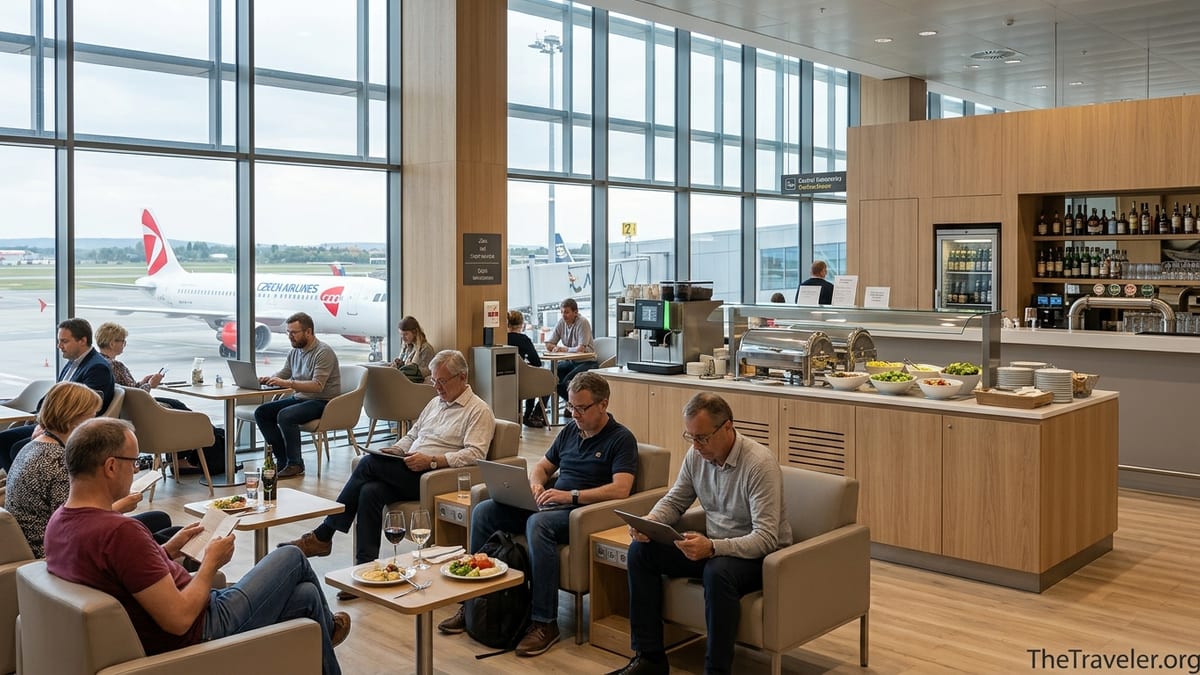
The Erste Premier lounges in both terminals are modern, bright spaces more akin to high-end business-class waiting rooms than five-star hotel lobbies. Expect a mix of soft armchairs, café-style tables for eating, and a few higher bar stools along windows or counters. The décor tends to feature light woods, neutral colors and plenty of natural light from large windows that overlook the apron or runway, especially in Terminal 2. For travelers who enjoy plane spotting, some seating areas offer a clear view of aircraft taxiing or parked at nearby gates.
Wi-Fi is included and usually fast enough for streaming, though during peak times speeds can drop slightly as more users log on. Power outlets are fairly well distributed, although older seating clusters may only have a few sockets per row, so it is wise to carry a multi-USB charger if you are traveling with multiple devices. Printed newspapers and magazines are available but have become less central than they were a decade ago; many travelers now rely on their own tablets and smartphones, and the lounge Wi-Fi makes it easy to download offline reading before boarding.
Bathrooms are located inside or directly adjacent to the lounges, which is a noticeable convenience compared with using the sometimes crowded terminal facilities. Showers are not always guaranteed directly inside the lounge, but Prague Airport offers shower cabins in the non-public area of Terminal 2 near the business lounges. Lounge staff can point you toward these facilities and explain any separate fees or access controls. For long-haul passengers connecting in Prague or travelers arriving early after an overnight bus from another city, this shower area can be a significant comfort upgrade compared with waiting around in the public concourse.
Noise levels are moderate rather than hushed. You will hear boarding announcements, quiet conversations and the occasional phone call, but the environment is still considerably calmer than the main departure halls, which can feel hectic when multiple flights are boarding simultaneously. Travelers who need real quiet for work or rest may still prefer noise-cancelling headphones, but the controlled access and limited number of people usually prevent the worst crowding you might find in some of Europe’s biggest hub airports.
Food and Drinks: How Generous Is Prague Compared With Other Airports?
Catering in Prague’s lounges tends to be solid, if not spectacular. Most travelers will find enough for a light meal and a drink before their flight, though the experience will not typically rival a full restaurant. Hot dishes often include items like pasta, dumplings, grilled vegetables, sausages or schnitzel-style meat, rotating between lunch and dinner times. At breakfast you can expect scrambled eggs, sausages, pastries, yogurt, cereals and bread, which is perfectly adequate for a pre-flight start to the day.
Cold options normally feature salads, sliced cheeses and cold cuts, bread rolls and basic snacks. For example, you might see a simple green salad, a pasta salad, slices of ham and salami, and individual packaged snacks such as crisps or nuts. Dessert is usually limited to cakes, biscuits or small pastries rather than elaborate sweets. Importantly for families, there is almost always something a picky eater can accept, even if it is just plain bread, cheese and fruit juice, which can be a relief before a budget airline flight with limited onboard catering.
Alcoholic drinks at Prague lounges are self-service in most cases. You will typically find Czech beer on tap or in bottles, a selection of basic red and white wines, and a modest range of spirits such as vodka, gin and whisky. Cocktails are rare, and if available they tend to be simple mixed drinks. Soft drinks, coffee from machines, tea and still or sparkling water are widely available. This unlimited beverage access becomes particularly good value in an airport where a single beer or glass of wine in a public bar can easily cost around 5 to 7 euros and a basic main course in a sit-down restaurant can exceed 15 to 20 euros.
Compared with flagship lounges in hubs like London Heathrow or Frankfurt, Prague’s food selection is a step below in variety and presentation, but still much better than what you might receive on a low-cost airline flight. Travelers who would otherwise order a large meal and several drinks in the terminal might easily spend 30 to 40 euros per person, roughly equivalent to the lounge entry fee, while in the lounge they gain not only food and beverages but also quieter seating, Wi-Fi and workspace.
Paid Entry vs Priority Pass vs Airline Status: Value Scenarios
Whether a Prague Airport lounge is worth the money depends heavily on how you access it. For travelers with all-inclusive memberships like Priority Pass Prestige or premium credit cards that include unlimited visits, the marginal cost of entering the lounge is effectively zero. In those cases, the decision becomes straightforward: if the lounge is not at capacity and you have at least an hour before boarding, you will almost always be better off stepping inside for a drink, Wi-Fi and a seat with a power outlet.
For those paying per visit, either with a limited number of free entries on a bank card or with a cash payment of around 30 to 40 euros, the calculation is more nuanced. A solo traveler on a short intra-Europe flight might find that a takeaway sandwich, coffee and water from a landside café costs about 12 to 15 euros. If you do not value the quieter environment and do not plan to drink alcohol, paying more than double that amount for lounge access may feel like poor value, especially if you only have 45 minutes before boarding and the lounge is busy.
On the other hand, a couple or small family planning to sit down for a meal and a round of drinks can easily surpass 60 or 70 euros in Prague’s airside restaurants. In this scenario, a lounge entry package for each adult and a discounted rate for a child can actually save money while adding comfort. Consider a real-world example: two adults and one child flying to Paris out of Terminal 2 around lunchtime. They might otherwise buy three mains and drinks at a chain restaurant for roughly 20 euros per adult and 10 to 15 euros for the child, plus additional soft drinks or coffee, quickly approaching 60 to 70 euros. If they instead pay for lounge access at around 35 euros per adult and a smaller fee or free entry for a young child, the total cost is comparable, yet they enjoy unlimited soft drinks, beer or wine, snacks throughout their stay, and quiet seating with space for hand luggage.
Airline status and business-class tickets simplify matters even further. If you fly in business or have elite frequent-flyer status on a carrier that uses Prague’s lounges as a contract facility, your access will be automatic on eligible flights. In this case, you are not making a value decision at the airport; the cost is built into your ticket or your travel pattern. The key consideration becomes time management: allowing enough time to actually enjoy what is included, rather than arriving too late and barely having time for a cup of coffee.
When Lounges at Prague Are Not Worth It
There are several situations in which paying for lounge access at Prague may not be worth it. The first is when your layover or pre-flight window is very short. If you arrive at the airport late, check in, clear security or passport control and find that your flight is already boarding or scheduled to board within 20 to 30 minutes, you will barely have time to grab a drink before walking to the gate. In such cases, sticking with a takeaway coffee or snack from a nearby kiosk and heading straight to boarding is often the smarter move.
The second scenario is peak-time crowding. Although Prague is not as intense as some mega-hubs, lounges can fill up during early morning waves of departures to major European hubs or late evening long-haul flights. When this happens, staff may operate a one-in, one-out system or restrict entry for some membership types. Even if you are allowed in, the space could feel more like a busy café than an exclusive retreat, with limited available seating and food stations that need constant replenishment. If you see a line of people waiting at the lounge door and your alternative is a half-empty public seating area with nearby cafés, it might be more pleasant to skip the lounge altogether.
Third, if you strongly prefer restaurant-quality dining or have specific dietary needs that the buffet cannot meet, the value of the lounge diminishes. Prague’s lounge catering covers common requirements, with vegetarian options and clearly labeled items, but it may not reliably offer extensive vegan, gluten-free or allergy-sensitive menus. Travelers with strict diets might be better off choosing a restaurant in the terminal that can adapt a hot dish to their needs, even if that means foregoing the lounge’s unlimited drinks.
Finally, travelers who do not drink alcohol and only want a simple snack can find that a small café purchase is cheaper and equally satisfying. In that case, the main advantages of the lounge are seating, power outlets and slightly more privacy. If those factors are not important to you, or if you are comfortable working at a gate-side table, reserving your cash for your destination rather than the lounge can be the more rational choice.
Terminal 1 vs Terminal 2: Which Lounge Experience Is Better?
Travelers often ask whether the experience differs meaningfully between Prague’s lounges in Terminal 1 and Terminal 2. In practice, both Erie Premier lounges offer similar core services: comfortable seating, buffet-style food, self-service drinks, Wi-Fi and access controlled by the same mix of bank products and lounge networks. However, there are some subtle differences that might sway your preference if you have flexibility or a long layover involving both Schengen and non-Schengen zones.
Terminal 2, being newer and dedicated to Schengen flights, often feels a bit more spacious and open. Its lounge benefits from large windows and a relatively short walk from security, making it particularly attractive for morning departures and mid-day European connections. Some frequent flyers report that the Terminal 2 lounge can feel calmer, with a more business-oriented crowd heading to nearby European hubs like Munich, Vienna or Amsterdam.
Terminal 1, serving long-haul and non-Schengen flights, sometimes sees more fluctuating waves of passengers tied to specific departure banks. When a large transatlantic or Middle Eastern flight departs, the lounge can momentarily feel busier, especially in the hours just before departure. At other times of day, it may be fairly quiet, particularly between major departure waves. If you are flying in economy class on a non-Schengen route such as Prague to London, New York or Dubai, the Terminal 1 lounge can be a significant upgrade from the often congested main concourse where multiple flights board from nearby gates.
If you are connecting between Schengen and non-Schengen flights and have several hours in Prague, you may experience both terminals, but you cannot freely move back and forth between them due to Schengen border controls. In that case, it is usually best to follow the normal flow of your ticket: use the lounge in the terminal from which your onward flight departs, ensuring you are on the correct side of passport control for boarding. Trying to switch terminals only for lounge-hopping is rarely worth the time and complexity.
The Takeaway
Prague Airport’s lounges will not compete with the most luxurious flagship lounges in the world, but they deliver exactly what most travelers need: a quiet seat, reliable Wi-Fi, a simple but filling buffet and a reasonable selection of drinks. For passengers with included access through bank programs, LoungeKey, Priority Pass or airline status, they are almost always worth using whenever time permits. The marginal cost is low, and even a short visit can make the airport experience more pleasant.
For those paying out of pocket, the value equation is more delicate. If you plan to eat and drink in the terminal anyway, especially as a couple or family, the lounge can match or beat restaurant prices while adding comfort. If you only want a quick coffee or have a very tight connection, paying for entry makes less sense. Crowding at peak times can also erode the sense of calm you are paying for, so it is wise to manage expectations and have a backup plan in mind.
Ultimately, the worth of Prague Airport lounges comes down to your personal travel style. Business travelers who need to work, families looking for a base to regroup before a flight and passengers making long-haul connections will probably find they get good value from a couple of hours in Erste Premier. Minimalist travelers, or those who prefer to explore the public spaces and restaurants, may be happier saving the lounge fee and putting that money toward a better meal in the city itself. Knowing what the lounges offer and how to access them lets you make that decision with clear eyes, rather than guessing at the door five minutes before boarding.
FAQ
Q1. Which lounges are available at Prague Airport in Terminal 1 and Terminal 2?
The main options today are the Erste Premier lounges in both Terminal 1 (non-Schengen departures) and Terminal 2 (Schengen departures). These spaces serve a mix of airline business-class passengers, status holders, bank clients and travelers with lounge memberships like Priority Pass or LoungeKey.
Q2. How much does paid lounge access at Prague Airport usually cost?
Walk-up or pre-booked entry typically costs around 30 to 40 euros per adult for a stay of up to about three hours, with discounts or free entry for young children depending on the lounge’s policy. Prices can vary slightly depending on whether you book directly through the airport, a third-party platform or pay at reception.
Q3. Can I use Priority Pass or LoungeKey to access Prague Airport lounges?
Yes, Prague’s Erste Premier lounges generally recognize major lounge networks such as Priority Pass and LoungeKey, subject to capacity and the specific terms of your membership. You will need to present a valid digital or physical membership card together with your same-day boarding pass.
Q4. Do any Czech bank cards still give free access to Prague Airport lounges?
Some Czech premium banking products, such as Erste Premier, still include complimentary lounge entry for the cardholder and small children. However, other banks have recently shifted from direct lounge partnerships to offering access via networks like Priority Pass or LoungeKey, so you should always check the latest benefits on your card issuer’s website.
Q5. Is the food in Prague Airport lounges good enough to replace a meal?
For most travelers, yes. The lounges offer a buffet of hot and cold dishes that is usually sufficient for breakfast, lunch or a light dinner, plus snacks, desserts and unlimited soft and alcoholic drinks. While not gourmet, it is comparable in value to a mid-range airport restaurant meal, especially if you would otherwise buy multiple drinks.
Q6. Are Prague Airport lounges worth it if I do not drink alcohol?
They can still be worthwhile if you value quieter seating, Wi-Fi, power outlets and light food, but the arithmetic is different. If you only want a coffee and a snack and have limited time, a regular café may be cheaper. If you plan to work, rest and eat over a couple of hours, the lounge can still be good value even without alcohol.
Q7. What is the dress code in Prague Airport lounges?
Dress codes are relaxed; smart-casual is more than sufficient. You will see a mix of business travelers in office wear and holidaymakers in jeans or comfortable travel clothes. Beachwear, bare feet and very scruffy outfits may be frowned upon, but there is no need for formal clothing or suits.
Q8. Are showers available in Prague Airport lounges?
Showers may or may not be located directly inside the lounge, but Prague Airport provides shower facilities near the business lounges in Terminal 2 and staff can direct you there. Access policies and any extra fees can change, so if a shower is important, ask at reception when you arrive.
Q9. Can I access a Prague Airport lounge on arrival instead of departure?
Generally, access is tied to a same-day departing flight and is checked against your boarding pass. Some memberships and banks may allow use on arrival in specific circumstances, but this is not guaranteed and depends on whether the lounge and your card issuer support it. As a rule of thumb, plan for lounge use before departure rather than after landing.
Q10. How early should I arrive at Prague Airport to make lounge access worthwhile?
If you want to get value from a paid visit, aim to be inside the lounge at least 60 to 90 minutes before boarding. That typically means arriving at the airport about two hours before a European flight and a bit earlier for long-haul routes, allowing time for check-in, security or passport control and the walk from the lounge to your gate.