


More news on this day
Passengers on a Princess Cruises voyage in Alaska recently watched crew members divert course to inspect a mysterious, empty lifeboat drifting alone in open water, sparking speculation about its origins and highlighting ongoing concerns about maritime safety in northern waters.
Get the latest news straight to your inbox!
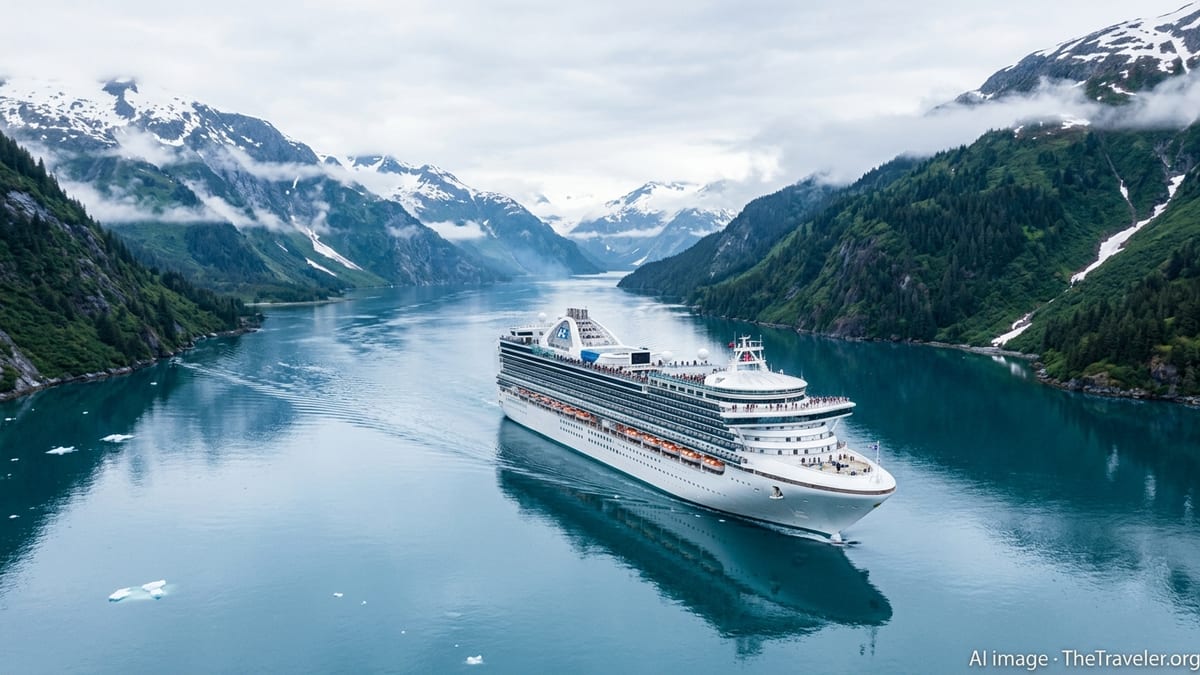
Unoccupied Lifeboat Prompts Course Change in Alaskan Waters
Accounts shared on cruise forums and social media describe a Princess Cruises ship, identified in posts as the Emerald Princess, altering its route along the Alaska coast after crew on watch reported a small craft adrift with no one visible on board. Images posted publicly show a bright-orange covered lifeboat riding low in a gray sea, with the cruise vessel holding position nearby while crew evaluated the scene.
Reports indicate the ship’s bridge team slowed and maneuvered around the object, maintaining distance while binoculars and long lenses were used to check for any sign of people or distress signals. Passengers writing online describe at least one smaller craft from the cruise ship being prepared, though publicly available accounts suggest the crew ultimately determined the lifeboat was unoccupied.
The sighting occurred along one of North America’s busiest seasonal cruise corridors, where large vessels routinely share constricted passages with fishing boats, cargo ships and private craft. The appearance of a seemingly intact but abandoned lifeboat in these waters immediately raised questions among travelers about when and where it might have been launched, and from what vessel.
According to published coverage of similar maritime incidents, empty survival craft found at sea are often treated cautiously, with nearby ships asked to investigate where feasible while coast guard agencies evaluate whether a broader search is justified based on drift patterns and any recent distress reports.
Mystery Tied to 2025 Vehicle Carrier Sinking
Discussion threads about the Alaska encounter quickly linked the “ghost” lifeboat to the sinking of a vehicle carrier reported lost in northern waters in 2025 after a major fire in its cargo decks. Publicly available information and maritime commentary at the time indicated that the ship was carrying thousands of vehicles when it was abandoned, with crew evacuated to survival craft and later rescued by a merchant vessel operating in the region.
Images circulating alongside those of the Alaskan lifeboat suggest a close resemblance between the covered survival craft now drifting and the type carried on that ill-fated roll-on/roll-off ship. Posts shared by maritime enthusiasts note matching hull lines, color schemes and canopy structures, and point to the likelihood that one lifeboat separated or was released during the emergency, remaining afloat long after the mother vessel sank.
Analyses shared in public forums describe how regional currents and wind patterns in the North Pacific and Gulf of Alaska can keep large debris, including lifeboats, circulating for extended periods. Commenters noting the same lifeboat in different locations over time assert that it has been adrift for roughly a year, slowly weathering but remaining buoyant, before being encountered by the Princess ship.
The operator of the sunken vehicle carrier has not been widely cited in relation to the latest sighting, and the drifting craft itself bears no easily visible markings in the available passenger images. Maritime observers point out that without a hull number or readable vessel name, formally linking the lifeboat to a specific casualty would likely require closer inspection or recovery.
How Cruise Ships Respond to Drifting Craft
Although details of the Emerald Princess bridge team’s decision-making have not been formally released, the actions visible in passenger accounts mirror standard expectations for large passenger vessels encountering possible distress at sea. Publicly accessible guidance from international maritime bodies outlines that ships are generally expected to render assistance when there is a reasonable belief that people may be in danger, while balancing the safety of everyone on board the responding vessel.
In practice, this often means an initial visual assessment from a safe stand-off distance, with officers looking for movement, signal flares, lifejackets, or other indicators that someone might still be aboard or in the water. If no such signs are apparent, crews may continue to monitor the object for a period while relaying its position and description to coastal authorities through established reporting channels.
Experts quoted in previous coverage of ghost-ship encounters have noted that abandoned lifeboats present operational challenges. The craft are built to remain afloat for long periods and can be difficult to recover safely in open-sea conditions, especially for high-sided cruise ships with thousands of passengers on board. As a result, many are left to drift unless they pose an immediate threat to navigation near harbors or busy traffic lanes.
Alaska’s coastal regions see intense seasonal traffic from May through September, and vessel traffic studies produced in recent years by regional agencies emphasize risk-management practices for large passenger ships operating near remote communities, narrow channels and sensitive marine habitats. The appearance of a derelict lifeboat in these waters underscores the need for coordination between cruise operators, cargo lines and regulators on how such hazards are tracked and managed.
Ghost Vessels and the Lore of Northern Seas
The Princess lifeboat sighting quickly drew comparisons with famous maritime mysteries, from the 19th-century brig Mary Celeste to more recent “ghost ship” cases in the North Pacific. In those historical episodes, fully rigged or partially powered vessels were discovered with no one on board, fueling speculation that has persisted for generations.
Maritime historians note that abandoned craft in Alaska and Arctic waters have long captured public imagination, including the enduring story of the SS Baychimo, a cargo ship reported adrift and occasionally sighted for decades after being left to the ice in the early 20th century. While today’s regulations and monitoring technology have reduced the frequency of such cases, isolated discoveries still occur, particularly in remote northern regions.
In online reactions to the latest incident, some travelers described the empty lifeboat as unsettling, especially when framed against a backdrop of low cloud and cold gray seas. Others viewed it as a rare, if eerie, glimpse into the realities of commercial shipping, where even successful evacuations can leave behind scattered equipment and debris that reappear months or years later in unexpected places.
Cruise specialists commenting publicly on the Alaska market highlight that such encounters remain extremely uncommon given the scale of modern operations. Millions of passengers transit the Inside Passage and Gulf of Alaska each season without incident, and most never witness the aftereffects of maritime casualties that may have unfolded hundreds of miles away or many months before.
Safety Focus as Alaska Cruise Season Continues
The encounter with the ghost lifeboat comes during an already scrutinized summer for large-ship operations in Alaska. In June, a pregnant fin whale was found on the bow of a cruise ship near Seward, prompting fresh attention to ship speeds and wildlife interactions in coastal corridors. Separate coverage this month has also described an overboard fatality on a Princess vessel sailing from Florida, underscoring the range of safety issues facing the industry worldwide.
Advocacy groups and marine scientists have used recent incidents to reiterate calls for stricter monitoring of vessel movements, improved onboard training, and expanded reporting requirements when ships encounter derelict craft or debris that might indicate an unreported casualty. Passenger ships plying Alaskan routes operate under a complex web of international conventions, federal rules and state-level oversight intended to reduce risks in a region where cold water and sparse coastal infrastructure can quickly turn minor problems into major emergencies.
For travelers, the Alaska ghost-lifeboat episode serves as a reminder that cruise itineraries traverse working seas where cargo vessels, fishing fleets and long-haul shipping converge. Public information about the Emerald Princess encounter points to a textbook response: slow, assess, document and pass details to the appropriate authorities while keeping guests informed and safe.
As the summer season progresses, the drifting lifeboat that briefly shared the stage with a modern cruise liner may continue its solitary journey on northern swells. Whether it is eventually recovered, broken apart in a storm, or washed ashore on a remote stretch of coastline, the images captured from the Princess ship have already added a new chapter to the lore of ghost vessels in Alaskan waters.