


Few moments feel better than stepping off the plane in Puerto Vallarta, picturing the pool, the margarita, and the view waiting at your hotel. That is, until you hit the infamous arrival hall, where a wall of smiling “helpers” in polo shirts and name badges suddenly appears. Many first-time visitors mistake these desks for official transport or tourism services. In reality, they are almost all timeshare marketers, and a friendly offer of a free taxi or discounted tour can quickly turn into a three-hour sales siege and hundreds of dollars lost. Knowing exactly what to expect inside Puerto Vallarta’s airport, and how to walk past it with confidence, is the single best way to start your trip on your own terms.
Get the latest updates straight to your inbox!
What Actually Happens After You Land in Puerto Vallarta
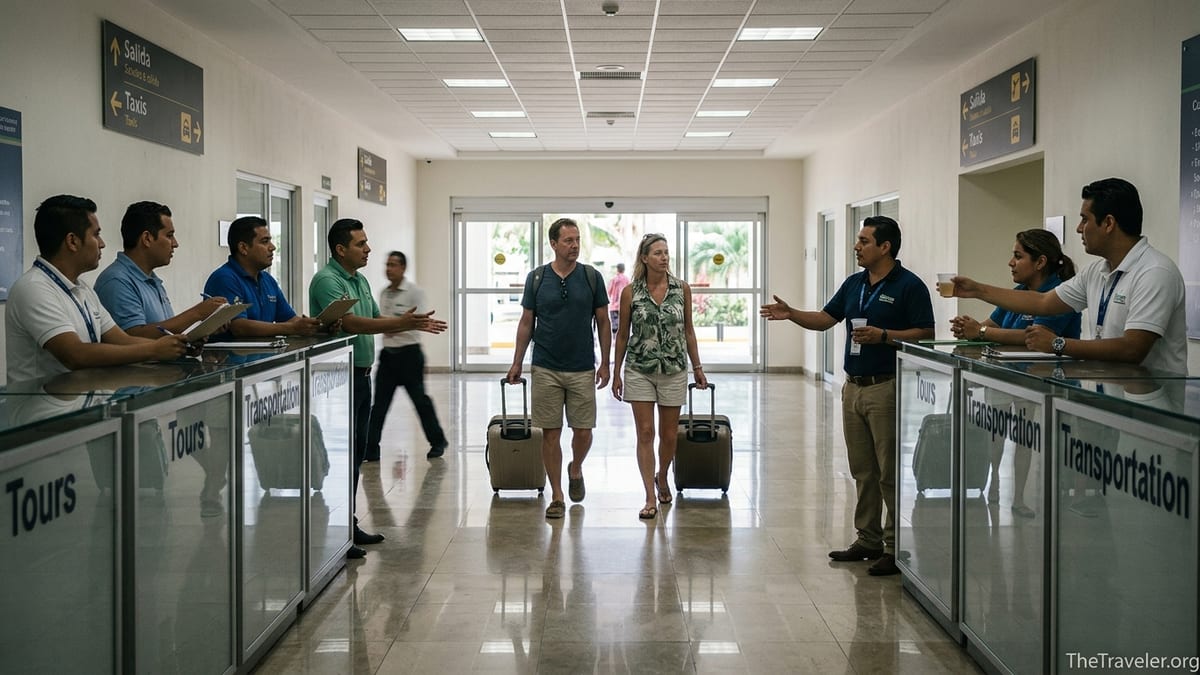
Puerto Vallarta’s Licenciado Gustavo Díaz Ordaz International Airport is compact and generally efficient, but its layout funnels every arriving international passenger through the same gauntlet. After passport control, you collect your luggage and pass customs. From there, instead of emerging directly into the bright main arrivals hall, you are routed down a long indoor corridor lined with booths. Locals and regulars call this corridor the “shark tank,” “hall of lies,” or “hall of doom” for a reason: nearly every person behind those counters is selling timeshares or vacation club presentations, not official transportation or airport services.
The people in this hallway look legitimate. They wear embroidered resort logos, laminated ID badges, and sometimes stand behind counters labeled with tour company names or generic signs like “Information” or “Transportation.” Some hold clipboards and ask, “Which hotel?” as if they are there to direct you. Others hold margaritas or tequila shots and invite you to celebrate your arrival. None of this means they are airport staff. In most cases they work as off‑property sales agents whose entire income depends on getting you to agree to attend a “90‑minute presentation.”
Only once you walk all the way through this interior corridor and out the sliding doors into daylight do you reach the real arrivals curb. Outside, you will see the official taxi kiosk, pre‑booked transfer reps holding printed signs, rideshare pick‑up areas where allowed, and family or friends waiting. Every legitimate ground transport option is either outside or at clearly labeled counters after you exit the shark tank, not inside it.
Understanding this sequence before you land changes everything. You can treat the shark tank as just another airport walkway: a place you move through briskly, without stopping, on your way to transport you actually want.
How the Timeshare Pitch Works in the Arrival Hall
The airport timeshare machinery in Puerto Vallarta runs on a few simple scripts that repeat day after day. One common opening line is, “I am with the airport / tourism board / your hotel, let me verify your transportation.” A visitor who pre‑booked a shuttle with a company like Amstar, Vallarta Adventures, or a hotel car might naturally assume these people are the right contact. The agents then claim your shuttle counter is “on break” or “closed” and offer to “take care of it” while they seat you at a nearby desk. Ten minutes later, you find yourself being offered a “welcome breakfast orientation” with a local resort in exchange for “complimentary” transportation.
Another popular script is pure sugar: “Congratulations, you have a free taxi to your hotel, plus two excursion tickets and a bottle of tequila. All you have to do is attend a 90‑minute presentation tomorrow.” Travelers report being offered whale‑watching tours, canopy zip‑line tickets, city tours, or spa vouchers worth several hundred dollars. In one recent account, a couple paid a roughly 1,000‑peso “refundable deposit” at the airport to lock in gifts and a cheap future stay, only to discover later that they had essentially purchased a timeshare‑presentation package with strict small print and no easy refund.
There is usually a timer element. Agents stress that the orientation is “only this morning” or that the excursion discount is “valid today only,” pushing you to commit before you have even left the airport. They will often ask who you are traveling with and subtly separate the more hesitant partner by talking directly to the more enthusiastic one. Offers balloon as you hesitate: upgraded bottles of tequila, more tour tickets, private transportation to a resort like Vidanta or Villa del Palmar, or a subsidized three‑night stay on your next visit if you just sign a voucher now.
The “90‑minute” promise is rarely accurate. Many visitors describe being stuck in a sales room for four to six hours, shuffled from one closer to another, with increasing pressure to hand over a credit card for a membership, supposed resale service, or “vacation investment.” Even when guests firmly refuse all purchases, they may walk away having lost half a day of vacation to get a couple of tour tickets whose conditions or blackout dates make them hard to use.
Spotting the Difference: Real Transport vs Shark Tank Sellers
In the confusion of arrival, it is easy to misread uniforms and signage. The cleanest rule is simple: inside the building, before you see daylight, assume everyone approaching you about shuttles, taxis, or excursions is a marketer. Official airport staff tend to be in neutral uniforms, focused on security or operations, and they do not chase you or promise freebies. Timeshare sellers wave you over, call out your hotel name like a guess, or stand directly in your path so you feel compelled to respond.
Legitimate ground transportation in Puerto Vallarta is organized in clear, predictable ways once you are outside. Government‑regulated airport taxis sell fixed‑price tickets at a booth just beyond the exit doors, usually marked as a taxi or “Transportación Terrestre” kiosk. There you tell the clerk your destination, pay in pesos or often with a card, and receive a paper ticket you hand to the driver waiting at the taxi line. Prices vary by zone and vehicle size, but a typical official taxi fare to the Hotel Zone or Marina is openly posted at the counter, not whispered as a special deal.
If you booked a private transfer in advance, your driver will normally be waiting outside the terminal, beyond the shark tank, holding a sign with your name or your provider’s brand. Common operators instruct guests in their confirmation emails to ignore anyone inside the building and to walk straight out to the designated meeting point. When in doubt, use your phone to call the company number in your booking confirmation rather than trusting someone who says, “They sent me instead.”
Rental car counters are another source of confusion. The real desks for major companies like Hertz, Avis, or National are past customs and generally clearly labeled with the company’s logo, but even there you may see nearby agents trying to redirect you to a “partner” resort breakfast. If you are renting a car, complete your paperwork and decline any offers that require you to commit to a meeting or tour the next day. Car hire is one thing; a mandatory sales breakfast two towns away is another.
Play‑By‑Play: How to Walk Past the Sharks
Having a mental script before you land is the easiest defense. Once you clear customs and the sliding doors open into the shark tank, fix your eyes straight ahead toward the exit signs. Do not stop at counters, accept drinks, or engage in small talk. When someone steps in front of you with, “What hotel are you staying at?” or “Your taxi, my friend?” reply briefly with “No, gracias” and keep walking at a steady pace. You are not being rude; you are declining a sales pitch.
Travelers who sail through this corridor usually share the same habits. They have already arranged their transportation or budgeted for an official taxi, they know that no one inside the building is holding their pre‑paid shuttle, and they have talked with their companions about not splitting up. Couples sometimes agree in advance that one person will lead the way with the luggage cart while the other walks slightly behind, repeating “No, gracias” without breaking stride, so neither gets cornered at a desk.
If an agent insists they are from your hotel, ask a question only your hotel would know, such as the exact name of the room category you booked or the last four digits of the credit card on file. They will not have it. More simply, say, “I have already checked in online, my transportation is confirmed, thank you,” and continue walking. Once you are past the shark tank and in the public arrivals hall, you can take a breath, find a restroom, an ATM, or a coffee shop, and orient yourself without pressure.
This walk from customs to the exit typically takes two or three minutes if you do not stop. Reminding yourself of that short time frame helps. You are not entering a maze; you are traversing a hallway. The sooner you reach the outside, the sooner you are standing at the real taxi kiosk or with your actual driver, watching the palm trees instead of listening to sales pitches.
Common Traps First‑Time Visitors Fall Into
Despite abundant warnings online, many first‑time visitors to Puerto Vallarta still fall into the same predictable traps. The first is mixing up “concierge” with “sales.” At home, a concierge is someone your hotel employs to help you with dinner reservations or directions. In the Puerto Vallarta airport shark tank, many desks label themselves as concierge services but exist primarily to feed people into resort presentations. If a so‑called concierge at the airport is offering you hundreds of dollars of benefits in exchange for two hours of your time, you are not dealing with neutral assistance.
A second trap is the “refundable deposit.” Travelers are often asked to leave a cash or credit card deposit, usually a modest sum like 1,000 pesos or 50 US dollars, to “ensure you show up” for a free breakfast and tour. In theory, the deposit comes back when you attend. In practice, stories abound of people having to chase refunds, being told they did not meet some hidden qualification (age, income, marital status), or learning that the deposit was actually applied to a future stay package they do not really want.
Third, visitors underestimate just how draining the presentation itself will be. Even when guests are promised a 90‑minute talk, accounts describe three separate salespeople rotating through, managers being called over, and a slow escalation from friendly to insistent. Those who mention owning an existing timeshare can be targeted with offers to “buy out” the old contract through a new purchase, something that later proves difficult or impossible to verify. A family might think they are sacrificing just one breakfast; instead, they lose their entire first morning in Puerto Vallarta only to walk away angry and tired.
The last big mistake is letting embarrassment override common sense. Many people keep saying yes because they do not want to appear impolite, especially after accepting a complimentary drink or ride. Remember that politeness does not require surrendering your vacation plans or financial information. A firm, repeated “No, gracias, we are not interested” is culturally acceptable and widely understood. Agents expect a high rate of refusal; you are not hurting anyone’s feelings by declining.
If You Already Agreed to a Presentation: Damage Control
Sometimes the pitch succeeds before you realize what is happening. Maybe you arrived after a long flight with kids in tow, you took the free margarita, and you signed a form booking you into a breakfast at a specific resort the next morning. All is not lost. Before you leave the airport, take clear photos of anything you signed, including the front and back of any voucher or receipt that mentions deposits, refunds, or penalties. This gives you a record in case details change later.
Back at your hotel, read the fine print on the voucher in good light. Look for words like “vacation club presentation,” “mandatory tour,” or “sales meeting.” Check the stated length of the meeting and any income or age requirements. If you are uncomfortable, you can usually cancel by contacting the resort directly or simply not showing up. You may forfeit the deposit you paid at the airport, but you will have protected the rest of your vacation time and your larger finances. Many seasoned Mexico travelers will tell you that losing a small deposit is preferable to losing several hours to high‑pressure selling.
If you do decide to attend, set strict boundaries in advance. Agree with your travel companions that you will not sign anything on the spot, that you will not give a credit card for any “fully refundable” purchase, and that you will leave once the stated time is up, regardless of whether the sales process has finished. Carry a watch or set a phone alarm for the promised 90 minutes. When it goes off, stand up together, thank them for their time, collect whatever agreed gift you are due, and leave. If the gifts are suddenly withheld because you did not buy, consider that an expensive lesson and walk away anyway rather than arguing.
For those who have already attended a presentation and feel misled into signing a large timeshare contract, there are consumer protection agencies in Mexico, such as PROFECO, and international timeshare exit firms that may offer advice. However, untangling a signed contract can take months and may not always succeed. The simplest protection is to avoid signing in the first place, especially in the emotional, disorienting window right after your plane lands.
Choosing Better Ways to Save Money on Your Trip
The lure of airport timeshare offers is almost always about savings: free rides, free excursions, cut‑price future stays. If you plan ahead, you can often achieve similar or better value without entangling yourself in a presentation. For transportation, for example, comparing the cost of an official airport taxi with a reputable pre‑booked shuttle can make the “free” timeshare ride look much less impressive. A typical taxi from the airport to the central Hotel Zone split between two or three people often works out to just a modest cost per person, far less than the value of your vacation hours.
For activities, local tour operators in Puerto Vallarta frequently run their own promotions that you can access by booking online a few days in advance or through your hotel’s real concierge once you arrive. A whale‑watching trip or canopy tour booked directly may come with an early‑bird discount or off‑season pricing that beats the inflated “retail” price cited in airport pitches. Travel agencies and package operators sometimes include airport transfers and a basic excursion in bundled prices as well, reducing the psychological appeal of freebies dangled by timeshare marketers.
If you genuinely enjoy attending presentations and are confident you will not buy, some experienced travelers treat them as a calculated trade: they willingly give up a half‑day for substantial perks, schedule it on a day when jet lag would slow them down anyway, and go in with a strict “no purchase” rule. But this approach is best left to people who know exactly what they are doing and who fully understand the contracts in Spanish and English. For most first‑timers, the simplest, safest way to “save” money is to skip the shark tank entirely and spend that time settling into your hotel, exploring the Malecón, or enjoying your first sunset instead.
When you budget for Puerto Vallarta, think of seamless arrival as a real line item. Setting aside a bit of money for straightforward transportation and paying normal prices for a couple of carefully chosen tours is far cheaper, in stress and potential risk, than being drawn into complex financial products you never intended to consider.
The Takeaway
Puerto Vallarta is a warm and welcoming destination, but its airport arrival hall has earned its reputation as a shark tank because it preys on tired, excited travelers who simply do not yet know the layout. The key facts are uncomplicated. Everyone must walk through a corridor lined with timeshare marketers after customs. These sellers often pose as transport coordinators or concierges, offering free rides and excursions in exchange for attending lengthy sales presentations at resorts around the bay.
You do not need to argue, justify yourself, or feel guilty to avoid them. All you need is a plan: keep walking until you are outside in the real arrivals area, say “No, gracias” to anyone who approaches you inside about transportation or tours, and find either the official taxi kiosk or your pre‑booked driver where they are supposed to be. If you have already been drawn into a presentation, remember that you can usually back out at the cost of a small deposit rather than a multi‑year commitment.
Knowing this before you land turns the shark tank from a threatening unknown into just one more airport corridor. Armed with a little situational awareness, you can step off the plane, breeze past the pitches, and be in a real cab toward your hotel in minutes, starting your Puerto Vallarta vacation on your own schedule, not a salesperson’s.
FAQ
Q1. Is it safe to walk through the Puerto Vallarta airport “shark tank” if I just ignore everyone?
Yes. The corridor is inside the secure part of the airport and is physically safe; the risk is financial and time‑related, not personal safety. If you keep moving and politely decline offers, you will be outside at the real arrivals curb within a few minutes.
Q2. Are any of the people in the arrival hall actually from my hotel or tour company?
Almost never. Most are independent marketers paid to send guests to timeshare or vacation club presentations. Legitimate hotel representatives and pre‑booked drivers usually wait outside the terminal, beyond the sliding doors, often holding a sign with your name or the company name.
Q3. How do I find the real airport taxi stand in Puerto Vallarta?
After you walk past the shark tank and exit to the public arrivals area, look for the official taxi kiosk or counter, typically near the curb. You tell the clerk your destination, pay a fixed zone fare, receive a ticket, and then hand it to the driver at the taxi line just outside.
Q4. I prepaid a shuttle online. What should I do when I arrive?
Before your trip, read the confirmation email carefully, as most companies give precise instructions, such as “Ignore timeshare desks, exit the terminal, and meet us at Gate X.” When you land, follow those instructions exactly and call the number in your booking if anyone inside claims to represent your shuttle without proper identification.
Q5. Are the free tours and gifts from airport timeshare offers ever worth it?
Sometimes the tours are real, but the cost is hidden in hours of high‑pressure selling and possible deposits or future obligations. Unless you are very experienced and absolutely certain you will not sign anything, it is usually not worth trading your vacation time and peace of mind for those perks.
Q6. What if I already gave a deposit at the airport for a presentation?
Keep all paperwork and take photos of any vouchers or receipts. You can often cancel by contacting the resort directly or simply not attending, though you may lose the deposit. Consider it a small loss that prevents you from potentially entering a far more expensive contract.
Q7. Can I be forced to buy anything at a timeshare presentation?
No. Salespeople may use strong psychological pressure, but they cannot legally force you to sign. You always have the right to say no, stand up, and leave, even if they try to guilt you or threaten to withhold gifts.
Q8. Are timeshares in Puerto Vallarta illegal or always scams?
Timeshares themselves are legal and some owners are satisfied, but the sales tactics can be aggressive and promises may be exaggerated. The problem at the airport is not legality; it is that people are pitched complex, long‑term financial products moments after landing, when they are least prepared to evaluate them.
Q9. How can I politely decline without feeling rude?
Simple phrases like “No, gracias, tenemos todo arreglado” or “No, thank you, we already have transportation” are enough. Repeat as needed while walking. In local culture, direct but calm refusals are normal in this context, and agents expect many people to say no.
Q10. What is the best single tip for a first‑time visitor arriving at PVR?
Decide before you land that you will not stop for anyone inside the building after customs. Walk straight out to daylight, then find the official taxi stand or your pre‑booked driver there. That one decision removes almost all risk from the shark tank experience.