


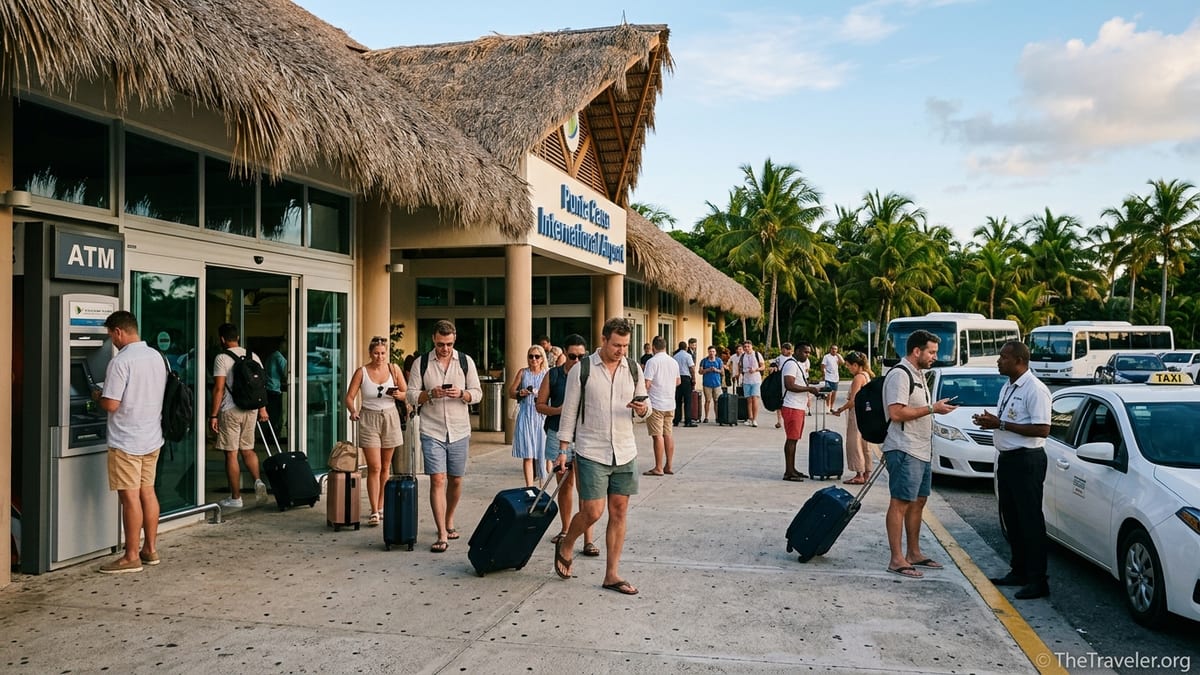
Arriving at Punta Cana International Airport can feel like stepping straight into a resort brochure: open-air thatched terminals, tropical heat, and crowds of vacationers juggling beach bags and passports. Beneath the relaxed atmosphere, however, there are a few formalities you must navigate smoothly: the mandatory Dominican Republic e-ticket, immigration and customs, getting local cash, and figuring out mobile data before you leave the terminal. This guide walks you through each step so you know exactly what to expect from the moment your plane’s doors open until you slide into a taxi or transfer van.
Get the latest updates straight to your inbox!
Understanding the Dominican Republic e-Ticket
The Dominican Republic no longer uses paper immigration or customs forms on arrival or departure. Instead, every traveler must complete the electronic ticket, known locally as the “e-ticket,” for both entry and exit. This digital form combines immigration, customs, and health questions into a single process and generates a QR code that you present at the airport. Airlines flying into Punta Cana now treat the e-ticket as part of your travel documents and may not let you check in if you cannot show it.
The e-ticket is required for all passengers, including children, regardless of nationality or whether you are staying at an all-inclusive resort or a rental apartment. The Dominican authorities recommend completing it before you reach the airline counter at your departure airport, since many airlines ask to see the QR code at check-in. For example, if you are flying from New York to Punta Cana, you would normally complete the arrival e-ticket the day before your outbound flight, then complete a separate departure e-ticket a day or two before flying home.
The form asks for basic information: your full name, passport number, email, flight number, airline, and where you will stay in the Dominican Republic. Having your hotel confirmation or rental address handy makes the process much faster. You also answer customs questions about what you are bringing into the country, such as high-value electronics or large amounts of cash. The system then generates a QR code for your trip. You can print it or keep it as a screenshot on your phone; both formats are accepted by airport staff and immigration officers.
Families benefit from a useful feature: one e-ticket can cover several people traveling together. You specify how many family members are included, and the system produces a single QR code for the group. For instance, a family of four flying from Toronto to Punta Cana can submit one entry form for all four members, instead of filling out separate documents for each person. This saves time at home and speeds things up at the airport when everyone is tired after a long flight.
How and When to Complete Your e-Ticket
Although the e-ticket form itself usually takes around five to ten minutes, it pays to give yourself more time in case the site is busy or you need to look up details such as your accommodation address. A practical approach is to complete your arrival e-ticket 48 to 72 hours before departure and your departure e-ticket at least 24 hours before your flight home. This window leaves room to correct any mistakes without rushing.
If your travel details change after you have already generated your QR code, you can usually go back into the system with your application code and update your information. For example, if your airline moves your flight from a Saturday to Sunday, you do not need to start from scratch; you can adjust the date and keep the same e-ticket record. That said, always double-check the updated QR code before you head to the airport, because airline check-in agents and immigration officers will expect the dates and flight numbers to match what appears in their systems.
Many travelers complete the e-ticket on their phone, but a laptop or tablet often makes the process more comfortable, especially when entering passport data for several family members. Once you submit the form, immediately take a screenshot of the QR code and also save the confirmation email if one is sent. A common real-world scenario is a traveler arriving at Punta Cana with low phone battery and slow roaming data; having printed copies of the QR codes lets you pass immigration even if your phone fails at the worst moment.
Be cautious of third-party sites that offer to complete the e-ticket for a hefty fee. The official form is free, and any site that charges you for “processing” is simply entering your data into a free government portal and keeping the difference. Travelers have reported offers of “express e-ticket service” for 50 to 70 US dollars per person, which is unnecessary. As long as you have your passport and flight details, you can complete the form yourself in a few minutes at no cost.
Arrival Flow: From Aircraft Door to Customs Exit
Once your plane lands in Punta Cana, you typically disembark via jet bridge or, on some flights, down stairs to the tarmac and walk or take a short shuttle to the terminal. The first thing you may notice is the warm tropical air and the open-sided design of the building. Follow the signs for immigration. Along the way, airport staff sometimes ask to see your e-ticket QR code as a quick pre-check, especially during peak arrival times when multiple flights land within minutes of each other.
At immigration, you join the line for foreign visitors unless you are a Dominican citizen or resident. When it is your turn, you present your passport and, if requested, your e-ticket QR code. Some officers scan the code directly from your phone; others rely mainly on their internal system but may still ask to see the code to confirm your details. The process is usually quick for tourists from countries that do not require a visa, particularly from North America and much of Europe, but times vary depending on how many flights arrive at once.
After passport control, you proceed to the baggage claim area. Screens show the carousel numbers for each flight, and luggage carts are available for a small fee or deposit. Around the carousels you pass your first opportunities to change money or withdraw cash. There are also duty-free shops where some travelers pick up items like rum or cigars while waiting for bags. Keep in mind that your checked luggage and any duty-free purchases will still be subject to customs rules after you leave the carousel.
When you collect your baggage, you move toward customs. Dominican customs officers may ask about the purpose of your visit and what you are bringing into the country. In practice, most tourists with standard luggage walk through without detailed inspection, but random checks do occur. Your e-ticket covers the customs declaration portion that used to be on paper, so you no longer fill out a separate form here. Once cleared, you pass through sliding doors into the public arrivals hall where drivers, family members, and hotel representatives wait with signs.
Cash, ATMs, and Currency Exchange at Punta Cana Airport
The local currency is the Dominican peso, often written as DOP or RD$. While some prices in Punta Cana’s resorts and tourist zones are quoted in US dollars, especially for tours and tips, it is wise to have at least a small amount of local cash for taxis, snacks, and supermarket stops en route to your accommodation. The good news is that Punta Cana Airport has multiple ATMs in the arrivals area and near the exits, as well as currency-exchange counters around immigration and baggage claim.
ATMs are generally the most cost-effective way to obtain pesos, since they dispense cash at or close to the official exchange rate, plus whatever fee your home bank charges. A typical real-world example: a US traveler arriving with a debit card from a major bank might withdraw 10,000 pesos (roughly a few hundred US dollars, depending on the rate) from an ATM run by a large Dominican bank such as Banco Popular or Banreservas. The machine may charge a local fee, and the traveler’s home bank might add an international ATM fee and a 1 to 3 percent foreign transaction fee. Even with these costs, the overall rate often beats what you would receive at an airport exchange counter.
Currency-exchange booths are convenient but almost always offer less favorable rates. In practice, that can mean receiving 6 to 12 percent fewer pesos compared with withdrawing from an ATM. For example, if the mid-market rate would give you 5,500 pesos for 100 US dollars, an airport exchange desk might give you closer to 4,900 to 5,100 pesos for the same amount. If you only need a modest amount of cash to pay a taxi to your hotel, exchanging 50 to 100 dollars here for convenience can be reasonable, but avoid changing large sums in the arrivals hall if you can use an ATM or a bank in town instead.
Whatever method you use, plan to get enough pesos at the airport to cover your immediate needs: taxi or shuttle tips, a supermarket stop, and perhaps your first meal if it is not already included. Many taxi drivers in the Punta Cana area accept US dollars, and some even quote fares directly in dollars, that might be around 35 to 45 US dollars to major resort areas. Still, having pesos allows you to negotiate and pay what locals expect, especially if you are heading to guesthouses, smaller hotels, or destinations beyond the main resort strip.
SIM Cards, eSIMs, and Getting Connected
Staying online in Punta Cana is simpler if you plan ahead. Many visitors rely on the free Wi-Fi at resorts and only need limited connectivity during transfers, in which case a roaming pass from your home carrier may be enough. For example, US travelers with major providers often have daily international roaming packages that cost around 10 US dollars per day for voice and data in the Dominican Republic. If you only need to check messages during a week-long resort stay and want to avoid chasing local SIM cards, this can be an easy, though not the cheapest, option.
Travelers who want substantial data at lower cost often choose local SIM cards or eSIMs. Dominican mobile operators include Claro, Altice, and Viva. In urban areas such as Punta Cana town, Bávaro, and Santo Domingo, coverage is generally solid, although speeds and signal strength can drop in rural or coastal stretches between resorts. Prepaid data packages are usually affordable. A common example described by recent visitors is paying the equivalent of under 10 US dollars for several gigabytes of data valid for a week, enough for maps, ride apps, social media, and video calls in moderation.
Availability of SIM cards directly inside the arrivals area at Punta Cana Airport can change, and dedicated telecom booths do not operate on every flight’s schedule. Some travelers report finding operator desks or stands in or near the arrivals hall, while others arrive in the evening or off-peak hours to find no active mobile counters. As a result, a reliable strategy is to use your home roaming or the airport’s Wi-Fi to get to your accommodation, then purchase a local SIM from a supermarket or mall such as Jumbo, Super Pola, or a branded Claro or Altice store in the Punta Cana or Bávaro area. Staff in these locations are familiar with tourists and can usually activate a prepaid plan on the spot after scanning your passport.
Another increasingly popular solution is to buy an international eSIM before traveling. Several well-known travel eSIM providers sell regional Caribbean or Latin America data packages that you can install on your phone using a QR code before you leave home. For instance, a traveler from London might purchase a 10 to 20 GB eSIM package for the Dominican Republic for a fixed price, activate it on landing, and be online without needing a physical SIM card at all. While these packages are usually more expensive than a local SIM, they still tend to be cheaper and more flexible than daily roaming from many home carriers, especially for heavy data users.
Paying for Taxis, Transfers, and First-Day Expenses
Once you exit customs into the arrivals hall, you will see a mix of official taxi desks, private transfer representatives, and tour company counters. Hotel shuttles and prebooked transfer drivers typically hold signs with guest names or hotel logos. If you have arranged a transfer in advance through your tour operator or accommodation, ask whether your ride is already paid for or if you must settle up in cash on arrival. In all cases, clarify the fare and currency before you get into the vehicle.
Taxi fares from Punta Cana Airport are often fixed by zone. For example, a ride to many of the large resort complexes in the Bávaro area might fall in the 35 to 45 US dollar range for up to four passengers, while journeys to more distant areas such as Uvero Alto or Cap Cana can cost more. Some official taxis will quote the price in US dollars and accept either dollars or pesos. If you only have a small amount of cash, it is practical to pay in whichever currency you obtained at the airport, but having smaller bills helps avoid awkward conversations about change. Tips are appreciated but not strictly mandatory; rounding up or adding 5 to 10 percent for good service is common.
Ride-hailing apps and hotel shuttles also operate around Punta Cana, although app-based services may face restrictions in some resort zones. If you intend to use these services, having mobile data is crucial. A common real-world sequence is to use airport Wi-Fi to contact your driver via app messaging while you are still within the terminal, then rely on your roaming or local data plan as you move outside toward the pick-up point. Make sure your phone is well charged; long flights plus heavy use of boarding passes, entertainment, and messages can leave batteries low just when you need connectivity most.
Beyond transport, your first day in Punta Cana often includes incidental expenses such as porters, snacks, or a grocery stop if you are staying in a self-catering rental. Porters in the arrivals area and outside the terminal may offer to help with bags; if you accept, be ready with small denominations in pesos or dollars to tip them. Supermarkets and many shops in resort areas accept major credit and debit cards, but smaller stores and street vendors may prefer cash. Having a mix of payment options when you leave the terminal reduces stress and lets you adapt to whatever you encounter.
What to Do Before You Leave the Terminal
Before walking out into the tropical sunshine, take a moment in the arrivals hall to confirm that you have everything you need for the next few hours. Start by checking your documents: passport, printed or digital e-ticket QR codes, hotel confirmation, and any transfer vouchers. A surprising number of travelers accidentally leave something in the seat pocket on the plane or at the baggage carousel, and discovering this only when you reach your resort can turn a relaxing first day into a bureaucratic headache. If you realize something is missing, contact your airline’s baggage service counter inside the terminal while you are still on the premises.
Next, think about connectivity and navigation. If you plan to use offline maps, download the Punta Cana and Bávaro area map to your phone via your preferred app while you are on the airport Wi-Fi. Save the address and phone number of your accommodation in a notes app or take a screenshot of the booking confirmation, so you can show it to a taxi driver even if your mobile data fails. Travelers heading to less well-known guesthouses or rental villas often show drivers a dropped pin on a map app, which can be more accurate than using a street name alone.
If you have not yet withdrawn cash or arranged for a SIM card, the arrivals hall is a good place to take care of the essentials. Visit an ATM from a recognizable Dominican bank to withdraw enough pesos for your first day or two. If your card is declined, try a second machine and then contact your bank using Wi-Fi if the problem persists. This scenario is common when banks automatically block foreign ATM transactions until you confirm they are legitimate. Sorting out these issues while you are still at the airport, with staff nearby and reliable connectivity, is far easier than doing so from a remote resort.
Finally, once you meet your driver or shuttle representative, confirm your destination, approximate travel time, and whether there will be any stops along the way, such as a supermarket or exchange house. Many transfer companies happily pause at a large grocery store so guests can stock up on water, snacks, and basic supplies; some even build this into their service description. Knowing the plan before you leave the terminal reduces surprises and helps you settle into vacation mode as your vehicle pulls away from the airport and heads toward the palm-lined resorts.
The Takeaway
Arriving at Punta Cana Airport is more enjoyable when you know what to expect and have a simple plan for each step: e-ticket, immigration, customs, cash, and connectivity. Completing the free e-ticket form before you depart, printing or saving your QR codes, and traveling with your accommodation details handy will take much of the stress out of the formalities. The airport’s ATMs and, if necessary, currency-exchange counters give you immediate access to Dominican pesos so you can pay taxis and tips without overpaying, while a mix of roaming, local SIM, or eSIM keeps you online when you need directions or ride apps.
With these logistics sorted before you leave the terminal, you are free to focus on the good parts: the first glimpse of turquoise water from your transfer van, the warm evening air as you step into your resort lobby, and the knowledge that the practical details are under control. A little preparation at Punta Cana Airport goes a long way toward ensuring the rest of your Dominican Republic stay feels as relaxed as the palm trees suggest.
FAQ
Q1. Do I really need to complete the Dominican Republic e-ticket for Punta Cana?
The e-ticket is mandatory for all passengers entering and leaving the Dominican Republic, including those arriving at Punta Cana Airport. Airlines and immigration officers expect to see your QR code, so you should complete it for both your arrival and your departure.
Q2. How far in advance should I fill out my Punta Cana arrival e-ticket?
Most travelers complete the arrival e-ticket 48 to 72 hours before their flight to give themselves time to correct errors and print or save the QR code. You must have it ready before check-in, since some airlines will not issue a boarding pass without it.
Q3. Can one e-ticket cover my entire family traveling to Punta Cana?
Yes. The system allows you to include multiple family members on a single form, and it will generate one QR code for the whole group. You only need to submit a separate form if your group exceeds the maximum number of people allowed on one application.
Q4. What happens if my flight details change after I already have an e-ticket QR code?
If your airline changes your flight date or number, you can usually return to the e-ticket portal with your application code and update your information there. Always verify that the new details appear correctly before you go to the airport.
Q5. Is it safe and cost-effective to use ATMs at Punta Cana Airport?
ATMs at the airport are widely used by visitors and are generally considered safe when you follow normal precautions, such as shielding your PIN. They typically provide better exchange rates than currency-exchange counters, although you may pay local ATM fees plus any charges from your home bank.
Q6. Should I bring US dollars, or is it better to rely on Dominican pesos?
Both are useful. Many taxis, resorts, and tour operators around Punta Cana accept US dollars and may even quote prices in dollars, while smaller shops and local services expect pesos. A practical approach is to carry some US dollars for emergencies and withdraw pesos at the airport for everyday spending.
Q7. Can I buy a local SIM card directly at Punta Cana Airport?
Availability of SIM vendors in the arrivals area can vary by time and terminal. Some travelers find operator stands open when they land, while others do not. If you do not see an active kiosk, plan to rely on roaming or airport Wi-Fi at first, then buy a local SIM at a supermarket, mall, or branded mobile store near your accommodation.
Q8. Are eSIMs a good option for staying connected in Punta Cana?
Yes. Many travelers choose international eSIMs for their convenience. You can purchase and install an eSIM package for the Dominican Republic before you leave home, then activate it on landing. It usually costs more than a local SIM but can be cheaper and simpler than daily roaming from your home carrier.
Q9. How much cash should I get at the airport for taxis and first-day expenses?
It depends on your plans, but a typical couple might withdraw or exchange enough for one or two taxi rides, tips, and small purchases, such as 5,000 to 10,000 pesos. If your resort stay is mostly prepaid, you can always use another ATM later if you need more cash.
Q10. What should I double-check before leaving the Punta Cana terminal?
Before you walk out, confirm that you have your passport, e-ticket QR codes, hotel or rental address, transfer information, and enough cash for transport. If you rely on digital documents, take screenshots and download offline maps while you are still connected to the airport Wi-Fi.