


More news on this day
Qatar has joined a growing group of Middle Eastern and European partners in an emergency agreement with Switzerland that allows expatriates stranded by ongoing airspace disruptions to return home despite expired residency visas, without facing overstay penalties or immigration fines.
Get the latest news straight to your inbox!
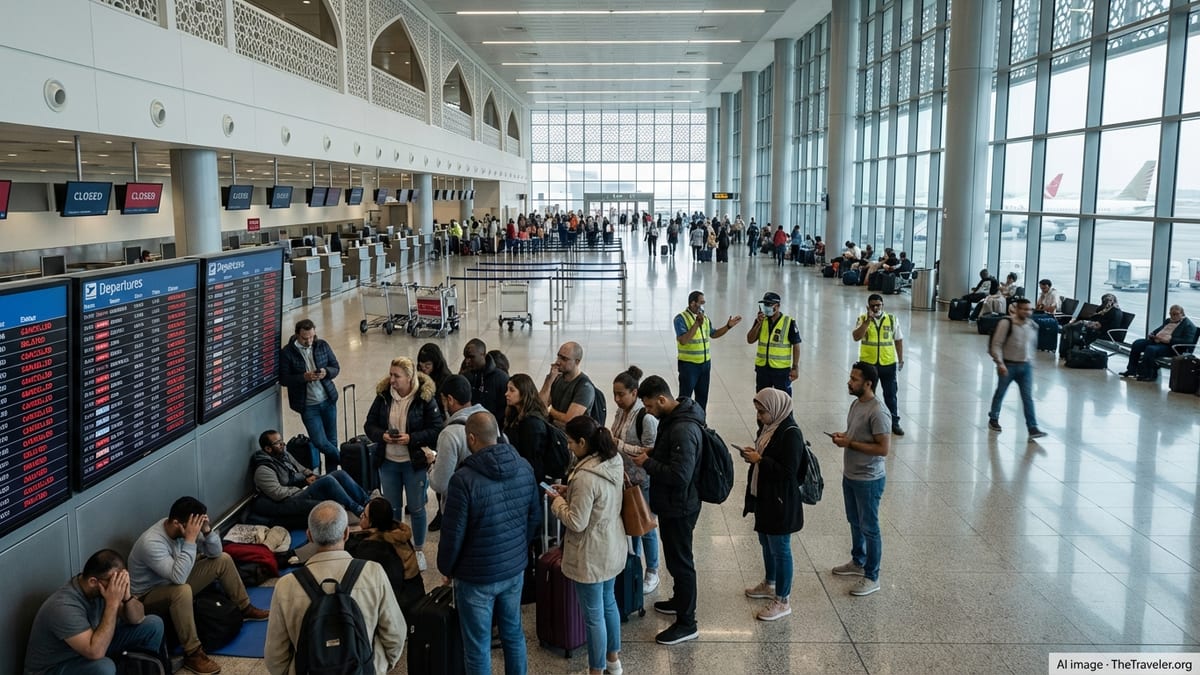
Humanitarian Response to Widespread Flight Disruptions
According to recent coverage in specialist travel and mobility outlets, Switzerland has coordinated a broad humanitarian framework with countries across the Gulf and wider Middle East to address visa problems created by sudden airspace closures and large-scale flight cancellations. The measures target residents and visitors who became stranded abroad or in transit when routes were suspended, leaving many unable to exit or re-enter on time.
Reports indicate that, under the Swiss-facilitated arrangement, partner states including Qatar, Bahrain, the United Arab Emirates, Oman, Egypt, Saudi Arabia and Jordan are temporarily relaxing overstay rules for affected foreign residents. Instead of automatic fines or immigration bans, stranded individuals are being offered pathways to either extend their stay lawfully or complete one-time penalty-free departures and re-entries.
The agreement has emerged alongside parallel moves by individual states to expand grace periods and waive fees for those whose visas expired after late February 2026, when airspace restrictions and rerouted traffic first began to cascade through airline schedules. Publicly available briefings from immigration advisory firms describe these steps as time-limited, crisis-specific concessions intended to keep people mobile and reduce legal uncertainty for employers and families.
Travel industry analysis suggests that Switzerland’s involvement has helped align multiple national responses into a more predictable framework for expats, especially those who hold residence in Gulf Cooperation Council countries but travel regularly through European hubs.
How the Emergency Agreement Works for Expats
While exact procedures differ by country, publicly available information describes a broadly similar pattern for those covered by the new arrangement. Expats whose residence permits or entry visas expired while they were stranded are being allowed to regularize their status on arrival or departure, provided they can show that travel was disrupted by the current airspace and route restrictions.
In many cases, residents of the UAE, Qatar, Saudi Arabia, Bahrain and other participating states who were abroad when their permits lapsed are being given a defined window in which they may re-enter without facing automatic overstay fines. Separate reporting from regional media indicates that some authorities are also waiving penalties for visit visa holders who became stuck in-country after their permitted stay ended due to grounded or heavily delayed flights.
The Swiss-led understanding appears to focus on practical steps at airports and border crossings, such as flagging eligible passengers in advance through airlines, and instructing local immigration desks to treat expired documents associated with the disruption as candidates for exceptional handling rather than immediate sanctions. Mobility law bulletins note that travelers may still need to present proof of prior bookings, cancelled flights or rerouted itineraries when seeking relief.
Experts tracking the situation caution that the measures do not equate to a blanket amnesty. Instead, they are targeted adjustments that give front-line officials flexibility in clear-cut disruption cases, while keeping ordinary visa rules in place for unrelated overstays or status violations.
Qatar’s Role Within the Regional Coalition
Coverage in regional travel media highlights Qatar’s decision to formally align with Bahrain, the UAE, Oman, Egypt, Saudi Arabia and Jordan under the Swiss-brokered framework as part of a wider pattern of coordinated crisis management in the Gulf. Qatar hosts a large expatriate population and functions as a key transit hub, meaning its policies can significantly influence how smoothly stranded travelers in the region are able to move.
Publicly available government guidance summarized in recent commentary points to Qatar offering travel flexibility for residents affected by rerouted or cancelled flights, including options to adjust itineraries and resolve documentation issues without immediately triggering penalties. This sits alongside separate regulatory steps, such as tighter controls on some visa-on-arrival schemes, which analysts interpret as an effort to balance border management with humanitarian exemptions.
By joining the Swiss-led initiative, Qatar effectively signals that residents and visitors caught out by the current disruptions should have access to coordinated solutions that mesh with those in neighboring states. For multinational companies operating across multiple Gulf jurisdictions, this alignment reduces the risk that an employee might be treated leniently in one country but penalized in another while attempting to complete a complex return journey.
Travel commentators note that Qatar’s participation also dovetails with its wider positioning as a regional transit gateway, where clear, predictable rules for irregular journeys are seen as vital for maintaining confidence among airlines and passengers.
Implications for Gulf Residents and Global Mobility
The emergency agreement arrives at a time when Gulf economies remain heavily reliant on foreign workers and frequent cross-border travel. Data cited in regional business coverage show that tens of millions of expatriates live in GCC states, many of whom shuttle between home countries and Gulf hubs on a regular basis for work and family reasons.
Mobility advisers suggest that the current measures provide two immediate benefits. First, they reduce the likelihood that expats will accumulate long-term immigration penalties for circumstances beyond their control, such as sudden airspace closures or cancelled return flights. Second, they give employers more room to manage staffing and rotation patterns without risking that key personnel become stranded, fined or barred from re-entry because a visa expired mid-crisis.
In practical terms, the framework may also ease pressure on consular services, which often become overwhelmed with emergency extension requests when travel routes suddenly change. By giving border authorities structured discretion to accept late departures and arrivals in documented disruption cases, some of that burden is redistributed away from embassies and consulates.
Analysts of the corporate travel sector add that the initiative could serve as a template for future coordination whenever regional tensions or natural events lead to prolonged airspace restrictions, making it easier to preserve continuity for mobile workforces.
What Stranded Travelers Should Watch Now
Despite the positive headlines, mobility experts emphasize that affected expats still need to act carefully and stay informed. Reports from relocation and immigration consultancies recommend that travelers document flight cancellations, rerouting notices and any official travel advisories they receive, as such records can be critical for demonstrating eligibility for fee waivers or special re-entry arrangements.
Individuals are also encouraged in public guidance materials to check the specific rules applying to their host country, since grace periods, cut-off dates and documentary requirements can vary. For example, some Gulf states have tied fine-free re-entry to visas expiring on or after a particular date, while others focus on the length of permitted overstay or the traveler’s existing residence status.
Travel and risk-management advisories further recommend that expats coordinate closely with employers or sponsoring entities, which are often required to validate employment or residence status as part of any exceptional immigration processing. Where possible, travelers are being urged to avoid voluntary overstays unrelated to the disruption, since these are unlikely to receive sympathetic treatment under the emergency measures.
With the crisis still evolving, industry observers expect Switzerland and its Middle Eastern partners, including Qatar, Bahrain, the UAE, Oman, Egypt, Saudi Arabia and Jordan, to continue refining their coordinated response. For now, the joint framework offers a critical safety valve for thousands of residents and visitors, aiming to ensure that disrupted flights and closed airspace do not automatically translate into long-term immigration problems for those caught in transit.