


More news on this day
Amman’s Queen Alia International Airport is experiencing a fresh wave of flight disruptions this week, with mounting cancellations, altered schedules, and growing uncertainty for travelers moving through Jordan’s main air gateway.
Get the latest news straight to your inbox!
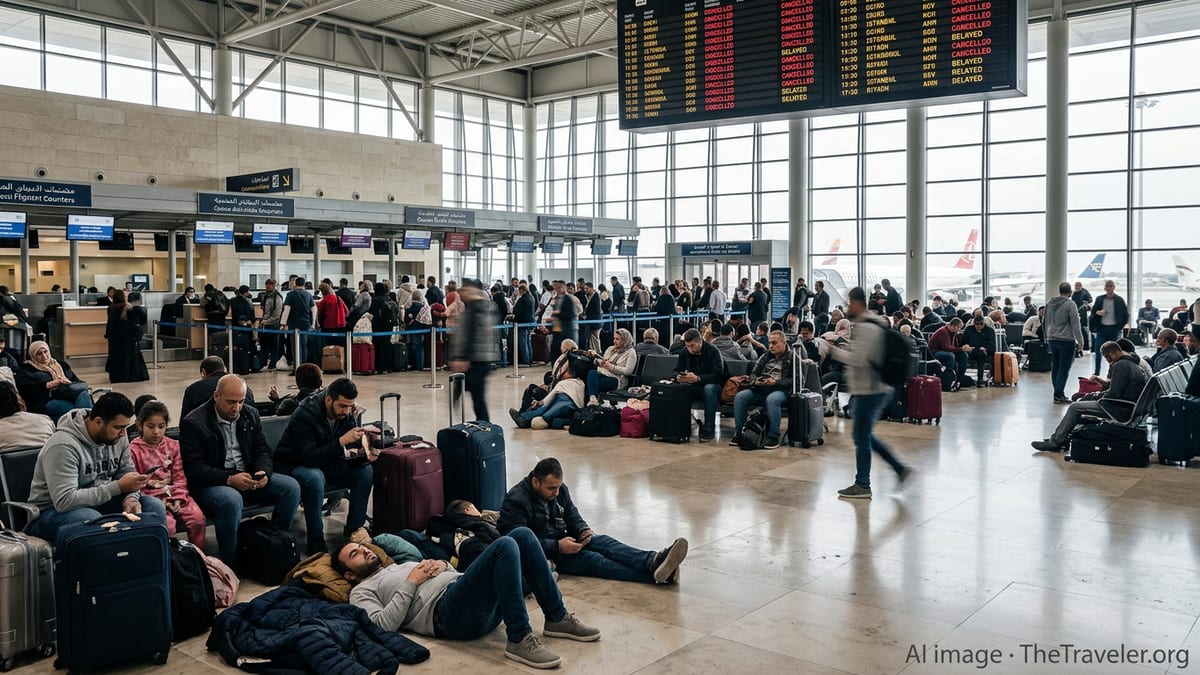
Visible Disruptions Across Key Regional Routes
Live flight-tracking data and airport information boards show a pattern of disrupted operations on some of Queen Alia’s busiest regional routes, particularly services linking Amman with neighboring Middle Eastern hubs. Recent flights between Amman and Beirut, for example, illustrate the volatility, with at least one regularly scheduled Royal Jordanian service from Queen Alia to the Lebanese capital listed as cancelled on July 24, while other departures on the same city pair remain scheduled or operating.
Despite the cancellations, a number of flights from Amman to major regional cities continue to depart and land, signaling that the airport remains open but under pressure. Services to destinations such as Aqaba, Tunis, and Barcelona show a mix of on-time operations and altered timings, illustrating that the current disruption is uneven rather than a full shutdown of traffic at Queen Alia.
Airport aggregation portals that compile live arrivals and departures reflect this patchwork picture, with some flights from different carriers departing close to schedule while others are marked delayed or cancelled. For passengers on the ground, the result is a confusing landscape in which flights on similar routes can be affected in very different ways, often with limited advance notice.
Airlines Adjust Schedules Amid Regional Volatility
Publicly available coverage and travel-industry reporting indicate that several carriers using Queen Alia International Airport have recently reworked parts of their July schedules. One widely cited example is Royal Jordanian, which has cancelled a cluster of departures from Amman to regional destinations including Jeddah, Istanbul, and Dammam during the month, affecting some of the airline’s most important short-haul links.
These adjustments appear to be unfolding against a backdrop of broader regional aviation instability driven by security tensions and shifting airspace restrictions in parts of the Middle East. While Jordanian regulators have repeatedly emphasized that the country’s airspace and its main airport remain open, travelers are still encountering last-minute changes as individual airlines recalibrate capacity, reroute aircraft, or trim frequencies in response to operational risk and demand fluctuations.
Industry analyses of airline disruption patterns suggest that such schedule changes are often driven by a combination of factors, including crew and aircraft availability, the need to consolidate passenger loads on fewer departures, and evolving overflight permissions in neighboring states. At Queen Alia, that has translated into sporadic cancellations and retimed departures that can ripple across connecting itineraries, particularly for long-haul passengers transiting Amman en route between Europe, the Gulf, and North America.
Official Messaging Stresses Normal Operations
Jordan’s Civil Aviation Regulatory Commission has recently underscored that operations at Queen Alia International Airport are continuing normally, with the country’s airspace described as fully open. Public statements from the regulator highlight ongoing coordination between aviation stakeholders to manage any knock-on effects from the wider regional crisis, while also urging passengers facing delays or cancellations to deal directly with their airlines for rebooking and assistance.
This messaging aligns with past performance data that has placed Queen Alia among the more punctual airports in its region, with relatively low historical cancellation rates compared with some neighboring hubs. That track record has helped position Amman as a reliable connecting point, particularly when other airports in the Middle East have faced temporary closures, severe congestion, or airspace restrictions.
The current wave of disruptions therefore stands in contrast to the airport’s reputation for operational stability. Travel forums and passenger accounts over recent months describe Queen Alia as generally functioning, but often with several cancellations showing on arrivals and departures boards on any given day. For many travelers, the experience is one of a working hub that nonetheless requires extra flexibility and contingency planning.
Passengers Confront Uncertainty and Complex Rebookings
For individual travelers, the practical impact of this disruption is being felt most sharply in missed connections, extended layovers, and complicated rebooking processes. Reports from passengers transiting Queen Alia describe situations in which long-haul journeys involving multiple airlines are particularly vulnerable, as a single cancellation on a short regional leg can cascade into missed onward flights to Europe or North America.
Some travelers have opted to proactively reroute away from the region’s most affected corridors, while others continue to rely on Queen Alia as one of the comparatively more stable hubs amid wider Middle Eastern aviation turbulence. Online travel discussions point to mixed experiences, with some passengers encountering smooth transfers through Amman and others seeing last-minute cancellations or multi-hour delays added to their itineraries.
Travel-industry guidance generally encourages passengers heading to or through Amman to monitor flight status frequently in the days and hours before departure, to leave generous buffers for connections, and to ensure that airline contact details and booking references are easily accessible. In the context of ongoing schedule changes, same-day notifications via airline apps or email have become a critical source of real-time information.
What Travelers Should Expect in the Coming Days
Looking ahead, aviation analysts and logistics bulletins point to a period of continued uncertainty for Queen Alia International Airport, even as it remains operational. While there are no indications of a complete shutdown, the combination of regional security concerns, fluctuating demand, and airline-specific decisions suggests that intermittent cancellations and delays are likely to persist in the short term.
Travelers planning to use Amman as either a destination or a transit point in the coming days are being advised by travel advisers and online communities to prepare for potential changes. Flexible tickets, comprehensive travel insurance, and a willingness to accept rerouting via alternative hubs are increasingly seen as prudent measures for those passing through Queen Alia.
For now, the airport continues to serve as Jordan’s primary international gateway, with a substantial number of flights still operating on or close to schedule. Yet the pattern of scattered cancellations across different airlines and routes underscores how quickly conditions can shift in the current regional climate, leaving passengers to navigate a travel landscape where disruption at Queen Alia has become an unwelcome but important possibility to factor into any itinerary.