


More news on this day
Alabama now ranks among the 10 U.S. states with the highest share of disrupted flights, according to recent analysis of federal aviation records, highlighting increased risk of delays and cancellations for travelers departing from the state’s airports.
Get the latest news straight to your inbox!
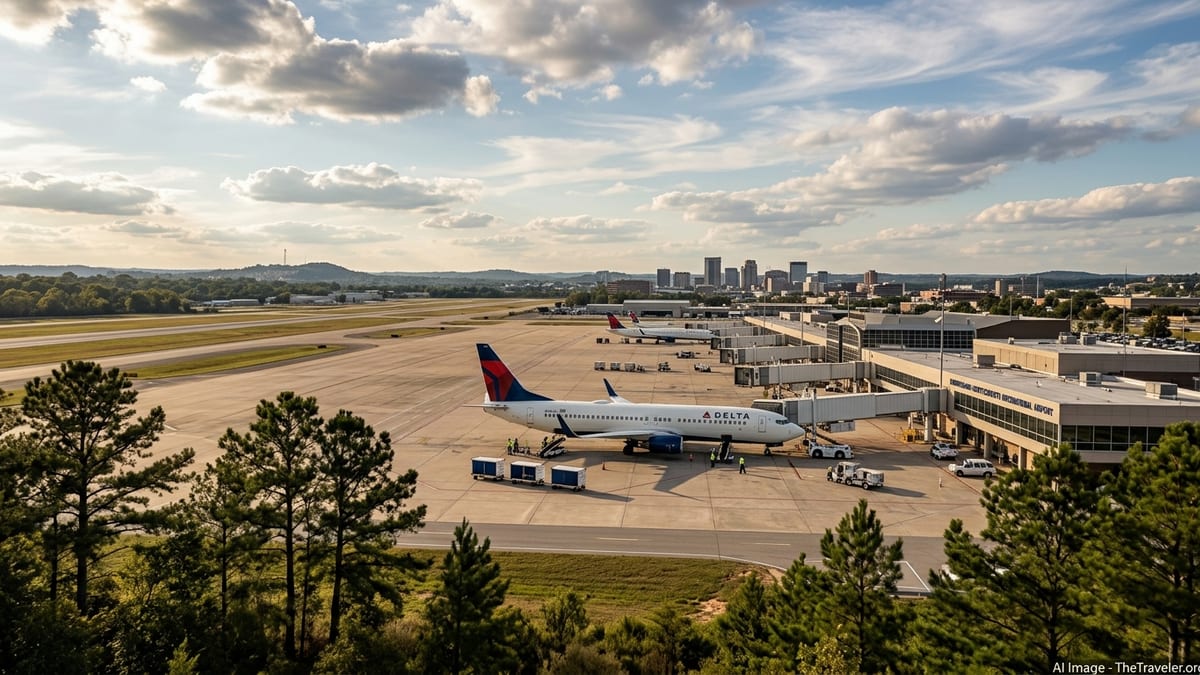
Where Alabama stands in new state-by-state disruption rankings
The latest ranking comes from travel insurance platform Squaremouth, which analyzed federal aviation data on completed flights between July 2025 and June 2026 to calculate the share of departures that were delayed or cancelled. The study placed Alabama in the national top 10 for disruption, with 23.6% of its flights during that period either arriving late or not operating as scheduled. That compares with a U.S. average of 21.7% across all states included in the analysis, meaning roughly one in four flights touching Alabama experienced some form of disruption versus closer to one in five nationwide.
Within the Squaremouth study, Alabama appears alongside states such as Florida, Pennsylvania and several smaller aviation markets that also recorded elevated disruption rates. The state does not top the list, but it is categorized as one of the more disruption-prone parts of the domestic network rather than among the best-performing regions. The ranking is based on origin state, so the statistics reflect flights departing from airports in Alabama, regardless of the operating airline or final destination.
Squaremouth’s report uses government flight records but is not itself a federal publication. The U.S. Department of Transportation and its Bureau of Transportation Statistics routinely release on-time and cancellation data by airline and by airport, rather than by state. That means Alabama’s position in a top 10 state ranking depends on the methodology of this secondary analysis, but the underlying disruption figures are drawn from the same official data sources that feed into federal on-time performance reports.
What is driving disruption at Alabama airports
Alabama’s commercial air service is concentrated at a small number of airports, led by Birmingham-Shuttlesworth International Airport, with additional scheduled service at Huntsville International, Mobile International and a handful of regional facilities. Because the state has a relatively modest volume of daily departures compared with major hubs, a cluster of delayed or cancelled flights at a single airport can have an outsized effect on its aggregate disruption rate. Even a series of weather events or operational issues on busy travel days can shift a state’s ranking when total flight counts are limited.
Federal Air Travel Consumer Reports show that nationally, the main documented causes of delay include carrier-controlled issues such as maintenance or crew scheduling, broader national aviation system factors like air traffic management and routine weather, and a smaller share tied to extreme weather events. Those same categories apply to flights in and out of Alabama. The Squaremouth analysis does not break down the Alabama-specific causes in detail, but national data indicate that airline-related factors and national aviation system constraints together account for the majority of delay minutes, while extreme weather drives a smaller, though sometimes highly visible, portion of disruptions.
Alabama’s location means its airports can be affected by seasonal weather patterns that influence the broader Southeast, including strong thunderstorms during warmer months and occasional impacts from tropical systems in the Gulf region. Even when storms do not directly strike an Alabama airport, disruptions at large hubs that handle connecting traffic from the state, such as Atlanta and Dallas-Fort Worth, can cause knock-on delays and missed connections for passengers starting their trips in Birmingham, Huntsville or Mobile. The new state ranking captures the final result of those interconnected issues in the form of late arrivals and cancellations, rather than pinpointing a single dominant cause within Alabama itself.
How Alabama compares with other high- and low-disruption states
According to the Squaremouth study, the states with the highest disruption rates between July 2025 and June 2026 were West Virginia, with 27.3% of flights delayed or cancelled, and New Jersey at 26.4%. Virginia and Kansas each recorded disruption shares of 23.8%. Alabama, at 23.6%, falls just below that tier but still clearly above the national average. The analysis notes that these differences are based on percentages of disrupted flights, not on total traffic volume, so small or mid-sized aviation markets can appear prominently in the rankings even if they handle far fewer passengers than giants like California or Texas.
By contrast, several states with large aviation networks recorded lower disruption percentages than Alabama during the same period, despite having many more departures. This reflects a combination of factors, including the mix of hub and point-to-point operations, the presence of airlines that emphasize on-time performance, and local meteorological conditions. The study does not adjust for route length, time of day or airport congestion, so its state-level percentages represent a broad snapshot rather than a normalized comparison of like-for-like services.
Analysts caution that the rankings should not be interpreted as a guarantee that a given flight from Alabama will be delayed or canceled. Even in the most disruption-prone states, the majority of flights still operate on time. In Alabama’s case, the data imply that more than three out of four flights during the study period arrived as scheduled. The ranking is best used as a planning indicator for relative risk rather than an absolute prediction of individual flight outcomes.
Limitations of the data and what travelers should know
The state ranking that puts Alabama in the top 10 for flight disruptions is based on a defined 12-month period that ended in June 2026. It does not yet capture performance during late 2026, including the current holiday travel season. Federal data used in the analysis are typically reported with a lag of several months, which means any improvements or deteriorations in on-time performance at Alabama’s airports since mid-2026 are not reflected in the published percentages. Travelers should therefore treat the ranking as a recent historical record rather than a real-time assessment of reliability.
Another limitation is that state-level figures do not distinguish between airports with very different operational profiles. For example, Birmingham-Shuttlesworth handles a wider range of mainline and regional services than smaller Alabama airports, including a significant number of connections via major carriers’ hubs. A traveler who primarily uses one airport may experience better or worse performance than the state average suggests, depending on local infrastructure, airline schedules and dominant route patterns. Detailed airport-by-airport statistics, which are available in Bureau of Transportation Statistics on-time tables and Department of Transportation consumer reports, can provide a more granular view for those willing to consult the underlying federal data.
The study also combines delayed and cancelled flights into a single disruption metric. From a passenger’s perspective, a modest delay and a full cancellation have very different consequences, but both are counted as disruptions in the state ranking. Federal reports show that nationally, outright cancellations represent a smaller share of total flights than delays, and this pattern generally holds across states. For Alabama, the combined figure of 23.6% therefore likely reflects a larger proportion of delayed flights and a smaller subset of cancellations, though the precise split is not separately detailed in the Squaremouth summary.
Practical implications for passengers flying from Alabama
For travelers, Alabama’s position among the more disruption-prone states reinforces the value of conservative planning, particularly during peak travel periods such as Thanksgiving, Christmas, spring break and major regional events. When possible, passengers starting their journeys in Birmingham, Huntsville or Mobile may wish to allow extra connection time at onward hubs, especially if their itineraries involve tight domestic or international transfers. Booking earlier flights in the day can sometimes reduce exposure to knock-on delays that accumulate across aircraft rotations, although this pattern can vary by route and season.
Because the new ranking is grounded in federal flight records, it aligns with broader national findings that nearly a quarter of U.S. flights arrived at least 15 minutes late during the November and December 2025 holiday period. That wider context suggests that disruption risk is not unique to Alabama but is part of a system-wide challenge that can affect passengers regardless of departure state. Alabama’s somewhat higher-than-average disruption rate indicates that its airports sit on the more vulnerable side of that national picture, particularly when severe weather or operational issues ripple through major connecting hubs.
Travelers concerned about disruption-related costs can also look at financial protections. Squaremouth’s analysis notes that travel delay claims in the United States averaged several hundred dollars, most commonly used to cover hotel stays, meals and ground transportation when flights did not operate as scheduled. While those figures are nationwide rather than Alabama-specific, they highlight the type of out-of-pocket expenses that passengers from any state, including Alabama, may face if they encounter significant delays or cancellations.
What to watch next and how to prepare upcoming trips
Looking ahead, the full effect of operational changes by airlines, airports and federal authorities on Alabama’s disruption rate will only become clear as new data for late 2026 and 2027 are compiled and released. The U.S. Department of Transportation continues to publish monthly Air Travel Consumer Reports that track on-time performance, cancellations and causes of delay at individual airports, while separate analyses like the Squaremouth study periodically reassemble those figures into state rankings. Travelers planning trips in 2027 and beyond may see updated lists that confirm or reposition Alabama’s standing once additional months of flight records are incorporated.
In the meantime, passengers flying from Alabama can take several practical steps to navigate the elevated disruption risk reflected in the recent rankings. Checking the historical on-time performance of specific routes and carriers through federal statistics or airline tools, building extra connection time into itineraries where possible, and monitoring forecasts for severe weather in both Alabama and key hub cities can all help reduce the chance that a delay will cascade into a missed connection or overnight stay. For itineraries tied to fixed events such as cruises, tours or important meetings, some travelers may also consider arriving a day early to create a buffer.
Because conditions in the U.S. aviation system continue to evolve, passengers should verify schedule changes and operational updates directly with their airlines and, when relevant, with their departure airports in Alabama shortly before travel. While Alabama’s appearance in the top 10 states for flight disruptions is based on recent and robust data, it remains a backward-looking indicator. Individual trip outcomes will depend on the specific airline, route, travel date and prevailing operational environment on the day of departure, so up-to-date information at the time of booking and again before leaving for the airport remains essential.