


More news on this day
Homeland Security Secretary Markwayne Mullin has faced pointed questioning on Capitol Hill after a rare nationwide Federal Aviation Administration ground stop on November 13, 2026, and a series of high-profile technology outages disrupted air travel, banking, government communications and other essential services across the United States, leaving lawmakers and travelers seeking clearer answers on causes, accountability and future safeguards.
Get the latest news straight to your inbox!
What Happened In The Nationwide Ground Stop
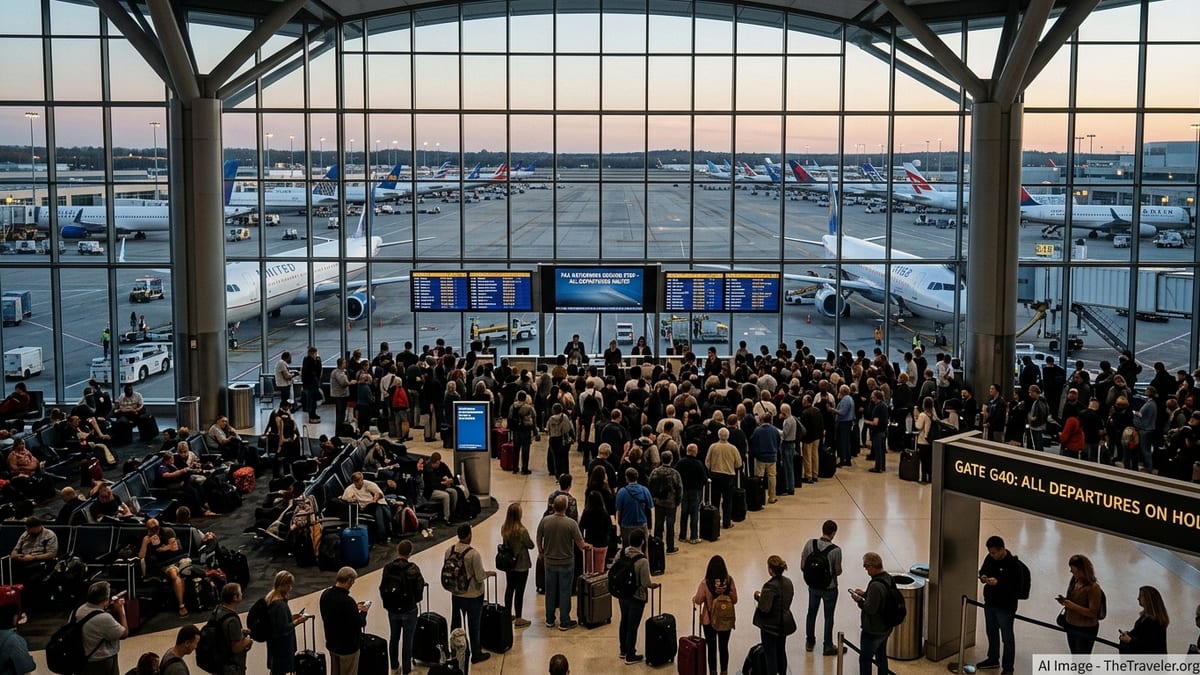
The November 13 event marked only the second time since the September 11, 2001 attacks that the United States has seen a full nationwide halt of civil air departures. According to FAA summaries and contemporaneous reports, the agency ordered a stop to all domestic departures shortly after 3 p.m. Eastern Time after controllers experienced intermittent losses of radar feeds and communications with aircraft across multiple facilities. The ground stop lasted roughly five hours before being lifted shortly after 8 p.m., but disruption continued through the weekend as delayed crews and aircraft rotated back into position.
Subsequent explanations from transportation officials and briefing materials for Congress describe the trigger as a technology upgrade to the air traffic control network that unexpectedly flooded legacy telecommunications equipment with data. Senate Commerce Committee members, in a November 16 letter to the Department of Transportation and FAA, cited briefings that data surges destabilized portions of the FAA Telecommunications Infrastructure, affecting communications and surveillance feeds and forcing the agency to halt departures until safety could be assured. Investigators have since focused on how new hardware and software interacted with older routers and switching equipment, and why early warning indicators did not prompt an earlier, more limited response.
Early estimates from flight-tracking and federal transportation data indicate that thousands of flights were delayed or cancelled as a direct result of the stop and the ensuing ripple effects. Millions of passengers faced missed connections, overnight stays and rebookings stretching into the following week. Major hubs such as Atlanta, Dallas-Fort Worth, Chicago O’Hare and Denver reported extensive queues and gate holds as operations restarted and airlines worked through backlogs, though the specific impact varied by carrier and region.
Congressional Scrutiny Of Mullin’s Response
The political fallout intensified on November 18, when Mullin appeared before the House Homeland Security Committee for an annual hearing on worldwide threats. While the session was formally organized to discuss terrorism, cyber risks and other national security concerns, members from both parties quickly focused on the aviation breakdown and a cluster of unrelated but near-simultaneous technology outages affecting Microsoft cloud services, major U.S. banks and even a classified National Security Agency communications system.
Lawmakers pressed Mullin to clarify the Department of Homeland Security’s role in the response to the FAA incident and whether his department should have had better insight into potential vulnerabilities in the aviation network. Committee members cited earlier public comments by Mullin, including his assurances at a November 13 White House briefing that there was no indication at that time of a malicious cyberattack, as well as his televised remarks emphasizing that outdated equipment was at the heart of the failure. Several representatives questioned why more specific technical information had not yet been shared with the public and why initial statements from different agencies appeared to conflict on whether the outage stemmed from a telecommunications provider problem or internal FAA systems.
Mullin defended the decision to support the FAA-led response, arguing that the priority was maintaining safety while technical teams traced the exact fault. He reiterated at the hearing that, based on current investigations, officials have found no evidence that the ground stop resulted from a coordinated cyberattack. Intelligence and law enforcement leaders testifying alongside him gave similar assessments about the wider pattern of outages. Mullin also stressed that responsibility for day-to-day operation of the air traffic system rests with the Department of Transportation and the FAA, though he acknowledged that DHS has a stake in aviation security and resilience and would be involved in broader follow-up reviews.
Outages Beyond Aviation And Questions About Cyber Risk
The hearing unfolded against the backdrop of a broader November spike in technical problems across multiple sectors. In the week surrounding the November 13 ground stop, U.S. users experienced a significant Microsoft services disruption affecting cloud-hosted email and productivity tools, major banks reported transaction and connectivity issues, and intelligence officials confirmed that a classified internal network at the National Security Agency suffered a temporary outage. While these events were operationally separate from the FAA incident, their timing contributed to public anxiety and shaped the tone of questioning in Congress.
Members of the House committee asked whether the pattern might reflect a coordinated cyber campaign, potentially by a foreign adversary, and whether existing systems for monitoring critical infrastructure were sufficient. Mullin, joined by the Director of National Intelligence and senior FBI officials, told lawmakers that ongoing investigations had turned up no evidence so far that the outages were linked to each other or to hostile cyber activity. Officials instead pointed to maintenance work, configuration changes or equipment failures as the current working explanations for each incident, while emphasizing that forensic reviews had not yet fully concluded.
For travelers, the immediate concern has been the reliability of transportation and payment systems rather than the technical distinctions among the outages. The ground stop pushed back departure times across the country for hours, and as airlines attempted to recover schedules, some passengers also encountered difficulties processing refunds or rebookings when banking and online services were intermittently unavailable. At the hearing, several representatives relayed constituent stories of being stranded in airports while struggling to reach customer service or access digital boarding passes, underscoring how intertwined aviation, financial networks and cloud platforms have become for modern travel.
Controversy Over Mullin’s Football Trip And Use Of Government Aircraft
Another flashpoint in the hearing was Mullin’s decision to fly on a government aircraft to attend a Louisiana State University versus Texas college football game in Baton Rouge on Saturday, November 14, the day after the ground stop ended. News of the trip emerged in the days following the disruption, as travelers continued to report long lines and cascading delays at many airports. Critics argued that the journey displayed poor judgment at a moment when many Americans were still working through travel disruptions that originated under the broader homeland security umbrella.
In testimony and separate media interviews, Mullin defended the travel as consistent with obligations of his office and existing rules governing use of government planes. He told lawmakers that he had approval from the White House and that continuity-of-government requirements meant he needed secure communications capabilities that are more easily maintained on government aircraft. Mullin also argued that canceling the trip could have sent the wrong signal about the safety of flying following the incident, saying he wanted to demonstrate confidence in the aviation system once the ground stop had been lifted.
The optics question, however, has persisted, particularly as reporting revealed that hundreds of flights remained delayed or cancelled on November 14 as airlines sought to reposition aircraft and crews. The Washington Post and other outlets reported that Mullin has said he will reimburse the government for the cost of the trip, though specific accounting details have not yet been publicly disclosed. Several lawmakers at the hearing used the episode to raise broader concerns about transparency, communications discipline and the perception that senior officials were minimizing the ongoing impact on ordinary travelers.
Implications For Travelers And What Comes Next
For passengers, the most practical question is whether another sudden, nationwide halt of flights could occur in the near future. Transportation officials, including Transportation Secretary Sean Duffy and senior FAA leaders, have acknowledged that the November 13 event exposed serious weaknesses in how new technology is integrated into the aging national airspace system. In public statements and in briefings summarized in congressional correspondence, they have pointed to accelerated plans to replace legacy telecommunications infrastructure and to strengthen system redundancy so that a localized failure or overload does not cascade into a nationwide stoppage.
Ahead of the late November Thanksgiving travel surge, FAA officials have highlighted short-term mitigations, including closer monitoring of network loads, stricter change-management procedures for software and hardware updates, and additional staffing in key technical centers during peak travel windows. While these measures cannot eliminate all risk of disruption, they are intended to reduce the likelihood that a similar configuration change would progress far enough to require an emergency national stop. At the same time, congressional leaders from both parties have signaled interest in hearings focused specifically on the FAA’s modernization program, with some already requesting detailed timelines for equipment replacements and contingency planning.
Travelers planning flights in the coming weeks are not being advised to avoid flying as a result of the November 13 disruption, but consumer advocates and airline industry groups alike are encouraging passengers to build in extra time, particularly on peak days, and to ensure they have airline mobile apps, contact numbers and any alternative payment methods available should specific digital platforms experience outages. Because the various November incidents affected different systems at different times, no single vulnerability or provider has emerged as a clear point of failure, and experts caution that resilience will depend on a combination of upgraded infrastructure, clearer interagency coordination and more consistent communication with the public when disruptions do occur.
The House Homeland Security Committee is expected to seek follow-up briefings from Mullin and other officials as technical investigations progress, and the Senate has already requested written responses from the Department of Transportation and FAA about the precise timeline, warnings and decision points surrounding the ground stop. For now, federal officials maintain that there is no evidence of a coordinated cyberattack behind the outages and that air travel remains fundamentally safe, while acknowledging that the November events have shaken confidence in the reliability of the systems that underpin both aviation and the broader travel experience. Passengers considering upcoming trips may wish to check with their airlines for any schedule adjustments related to ongoing recovery, monitor federal transportation advisories, and stay alert to further updates as agencies complete their reviews and propose longer-term fixes.