


More news on this day
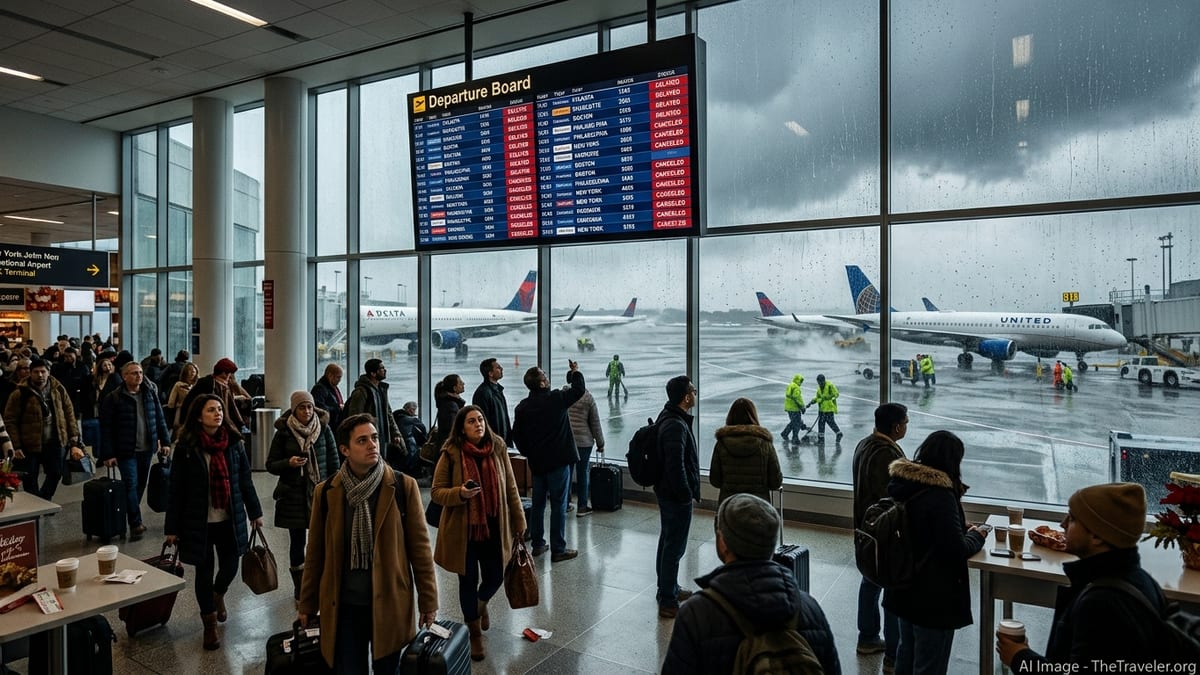
A powerful storm system forecast to evolve into a Thanksgiving nor’easter along the East Coast is expected to bring strong winds, heavy rain, coastal flooding and pockets of snow from the Southeast to New England between Wednesday 25 November and Friday 27 November 2026, creating a high risk of flight delays and cancellations at some of the country’s busiest airports during one of the peak travel periods of the year.
Get the latest news straight to your inbox!
What the Thanksgiving Nor’easter Forecast Shows So Far
Forecasts from the National Weather Service and major private meteorological services indicate that a large storm system will organize over the Southeast on Wednesday 25 November, then track up the Eastern Seaboard on Thanksgiving Day before moving into New England and the Canadian Maritimes on Friday 27 November. As the system strengthens along the coast, it is expected to take on classic nor’easter characteristics, with winds wrapping around the low-pressure center and blowing from the northeast over coastal areas.
Current projections point to widespread rain across the Mid-Atlantic and Northeast urban corridor, including Atlanta, Charlotte, Washington, Baltimore, Philadelphia, New York and Boston over the Thanksgiving period. The Washington Post and other outlets summarizing federal and private forecasts highlight expectations of 1 to 2 inches of rain in many lowland locations, with higher totals possible in localized bands where showers linger. For travelers on the ground, that means wet highways and reduced visibility, while for aviation the primary immediate concern is low clouds, turbulence and reduced runway braking conditions during heavier downpours.
In addition to rainfall, forecasters warn that parts of the interior Northeast, the central Appalachians and portions of the eastern Great Lakes region may see a transition to wet snow or a rain–snow mix as colder air wraps into the system. Accumulating snow is most likely at higher elevations and in areas north and west of major I‑95 cities. While this snow risk is geographically limited, even modest accumulation around secondary airports and along key road and rail links could further complicate multi‑modal travel plans before and after the holiday.
Wind, Coastal Flooding and Where Flight Operations Are Most Exposed
Meteorologists expect the emerging nor’easter to be notably windy, with several forecast discussions pointing to gusts in the range of 40 to 55 miles per hour along portions of the Mid-Atlantic and Northeast coastlines on Thanksgiving Day and into Friday. Time magazine’s summary of forecasts, along with analyses from outlets such as the Washington Post and specialty weather providers, emphasize that these wind speeds are strong enough to trigger operational restrictions at major airports, particularly when gusts are aligned crosswind to active runways.
Airports likely to face the most significant wind-related challenges include New York’s LaGuardia and John F. Kennedy, Newark Liberty, Philadelphia, Baltimore/Washington, Ronald Reagan Washington National, Boston Logan and smaller coastal facilities in New England. At these hubs, strong gusts can reduce the rate at which aircraft take off and land, force changes to runway configurations and require greater spacing between aircraft for safety, all of which can quickly translate into mounting departure and arrival delays. Even if conditions remain within safety limits, sustained crosswinds and turbulence often prompt airlines to pad schedules or proactively thin operations to maintain reliability.
Coastal flooding is another aspect of the nor’easter that forecasters are monitoring closely, particularly for low-lying sections of the Mid-Atlantic and New England shoreline. Elevated tides and wave action combined with heavy rain could inundate roads that provide access to airports, seaports and coastal rail stations. While large commercial airports themselves are generally protected against routine coastal flooding, travelers using smaller coastal airfields, ferries or driving across causeways should be prepared for temporary closures and detours if water levels rise higher than expected during peak storm tides.
Projected Impact on an Already Busy Thanksgiving Aviation Network
The weather disruption risk comes as U.S. air travel for Thanksgiving 2026 is already projected to be exceptionally busy. The Federal Aviation Administration’s holiday forecast, summarized in a public statement, anticipates the busiest Thanksgiving skies in 16 years, with more than 417,000 flights scheduled nationwide over the nine-day period from 23 November to 1 December. Axios reporting on the FAA figures underscores that this level of traffic leaves relatively little slack in the system when severe weather affects major hubs.
Because the nor’easter is expected to influence a large slice of the East Coast at once, any reduction in runway acceptance rates at hubs such as Atlanta, Charlotte, Washington, New York or Boston is likely to create ripple effects far beyond the storm’s core. Washington Post coverage of the evolving system notes that delays could begin in parts of the East and Midwest even before the storm fully matures, as rain bands and strengthening winds reach major airports on Wednesday and Thursday. This timing places the worst of the expected aviation impact squarely within the peak departure and return windows for holiday travelers.
At the same time, the nor’easter is only one part of a broader, unsettled national pattern. The Weather Channel’s holiday travel forecast highlights additional storm systems affecting parts of the West Coast and interior West around the same time, which could further constrain options for rerouting flights. For travelers, the combined effect is a network where a delay or cancellation in one region can more easily cascade into missed connections and schedule disruptions elsewhere, even if local weather away from the coasts appears calm.
How Airlines, Airports and Authorities Are Preparing
In advance of the Thanksgiving rush, the U.S. Department of Transportation and the FAA have emphasized a series of measures intended to improve holiday resilience, including using traffic management tools to reduce bottlenecks around busy corridors, staffing additional air traffic positions and coordinating closely with airlines on schedule planning. The FAA’s Thanksgiving travel advisory specifically encourages passengers to check flight status before leaving for the airport and to allow extra time for security and boarding, particularly during early morning and late afternoon peaks.
Airlines typically respond to high-confidence storm forecasts by activating operational control centers, increasing staffing and making targeted schedule adjustments. This can involve consolidating lightly booked flights, substituting larger aircraft on certain routes, adding spare crews and repositioning aircraft ahead of expected impacts. For coastal storms with strong wind components, carriers sometimes issue travel waivers that allow customers to rebook away from peak impact periods without change fees, although such policies vary by airline and are usually confirmed only once the forecast has sharpened.
Individual airports along the East Coast have also been leveraging their own preparation playbooks. These plans often include readying de-icing equipment where wintry precipitation is a risk, coordinating with local transit agencies in case of access disruptions, and staging additional customer service and snow or water removal teams. Some cities have already taken related weather precautions; for example, a major Thanksgiving Eve parade in Charlotte was canceled due to a forecast of high winds and rain, underscoring that municipal authorities are prepared to curtail large outdoor events when hazards become likely. While parade decisions do not directly determine airport operations, they reflect the seriousness with which local officials are treating the broader weather pattern.
What Travelers Should Watch Next
Although confidence is high that a significant storm will affect a broad part of the eastern United States around Thanksgiving, important details remain uncertain, including the exact track of the low-pressure center, the peak wind speeds at specific airports and the precise timing of the heaviest rain and any snow transitions. These factors will heavily influence whether the nor’easter results primarily in moderate, manageable delays or in widespread cancellations at key hubs. Forecasts from the National Weather Service, the Weather Prediction Center and specialized outlets such as The Weather Channel and AccuWeather will continue to be refined through Tuesday 24 November and into Wednesday as new data are assimilated.
For air travelers, the most practical step over the next 24 to 72 hours is to monitor airline apps, text alerts and email notifications closely, particularly if flying into or out of airports in the Southeast, Mid-Atlantic, Northeast or eastern Great Lakes. Passengers with flexible plans may wish to consider moving departures to early Wednesday or delaying return trips to periods when the storm has moved offshore and residual winds have diminished, if their airline offers fee waivers or low-cost changes. Those with immovable travel dates should build in extra buffer time for connections, prepare for the possibility of extended ground delays and have contingency plans in place for overnight stays if connections are missed.
Travelers using trains, long-distance buses or driving along the I‑95, I‑81, I‑90 and other key Thanksgiving corridors should also follow route-specific forecasts, since heavy rain, ponding water and, in some interior locations, wet snow could slow ground movements even if flights remain operational. As of 24 November, there was no comprehensive list of airline waivers or preemptive cancellations tied specifically to the nor’easter, but carriers frequently update their advisories as confidence increases. Anyone traveling into or through the affected regions from Wednesday through Friday should verify their booking details repeatedly, pay close attention to rapidly updated forecasts and remain prepared for conditions that range from minor schedule adjustments to more severe, weather-driven disruptions.