


More news on this day
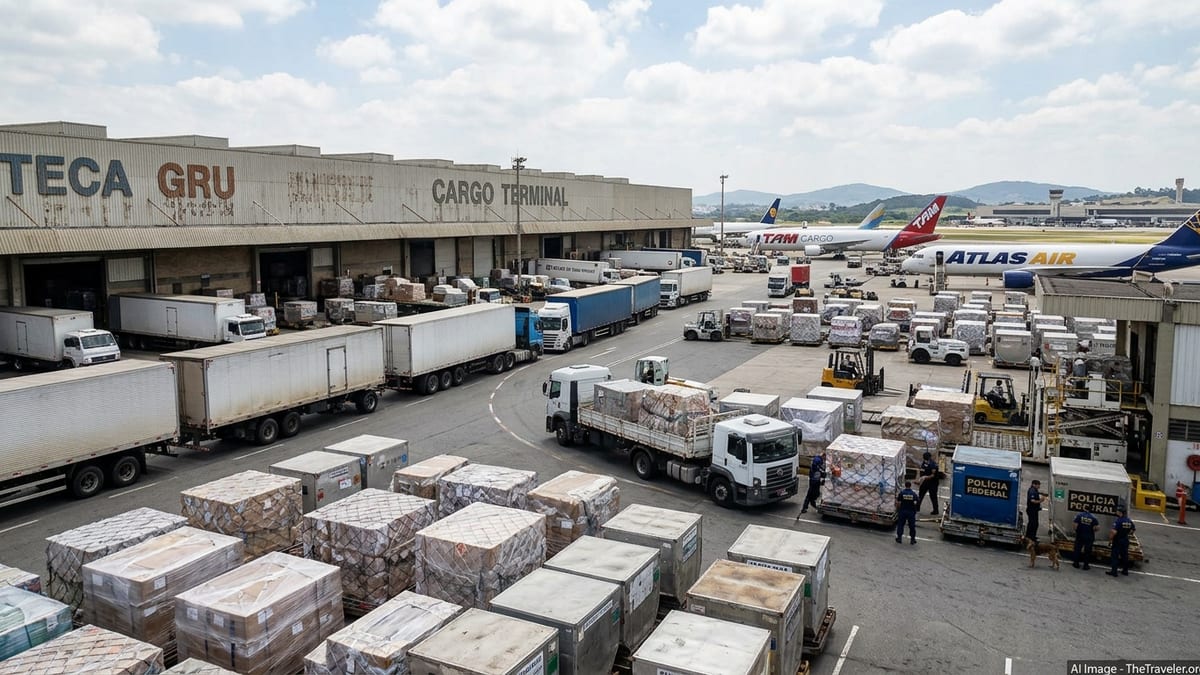
Airfreight operations at São Paulo–Guarulhos International Airport (GRU), Brazil’s largest cargo gateway, are facing significant disruption after a Federal Police operation intensified security checks across the terminal, slowing the acceptance, processing and release of general cargo for both imports and exports.
Get the latest news straight to your inbox!
What triggered the disruption at Guarulhos cargo terminal
According to information shared with freight customers and local trade bodies, the current disruption follows a Federal Police operation carried out at São Paulo–Guarulhos International Airport between 18 and 22 November. During that period, Federal Police teams increased their presence in cargo areas, including storage zones and acceptance platforms, as part of an investigation into criminal activity linked to air cargo movements. While full details of the operation have not been made public, the authorities confirmed that recent actions at the airport target drug trafficking schemes and that inspections of cargo flows and access to restricted areas have been tightened as a result.
These enhanced controls have coincided with an already stretched cargo terminal. GRU Airport’s own communication on cargo handling notes that when security verification processes are intensified, warehouse volumes quickly rise as pallets and loose shipments wait for inspection and clearance. With Guarulhos handling a high share of Brazil’s international airfreight, especially higher‑value manufactured goods and e‑commerce, even short periods of slower processing can lead to queueing trucks, congested yards and delayed collections by airlines and freight forwarders.
Brazil’s civil aviation and transport authorities have monitored bottlenecks at the GRU cargo terminal since late 2024, when a surge in volumes, infrastructure constraints and security checks combined to cause a well‑publicised cargo backlog. On that occasion, the National Civil Aviation Agency and the Ministry of Ports and Airports requested an action plan from the concessionaire to reduce cargo accumulation and speed up flows. The current situation builds on that context but is more directly linked to law‑enforcement activity and intensive inspections by Federal Police and Customs officials along the cargo chain.
How imports are being handled and where delays occur
For importers, the most immediate effect is on the time it takes to receive cargo that has already landed at Guarulhos. Freight operators report that, as of the days following 22 November, there are no large numbers of inbound trucks waiting outside the terminal to unload import freight. Instead, delays are concentrated inside the terminal, at the point between customs clearance and final delivery to consignees or bonded transit facilities. Shipments that have completed customs formalities can still face extended waits before they are physically released and made available for pick‑up.
Terminal management has responded by prioritising the consolidation of import cargo batches before delivery. That means grouping shipments and organising them by airline, consignee or bonded destination to make more efficient use of internal handling resources and truck movements. While this batching strategy can improve overall throughput in a constrained environment, it also lengthens individual lead times between customs release and physical handover, especially for smaller consignments and less urgent traffic.
Freight forwarders and logistics providers note that, in practice, import customers may see an additional delay of several days compared with typical conditions, depending on the commodity and handling requirements. Cargo subject to special controls, such as certain chemicals, pharmaceuticals or high‑value electronics, may experience longer dwell times when they fall within the scope of intensified inspections. However, the current disruption does not involve a blanket suspension of imports, and aircraft carrying import cargo continue to arrive and unload at Guarulhos.
Exports facing more severe congestion and temporary acceptance limits
Export operations are experiencing more visible and acute disruption than imports. Logistics firms active at GRU report that in the days after the Federal Police operation, parts of the export terminal have been operating at or near full physical capacity. Trucks that arrived at the terminal as far back as the end of the week of 18 November have in some cases had to wait extended periods to unload, with parking areas and internal roads heavily congested.
The congestion has several knock‑on effects. When yards and dock areas are blocked, trucks cannot manoeuvre easily to unloading positions, and outbound pallets cannot be moved quickly from storage racks to aircraft build‑up zones. Some airlines have not been able to collect all of the export cargo assigned to their flights, leaving additional freight on hand and further reducing the space available for new shipments. In this environment, the terminal’s capacity to accept fresh export bookings is constrained, and shippers are seeing more frequent rescheduling of flights or reallocation of cargo to later departures.
Statements shared with customers in Brazil indicate that general dry cargo is the most affected segment. Perishable exports such as fresh food are being prioritised for acceptance and movement through the terminal, in line with typical contingency measures at air cargo hubs. This mirrors earlier restrictions implemented at Guarulhos in November 2024, when a separate period of congestion led airport authorities to temporarily embargo non‑perishable international cargo and accept only time‑sensitive categories such as perishables, pharmaceuticals, live animals and critical aircraft parts. While the current disruption is distinct and rooted in police activity, operators again report a practical hierarchy that favours cargo with strict temperature or shelf‑life constraints.
Role of authorities and airport operator in managing the backlog
Federal Police and Customs officers are presently conducting more extensive inspections across multiple points of the cargo chain at Guarulhos, including airline storage areas and cargo acceptance platforms. This involves both documentary checks and physical inspections, adding time to processes that are normally highly sequenced and time‑critical. Security verification systems used by the Federal Police for export screening have been a particular focus in recent months, and industry circulars in 2026 have highlighted periods when these systems were temporarily unavailable or restarted, contributing to fluctuations in terminal productivity.
The airport concessionaire, GRU Airport, manages the main cargo terminal complex, known as TECA GRU, which handles imports, exports and specialised traffic such as pharmaceuticals and high‑value goods. In earlier episodes of congestion, the concessionaire coordinated with regulators to introduce temporary measures including limits on the receipt of new export shipments, the opening of additional storage facilities for dry cargo and incentives to encourage cargo pick‑up on weekends. Authorities at the time stressed that they expected a concrete action plan to reduce backlogs and that administrative measures against the operator could be considered if service levels did not improve.
For the current disruption, no formal end date has been communicated by the airport or law‑enforcement agencies. Market advisories from freight operators state that export operations remain congested and that a timeline for full normalisation of cargo flows has not yet been defined. The Federal Police have signalled that their investigations into criminal schemes using the airport will continue beyond the initial 18 to 22 November operation window, suggesting that heightened scrutiny of cargo movements could remain in place even as the terminal works to clear its existing backlog.
Implications for shippers and how to plan movements via GRU
For shippers using Guarulhos as an export gateway, the main practical consequence is increased transit time and reduced flexibility in scheduling departures. Forwarders are warning customers to expect shipment rescheduling and, in some cases, partial uplift of booked cargo when flights depart with only a portion of the planned freight due to handling delays. Clients moving general cargo out of Brazil are being advised to plan with longer lead times and to check on uplift status more frequently in the days before scheduled departures.
Some logistics providers recommend evaluating alternative routings via other Brazilian gateways such as Viracopos or Rio de Janeiro for time‑critical exports, subject to service availability and cost considerations. During the November 2024 congestion episode, those airports were frequently used as alternatives while Guarulhos applied strict limits on the receipt of non‑perishable cargo. While there is no broad official embargo on exports in the current situation, the combination of security checks and physical congestion means available capacity at GRU is tighter than usual, and opportunities to reroute through less affected terminals may help certain supply chains maintain reliability.
Importers should anticipate that cargo which has arrived in Brazil and cleared customs at Guarulhos may still need several additional days before it can be collected from the terminal. Companies with just‑in‑time production lines or tight distribution windows are being encouraged by logistics partners to monitor shipment status closely and, where possible, build buffer stock or flexibility into downstream operations. For sensitive goods, including pharmaceuticals and temperature‑controlled cargo, the prioritisation applied by the terminal and airlines should mitigate the worst delays, but senders are still advised to confirm specific handling arrangements on a shipment‑by‑shipment basis.
Looking ahead, airport and government statements suggest that measures to improve cargo handling at Guarulhos, such as capacity expansions in storage and digitalisation of processes, remain on the agenda, but timelines and concrete projects are not directly tied to the present disruption. For now, the most immediate step for affected customers is to stay in close contact with their airline or freight forwarder, verify routings and estimated transit times before dispatch, and be prepared for short‑notice adjustments while law‑enforcement checks and terminal operations gradually stabilise.