


More news on this day
Millions of Americans heading out for Thanksgiving 2026 are facing a complicated mix of coastal storms, record king-tide flooding, recent aviation technology failures and the most expensive holiday airfares in at least a decade, creating one of the most fragile travel environments in years for the peak period from Tuesday, November 24, through Monday, November 30.
Get the latest news straight to your inbox!
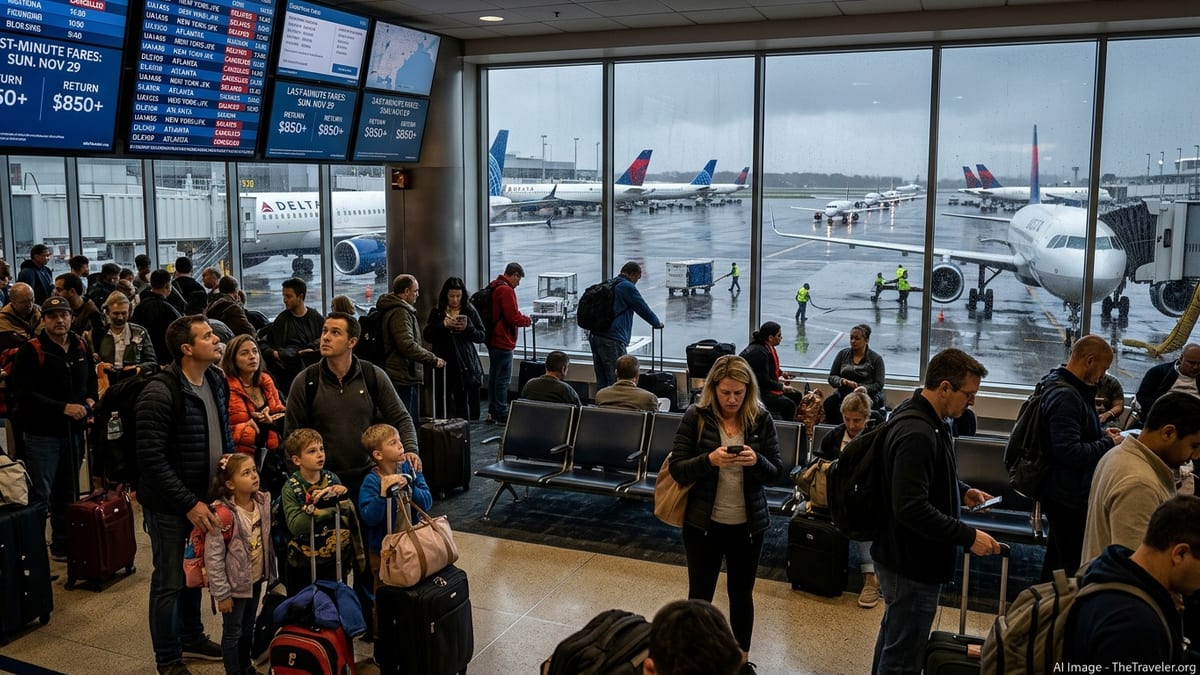
Heavy demand and higher prices on the busiest travel week
Thanksgiving week air traffic is expected to reach its highest level since before the 2008 financial crisis, with federal forecasts pointing to more than 400,000 commercial flights scheduled nationwide between November 23 and December 1. Domestic round-trip airfares for Thanksgiving departures are averaging about 400 dollars, roughly one-third higher than in 2025 and the steepest Thanksgiving pricing in at least a decade, according to recent booking analyses. Travelers who have not yet locked in flights for return on Sunday, November 29, face particularly elevated prices, as that date is tracking as one of the costliest single travel days of the year.
On the ground, overall holiday mobility is also running near record levels. The latest national forecast from a major U.S. motoring organization projects roughly 81.5 million people will travel at least 50 miles from home between Tuesday, November 24, and the Monday after Thanksgiving, only marginally below 2025 and still close to an all-time high. That volume, combined with higher fuel and operating costs for airlines, helps explain why both roads and skies are likely to feel crowded even before weather and operational problems are factored in.
For travelers, the combination of high demand and high fares limits flexibility. With many Thanksgiving-period flights already heavily booked, same-day rebooking options after cancellations or long delays are scarcer than in quieter months, and fare differences for last-minute changes can be substantial compared with normal shoulder-season travel.
Recent FAA and airline tech failures heighten reliability concerns
The busy holiday period follows a series of high-profile aviation technology problems that have shaken confidence in the resilience of U.S. air travel systems. Earlier in November, the Federal Aviation Administration ordered a nationwide ground stop that lasted more than four hours after a failure in key communications infrastructure supporting its data networks. It was the third time in a quarter-century that the agency resorted to stopping most domestic departures nationwide, after the September 11, 2001 shutdown and a January 11, 2023 outage in the Notice to Air Missions system.
In the days since that federal disruption, individual airlines have faced their own technology issues just as Thanksgiving travel has ramped up. Delta Air Lines experienced a significant outage at its largest hub on Sunday, November 22, tied to a malfunction in software used for dispatch and aircraft performance calculations. The disruption briefly halted some departures and led to rolling delays and a wave of aircraft and crew misalignments. United Airlines reported problems the following day that affected its ability to process flights on schedule, again leading to delays across parts of its network.
Both carriers reported that operations had stabilized by Monday, November 23, and the FAA has emphasized that the recent airline-specific disruptions were not caused by air traffic control systems. However, the closeness of these events to the peak holiday period is prompting federal officials to publicly underscore the steps being taken to reduce the risk of cascading delays, including expanded staffing at key air traffic facilities and wider use of congestion prediction tools. For travelers, the recent outages are a reminder to monitor flight status frequently, download airline apps that can rebook disrupted trips and consider building longer connection times into complex itineraries over the holiday window.
East Coast storm threatens parades, flights and road travel
The most immediate risk to Thanksgiving travel in 2026 is a coastal storm forecast to track slowly up the Eastern Seaboard from Wednesday into Friday. Meteorologists at the National Weather Service and private forecasting services expect heavy rain, strong onshore winds and pockets of coastal flooding from the Carolinas through New England, with the worst conditions varying by location between late Wednesday, November 25, and Friday, November 27. Forecasts as of Tuesday, November 24, indicate that rain and wind will intensify along the Carolinas and mid-Atlantic coast on Wednesday before spreading toward the New York City and Boston areas during Thanksgiving Day and into Friday.
The system’s timing is especially sensitive for New York City’s 100th Macy’s Thanksgiving Day Parade, scheduled to begin at 8:30 a.m. on Thursday, November 26. City regulations prohibit flying full-size character balloons if sustained winds exceed 23 miles per hour or gusts rise above 34 to 35 miles per hour along the route. Current projections suggest that the heaviest rain may hold off until later on Thursday, but that wind gusts could approach the upper permitted range during parts of the morning. Parade organizers are coordinating with city agencies and rely on real-time wind measurements along the route, meaning final decisions on whether balloons fly at full height, fly lower or are grounded altogether will likely be made shortly before the event starts.
Beyond the parade, the same storm threatens to disrupt air and road travel across much of the Eastern United States. Periods of strong crosswinds and low cloud ceilings can slow airport operations from major hubs such as Atlanta, Charlotte, Washington, Philadelphia, New York and Boston, which in turn can ripple across the national network when aircraft and crews are delayed. On the roads, low visibility, ponding on highways and scattered coastal flooding are all possible, particularly in low-lying neighborhoods in cities such as Charleston and Norfolk, and in parts of coastal New Jersey and Long Island. Travelers driving on Wednesday evening and through Thanksgiving Day in affected regions are being advised to allow additional time and check local advisories for road closures or coastal inundation.
West Coast flooding and mountain snow add regional complications
The West Coast is grappling with its own weather hazards as Thanksgiving travel peaks, driven less by a single large storm than by a combination of king tides, saturated ground and incoming Pacific systems. In Northern California, the National Weather Service and state emergency officials report that high astronomical tides, enhanced by current ocean and climate patterns, are already flooding some low-lying coastal and bayside communities. Forecasters caution that later this week those tides could reach or exceed levels not seen in decades, particularly around the San Francisco Bay shoreline and along parts of the state’s northern coast.
San Francisco International Airport, which sits on reclaimed land along the bay, has activated flood preparedness plans that include inspecting and, where needed, deploying pumps, clearing drainage channels and readying temporary barriers and sandbags in areas that are most vulnerable to water intrusion. While these measures are designed to keep runways and taxiways open, very high tides coinciding with heavy rain or onshore winds can still complicate ground operations, slow baggage handling and limit vehicle access to some airport roads and parking facilities.
Farther north, in the Pacific Northwest, forecasters expect rounds of rain at lower elevations and heavy snow over the mountains, particularly along travel corridors such as Interstate 90 east of Seattle. Snowfall in the Cascades and northern Rockies, along with periods of freezing temperatures, may require chain controls or temporary closures over mountain passes, affecting drivers heading to and from inland destinations. While these impacts are expected to be more localized than the East Coast storm, they can still create significant delays for travelers on heavily used routes and complicate logistics for airlines serving smaller regional airports.
What travelers can realistically do next
For those who have not yet departed, the evolving weather and operational picture means there is still value in adjusting plans within the constraints of available options. On the East Coast, passengers with flexible tickets might consider shifting flights away from the worst forecast periods, such as late Wednesday night into Thursday morning at coastal airports directly in the storm’s path. Where airlines have issued weather waivers, travelers may be able to change to earlier or later departures without paying standard change fees, although fare differences can still apply on heavily booked routes.
At airports nationwide, federal security guidelines continue to recommend arriving at least two hours before scheduled departure for domestic flights and three hours for international journeys. Given the combination of near-record travel volumes, ongoing staffing challenges in some airport operations and the risk of weather-induced backups at check-in and security, many local authorities and carriers are urging travelers to treat these as minimums rather than targets, particularly on peak days such as Wednesday, November 25, and Sunday, November 29. Leaving extra time is one of the few aspects of the holiday journey that remains fully within passengers’ control.
On the road, motorists in storm-affected regions can reduce risks by scheduling drives for the relative lulls between the most intense periods of wind and rain, where forecast guidance allows. In coastal areas, checking tide forecasts and local flood advisories before setting out is particularly important this week, as king tides and onshore winds can flood streets that are normally passable at high tide. In mountain areas across the West and interior Northeast, drivers should verify pass conditions, carry appropriate winter gear and allow for the possibility that snow and ice will slow travel over summits even if valley locations remain merely wet.
Across all modes, the key theme for Thanksgiving 2026 is that the system is under more strain than usual, from weather, infrastructure and demand. Travelers who closely monitor forecasts and flight status, build extra time into connections and departures, and keep contingency plans in mind will be better positioned to navigate what is shaping up to be a complex but manageable holiday travel period, provided the most severe weather and technical risks do not converge at the same time and place.