


More news on this day
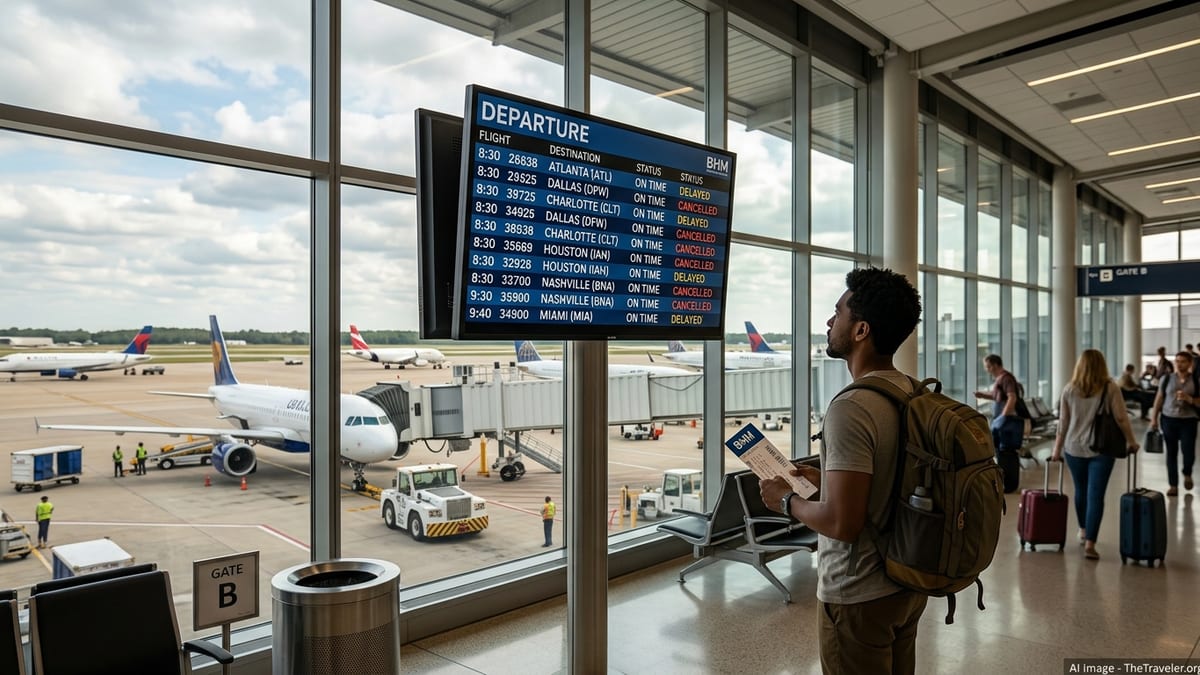
Alabama has emerged among the U.S. states with some of the highest rates of flight delays and cancellations, according to recent analyses of federal on-time performance data that highlight growing reliability concerns at key airports including Birmingham-Shuttlesworth International.
Get the latest news straight to your inbox!
What the latest delay and cancellation data actually show
The newest national data on flight punctuality come from the U.S. Department of Transportation’s Air Travel Consumer Reports and from aggregated on-time performance databases that organize Bureau of Transportation Statistics records by airport and state. While federal reports primarily rank airlines, not states, third-party compilers using the same raw data have assembled state-by-state views of flight disruptions. In those rankings, Alabama consistently falls into the top 10 states with the highest combined share of late arrivals and cancellations over the most recent full-year periods available.
At Birmingham-Shuttlesworth International Airport, the state’s largest commercial facility, compiled destination statistics for 2024 show that roughly three-quarters of flights arrived on time while more than one in five arrived late enough to be classified as delayed. A further small share were canceled. That pattern leaves Alabama with a noticeably higher disruption rate than many other states when figures are grouped by passengers’ origin or destination, even though the airport is relatively small compared with major hubs.
Because federal regulators do not publish official state league tables, any ranking of states reflects methodological choices by private analysts. In this case, the top-10 placement for Alabama is based on the percentage of delayed and canceled flights touching the state’s airports, rather than absolute numbers of disrupted passengers. That approach tends to draw attention to smaller markets where each disruption has a larger statistical impact, and it means Alabama’s position should be understood as a relative measure rather than a formal federal designation.
How Alabama compares with other U.S. air travel markets
When measured by total flights, Alabama accounts for only a small fraction of U.S. commercial air traffic, but its proportion of delayed operations is elevated compared with the national average in recent holiday and summer peaks. Nationally, federal data indicate that about 1.5 to 2 percent of scheduled flights were canceled over the most recent reporting periods, while roughly three-quarters arrived within 15 minutes of schedule. At Birmingham-Shuttlesworth, 2024 aggregated figures suggest a lower on-time share and a higher proportion of delayed arrivals than those national baselines, placing Alabama alongside several other smaller states that struggle with reliability despite modest traffic volumes.
These comparisons, however, come with important caveats. Heavily trafficked hubs in states such as Georgia, Illinois, California and Texas handle far more flights and passengers than Alabama’s airports, which means that even if their delay percentages are lower, they may still generate more individual disrupted journeys. In other words, Alabama’s ranking reflects disruption intensity as a share of traffic, not the total number of affected travelers. For passengers deciding where to connect, this distinction is material, since a large hub with robust rebooking options can sometimes offer more flexibility than a smaller airport that depends on a limited set of routes.
Another factor in the comparison is the mix of airlines serving each state. Federal consumer reports show that mainline carriers and their regional partners differ in cancellation rates and on-time performance, and Alabama’s commercial service is dominated by a handful of carriers that route most traffic through major hubs in neighboring states. If those partners experience systemwide issues, the knock-on effects can be felt disproportionately in smaller spoke airports, even though the underlying problems may originate elsewhere in the network.
What is driving disruption risk at Alabama airports
Several structural features help explain why a state with modest air traffic like Alabama can still record a high percentage of late and canceled flights. Geography is one contributor. Although Alabama is not among the most weather-challenged states overall, its airports are exposed to summer thunderstorms, remnants of tropical systems along the Gulf Coast and occasional winter weather that can interfere with operations. Because smaller airports usually have fewer runways and less slack in their daily schedules, even localized storms can trigger a sequence of delays that is harder to absorb than at larger hubs.
Network design is another driver. Much of Alabama’s scheduled service links travelers to major hubs such as Atlanta, Dallas-Fort Worth, Charlotte and Houston. Disruptions at those hubs, whether caused by weather, air traffic control restrictions or airline-specific technology issues, can cascade into Alabama’s airports as inbound aircraft and crews arrive late or are reassigned. In monthly federal breakdowns of delay causes, late-arriving aircraft and carrier-related issues routinely account for a significant share of delay minutes nationwide, and those same patterns apply to spokes feeding large hubs, including those in Alabama.
Operational capacity also plays a role. Smaller airports typically have limited numbers of daily departures on each route, so a single cancellation may mean a lost travel day rather than a short wait for the next available flight. With fewer gates and constrained staffing, recovery from a disruption can be slower, especially when irregular operations coincide with peak holiday travel. As a result, even if an airport’s absolute number of disrupted flights is modest, the percentage impact on its schedule and on individual passengers can be severe, contributing to a higher apparent disruption rate for the state as a whole.
Implications for travelers using Alabama airports
For passengers planning trips into or out of Alabama, the state’s high ranking for delays and cancellations does not mean that most flights will be disrupted, but it does suggest that itinerary choices and timing warrant extra attention. With on-time performance figures at the state’s main airport hovering around the mid-70 percent range for arrivals, travelers booking tight layovers through Alabama or onward from major hubs on the same day face a measurable risk of missed connections if an inbound leg is significantly delayed. Building longer connection windows or choosing nonstop services where available can lower that risk.
Travelers should also be aware that disruption patterns are not evenly distributed across the calendar. Analyses of late 2025 federal data show that nationwide delay rates spike during peak holiday periods such as Thanksgiving and Christmas, and that Sundays tend to see more late arrivals than midweek days. While Alabama-specific breakdowns mirror these broad national patterns only in general terms, the combination of peak seasonal demand and a state that already sits in the upper tier for disruptions suggests that holiday travelers in Alabama may want to allow additional time and consider earlier departures in the day, when schedules are less susceptible to knock-on delays.
Given Alabama’s reliance on connecting service through out-of-state hubs, passengers should monitor not only local forecasts but also conditions at their intermediate airports. Weather systems, air traffic control restrictions or airline technology problems at those hubs can have outsized effects on smaller spokes. Enrolling in airline alert systems, tracking flights through carrier apps and confirming day-of-travel status before leaving for the airport remain key steps for anyone flying to or from Alabama, particularly during busy travel periods.
What to watch next in reliability reporting
Looking ahead, more detailed pictures of flight reliability in Alabama will emerge as additional months of federal on-time data are compiled and released. The Department of Transportation typically publishes Air Travel Consumer Reports with a lag of several months, meaning that full-year 2025 state-related analyses from private compilers are still being updated. Any new airline schedule changes, shifts in carrier market share at Alabama airports or infrastructure improvements could alter the state’s position in future rankings, either by improving on-time performance or by changing the mix of flights included in the calculations.
Travelers should treat Alabama’s current top-10 placement as a snapshot rather than a permanent label. Rankings based on percentages are sensitive to relatively small changes in performance at airports with limited traffic, and different compilers may weigh late arrivals and cancellations differently in their league tables. Before making major itinerary decisions based solely on such rankings, passengers may want to consult the latest federal on-time statistics for their specific routes and carriers, along with recent month-by-month data for Birmingham-Shuttlesworth and any other Alabama airports they plan to use.
As peak holiday and summer travel periods approach, the most immediate step for travelers remains the same: verify the latest performance information close to the date of departure. Because delay and cancellation patterns can shift quickly in response to weather, operational issues or broader network disruptions, up-to-date statistics and real-time flight status alerts provide a more reliable guide for trip planning than any single annual ranking, particularly in a state where a relatively small number of delayed flights can significantly influence the overall picture.