


More news on this day
WestJet has been ordered to pay $2,226.92 to a Canadian couple whose Minneapolis to Vancouver journey arrived nearly 16 hours late, after British Columbia’s Civil Resolution Tribunal ruled the airline failed to prove that strong winds and safety-related maintenance excused it from paying compensation under Canada’s Air Passenger Protection Regulations.
Get the latest news straight to your inbox!
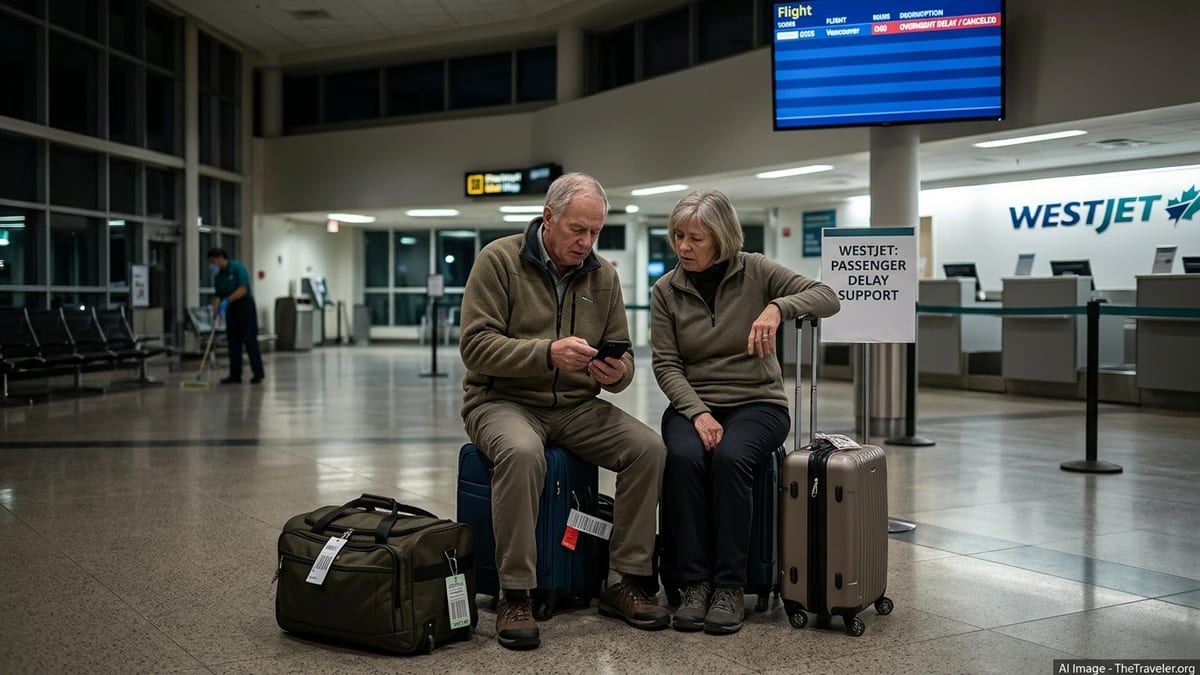
How a one-hour delay turned into an overnight disruption
The case centres on Kevin and Marie Isobel Fraser, who were travelling home to Vancouver from Minneapolis on 6 June 2024. According to the Civil Resolution Tribunal (CRT) decision, their itinerary involved a WestJet flight from Minneapolis to Regina, followed by a connection from Regina to Vancouver later the same day. The first leg arrived in Regina 1 hour and 37 minutes behind schedule, which meant the couple missed their onward connection and could not complete their journey as planned.
With no suitable same-day alternative available, the Frasers stayed overnight in a hotel in Regina before continuing their trip the following day on replacement services routed via Calgary. By the time they finally reached Vancouver, they were almost 16 hours later than their original scheduled arrival time. That length of delay is significant under Canada’s Air Passenger Protection Regulations (APPR), which grant compensation rights on flights operated by large carriers such as WestJet when passengers arrive at their destination nine hours or more behind schedule and the disruption is within the airline’s control.
After the trip, the couple sought compensation from WestJet, arguing that the delay stemmed from factors within the airline’s control. WestJet declined their request, maintaining that the cause of the delay qualified for exceptions under the APPR. The disagreement over whether the disruption was compensable eventually led the Frasers to file a claim with the B.C. Civil Resolution Tribunal, which handles many small consumer and travel disputes in the province.
WestJet’s defence: wind, maintenance and safety exemptions
In its submissions to the tribunal, WestJet argued that it should not have to pay APPR compensation because the delay was the result of circumstances outside its control and, alternatively, maintenance required strictly for safety purposes. The airline said that in Minneapolis, strong winds had pushed a motorised luggage belt loader into the aircraft, damaging the net used to secure baggage in the cargo hold. WestJet contended that this event both qualified as a weather-related circumstance and triggered unplanned safety maintenance on the aircraft.
WestJet told the CRT that because aviation rules require baggage to be properly restrained so it cannot shift during flight, the damaged net had to be addressed before the aircraft could depart. The carrier relied on the APPR provisions that exempt airlines from paying compensation where delays or cancellations are caused either by situations outside their control, such as severe weather, or by genuinely unavoidable maintenance required for safety, even though maintenance itself is technically within the airline’s sphere of responsibility.
To support its position, WestJet supplied an internal “defect report” describing the damage to the aircraft’s aft baggage door threshold net and recording when the net was ultimately replaced. The airline presented this as evidence that an unexpected weather event in Minneapolis had set off a sequence of safety-driven maintenance actions that made the delay non-compensable.
Tribunal’s findings: equipment damage was within airline control
Tribunal member Deanna Rivers closely examined the documentation WestJet provided, particularly the defect report it had put forward to substantiate its explanation. Her written reasons, issued in November 2026, note that the report recorded the pilot’s account of a belt loader damaging the aft baggage door threshold net while the vehicle was moving away from the aircraft on 6 June 2024. The report also described the extent of the damage and identified the resolution as replacing the aft baggage door restraint net in Calgary on 16 June 2024.
Crucially for the outcome, Rivers pointed out that the defect report itself mentioned neither wind nor weather as contributing factors. In her decision, she highlighted that the only clearly identified cause of the damage was the belt loader coming into contact with the aircraft structure. No contemporaneous records linked the damage to adverse weather conditions, nor did WestJet provide additional documentation showing that wind directly prevented the flight from operating on schedule.
Rivers also referred to decisions by the Canadian Transportation Agency that distinguish between truly external events and problems that arise from how airline staff or contractors handle equipment and operations. Those precedents consider that where equipment like ground vehicles is not operated with due care, any resulting delay remains within the airline’s control for the purposes of passenger compensation rules. Adopting similar reasoning, Rivers concluded that even if the baggage-net damage had to be assessed for safety reasons, WestJet had not shown that an unforeseeable weather event caused it. Instead, the available evidence only established that a belt loader damaged the net, making the delay attributable to factors within the carrier’s control.
How the Air Passenger Protection Regulations applied
Canada’s Air Passenger Protection Regulations set out compensation tiers for passengers who arrive late due to reasons within an airline’s control that are not required for safety. For large carriers, the highest band of compensation applies when a passenger reaches their final destination at least nine hours after the original scheduled arrival time. In the Frasers’ case, the near 16-hour delay placed them in this top bracket, meaning that, if the disruption was indeed within WestJet’s control and not strictly for safety, they would be owed $1,000 each.
WestJet argued that the damage fell into two APPR exceptions: as an event outside its control because of the alleged wind, and as necessary maintenance required for safety purposes. The tribunal decision shows how such claims are tested. It is not enough for an airline to label an event “weather” or “safety”; it must present persuasive evidence that adverse conditions or mandatory safety needs were the true cause of the delay and that these were not reasonably preventable through normal care and planning.
In her analysis, Rivers determined that the evidence did not prove an external weather event that made the flight impossible to operate, nor that the maintenance was independent of WestJet’s control. Instead, she found that the belt loader incident was squarely within the realm of ground handling activities for which the airline is responsible. Consequently, the delay was characterised as being within the airline’s control and not one of the limited safety maintenance scenarios that allow carriers to deny compensation under the APPR.
Breakdown of the $2,226.92 awarded to the travellers
Because the couple’s arrival delay exceeded nine hours and the tribunal concluded that the disruption was within WestJet’s control, Rivers ordered the airline to pay the Frasers the maximum APPR compensation applicable in their situation. WestJet must pay $1,000 to each traveller, for a total of $2,000 in statutory compensation arising from the delay between Minneapolis and Vancouver.
The tribunal also considered out-of-pocket costs the couple incurred as a direct result of the disruption. The decision notes that WestJet is required to reimburse $35.28 for taxi fares between Regina Airport and the hotel used for the unscheduled overnight stay. In addition, the tribunal awarded Kevin Fraser $51 because he was seated in a lower class of service on one of the replacement flights routed through Calgary, compared with what he had originally booked.
On top of compensation and direct expenses, the CRT routinely decides whether to award claimants the costs associated with bringing their dispute. In this case, Rivers ordered WestJet to reimburse the Frasers’ $125 tribunal filing fee and $15.64 spent serving documents on the airline by registered mail. Once those amounts are added to the $2,000 in APPR compensation, the total WestJet must pay the couple comes to $2,226.92.
What this ruling means for Canadian air passengers
Although the Civil Resolution Tribunal decision is specific to the Frasers’ journey and the particular facts of a belt loader striking an aircraft in Minneapolis, it provides travellers with a concrete example of how Canadian compensation rules are being applied in practice. The ruling shows that when an airline attributes a long delay to weather or to safety-related maintenance, tribunals will look beyond the label and examine the evidence, including internal operational reports, to see whether the situation was really outside the carrier’s control.
The decision also reinforces that ground-handling incidents can fall within the airline’s responsibility, even when weather is present in the background. For passengers, this means that a disruption linked to equipment such as belt loaders, tugs or other airport vehicles will not automatically be treated as a non-compensable weather event. Instead, adjudicators may assess whether ordinary care by airline staff or contractors could reasonably have prevented the incident and the resulting delay.
For travellers in Canada, the case underlines the importance of documenting delays and following up when compensation requests are denied. Where a passenger believes a disruption was within the airline’s control and meets the APPR time thresholds, tribunal decisions like this one indicate that an independent body may be prepared to scrutinise the airline’s evidence and, if necessary, order payment. As always, passengers should carefully check their eligibility under the current regulations, retain boarding passes and receipts for extra expenses, and be prepared for the possibility that a claim could take time to resolve if it progresses to a formal dispute process.