


More news on this day
Delta Air Lines says it has restored its automated weight-and-balance system after a November 22 outage that triggered a ground stop into Atlanta, slowed departures nationwide and disrupted travel for thousands of passengers at the start of the busy U.S. Thanksgiving period.
Get the latest news straight to your inbox!
What happened to Delta’s automation system
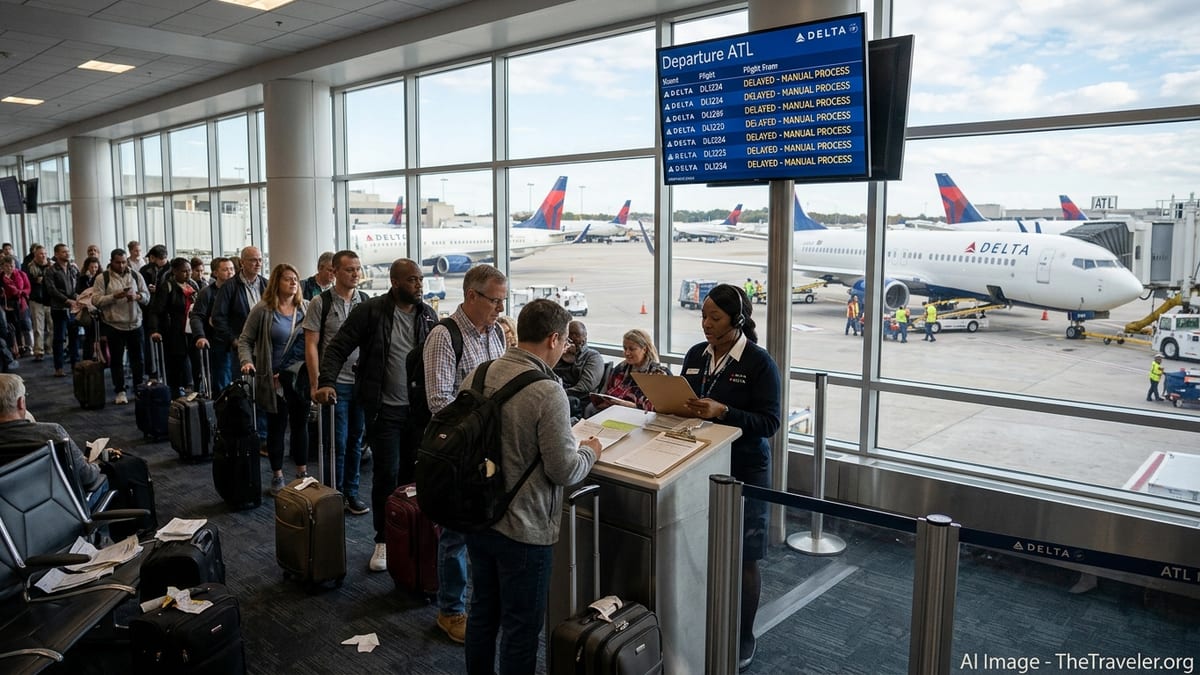
The disruption began on Sunday, November 22, when Delta reported a problem with the automated system it uses to calculate aircraft weight and balance before departure. The carrier said the failure affected departing flights across its network, forcing crews to fall back on manual procedures while technicians worked to restore automation. Complying with weight and balance limits is a standard safety requirement before every flight, and the system is used to check that the aircraft remains within certified weight and center-of-gravity limits.
As the outage unfolded on Sunday morning, Delta asked the Federal Aviation Administration to temporarily halt some operations into its main hub at Hartsfield-Jackson Atlanta International Airport. The FAA imposed a ground stop for Delta flights bound for Atlanta, then downgraded the measure to a ground delay program later in the morning. Advisories indicated that the delay program initially added close to an hour to some departures, with longer waits on individual flights as Delta and airport teams worked through the backlog.
Throughout the day, Delta emphasized in public statements that the disruption was confined to its internal automation systems and was not the result of an FAA air traffic control outage. The airline confirmed that it had implemented what it called “manual workarounds” to perform weight-and-balance calculations flight by flight, allowing departures to continue at a slower pace while efforts to fully restore the automated system continued in the background.
Scale of the delays at Atlanta and across the network
Atlanta, the world’s busiest airport by passenger numbers and Delta’s largest hub, was the focal point of Sunday’s delays. Flight-tracking data from FlightAware showed that by early evening on November 22, nearly 1,250 flights in and out of Hartsfield-Jackson had been delayed across all airlines. Delta said about 70 percent of its own delays and cancellations logged by FlightAware that day were directly tied to the weight-and-balance automation issue, with the remainder attributed to poor weather and air traffic control constraints in the New York and Northeast airspace.
Separate tallies compiled by aviation outlets after the event suggest that more than 1,600 Delta and Delta Connection flights arrived or departed late on November 22 as a result of the system failure and subsequent knock-on effects. On a typical Sunday, Delta and its regional partners operate around 5,000 flights, meaning that roughly one in three services experienced a delay linked at least in part to the outage. While the carrier described the delays at its main hub as “brief” by the end of the day, the disruption was substantial for passengers on the affected flights, with some reporting tarmac waits of several hours before departure.
The impact extended well beyond Atlanta. Passengers posted reports of delays from airports including New York LaGuardia, Newark, Washington Reagan National, Washington Dulles, Boston, Baltimore, Miami, Minneapolis, Nashville, San Antonio, Birmingham, Dallas–Fort Worth, Seattle and Los Angeles. In these locations, Delta crews were also required to complete weight-and-balance paperwork manually, adding extra time before pushback. Although other airlines were not directly affected by Delta’s automation failure, some carriers experienced secondary delays on routes into and out of Atlanta as gates and taxiways became congested while Delta worked through its backlog.
Delta and FAA responses and current status
By late Sunday, November 22, Delta said its automated weight-and-balance system had been restored and that it was focusing on completing the remainder of the day’s schedule. The carrier characterized cancellations as a “last resort” and said it was rebooking impacted customers on the next available itineraries while offering hotel accommodation and meal support where necessary. Customers whose flights were canceled and who chose not to travel were offered refunds under the airline’s standard policies.
The FAA confirmed that the measures taken at Atlanta were at Delta’s request and that the agency’s own air traffic control systems were operating normally throughout the incident. The ground stop, which affected Delta flights inbound to Hartsfield-Jackson, was lifted the same morning and replaced with a ground delay program that gradually eased as Delta’s operations stabilized. Industry tracking services show that the main delay program into Atlanta had ended before midday, although residual congestion continued during the afternoon as aircraft and crews returned to normal rotations.
Some passengers and flight crews reported continued use of manual weight-and-balance procedures on November 23, suggesting that Delta’s automation systems, while nominally restored, were still being supplemented by manual checks on certain routes. The airline has not provided a detailed technical explanation of the initial failure or any subsequent limitations, and as of November 24 no regulator had announced an investigation specifically focused on Delta’s internal systems. For travelers, the key practical development is that the broad, networkwide delays tied to the outage appear to have subsided, with only routine levels of disruption showing in tracking data at Delta’s hubs on November 24.
Connection to this month’s nationwide ground stop
The weight-and-balance system failure at Delta came less than two weeks after a rare nationwide ground stop ordered by the FAA on November 13, which halted nearly all commercial departures across the United States for several hours. That earlier event, which federal officials have linked to problems in the agency’s communications infrastructure, led to more than 15,000 delayed or canceled flights systemwide and affected an estimated hundreds of thousands of passengers. Investigations into the exact technical causes of that outage are still under way, and the FAA has said it is working on further modernization of its systems.
Although the two disruptions were unrelated in technical terms, their close timing has intensified scrutiny of the resilience of both airline-owned and government-operated systems that underpin U.S. air travel. The November 13 ground stop highlighted vulnerabilities in central FAA networks that support air traffic control, while the November 22 Delta outage involved the carrier’s own operations technology, particularly the tools used to calculate aircraft loading, fuel distribution and center of gravity. Aviation regulators have long treated weight-and-balance compliance as a core safety safeguard, which is why airlines maintain manual procedures that can be used when automation fails.
For travelers heading into the Thanksgiving period, the combination of a recent national ground stop and a major airline-specific outage has raised concerns about the potential for further disruption. Transportation and aviation officials have pointed to new congestion management tools and contingency protocols designed to limit the ripple effects of such incidents, but they also caution that high traffic volumes, winter weather and system failures can interact in unpredictable ways. The recent episodes underscore that while automation has greatly streamlined airline operations, it can also become a single point of failure when robust backups and rapid recovery plans are not in place.
What affected travelers can do now and what to expect next
Delta says customers whose travel was disrupted on November 22 and the surrounding days should already be receiving rebooking options or confirmations, either through the Fly Delta app, email or airport agents. Passengers who were rebooked and have completed their journeys can still claim any meal vouchers or hotel coverage that were issued at the airport, subject to the conditions noted on their travel documents. Those who had their flights canceled and chose not to travel can request refunds through Delta’s official channels; in these cases, standard refund rules apply because the cancellations originated with the airline rather than weather or air traffic control.
Looking ahead to the remainder of the Thanksgiving peak, travelers flying with Delta or through Atlanta are being advised by airports, airlines and regulators to build in extra buffer time and to monitor flight status frequently on the day of travel. While Delta’s automation issue has been resolved according to the airline and the FAA, network operations typically remain fragile for at least a day after a large-scale disruption as aircraft and crews are repositioned. Holiday passengers who are connecting through Atlanta, Minneapolis, Detroit, New York LaGuardia or Salt Lake City may want to pay particular attention to minimum connection times and consider earlier departures when possible to preserve options if delays recur.
Regulators and industry analysts expect further information about both the November 13 national ground stop and Delta’s November 22 system failure to emerge in the coming weeks, including any recommendations for technology upgrades or procedural changes. For now, the key message for travelers is that flights are operating relatively normally as of November 24, but the recent incidents illustrate why it can be important to keep itineraries flexible where possible, stay alert to schedule changes and understand airline policies on rebooking and refunds before heading to the airport during peak travel periods.