


More news on this day
An RBE passenger train operating on Myanmar’s Mandalay–Lashio railway line has derailed on the mountain route, disrupting services along one of the country’s most scenic yet technically challenging rail corridors and prompting renewed scrutiny of safety standards on the line.
Get the latest news straight to your inbox!
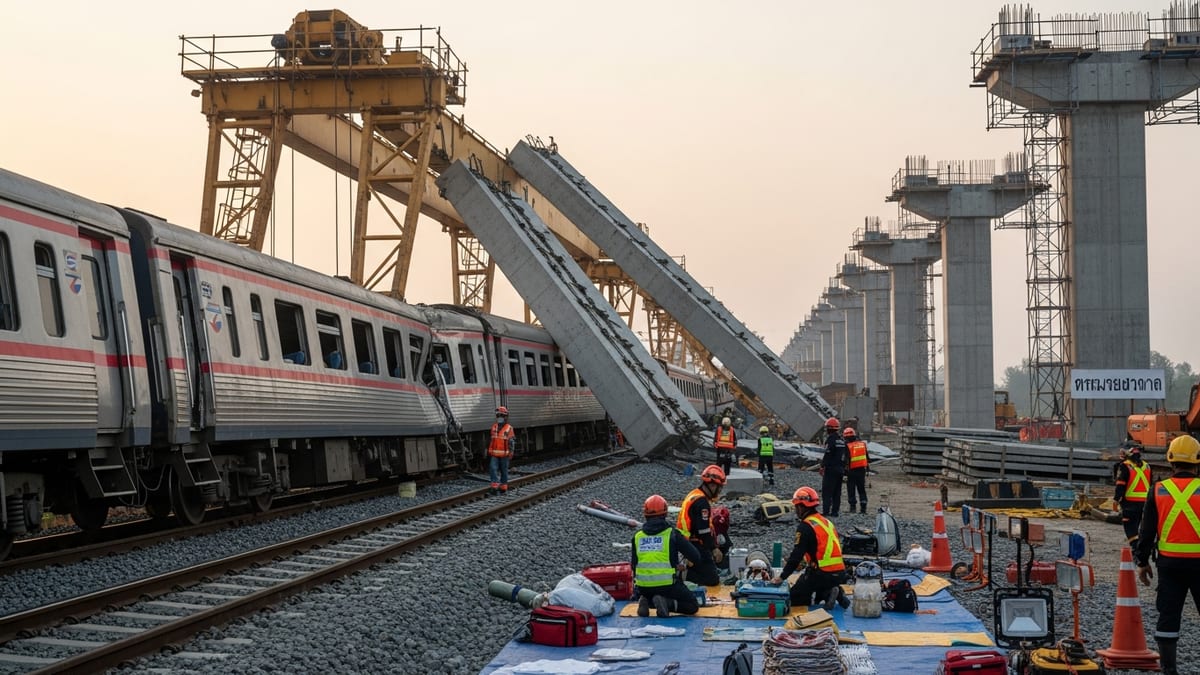
Mountain route incident on key northern corridor
Initial reports indicate that the derailment occurred on a section of the Mandalay–Lashio railway known for steep gradients, tight curves and aging infrastructure. The line, which connects Mandalay in central Myanmar with the hill town of Lashio in northern Shan State, is a crucial inland corridor for both local travelers and regional commerce.
The train involved was reportedly an RBE unit, a type of diesel multiple unit adapted from Japanese rolling stock and widely used on Myanmar’s intercity services. These trains operate as self-contained sets, meaning that damage to one part of the consist can sideline the entire unit and complicate recovery operations.
While detailed accounts of the precise location and cause remain limited, publicly available information suggests that the derailment occurred away from major urban centers, on a rural stretch where track access for heavy equipment is challenging and emergency response can be slow.
Passenger numbers on the Mandalay–Lashio route vary seasonally, with higher demand from domestic travelers, traders and a smaller number of international visitors during the cooler months. Any disruption on the line can quickly ripple through local transport patterns, as alternative road routes in northern Shan State are themselves vulnerable to weather, security considerations and congestion.
Disruption to services and recovery challenges
Following the derailment, services on the affected section of the Mandalay–Lashio railway were suspended while rail workers moved to assess the damage to the track, rolling stock and surrounding terrain. On single track mountain lines, even a relatively contained derailment can force a full halt to traffic until the line is cleared and inspected.
Removing a derailed multiple unit on a hillside alignment typically requires rail cranes or heavy machinery that must be brought in by road along narrow mountain routes. In some past regional incidents on comparable terrain, recovery crews have faced multi day operations to rerail coaches, replace damaged sleepers and restore signaling or communications equipment.
Rail operators on the Mandalay–Lashio line must also consider seasonal weather conditions. Heavy rain can loosen soil and ballast, while intense heat can affect rail stability. Such environmental pressures can extend repair timelines and may require speed restrictions on adjacent sections until full inspections are completed.
For travelers, the immediate impact is a loss of direct rail connectivity between Mandalay, Pyin Oo Lwin and Lashio. Some passengers are likely to be re-routed onto buses or shared vans over the parallel road corridor, which adds time to journeys and may be less comfortable on winding mountain sections.
Safety record and infrastructure constraints
The Mandalay–Lashio railway has a long history dating back to the early 20th century, when it was constructed as part of a northern expansion of Myanmar’s rail network. Its most famous feature is the towering Goteik viaduct, a steel bridge and surrounding diversionary curves that highlight how the line threads through deep valleys and rugged hillsides.
Over time, the combination of aging track, modest maintenance budgets and demanding geography has contributed to a pattern of operational incidents across Myanmar’s network, including derailments on freight and passenger services. Technical studies and development reports have repeatedly pointed to low average speeds, worn rails and limited signaling systems as ongoing challenges for safe and reliable operations.
RBE sets themselves are part of an effort to modernize rolling stock by importing and adapting used trains from abroad. While they offer improved comfort over some older coaches, they still rely on legacy infrastructure, and the interface between heavier or more powerful trains and older track structures can introduce new maintenance and safety considerations.
Analysts of regional rail safety emphasize that mountain lines like Mandalay–Lashio require close monitoring of track geometry, drainage and slope stability, along with consistent inspection regimes. In practice, these safety measures can be difficult to sustain in environments where funding, access and technical resources are constrained.
Implications for travelers and tourism on the Mandalay–Lashio route
The Mandalay–Lashio corridor has long held appeal for rail enthusiasts and adventurous travelers drawn to its dramatic landscapes and historic engineering works. Before the current political and security climate reduced international tourism, the route was promoted as one of Southeast Asia’s classic railway journeys, with slow but scenic rides over viaducts and through hill stations.
Each new derailment or disruption, however, complicates efforts to restore confidence in Myanmar’s long distance rail travel. Even when casualties are avoided or limited, images of derailed carriages and buckled track can reinforce perceptions of risk and unreliability among both domestic passengers and the small number of international visitors still considering overland travel in the country.
In the near term, some travelers may shift to road transport between Mandalay, Pyin Oo Lwin, Hsipaw and Lashio, trading the charm of slow rail travel for potentially faster but less predictable highway journeys. Tour operators that continue to feature the Mandalay–Lashio line in their itineraries are likely to review schedules, contingency plans and advisories provided to clients.
Local communities along the line may also feel the effects. Many small towns and markets have grown up around stations, relying on passenger and light freight traffic. Service suspensions can mean fewer customers on market days, delays in receiving goods and a temporary loss of income for vendors who cater to rail travelers.
Calls for renewed investment and modern safety measures
The latest derailment is likely to intensify discussion around the long term future of the Mandalay–Lashio railway and Myanmar’s broader rail network. Publicly available policy papers and technical assessments have outlined proposals for upgrades ranging from track renewal and improved signaling to the introduction of more modern rolling stock specifically tailored for mountain operation.
Some planning documents have highlighted the strategic value of the Mandalay–Lashio axis within wider regional connectivity schemes linking central Myanmar with northern border areas and, eventually, international rail corridors into neighboring countries. For such ambitions to be realized, higher standards of reliability and safety would be required on existing lines.
Modern approaches to derailment prevention increasingly rely on a combination of better infrastructure, predictive maintenance and operational technology. This can include continuous track monitoring, more frequent ultrasound inspection of rails, and dynamic speed management systems that respond to weather and load conditions. Implementation on legacy lines like Mandalay–Lashio would demand significant capital, training and institutional capacity.
For now, travelers and local communities await full details of the RBE train derailment and the timeline for restoring normal service. The incident underscores how a single mishap on a mountain railway can reverberate well beyond the immediate scene, affecting mobility, livelihoods and perceptions of a region that relies heavily on a fragile but vital stretch of track.