


More news on this day
As heat records fall at busy hubs from Phoenix to Las Vegas, a less visible consequence is rippling through aviation: temperatures so high that aircraft must leave passengers, baggage or even entire departures behind.
Get the latest news straight to your inbox!
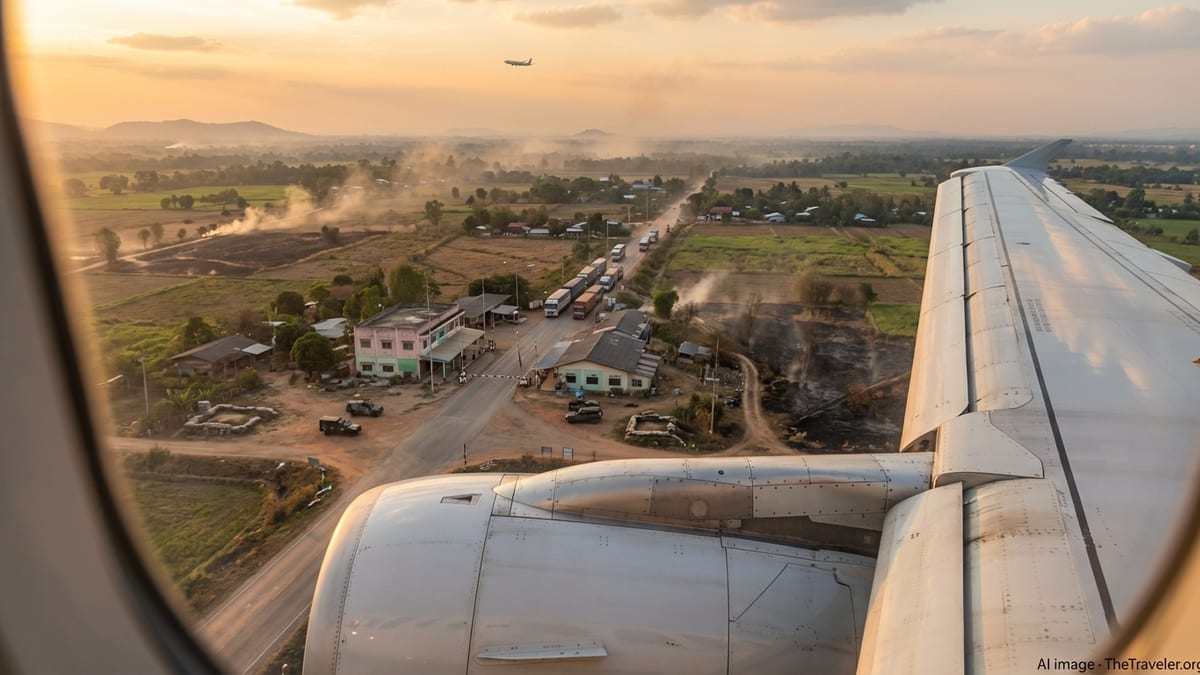
When the air gets too thin for takeoff
On scorching afternoons at so called hot and high airports, the problem is not the runway but the air itself. As temperatures spike, the air becomes less dense, depriving aircraft wings and engines of the thick cushion they need to generate lift. To achieve the same performance, jets must accelerate to higher true speeds and use more runway, a constraint that quickly collides with fixed pavement lengths and nearby terrain.
Aeronautical guidance and safety publications describe this as a high density altitude environment, where the aircraft performs as if it were operating thousands of feet higher than the airport’s physical elevation. At major Western U.S. hubs, summer heat now routinely pushes density altitude to levels that used to be reserved for rare extremes, forcing tighter limits on how much weight a departing aircraft can safely carry.
For airlines, the physics translates into operational choices. If the runway, temperature and aircraft type combine to exceed performance charts at a given weight, dispatchers must remove weight by offloading passengers, cargo or fuel, or by moving the departure to a cooler time of day. Each option has a direct impact on travelers, whether through denied boarding, missed connections or same day cancellations when no workable combination can be found.
Publicly available analyses by meteorological and aviation groups indicate that these margins are being tested more often as heatwaves intensify across North America, Europe and parts of Asia. While modern airliners are certified to operate at very high temperatures, their performance envelopes still assume certain runway lengths and obstacle clearances that some airports increasingly struggle to provide during peak heat.
From Phoenix to Denver, heat reshapes the daily schedule
Recent heat seasons have offered visible examples of how record temperatures can upend normal flight operations. In the U.S. Southwest, local media and industry coverage have documented multiple instances in which afternoon departures from airports such as Phoenix Sky Harbor and Las Vegas Harry Reid faced unusual weight restrictions during prolonged spells above 110 degrees Fahrenheit.
Reports from previous heatwaves describe regional jets taking particular strain, with some flights unable to depart at all during the hottest hours when performance data for certain models no longer covers the observed temperatures. On busier mainline routes, airlines have periodically asked for volunteers to switch to later flights when excess weight must be removed to meet takeoff limits.
Higher elevation hubs in the Rocky Mountain region face a compounded challenge. At Denver International Airport, which already sits over a mile above sea level, past episodes of near record heat have coincided with airlines reducing loads or moving flights to cooler parts of the day. Industry safety briefings note that a modest rise in temperature at altitude can effectively transform the performance environment into that of a significantly higher airfield.
These adjustments are beginning to alter the traditional daily rhythm of flying. Long haul and performance critical departures are increasingly scheduled for early morning or late evening at vulnerable airports, while airlines lean on midday slots for shorter routes and aircraft with stronger hot and high capabilities. For passengers, that can mean fewer nonstop options at comfortable daytime hours to certain cities, especially in peak summer months.
More delays today, more infrastructure decisions tomorrow
While individual heat related disruptions may look like routine weight and balance issues, climate and transport agencies have started to frame them as part of a longer term resilience challenge. International aviation bodies and national transport departments note in recent climate adaptation reports that extreme heat is among the top concerns identified by airports and operators, alongside storms and flooding.
Studies published by research institutions and space agencies over the past decade suggest that, under many climate scenarios, the number of days when aircraft must restrict weight on departure will rise at busy airports worldwide. The projected impact is not limited to a handful of desert hubs: coastal and inland airports at lower elevations are also expected to see more summer days when high temperatures erode performance margins.
For airport planners, that raises questions about infrastructure investments and layout. Extending runways, adjusting taxiway configurations, or rethinking obstacle clearance paths are among the measures being examined in technical literature as ways to preserve capacity when density altitude climbs. However, such projects carry high costs and long timelines, and compete with other climate related priorities such as flood defenses and cooling systems.
Airlines are also turning to operational and fleet based responses. Public planning documents and sustainability roadmaps discuss using newer aircraft with stronger takeoff performance on heat sensitive routes, fine tuning scheduling to avoid the hottest hours, and incorporating climate risk into network design. All of these strategies seek to reduce the risk that a heat spike on a critical afternoon will cascade into widespread delays across a tightly coupled system.
What record heat means for travelers this summer
For passengers, the mechanics of density altitude and takeoff charts are largely invisible, but the consequences show up as text alerts and departure board changes. When temperatures climb beyond seasonal norms, particularly at airports with short or constrained runways, travelers are more likely to encounter weight related gate holds, last minute requests for volunteers, or rebookings to later flights.
Travel industry guidance increasingly recommends that those flying from hot and high locations build in extra time and flexibility during peak heat months. Early morning departures generally offer the greatest buffer against temperature driven restrictions, while tightly timed same day connections through heat prone hubs carry higher risk of disruption when forecasts call for extreme temperatures.
There are also subtler effects on the passenger experience. To stay within safe limits, airlines may cap checked baggage on certain flights, restrict nonessential cargo, or change aircraft types on short notice, leaving fewer seats available than originally sold. Travelers who book far in advance may find themselves moved to different cabins or routings if performance constraints emerge closer to departure.
As heatwaves become a recurring backdrop to summer travel, these once occasional adjustments are becoming more routine. Publicly available climate assessments emphasize that, even as the aviation sector pursues long term emissions reductions, it must also adapt to a near term reality in which higher temperatures are already altering how, when and how reliably aircraft can take off.
A long term test for aviation’s climate resilience
Record breaking temperatures are often discussed in terms of human health, wildfire risk and power demand, but aviation sits at a sensitive intersection of these pressures. Airports are heat exposed workplaces, critical transport nodes and energy intensive facilities, all while serving as the starting point for flights that themselves contribute to warming.
Adaptation efforts underway across the industry reflect this complexity. Airport operators are studying new materials and shading for pavements and gates, terminal designers are revisiting cooling loads, and air navigation providers are examining how more frequent heat induced convective weather may interact with already crowded airspace. Each of these strands connects back to whether flights can depart safely and on time under more stressful conditions.
For now, most disruptions tied directly to heat remain localized and episodic, overshadowed in statistics by delays caused by storms, congestion and staffing. Yet climate planning documents compiled by aviation regulators and international organizations highlight extreme heat as a growing operational constraint that will shape future investments in infrastructure and fleet planning.
As another hot season unfolds, travelers may experience this shift not through sweeping, headline making cancellations, but through a steady accumulation of small frictions: slightly earlier alarms for pre dawn departures, more crowded evening flights, and the occasional announcement that a plane cannot take everyone or everything it was originally meant to carry because the air outside is simply too hot.