


Riyadh’s long-awaited metro has changed how travelers move between King Khalid International Airport (RUH), the King Abdullah Financial District (KAFD), and the rest of the Saudi capital. The Yellow Line, officially Line 4, is the backbone of this airport connection and a powerful alternative to battling Riyadh’s chronic traffic in a taxi. This guide walks you through the route, the terminal stations, KAFD links, ticketing, luggage rules, operating hours, and when it makes more sense to ride the metro instead of hailing a car.
Get the latest updates straight to your inbox!
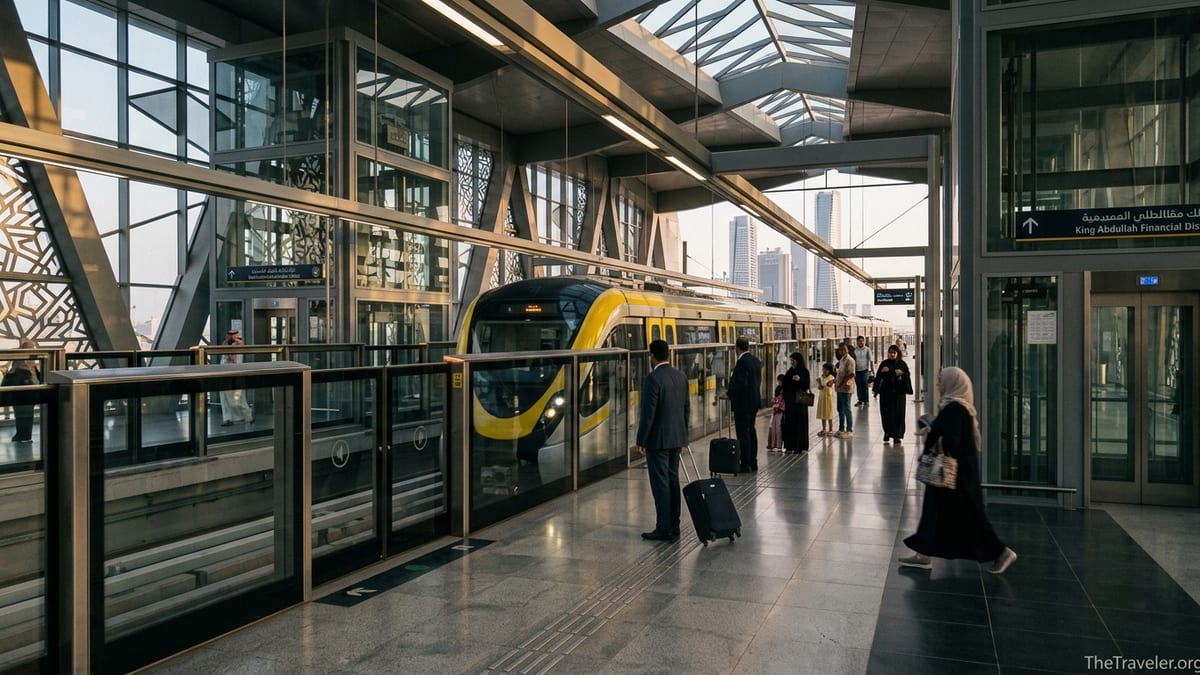
Understanding Riyadh Metro and the Yellow Line
The Riyadh Metro is a six-line, 176-kilometre driverless network designed as the core of the city’s public transport system. Line 4, commonly called the Yellow Line, is the airport line that runs along King Khalid International Airport Road and links directly to the King Abdullah Financial District. For visitors flying into Riyadh, this is the line that matters most, because it is the simplest way to get from the plane to the business district without sitting in highway congestion.
The Yellow Line operates as part of an integrated system with the Blue, Red, Green, Orange, and Purple lines, plus an expanding bus network. In practice, this means you can land at King Khalid International Airport, step onto Line 4, change to Line 1 (Blue) at KAFD or other interchange points, and reach dense central areas such as Olaya, Al Batha, or major universities with one or two easy transfers. The system is fully automated, with platform screen doors, air conditioned stations, and clear English and Arabic signage, which makes it accessible even if it is your first time in Saudi Arabia.
For many business travelers, the Yellow Line turns what used to be a 35 to 60 minute taxi ride from the airport into a predictable rail trip that is usually closer to 25 to 35 minutes station to station in normal conditions. Actual door to door time will depend on immigration, baggage claim, and the distance from the metro station to your final address, but the certainty of a set timetable is one of the main benefits compared with road transport.
Route Overview: From KAFD to the Airport Terminals
The Yellow Line runs between the King Abdullah Financial District in the northwest of Riyadh and King Khalid International Airport to the north of the city. KAFD is a major shared station where Lines 1, 4, and 6 intersect, making it a high-value starting point for business visitors staying in the Four Seasons, nearby tower hotels, or corporate apartments within the district. From KAFD, Line 4 heads north, serving residential and commercial areas such as Ar Rabi and continuing along Airport Road toward the terminal complex.
As you approach the airport, the Yellow Line branches into dedicated airport stations that correspond to different terminal groups. In broad terms, you will encounter stations serving Terminal 5, Terminal 3 and 4 combined, and the older Terminal 1 and 2 complex. The exact list of intermediate stations is less important for most international visitors than understanding which airport stop matches their departing or arriving airline, but signs and onboard announcements consistently reference both the terminal numbers and the airport name.
From central KAFD to the last airport station, journey times typically fall in the 25 to 30 minute range in timetabled conditions. Trains are designed to run at a regular frequency, often every few minutes at peak times, so even if you have just missed a service, the wait is usually shorter than the time it takes to navigate the taxi ranks on a busy evening.
Airport Terminal Stations: T1–2, T3–4 and T5 Explained
King Khalid International Airport currently operates a multi terminal layout in which airlines are grouped into terminal clusters. The metro mirrors this grouping with separate stations that are signposted for T1–2, T3–4, and T5. Each station is integrated into the terminal complex with climate controlled walkways or escalators so that you do not need to leave the secure airport perimeter or cross major roads on foot.
The Terminal 5 metro station sits closest to Riyadh’s main domestic hub, used heavily by Saudia’s internal flights and several other local carriers. If you are flying onward to destinations such as Jeddah, Dammam, or Abha on a domestic ticket, there is a high chance your flight uses T5 and you will follow the metro signs directly into that terminal. Passengers with connecting itineraries from international to domestic flights often find that arriving at the airport by metro and then continuing from T5 means less uncertainty than relying on two separate taxi rides.
The T3–4 metro station serves the cluster of terminals that handle a large share of international services. Many regional Gulf carriers and long haul airlines use these gates, and the station is positioned so that after clearing immigration you can follow overhead signs for “Metro / Line 4” in both English and Arabic. For airlines that still operate from the older Terminal 1 and 2 complex, the T1–2 metro station or the airport’s internal shuttle systems, sometimes branded as “Metro Link” services within the terminal area, provide short connections. For example, if you arrive on an international flight at T3 but depart the next morning on a domestic flight from T5, you can use the internal link and still rely on the Yellow Line for both airport arrivals and departures.
Connections at KAFD and Beyond
KAFD is more than just the end of the Yellow Line. It is one of Riyadh Metro’s flagship interchange stations, designed by an international architecture team and conceived as a multi level node where Lines 1, 4, and 6 intersect. For visitors, this means that a single change of platform at KAFD opens access to key districts without ever stepping outside the controlled environment of the metro system. You can ride Line 4 from the airport, change to Line 1 toward Olaya, and exit within walking distance of major hotels, government offices, and shopping malls.
In practical terms, an international business traveler landing at T3 late in the afternoon could board Line 4 toward KAFD, change to Line 1, and reach stations near King Fahd Road or Al Olaya Street, which are surrounded by hotels and offices, typically within 40 to 45 minutes total travel time from the terminal doors. During the same time of day, a taxi making the same trip can easily sit in slow moving traffic on airport road and the northern ring road, turning a nominal 35 minute drive into an hour or more. For people with fixed meeting schedules or evening events in KAFD, the predictability of the metro can be a decisive advantage.
From KAFD, you can also continue on Line 6 to reach newer northern suburbs as the system expands, or connect with bus rapid transit corridors that spread out into residential neighborhoods. For example, a commuter who lives near the Ar Rabi interchange can ride a local bus to the Ar Rabi metro station, board Line 4 to KAFD, work a full day in one of the financial towers, and then continue directly to the airport in the evening without ever needing a private car. This is precisely the sort of door to door trip pattern the network was designed to encourage.
Tickets, Fares and Payment Options
Riyadh Metro uses a time based fare structure similar to many European and Gulf systems. A standard two hour ticket typically costs in the low single digit Saudi riyal range, enough to cover a one way ride from the airport to KAFD or most central districts as long as you complete your trip within the validity window. For visitors planning a short stay with intensive travel on public transport, multi day passes of three or seven days are available, offering unlimited rides on the metro and associated buses for a flat fee that is usually comparable to the price of two or three basic taxi journeys.
Tickets and passes can be bought through ticket machines inside each station, staffed ticket counters at busy hubs like KAFD and the main airport stops, and increasingly through the official mobility apps promoted by the local transport authority. Machines generally accept both cash and major bank cards, and instructions are displayed in Arabic and English. Many residents and frequent visitors prefer to load credit onto a reusable smart card accessed through the Darb or equivalent public transport app, which allows contactless tapping at fare gates and simplifies transfers between metro and bus.
To understand the value, consider a traveler who arrives on Sunday evening and has meetings across KAFD, central Riyadh, and one of the university districts over three days. Instead of paying individually for each taxi, they could purchase a three day pass for an amount roughly equivalent to two mid distance taxi rides from the airport. By using the Yellow Line to and from the airport plus two or three metro or bus trips each day, the pass quickly pays for itself while also avoiding surge pricing during peak evening traffic.
Luggage, Classes and Station Facilities
Riyadh Metro trains are built with airport travelers in mind. Carriages have wide doors, generous standing space near the entrances, and dedicated luggage areas where you can park medium sized suitcases upright or lay flat larger check in bags. Overhead racks are designed for carry on trolleys and backpacks. On the platforms, clear pictograms show where luggage friendly doors will stop so that travelers can position themselves before the train arrives.
The system uses a three section layout on many trains: family and women only areas, general mixed sections, and sometimes a premium or first class zone. This arrangement is familiar from Saudi intercity services and is intended to give families and solo female travelers greater comfort. For an arriving visitor, this simply means paying attention to the overhead signage on the platform and the icons on carriage doors. If you are traveling as a mixed group or as a solo male passenger, you will follow arrows to the general or first class sections, while women traveling alone may choose to enter the women and families car if they prefer a quieter environment.
Most major stations on the Yellow Line, especially at the airport and KAFD, provide escalators, lifts suitable for wheelchairs and strollers, air conditioned waiting areas, prayer rooms, clean restrooms, and small kiosks selling drinks and snacks. It is common to see people buy a bottle of water or a coffee at the terminal concourse, then follow wayfinding signs directly to the underground or elevated metro platforms. Security checks, where present, are similar to those at large malls: bag scanners or quick manual inspections at the station entrance, handled respectfully and efficiently.
Operating Hours, Frequency and Real World Travel Times
Operating hours for Riyadh Metro are designed to match the city’s workday and social rhythm. Services on most lines begin early in the morning and run until around midnight, with peak frequencies at commute times and slightly longer headways during midday and late evening. The Yellow Line follows this general pattern, starting early enough to catch morning arrivals from nearby Gulf hubs and ending late enough to remain useful for passengers on late evening flights within the region.
Because the system is fully automated, trains tend to keep time closely, and platform screens show countdowns to the next departure. At busy interchanges such as KAFD, airport bound trains on Line 4 can arrive every few minutes during peak periods, which keeps the platforms from becoming overcrowded and reduces waiting time. Even at quieter times of day, typical headways are short enough that most travelers treat the metro as a turn up and go service rather than checking exact timetables.
In practice, a typical trip from T5 to KAFD takes around half an hour of train time. Allow another 10 to 15 minutes to walk from the arrival gate through immigration, collect luggage, and reach the metro concourse, and you can usually be standing on the KAFD platform within 45 minutes of stepping off the aircraft, assuming reasonable airport processing times. By comparison, a taxi performing the same journey in light traffic might be slightly faster door to door, but in the heavy evening peaks or during major events, road congestion can easily turn the ride into an hour or more.
Metro vs Taxi: When the Yellow Line Wins
Deciding between Riyadh Metro and a taxi largely comes down to three factors: time reliability, cost, and personal convenience. On time reliability heavily favors the metro. Traffic on the airport highway can back up without warning due to minor accidents or bottlenecks near major junctions, whereas Line 4 runs on its own right of way with no interference from road conditions. If you have a morning presentation in KAFD or a fixed check in time for a high profile event, taking the metro from the airport substantially reduces the risk of arriving late.
Cost is another clear differentiator. A typical taxi ride from King Khalid International Airport to KAFD or central hotels can cost many times more than a metro ticket, especially at night or during high demand periods. For a solo traveler or a couple with light luggage, the fare savings from using Line 4 both ways can be enough to cover an extra night at a mid range hotel or several meals. For example, a three day unlimited public transport pass often costs less than two full price single trips in an app based car service across the city.
There are, however, moments when a taxi still makes more sense. If you are arriving after midnight, when metro services may be limited or stopped, a licensed airport taxi remains the only direct option. Families with very young children, large groups carrying sports equipment, or travelers staying in neighborhoods far from any current metro or bus stop may find that a single door to door taxi ride is more practical than navigating transfers after a long flight. In many cases, a hybrid strategy works best: use the Yellow Line between the airport and KAFD or a central hub, then complete the last short segment by taxi from the station taxi stands, which are signposted outside most major stops.
The Takeaway
The opening of Riyadh Metro, and particularly the Yellow Line to King Khalid International Airport, has reshaped how visitors and residents move between the terminals, KAFD, and central districts. For many itineraries, Line 4 is now the smartest first choice: it is predictable, affordable, and well integrated with the rest of the network.
If your flight arrives or departs during operating hours, you carry manageable luggage, and your destination is anywhere near KAFD, Olaya, or other metro served corridors, the train will almost always beat a taxi on a combination of reliability and value. You can step off the plane, follow clear signs to the metro, and ride directly into the financial district or beyond without worrying about traffic or haggling over fares.
At the same time, taxis and ride hailing apps still have a role, especially late at night, for very remote destinations, or for travelers with special mobility or baggage needs. Understanding the strengths of each option allows you to mix and match: metro for the long trunk journey, taxi for the short final hop. With a bit of planning, Riyadh’s new rail spine can turn what used to be a stressful airport transfer into a straightforward, even enjoyable, part of your trip.
FAQ
Q1. Does the Riyadh Metro Yellow Line run directly into King Khalid International Airport?
The Yellow Line, or Line 4, has dedicated stations for the airport terminals, including stops serving Terminals 1–2, 3–4, and 5, all connected to the main terminal buildings by walkways and escalators.
Q2. How long does it take to travel from the airport to KAFD on the metro?
In normal conditions, the train journey between the airport stations and KAFD is usually around 25 to 30 minutes, with an additional 10 to 15 minutes needed for airport formalities and walking to or from the platforms.
Q3. Can I use the metro if I have large checked luggage?
Yes. Trains on the Yellow Line include dedicated luggage spaces and wide vestibules that can accommodate standard checked suitcases and carry on bags, and major stations have elevators for easy movement.
Q4. What are typical metro operating hours for flights arriving late at night?
Riyadh Metro generally operates from early morning until around midnight. If your flight arrives after services end, you will need to use a taxi or ride hailing service for that journey.
Q5. Is it cheaper to take the metro than a taxi from the airport?
For most solo travelers and couples, a single metro ticket costs significantly less than a taxi ride from the airport to KAFD or central Riyadh, and multi day passes provide even better value.
Q6. How do I buy tickets for Riyadh Metro as a visitor?
You can purchase single tickets or passes at station ticket machines and staffed counters using cash or bank cards, or through official transport apps that support contactless payment.
Q7. Are there special sections for women and families on the metro?
Many trains use a three zone layout with clearly marked cars for women and families, general mixed sections, and sometimes a first class area, giving passengers a choice of environment.
Q8. Can I reach central hotel districts like Olaya using the Yellow Line alone?
The Yellow Line takes you from the airport to KAFD, where you can change to other lines, especially Line 1, to reach central hotel districts such as Olaya and King Fahd Road with a simple transfer.
Q9. What happens if my metro ticket expires before I exit at my destination?
If your time based ticket expires while you are still traveling, you may be asked to regularize your fare at a help desk or kiosk before exiting, so it is wise to choose a ticket with enough validity for your full journey.
Q10. Is the Riyadh Metro safe and comfortable for first time visitors?
Stations and trains are modern, air conditioned, and monitored, with clear English and Arabic signage, making the system generally safe, comfortable, and easy to navigate even on a first visit to Riyadh.