


More news on this day
A Royal Caribbean cruise sailing the Caribbean this week has dramatically reworked its entire itinerary to stay clear of developing storms, trading its original port calls for a hastily assembled schedule designed to keep the ship in calmer seas.
Get the latest news straight to your inbox!
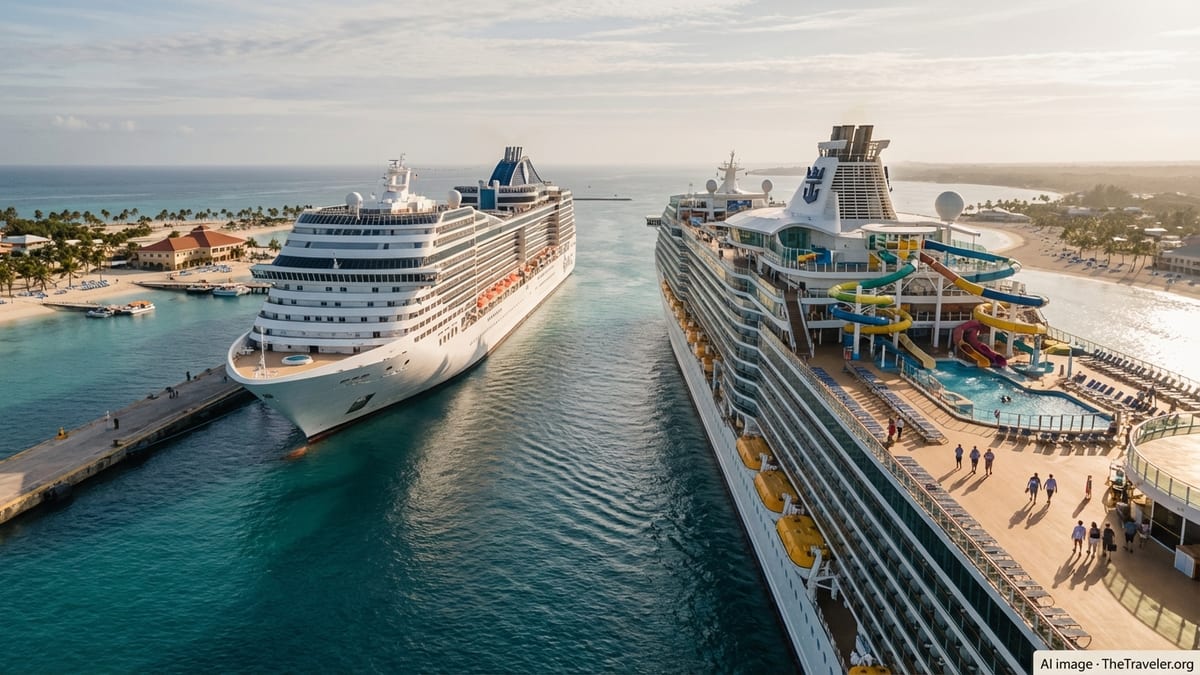
Storm Track Forces Rapid Itinerary Overhaul
Publicly available tracking data and passenger posts indicate that the vessel, operating a short Caribbean itinerary, altered course after forecasts showed a cluster of tropical systems strengthening along its planned route. Instead of continuing toward its original ports in the central and eastern Caribbean, the ship adjusted to remain on the outer edges of the weather, cutting a wide arc away from the most active storm zones.
The change unfolded over the course of roughly 24 hours, as updated advisories showed the storms organizing and expanding in size. Cruise schedule listings show that the voyage had been marketed with a mix of popular ports and a day at sea, a typical profile for Royal Caribbean’s regional deployments at this time of year. Once the forecast deteriorated, the ship shifted to a pattern that emphasized sea days and alternative, more sheltered calls.
According to published coverage of similar scenarios, itinerary overhauls of this scale are more common during the heart of Atlantic hurricane season, when systems can form quickly and alter track within a day. In those cases, cruise lines frequently reposition vessels on the fly, sometimes redrawing an entire weeklong route in order to avoid sailing near gale-force conditions.
Reports from cruise industry outlets note that modern forecasting and satellite monitoring allow navigation teams to watch storm paths several days ahead, but the margin for error around developing systems can still be large. As a result, ships may deviate earlier and more decisively than passengers expect, particularly when sailing in regions known for rapid tropical development.
New Ports, Extra Sea Days and Missed Private Islands
The storm-related changes have reshaped the cruise experience on board. Based on itinerary updates posted by cruise-tracking and fare-comparison sites, the ship’s new route substitutes alternative Caribbean ports that lie farther from the storms’ projected path, while at least one original call appears to have been dropped altogether. In some seasons, similar diversions have replaced calls in the Bahamas or eastern Caribbean with visits to western Caribbean destinations or with additional time at sea.
Travel industry reporting has highlighted how these shifts can affect highly anticipated stops, particularly visits to private-island destinations. Recent coverage of damage-related disruptions at Royal Caribbean’s Perfect Day at CocoCay, for example, has shown how quickly a single pier or weather event can trigger cascading itinerary swaps across multiple ships in the region. When severe weather limits safe berthing or makes tendering impractical, cruise lines often reroute vessels to larger, better-protected ports or cancel calls outright.
For passengers, the most visible impact is the revised daily program. Instead of a predictable sequence of island visits and short overnight sails, the ship’s schedule now centers on longer transits in comparatively calmer waters, with on-board activities, shows and dining taking on a larger role. Cruise news coverage of past diversions notes that operators typically expand daytime programming, adjust entertainment lineups and modify outdoor offerings when wind and sea conditions make certain decks or pools less usable.
Published FAQs from cruise lines also indicate that port fees for missed destinations are commonly refunded as onboard credit or to original forms of payment, and that prebooked shore excursions are automatically canceled and reimbursed if the related port call is dropped. In cases where substitute ports are added, new excursion options are usually loaded into booking systems within hours of the change.
How and Why Cruise Lines Redraw Routes Around Storms
Specialist cruise publications explain that decisions to overhaul an itinerary generally turn on three main factors: predicted wind and wave conditions along the route, the safety and practicality of entering specific ports, and the ship’s ability to maintain a comfortable ride for thousands of passengers. While the vessels are structurally capable of withstanding rough seas, modern cruise operations prioritize staying well away from the strongest parts of any storm system.
Analyses of captain Q&A sessions and behind-the-scenes explainers published on cruise-focused sites describe how navigation teams review updated weather models several times a day. When trajectories converge on a likely path that intersects with a scheduled port, planners begin to identify alternates within range that offer adequate harbor protection, berthing capacity and local infrastructure. If the pattern of storms is especially complex, an entire multi-port circuit may be redrawn to minimize repeated encounters with high seas.
Commentary from maritime experts also underscores that waiting to “sneak through” between bands of heavy weather is rarely favored. Strong crosswinds can complicate docking maneuvers in narrow harbors, and residual swells can linger long after the center of a storm has passed. By turning early toward safer waters and building in extra sea room, ships can avoid prolonged rolling and the risk of last-minute port closures that might strand a vessel offshore.
Industry guidance notes that these decisions are often taken on a voyage-by-voyage basis, even within the same region and season, because every storm behaves differently and every ship has unique handling characteristics. That variability helps explain why two similar itineraries, only days apart, can experience very different levels of disruption when tropical systems move through the Caribbean.
Passenger Rights, Fine Print and Practical Advice
Publicly available ticket contracts and advisory documents for major cruise brands, including Royal Caribbean, state that itineraries are not guaranteed and may be changed for reasons such as weather, safety or operational constraints. Travel reporting frequently points out that these terms give cruise operators broad discretion to skip, substitute or resequence ports without providing compensation beyond taxes and fees tied to missed calls.
Consumer-travel columns advise that travelers concerned about storms should review these conditions before sailing and consider travel insurance that covers trip interruption. Policies vary, but some plans may reimburse additional expenses or partial trip costs if severe weather leads to canceled flights, missed embarkation or extended delays returning home. The coverage typically does not extend to disappointment over substituted ports, as long as the cruise itself operates.
Experienced cruisers and travel advisors quoted in recent features recommend practical steps for passengers facing mid-cruise changes. These include monitoring official shipboard announcements, reviewing updated daily programs carefully, and checking onboard apps for new excursion offerings or time changes. Guests are also encouraged to pack seasickness remedies, particularly during peak storm months, even when sailing on larger, more stable vessels.
Reports also emphasize that while the loss of a marquee port can be frustrating, safety-focused diversions are a core part of modern cruise operations. Overhauling an itinerary to avoid storms, as seen on the current Royal Caribbean voyage, illustrates how quickly plans can pivot at sea when the priority is to keep a ship of several thousand people well away from the most hazardous conditions.