

More news on this day
Royal Caribbean is accelerating a global refresh of its fleet, with new dry docks and outfitting projects across Europe and Asia designed to introduce more immersive, resort-style experiences for guests ahead of several high-profile deployment seasons.
Get the latest news straight to your inbox!
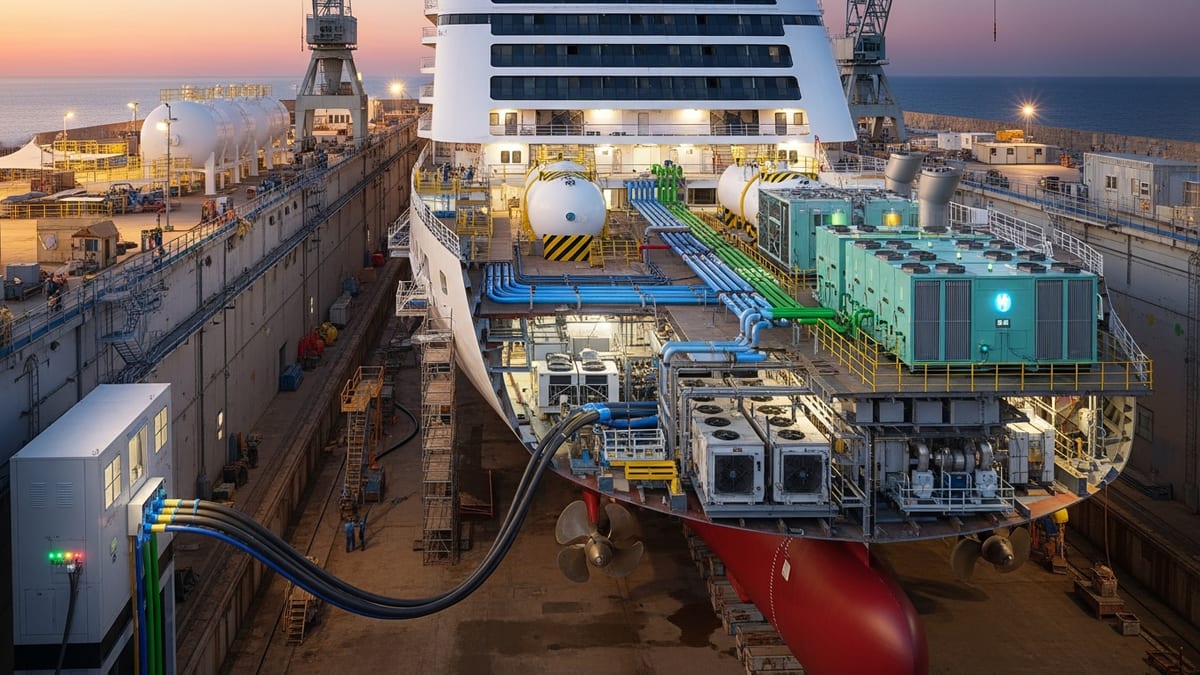
Quantum-Class Flagship Ovation of the Seas Transformed in Singapore
Recent reports from cruise industry outlets indicate that Ovation of the Seas has entered a major dry dock in Singapore, where the Quantum-class ship is undergoing an extensive renovation ahead of her 2026 Alaska season. Publicly available information describes the work as part of a renewed investment push in Asia-based shipyards, with Singapore positioned as a key hub for Royal Caribbean’s refurbishment program.
The project, valued at around 100 million dollars according to specialist cruise coverage, focuses on both guest-facing spaces and technical upgrades. Plans outlined in those reports include a complete reconfiguration of the Music Hall into a two-level entertainment and gaming complex, pairing an expanded Casino Royale on the lower deck with a new nightclub concept known as Sound Cellar above. The aim is to create a higher-energy evening scene that aligns the ship more closely with the newest vessels in the fleet.
While in dry dock, Ovation of the Seas is also reported to be receiving refreshed accommodations, upgraded connectivity and behind-the-scenes technical work. The timing of the overhaul, scheduled between Southeast Asia deployments and the upcoming Alaska season, reflects the company’s strategy of using regional shipyards to stage major enhancements between long-haul itineraries.
The Singapore project underscores how Asia is becoming more central to Royal Caribbean’s lifecycle planning for its large ships. Industry analysis notes that deploying high-profile refurbishments in the region helps support local supply chains, while also reinforcing Singapore’s role as a leading homeport and maintenance base for the brand’s growing Asian footprint.
Spanish Shipyards Deliver a Revitalized Allure of the Seas
In Europe, Royal Caribbean’s investment is visible in Spain, where Allure of the Seas recently completed a substantial refit at the Navantia shipyard in Cádiz. Publicly available technical summaries describe an upgrade program costing more than 100 million dollars, focused on aligning the Oasis-class ship with the latest onboard standards and attractions.
The work in Cádiz brought several headline features that have become hallmarks of the brand’s newest vessels. Allure of the Seas now carries the Ultimate Abyss dry slide, a multistory plunge connecting top decks to the Boardwalk neighborhood, along with the Perfect Storm trio of waterslides. The pool deck has been redesigned to create more resort-style lounging space, while the adults-only Solarium received refreshed finishes and upgraded relaxation areas.
Beyond outdoor thrills, the refit expanded family and multigenerational offerings. Documentation of the project points to a new Royal Escape Room, an updated laser tag experience, and a redesigned Adventure Ocean youth complex tailored to different age groups. Teen spaces, grouped under the Social298 concept, were also reimagined to reflect current trends in lounge design, gaming and social media content creation.
With Allure of the Seas scheduled for Western Mediterranean itineraries following the refit, the Cádiz project highlights how European shipyards are being used to prepare large ships for seasons in nearby cruise regions. Industry observers note that this approach reduces repositioning time and allows for quicker turnarounds between major enhancement phases and commercial deployment.
New Icon-Class Legend of the Seas to Debut in the Mediterranean
Alongside refurbished existing ships, Royal Caribbean is preparing to introduce new hardware with features that reflect the latest learnings from its European and Asian projects. Legend of the Seas, the third vessel in the Icon class, is scheduled to enter service in July 2026 and will debut in Europe with Western Mediterranean sailings from ports such as Barcelona and Civitavecchia.
According to publicly available technical profiles, Legend of the Seas will carry a capacity of more than 5,600 guests and offer a broad mix of neighborhoods, pools and high-thrill attractions. Industry previews point to a large waterpark with multiple slides, expanded infinity-style pool concepts and a wide choice of casual and specialty dining venues. The design continues the brand’s move toward densely programmed outdoor decks and multiuse spaces that can shift from family-friendly environments by day to nightlife hubs after dark.
Operational plans indicate that following an inaugural season in the Western Mediterranean, Legend of the Seas is expected to reposition to North America for Caribbean sailings later in 2026. The deployment pattern mirrors the path taken by earlier Icon-class vessels, using a European debut to highlight the ship’s profile in key source markets before moving to long-term Caribbean operations.
Shipbuilding reports also emphasize the integration of advanced environmental systems, including the use of liquefied natural gas propulsion and energy-efficiency measures such as heat-recovery technology and shore-power connectivity. These features are described as contributing to Royal Caribbean Group’s wider target of introducing a net zero cruise ship by 2035, linking the guest experience upgrades with longer-term sustainability commitments.
Asia Emerges as a Strategic Homeport and Refurbishment Hub
Beyond individual ship projects, Royal Caribbean’s deployment patterns suggest a broader strategy to leverage Asian ports for both guest operations and major technical work. Recent announcements highlighted by trade publications show that Navigator of the Seas will homeport in Singapore from late 2026, offering new itineraries across Southeast and East Asia. That move follows the seasonal return of Ovation of the Seas to Singapore and reflects a steady build-up of large-ship capacity in the region.
Industry coverage describes Singapore as benefiting from this shift through increased shipyard work, provisioning activity and hotel demand, while the cruise line gains a reliable base with developed infrastructure for complex vessels. The decision to concentrate dry dock activities for ships like Ovation of the Seas in local yards supports the technical ecosystem required to maintain features such as advanced waterparks, large-scale entertainment venues and high-capacity connectivity systems.
At the same time, the Asian deployments are calibrated to feed into marquee markets such as Alaska and the Caribbean. Ovation of the Seas, for example, uses its Singapore modernization to transition directly into an elevated Alaska season, with new onboard venues and refreshed accommodations positioned as key selling points in North American and international markets.
Analysts following the sector indicate that this combination of Asian homeporting and refurbishment activity, European newbuild deliveries and cross-regional repositioning reflects a more globally integrated approach to fleet management. It also points to an emphasis on using high-profile overhauls and newbuilds to sustain premium pricing and differentiate Royal Caribbean’s product in an increasingly competitive cruise landscape.
Elevating the Onboard Experience Through Technology and Design
Across these projects in Europe and Asia, a consistent theme emerges: an effort to transform ships into all-in-one resorts with layered experiences for different traveler segments. Updates to Allure of the Seas, for instance, concentrate on signature top-deck attractions and immersive youth spaces, while the Ovation of the Seas dry dock invests heavily in nightlife, gaming and multiuse entertainment venues.
Newbuilds like Legend of the Seas are designed from the keel up to support this model, with neighborhoods that blur the boundaries between indoor and outdoor space and infrastructure sized for large-scale shows, water attractions and high guest throughput. Technical documentation points to expanded bandwidth for digital services, along with layouts that accommodate mobile check-in, dynamic wayfinding and app-based reservations for dining and activities.
This combination of hardware upgrades and digital capability is framed by industry observers as central to Royal Caribbean’s plan to “elevate” the guest experience over the coming deployment cycles. By coordinating refurbishments in Singapore and Cádiz with the delivery of new Icon-class ships in European yards, the line is positioning much of its global fleet to offer a more consistent, high-impact product regardless of region.
For travelers, the practical outcome will be felt in more varied dining, higher-thrill pool decks, refreshed accommodation design and increasingly sophisticated entertainment options. For European and Asian ports, the ongoing wave of upgrades signals continued investment in local shipbuilding and maintenance capacity, as Royal Caribbean and other global brands rely on regional partners to bring their next-generation cruise concepts to life.