


More news on this day
A Ryanair passenger who reported being left stranded after facing huge queues at Tenerife South Airport has focused fresh attention on mounting congestion, changing border rules and the growing friction between airlines and airport operators in Spain’s busiest holiday hubs.
Get the latest news straight to your inbox!
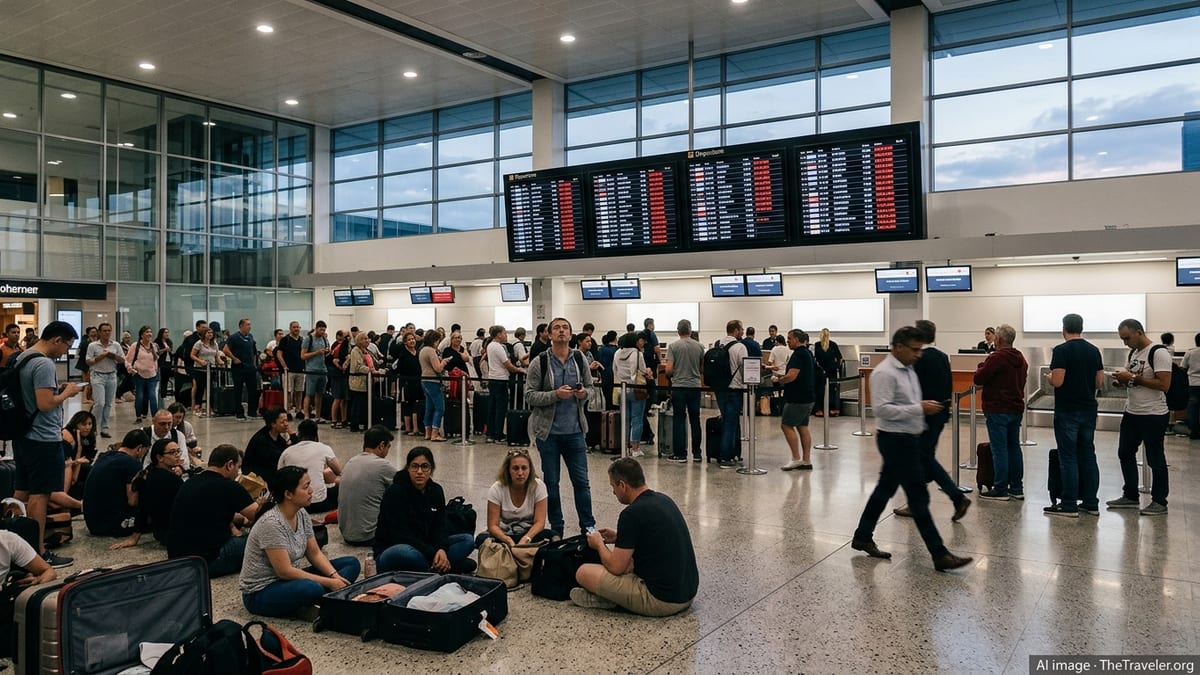
Viral account spotlights severe queues at Tenerife South
Recent reports describe a Ryanair customer departing Tenerife South who missed their flight after becoming stuck in long lines at the airport, later sharing images and video that showed dense crowds snaking through the terminal and describing the situation as a brutal reality for holidaymakers. The account has circulated widely on social media and in regional coverage, resonating with travelers who say they have faced similar scenes during peak departures.
According to publicly available information, the passenger had already checked in and arrived at the airport with what would normally be considered sufficient time before departure, only to be delayed by congestion at security and passport control. By the time they reached the gate, the Ryanair flight had already closed and departed, leaving the traveler to arrange new tickets and accommodation.
While the precise timings and operational details vary between accounts, the images of lengthy queues and the description of feeling “stranded” have fed into an already heated debate about whether Spain’s major leisure airports, including Tenerife South, are equipped to handle post‑pandemic demand combined with new border procedures for non‑EU nationals.
Ryanair has generally responded to similar incidents by attributing delays to airport security and border‑control bottlenecks, arguing that flights cannot be held indefinitely for late‑arriving passengers once boarding deadlines pass and aircraft slots are fixed. Airport‑side commentators, however, point to airlines’ dense scheduling and tight turnarounds as factors that leave little margin for disruption when queues build unexpectedly.
New EU border systems add pressure to holiday airports
The Tenerife case follows a wider pattern of disruption in Spain’s island and coastal airports, where the mix of European Union and British passengers has complicated border flows since Brexit. Local media and specialist travel outlets have recently highlighted how new digital Entry/Exit System checks and biometric gates are being phased in, with reports indicating that only a fraction of the new equipment at Tenerife South has been consistently operational in recent weeks.
In some published accounts, only a small number of electronic gates out of the full installed capacity were in use, forcing many non‑EU travelers into manually staffed channels. This has contributed to long backlogs just as peak holiday traffic returns, with social media posts from both arriving and departing passengers showing queues stretching across passport halls and towards departure concourses.
Industry analysis suggests that the combination of new border technology, higher documentation checks for British nationals and the seasonal spike in winter‑sun tourism has left airports such as Tenerife South operating close to their limits at busy times of day. Any additional stress, whether a staffing shortfall or a burst of late‑running arrivals, can quickly cascade into multi‑hour waits that imperil onward connections and outbound flights.
Travel advice shared by airlines, tourism boards and online forums has started to converge on a similar message for Tenerife and other Spanish leisure gateways: arrive significantly earlier than usual, head straight to security and passport control, and avoid assuming that short distances within compact terminals will translate into quick processing times.
Pattern of Ryanair passengers left behind in Spain
The Tenerife story comes shortly after a series of high‑profile incidents at other Spanish airports involving Ryanair passengers who were unable to board in time because of queues at security or passport control. In March, nearly 90 Ryanair travelers were left stranded at Lanzarote’s César Manrique Airport after long delays at border control prevented them from reaching the gate before departure, according to multiple regional reports.
Coverage of the Lanzarote case described how passengers who had already checked in became trapped in slow‑moving lines, even as final boarding calls were made. Similar reporting from France in March detailed how two dozen Ryanair customers at Tours Val de Loire Airport were left behind at the gate after lengthy delays at security screening, despite having arrived at the terminal earlier in the day.
In each instance, Ryanair has maintained that it is bound by strict slot and turnaround requirements and cannot postpone departures indefinitely, particularly at busy tourist airports where runway and stand capacity are tightly scheduled. Passenger groups, by contrast, argue that once travelers are inside the terminal and queuing for mandatory state‑run checks, they have effectively complied with airline guidance and should not bear the full cost when systemic delays occur.
The Tenerife passenger’s description of being stranded after queuing for extended periods closely mirrors those earlier episodes, reinforcing the perception among some travelers that Spain’s most popular sun destinations have become increasingly unpredictable for tight connections or standard two‑hour pre‑flight arrival windows.
Staffing, strikes and infrastructure under scrutiny
The latest complaints from Tenerife also intersect with broader issues affecting Spanish airports, including staffing levels at passport control and the impact of industrial action. The national airport operator and police‑run border units are responsible for manning desks and supervising the new biometric systems, and previous public statements from the sector have acknowledged that passenger flow is highly sensitive to daily staffing allocations.
Over the winter, rolling strikes by Azul Handling, the ground‑handling company that services Ryanair at several Spanish airports, added another layer of disruption. Tenerife South was among the locations cited in strike coverage, with reports of longer queues at check‑in, baggage drop and boarding, even on days when flights themselves operated broadly on schedule.
Infrastructure constraints are another recurring theme. Tenerife South has invested in expanded terminals and new technology, but recent images of crowded corridors suggest that bottlenecks can quickly reappear when airlines concentrate multiple departures within short time windows. Aviation analysts note that low‑cost carriers often schedule early‑afternoon or evening “waves” of flights to maximize aircraft utilization, which may overwhelm control points if they are not staffed to match.
The Ryanair passenger who reported being stranded in Tenerife tapped into this wider frustration, describing queues that seemed out of step with the island’s reputation for efficient tourist handling. Holidaymakers posting in travel forums now frequently exchange detailed tips on which times of day are quieter, how far in advance to arrive, and whether to prioritize fast‑track lanes where available.
What travelers can expect at Tenerife South this season
With the main summer season approaching, the Tenerife incident is likely to sharpen questions about how quickly airports and airlines can adapt operations to avoid more passengers being left behind. Publicly available forecasts suggest that overall traffic through Canary Island airports is expected to remain strong, supported by continued demand from the United Kingdom, Germany and northern Europe.
Travel commentators generally advise passengers flying Ryanair and other carriers from Tenerife South to build in extra time at every stage of the journey. That includes allowing for slow baggage drop‑off, possible queues to reach security, and extended waits at passport control for non‑EU travelers, especially during weekend peaks and early‑afternoon departure banks.
Consumer advocates emphasize that, under European air passenger regulations, entitlement to compensation and assistance depends on the specific cause of a missed flight. If the disruption stems from security or state border‑control delays rather than an airline operational failure, compensation for the fare itself may be limited, although passengers can still request information and basic care where overnight stays become necessary.
For now, the passenger’s account from Tenerife adds one more cautionary story to a growing list of reports about long airport queues in Spain’s most popular holiday gateways. For travelers heading to or from the Canary Islands in the coming months, the clearest consequence is a shift in expectations, with early arrival and a readiness for queues increasingly seen as a necessary part of the journey.