


Samos and Naxos both promise long beaches, mountain villages and clear Aegean water, but they deliver very different holiday experiences. Samos lies in the eastern Aegean, close enough to Turkey that day trips to Kusadasi and Ephesus are realistic. Naxos belongs to the Cyclades, sitting between Paros and the Small Cyclades, and is tightly woven into the classic island-hopping routes that link Athens with Paros, Santorini and Mykonos. Choosing between them means weighing not just scenery, but also flight access, ferries, buses, costs and how much you want – or need – a rental car.
Get the latest updates straight to your inbox!
Geography, Access and Ferry Reality Check
Samos sits in the North-East Aegean, only a couple of kilometres from the Turkish coast at its closest point. Its main port Vathy, secondary port Karlovasi and resort port Pythagoreio are strung along a large, mountainous island that feels almost like a miniature mainland. Naxos, by contrast, is the largest of the Cyclades but compact in feel, with most visitors funnelling through Naxos Town on the west coast before dispersing to nearby beach settlements such as Agios Prokopios and Plaka.
For flights, both islands connect through Athens International Airport. Samos International Airport has multiple daily flights to Athens and some domestic links to Thessaloniki and other Aegean islands, plus seasonal direct summer flights from several European airports including London Gatwick, Manchester, Birmingham and Brussels, operated by a mix of charter and low-cost carriers. These international routes typically run from roughly May to October and can change each year, so travelers should always verify current-season schedules. Naxos Airport is smaller but has frequent daily flights to Athens operated mainly by Olympic/Aegean and Sky Express, and new domestic links to Heraklion and Thessaloniki have begun, strengthening its mainland connections.
In ferry terms, Naxos is deeply integrated into the Cycladic network. Fast and conventional ferries from Piraeus and Rafina connect Athens to Naxos in roughly 3.5 to 5.5 hours, and Naxos serves as a through-stop on many routes linking Paros, Ios, Santorini and the Small Cyclades. This makes adding Naxos to a Paros and Santorini itinerary straightforward, sometimes with multiple sailings per day in July and August. Samos sees daily ferries from Piraeus, but crossings are longer, often 8 to 10 hours on conventional boats via intermediate islands, and routes can shift between Vathy and Karlovasi. There is also a short passenger ferry link from Samos to Kusadasi in Turkey, opening up easy side trips to Ephesus.
Crucially for trip planning, there is no simple, frequent, direct ferry between Samos and Naxos. Reaching one from the other almost always requires changing in another island port such as Mykonos, Syros or Ikaria, or returning via Piraeus. Schedules on these indirect routes may be limited to a few days per week and can have long layovers, especially outside high summer. If you are imagining a smooth Samos–Naxos hop in between beach days, it is safer to plan them as separate trips or to pivot via Athens or Mykonos rather than relying on a direct link that does not exist.
Beach Comparisons: Sand, Pebbles, Wind and Swimming
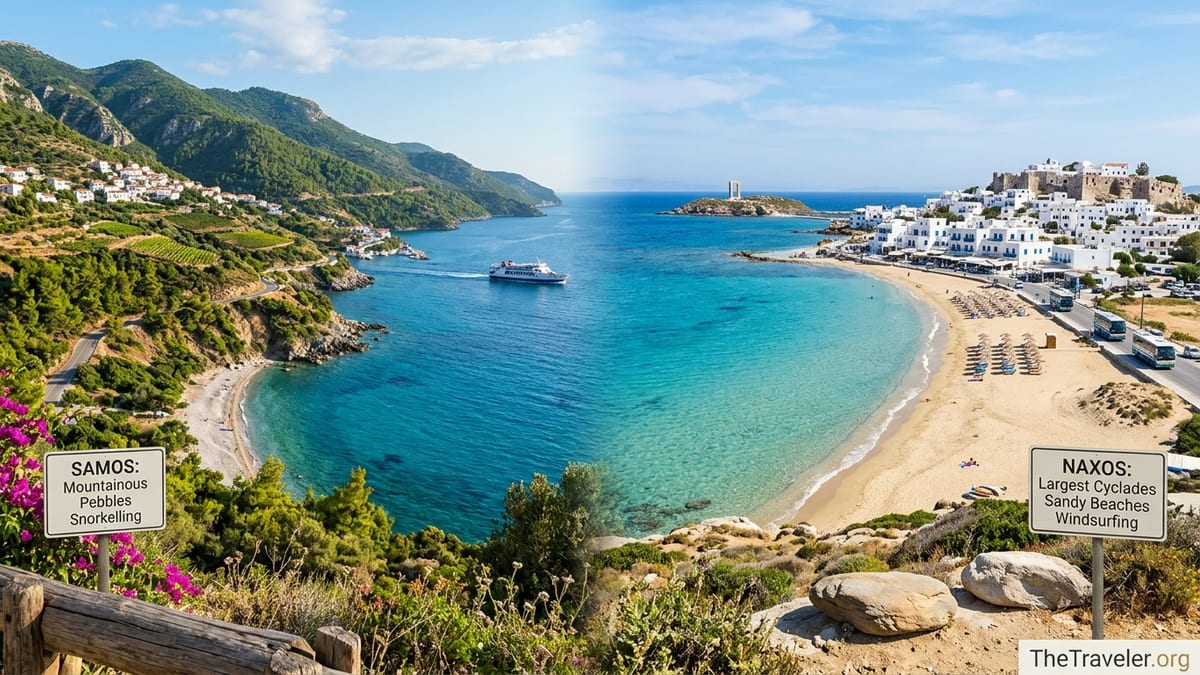
Samos and Naxos both have standout beaches, but they feel quite different. On Samos’ north coast near Kokkari, Tsamadou and Lemonakia are classic shingle-and-pebble coves backed by steep green hills. The water off these beaches drops deep quite quickly, creating an intense turquoise colour and excellent visibility for snorkelling. Walking barefoot can be uncomfortable without water shoes, and small children may find the sudden depth and occasional waves more intimidating than fun.
On Samos’ south coast near the airport, Potokaki offers a long stretch of coarse sand and fine shingle with clear, usually calm water, sunbed rentals and a few low-key bars. East of Pythagoreio, Psili Ammos is one of the island’s few genuinely sandy beaches, very shallow for a long way out, which makes it popular with families and non-confident swimmers. Here the sea feels more like a warm lagoon on settled days, although its openness means windy spells can still stir up chop.
Naxos’ west coast is built almost entirely around sand. Agios Prokopios is a broad, golden-sand bay with shallow, clear water that deepens gradually, backed by organized sections with sunbeds and tavernas as well as quieter stretches. Just beyond, Agia Anna feels like the continuation of Agios Prokopios, combining soft sand with a small harbour and beachside rooms. Plaka then runs for kilometres as one of the longest sandy beaches in the Cyclades, alternating between fully serviced zones and almost empty dune-backed sections. Mikri Vigla, further south, is a natural sandy beach famous for its wind and kite-surfing scene on one side of the headland, while the leeward side usually offers calmer water for swimming.
In terms of wind and family suitability, Naxos’ long sandy west coast is generally better for young children and long, easy swims, especially in sheltered pockets on days when the northern Meltemi wind is strong. Beaches such as Plaka, Agios Prokopios and the calmer side of Mikri Vigla offer gently shelving sand with lifeguard presence in peak season and many informal family-friendly tavernas just behind the shore. Samos’ highlight coves are more dramatic and great for strong swimmers and snorkelers, but they often have quicker drop-offs, stonier entries and in the case of the north coast, more exposure to swell, which suits couples and independent travelers more than toddlers.
Public Transport, Rental Cars and Getting Around
On both islands, buses exist but strongly shape how you experience the place if you skip a rental car. KTEL Samos runs routes linking Vathy, Pythagoreio, Kokkari, Karlovasi and some inland villages. Published summer timetables show several services per day on key routes like Vathy to Pythagoreio and the airport, with extra departures in July and August. However, services are much thinner on weekends and reports from recent travelers indicate that Sunday services on some lines can be extremely limited or absent, pushing car-free visitors toward taxis on those days. Distances on Samos are longer than they look on the map because of winding mountain roads, so even with buses you often face gaps in coverage and longer travel times.
Naxos has a denser bus network for visitors. KTEL Naxos runs frequent summer buses from Naxos Town’s central station to Agios Prokopios, Agia Anna and Plaka, as well as to inland villages like Apeiranthos and Halki. In high season, buses to the popular beaches can run roughly every 20 to 30 minutes during the day, and there is usually evening service back into town, which allows travelers staying along the west coast to dine in Chora without driving. Off season, frequencies drop and some beach routes are reduced to a handful of daily services, but basic coverage remains.
Car rental costs on both islands vary by season. In July and August, small manual cars on Naxos and Samos can easily reach or exceed around 45 to 60 euros per day when booked late, while shoulder-season rates in May, June, September and early October commonly fall closer to roughly 30 to 40 euros per day for the same category when booked in advance. Access to fuel and parking is straightforward in both destinations, but Naxos Town’s narrow streets and Samos’ mountain roads require confident driving. For travelers determined to avoid driving, Naxos’ combination of beach-focused bus routes and compact geography makes it the more practical car-free choice.
Where to Stay: Villages and Atmosphere
On Samos, most visitors choose between Vathy, Pythagoreio and Kokkari. Vathy, also known as Samos Town, is the main port with a long harbourfront, shops, banks and local life. It suits travelers who want access to a wide range of amenities and easier bus connections, even if the town beach is not the island’s most attractive. Pythagoreio, near the airport, is a charming harbour village centred on a fishing port and small promenade with tavernas and bars. It has a more resort-like feel but retains a historical character, sitting close to classical sites such as the Tunnel of Eupalinos and the Heraion of Samos.
Kokkari, on the north coast of Samos, appeals to couples and independent travelers thanks to its waterfront tavernas, atmospheric narrow lanes and immediate access to Tsamadou and Lemonakia beaches a short drive or bus ride away. The village beach is pebbly but scenic, and evenings have a sociable but not nightclub-heavy atmosphere. Compared with the Cyclades, nightlife leans toward relaxed wine bars and seaside dining rather than clubs.
On Naxos, the key decision is between Naxos Town (Chora), Agios Prokopios and Plaka. Staying in Naxos Town puts you next to the port, castle district and landmark Portara monument, with narrow alleys full of bars, bakeries and restaurants. It is ideal for travelers who want to explore by bus and ferry and enjoy more nightlife, as evening options range from cocktail bars around the old town to quieter cafés by the marina. Agios Prokopios provides a classic beach-resort environment within a 10 to 15 minute drive or bus ride of the port, with a continuous strip of hotels, rooms and tavernas behind a long sandy bay.
Plaka attracts guests seeking more space and a laid-back feel. Development here is linear and low-rise, mixing small hotels, villas and studios separated by fields and dunes. Many places offer direct or near-direct beach access, and the mood is quieter at night than Agios Prokopios or Naxos Town, with evenings centred on sunset dinners and stargazing. For travelers who value walking from bed to soft sand each morning, Plaka and Agios Prokopios on Naxos and Potokaki or parts of Psili Ammos on Samos are the closest equivalents.
Hiking, Culture, Food and Nightlife
Both islands reward visitors who like to leave the beach for a few hours. Samos is particularly strong on hiking, with signed trails in the mountains around Mount Kerkis and Mount Karvounis leading through pine forest, small chapels and springs. Traditional villages such as Manolates and Vourliotes, perched above the north coast, combine walking routes with panoramic views, while the wine-making area around Karlovasi showcases terraced vineyards and historic mansions. As a birthplace of the ancient mathematician Pythagoras and the philosopher Epicurus, Samos also offers notable archaeological sites, including the Temple of Hera and the Eupalinos tunnel near Pythagoreio.
Naxos counters with its own network of walking paths between marble villages like Halki, Apeiranthos and Filoti in the island’s interior. Trails around Mount Zas, the highest peak in the Cyclades, offer moderate hikes to views across the Aegean on clear days. Archaeological highlights include the Portara, the unfinished Kouros statues near Melanes and Apollonas, and Venetian-era towers scattered in the Tragea valley, making it easy to combine a driving or bus circuit with short walks.
Culinary experiences differ subtly. Samos is known for its sweet muscat wine and fresh fish, with many harbour tavernas grilling locally landed catch and offering regional meze. Naxos is a powerhouse of agricultural products, particularly potatoes, cheeses such as arseniko and graviera, and local kitron liqueur. Inland tavernas often serve slow-cooked goat, pork stews and handmade pasta, and prices in village restaurants can feel slightly lower than in the busiest seafront spots around Naxos Town. In both islands’ main towns, a main course at a mid-range taverna in 2026 commonly sits around 12 to 17 euros, with house wine by the carafe keeping costs manageable for couples.
Nightlife on Samos is low-key, focusing on harbourfront bars in Pythagoreio and Kokkari, where evenings mean drinks by the water and music until late but rarely into the early morning. Naxos Town has a more pronounced bar scene, with rooftop cocktail venues, music bars in the back alleys and beach bars at Agios Prokopios and Agia Anna that can feel lively in July and August without matching the intensity of Mykonos or Ios. For couples seeking a mix of sunset cocktails and relaxed nightlife, Naxos Town and Agios Prokopios offer more variety; for travelers who prefer quieter nights, Samos’ villages or Naxos’ Plaka are better fits.
Prices, Seasonal Costs and Sample Budgets
Accommodation prices shift with both island and season. In July and August, a well-rated mid-range hotel or studio within a short walk of the beach in Agios Prokopios or Plaka on Naxos often ranges from roughly 130 to 200 euros per night for a double with air conditioning and breakfast, depending on exact location and how far ahead you book. In Samos, similar properties near Potokaki, Psili Ammos or in Kokkari can be slightly less expensive at equivalent quality levels, with high-season double rooms sometimes available in the region of 100 to 170 euros per night. In May, June, September and early October, both islands usually see meaningful reductions, and it is common to find comfortable doubles between about 70 and 120 euros per night near the beach.
For a two-night high-season stay for a couple on Naxos in or near Naxos Town, a realistic mid-range budget might look like this: around 320 to 380 euros for two hotel nights, 80 to 120 euros for two days of a small rental car if you choose to drive, 60 to 90 euros for sunbeds and umbrellas spread over two beach days, and roughly 160 to 220 euros for four main meals plus snacks and drinks, producing a rough total around 620 to 810 euros excluding flights and ferry tickets. Replacing the car with buses could save perhaps 50 to 80 euros over two days, at the cost of less flexibility.
On Samos, a comparable two-night stay for a couple based in Kokkari or Pythagoreio in high season might total roughly 260 to 340 euros for accommodation, 70 to 110 euros for two days of small-car rental, 40 to 70 euros for sunbeds and drinks on the beach and about 150 to 210 euros for meals, leading to an approximate total in the region of 520 to 730 euros. Because Samos is less dominated by the peak Cycladic price effect seen in islands heavily targeted by international tourism, headline accommodation and restaurant costs can feel a little lower, especially outside the most sought-after waterfront addresses.
For a full seven-night stay in July or August, a couple on a mid-range budget might expect to spend roughly 1,200 to 1,600 euros on accommodation on Naxos if staying in a well-located beach or town hotel, plus perhaps 250 to 400 euros on a rental car for three to five days, and around 550 to 800 euros on food and incidentals, suggesting a ballpark of 2,000 to 2,800 euros before flights and ferries. On Samos, seven nights could come closer to around 900 to 1,400 euros for similar accommodation, 250 to 350 euros for car rental over part of the week and 500 to 750 euros for food and extras, giving a rough working range of 1,650 to 2,500 euros for a couple. These figures are indicative and depend heavily on how early you book and how often you choose higher-end dining or excursions.
Three-Day Sample Itineraries
For Naxos, a three-day car-free itinerary for a couple arriving by ferry might start with Day 1 in Naxos Town, exploring the old market lanes, the hilltop Kastro and the Portara at sunset, with dinner in a taverna overlooking the marina. Day 2 could focus on beaches: a morning bus to Agios Prokopios for swimming and coffee, walking along the sand through Agia Anna to Plaka, renting sunbeds for part of the day and returning by bus in the early evening for drinks in town. Day 3 could be an inland excursion using the bus network to reach Halki or Apeiranthos, walking local paths, visiting a kitron distillery or small museum, then returning for a final dinner in Chora. With a rental car, you would instead loop to Mikri Vigla, Aliko and the mountain villages in a single day, visiting at your own pace.
On Samos, a three-day stay focused around Pythagoreio or Kokkari might unfold differently. Day 1 in Pythagoreio could combine a stroll around the harbour, visits to the Archaeological Museum and the entrance of the Eupalinos tunnel, and swimming at a nearby beach such as Potokaki before dining at the waterfront. Day 2 could see you renting a car to explore the north of the island, stopping in Kokkari for coffee, then continuing to Tsamadou and Lemonakia for pebble-beach swimming and snorkelling, with a late-afternoon visit to mountain villages like Manolates. Day 3 might be dedicated to culture: driving or joining an excursion to the Heraion archaeological site and, in season, taking a ferry day trip from Pythagoreio to Kusadasi to visit Ephesus, returning for a low-key evening in a wine bar.
Both islands can also anchor longer stays with rest days built in. On Naxos, a week allows multiple beach days on the west coast interspersed with hiking Mount Zas and boat trips to the Small Cyclades. On Samos, a week gives you time to explore the distinct personalities of the island’s north and south coasts, spend unhurried days in villages and venture out on marked hiking trails that are too far for a quick half-day if you rely only on buses.
Wind, High Season Pressures and Who Should Choose Which Island
July and August bring strong Meltemi winds across much of the Aegean, particularly the Cyclades. On Naxos, this means that while west-coast beaches benefit from cooling breezes in the heat, certain exposed stretches such as Mikri Vigla become prime territory for kite-surfers and can feel blustery for sunbathers. Ferries on Cycladic routes in these months can also experience delays or cancellations on very windy days, which has knock-on effects for island-hoppers trying to make tight connections or same-day onward flights. Booking flexible tickets and building buffer days into your itinerary helps reduce risk.
Samos, being further east and closer to the Turkish mainland, still experiences summer winds but sometimes feels slightly less battered than the central Cyclades on the most intense days. Its longer ferry routes to and from Piraeus, however, mean that any weather-related disruption can lead to longer total travel times. High-season demand affects both islands, with accommodation and car rentals in late July and much of August often fully booked weeks or months in advance, but Naxos, thanks to its position on marquee island-hopping routes, tends to feel busier around the port and main beaches than Samos does in similarly popular areas.
For families, Naxos’ sandy, shallow beaches at Agios Prokopios, Agia Anna and Plaka, coupled with frequent beach buses and a wide choice of family-friendly accommodation, make it the more straightforward choice, especially for those not wishing to rent a car every day. Samos can also work well for families, particularly around Psili Ammos or Potokaki where the sea is shallower and many hotels have pools, but moving between beaches and villages comfortably almost always benefits from hiring a car, especially with limited buses on Sundays.
Couples looking for variety and nightlife may prefer Naxos Town combined with evenings in Agios Prokopios, while couples seeking quieter, more nature-led stays might gravitate to Kokkari or smaller coastal settlements on Samos. Hikers and culture enthusiasts who value less-trodden mountain trails and major archaeological sites within day-trip range may lean toward Samos, while island-hoppers, first-time visitors to Greece and those planning combinations such as Naxos with Paros and Santorini will generally find Naxos easier to integrate into a multi-island route.
How to Decide: Category Winners and Final Thoughts
In a head-to-head comparison, Naxos clearly wins for classic sandy beaches with gentle entries and extensive facilities, car-free logistics thanks to frequent summer buses between town and the main beaches, and straightforward integration into wider island-hopping networks. It is also the stronger choice for visitors who prioritize reliable domestic flight options from Athens and a moderate but not overwhelming nightlife scene. For families with young children, first-time Greece travelers and those who want to combine island time with minimal planning complexity, Naxos is usually the easier recommendation.
Samos, in turn, stands out for hiking, scenic pebble coves with excellent snorkelling, and access to both Greek and Turkish cultural sites, including day trips to Ephesus. It often offers slightly lower overall trip costs for similar levels of comfort, particularly in shoulder season, and its villages and landscapes deliver a more off-the-main-circuit feel than the central Cyclades. For experienced Greece travelers, walkers, and couples who do not mind renting a car and driving mountain roads, Samos can feel more exploratory and less choreographed than busier Cycladic hubs.
Ultimately, the best choice depends less on popularity and more on how you prefer to move around and spend your days. If your priority is waking up to soft sand, using buses to shuttle between beach and town, and potentially adding Paros or Santorini on the same trip, Naxos aligns beautifully with those goals. If you are willing to rent a car, enjoy a mix of beach time and mountain walks, and like the idea of pairing a Greek island stay with a foray into Turkey, Samos may offer a richer personal fit. Thinking through your tolerance for ferry time, your need or aversion to driving, and how important long sandy beaches are to you will quickly reveal which island should anchor your next Greek holiday.