


Arturo Merino Benítez International Airport in Santiago (SCL) has grown into a busy South American hub, and its terminal layout has changed significantly in the last few years. Travelers who last passed through before 2022 often remember a single main building for both domestic and international flights. Today, the airport operates with two distinct terminals: Terminal 1 (T1) for domestic flights and Terminal 2 (T2) for most international services. Understanding which terminal you actually need, and how to move between them when you do not, can save you stress, time, and in the worst cases, a missed flight.
Get the latest updates straight to your inbox!
Terminal 1 vs Terminal 2: The Big Picture
Santiago’s airport now operates with a clear basic split: Terminal 1 handles domestic flights within Chile, while Terminal 2 is the main international terminal. The new international building opened its doors in 2022, adding more than 200,000 square meters of space and relieving pressure on the original structure, which has since been reconfigured as the domestic terminal. In practice, this means that a flight from Santiago to Puerto Montt, Punta Arenas, or Antofagasta will normally use T1, while flights to cities like New York, Madrid, Sydney, or São Paulo will operate from T2.
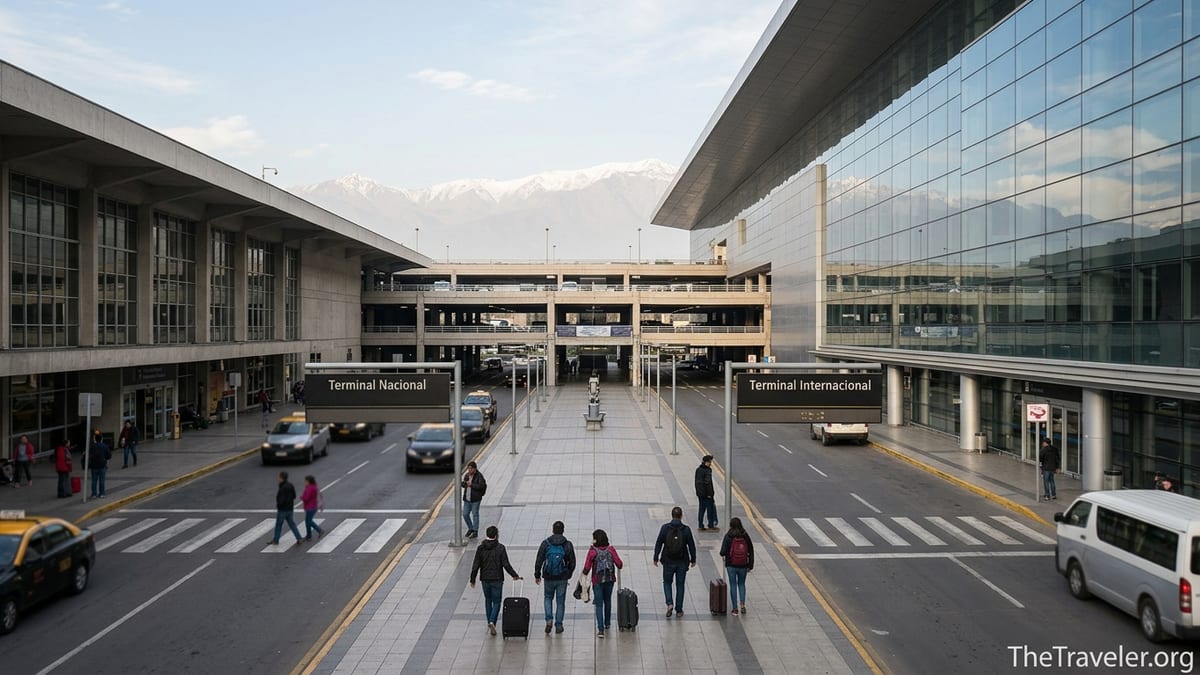
The two terminals are part of a single integrated complex and are connected by covered walkways and parking structures rather than being separate airports. From the central forecourt outside, you will see T1 on one side and the glassier, newer T2 on the other, with a plaza and parking towers in between. Travelers arriving by taxi or rideshare are often dropped roughly in the middle and then walk a short distance to the correct building, which is why knowing your terminal in advance is so important.
Both terminals share the same IATA code, SCL, and both are operated under the Nuevo Pudahuel concession. What changes from one to the other is the type of operation: security screening procedures, immigration and customs, check-in counters and gate layouts are all tailored to either domestic or international flows. For a smooth journey, always start by checking your booking confirmation, airline app, or boarding pass to see whether it lists “SCL T1” or “SCL T2.” If nothing is indicated, assume domestic equals T1 and international equals T2, then confirm with your airline.
One subtle complication is that the airport has introduced “mixed” operations in a shared area so some flights that combine domestic and international segments can use parts of T2 for domestic legs. These are still exceptional cases, usually arranged by airlines such as LATAM for through-ticket passengers, so the vast majority of travelers can stick to the basic rule that national flights use T1 and international flights use T2.
Which Terminal Does Your Airline Use?
Most airlines at Santiago base their operations on the nature of their route rather than a fixed terminal identity, so the same carrier may operate from both terminals on the same day. LATAM Airlines, for example, concentrates its international departures and arrivals in T2, including long-haul routes to North America, Europe, and Oceania, and many regional flights to destinations like Lima, Buenos Aires, and São Paulo. The same LATAM brand then uses T1 for domestic routes to places such as Concepción, Calama, and Balmaceda. Your boarding pass or app will typically display “SCL T2” for an international LATAM flight and “SCL T1” for a domestic one.
Other Chilean low-cost carriers follow a similar pattern but with more emphasis on domestic operations. SKY Airline and JetSMART both use T1 as their primary base for domestic services across Chile, running busy shuttles between Santiago and cities like Iquique, Puerto Montt, and Arica. When these carriers operate international flights, such as SKY’s services to Lima or JetSMART’s flights to Buenos Aires, those flights move across to T2. A traveler booked on a SKY flight from Santiago to Lima in the evening and then from Santiago to La Serena the following morning will therefore use T2 on the first leg and T1 on the second, even though both tickets carry the same airline name.
Foreign carriers are more straightforward. Major international airlines such as Delta Air Lines, American Airlines, Iberia, Air France, KLM, Qantas, and many others operate exclusively from T2, as all their flights to or from Santiago are international. If you are flying in from Atlanta on Delta, from Madrid on Iberia, or from Sydney on Qantas, you will arrive and depart via T2. This can be helpful when planning connections, because you can be certain that any long-haul overseas flight into or out of Santiago will involve the international terminal.
Where confusion often arises is with regional international flights using Chilean carriers. A LATAM or SKY flight to a neighboring country might feel “almost domestic” to frequent regional travelers, but it still uses T2 with immigration and customs controls. For example, a business traveler commuting between Santiago and Buenos Aires several times a month will always pass through T2 at SCL, regardless of how short the flight is. If in doubt, always verify the terminal shown in your airline’s app on the day of travel, as airlines may occasionally relocate check-in counters or gates during operational disruptions.
Domestic vs International Operations: What to Expect
Terminal 1 is set up for quick, straightforward domestic travel. You will find check-in counters grouped by airline, standard domestic security screening, and departure gates leading directly to buses or jet bridges without any immigration formalities. Arriving passengers at T1 collect their bags and walk straight out to the public arrivals hall where they can meet ground transport or connect to the walkway toward T2 and the parking structures. A typical domestic passenger might arrive 90 minutes before departure, check in at a LATAM or SKY counter, clear security in 15 to 30 minutes at busy times, and then walk a few minutes to the gate.
Terminal 2, by contrast, manages the full international process: check-in and baggage drop, exit immigration, international security screening, and then duty-free and departure gates. On arrival, passengers disembark into a series of immigration halls, retrieve baggage from the international claim area, pass through customs, and only then emerge into the public area. Long-haul flights arriving early in the morning can create noticeable peaks in waiting times, so airlines and the airport typically recommend arriving at least three hours before international departures from T2, and sometimes more during peak holiday seasons.
The facilities in T2 reflect its international focus. After security, you will find large duty-free shops selling regional wines, spirits, and cosmetics, along with international fashion brands. Airline lounges, including LATAM’s flagship lounge for premium and elite passengers and several contract lounges used by foreign carriers, are all located airside in T2. In contrast, T1 offers more functional services aimed at frequent domestic flyers, such as quick-service eateries, local coffee chains, pharmacies, and convenience stores where you can buy a Chilean SIM card, snacks, or a last-minute phone charger before boarding a morning shuttle to the south of the country.
A real-world example illustrates the difference. A traveler flying from Miami to Santiago on American Airlines and then continuing on a separate domestic ticket to Puerto Natales for a Patagonian trek will first pass through T2, clear immigration and customs, and then walk to T1 for the domestic leg. On the outbound journey, that same traveler must allow extra time in T2 for exit immigration and security before boarding the overnight flight back to the United States, whereas their domestic hop back from Puerto Natales to Santiago will be far simpler and quicker through T1.
Arrivals, Departures, and Transfers Between Terminals
For point to point travelers, knowing where to go is relatively simple: domestic departures and arrivals take place in T1, and international departures and arrivals in T2. The complexity appears when you connect between a domestic flight and an international one, or between two international flights which may both be in T2 but require you to clear immigration and customs in the middle. Because Chile is not part of a large regional border control zone, there is no Schengen style airside transfer; nearly all connecting passengers must formally enter Chile and then recheck bags and clear security again.
The walk between T1 and T2 is fully enclosed and typically takes around 10 to 15 minutes at a normal pace, slightly more with young children, heavy luggage, or mobility challenges. Many travelers describe the route as a straightforward corridor linking the terminals via the parking structures and central plaza, with clear signage marked “Terminal Nacional” and “Terminal Internacional.” There is currently no dedicated airside shuttle train or bus operating inside security, so most connections involve exiting one terminal into the public land-side area, following the signs across, and then entering the other terminal to check in and clear security.
Real-world accounts from recent travelers suggest that a well-timed connection from an international flight into a domestic one can be comfortably done in about 90 minutes when everything runs smoothly. One frequent scenario is a morning arrival from North America or Europe into T2, taking roughly 10 minutes to disembark, 15 to 30 minutes for immigration and baggage, another 10 to 15 minutes for customs and the walk to T1, and then 20 to 30 minutes to clear domestic security and reach the gate. However, this can stretch beyond two hours during peak bank arrivals, school holidays, or if your first flight is delayed. When booking separate tickets, most travelers sensibly leave at least three hours between scheduled arrival in T2 and departure from T1.
Transfers entirely within T2 between international flights can be more complex than they first appear. Some airline alliances arrange protected connections where bags are checked through to the final destination and you remain in the international departures area after a streamlined transit procedure. In many other cases, particularly when flying on separate tickets or on carriers without interline agreements, you will still need to collect your luggage, clear customs, and then recheck your bags at the departures level in T2 before heading back through immigration and security. Because policies vary, always check with your airline if you are planning a tight international connection through Santiago.
Walking Times, Accessibility, and Practical Tips
Although T1 and T2 are physically close, travelers should treat the connection like a short walk between buildings on a university campus rather than a quick dash across a single hall. The corridor between them passes through parking structures and a central plaza area, with moving walkways in some sections but not all. Rolling suitcases move easily across the smooth floors, and the route is covered so you are protected from rain and strong sun, which can be intense in Santiago during the summer months.
For passengers with reduced mobility, families with small children, or anyone carrying bulky sports gear such as ski bags or trekking backpacks, it is wise to request assistance from your airline in advance. Wheelchair assistance can be prebooked so that an attendant accompanies you from your arrival gate in T2, through immigration and baggage claim, and along the connecting routes to the check-in counters in T1. If you forget to arrange this ahead of time, ask at the airline transfer desk or an airport information counter as soon as you land; staff can often still coordinate support, though you may wait a bit longer during busy periods.
Time of day matters for walking times inside the terminals as well. Early morning and late evening peaks associated with long-haul flights can mean heavier crowds at immigration in T2 and at security in both terminals. Lines can stretch well beyond the roped lanes during holiday periods, adding 20 minutes or more to your transit time. A traveler arriving from Europe at around 8:00 in the morning and connecting to a mid-morning domestic flight to Puerto Montt might experience a much longer queue than someone connecting to a late-night departure to the north of Chile during a quiet weekday.
Practical comfort tips also make a difference. Wear shoes suitable for walking at least a kilometer with luggage, especially if you will be carrying outdoor gear for Patagonia or ski equipment for the Andes. Keep your passport, boarding passes, and any printed confirmations in a small, easily reachable bag rather than in a big checked suitcase. If you know you have a long layover between terminals, consider using a café in the central plaza or the public areas of T2, which often have more seating and power outlets than older domestic zones. Many travelers choose to spend their layover in T2’s airside lounges or food court even when they are heading on to a domestic flight later, then leave enough time to walk to T1, pass security, and board.
Common Wrong Terminal Mistakes and How to Avoid Them
The most frequent error at Santiago is arriving at the wrong terminal because the passenger focused on the airline name instead of the route type. Many visitors assume that all LATAM flights, for example, use the same building, only to discover at the airport that their domestic hop to the Atacama region actually departs from T1 rather than T2. Others, used to small regional airports, forget that even a short hop across the Andes counts as international, so a one hour flight to Mendoza or Córdoba still requires T2 with full immigration checks.
Another common mistake occurs when separate tickets are involved. A traveler might book an international ticket into Santiago that arrives in T2 and a low-cost domestic ticket out of T1 with very little time between them, assuming they can simply change gates. They then discover on arrival that they must clear immigration, collect their bags, walk to the other terminal, check in at a new counter, and clear security again. Cases where passengers miss an onward domestic flight to Patagonia because they underestimated the terminal transfer time are not rare, particularly in high season when long-haul flights from Europe and North America land one after another.
Misreading ground transportation drop-off locations can create extra stress as well. Many shuttle buses and taxis ask passengers whether they need the “nacional” or “internacional” terminal; travelers unsure of their terminal sometimes guess and end up at the wrong building. While the walk across the central plaza is not long, in heavy rain or strong summer heat it can feel longer than expected, especially with heavy bags or young children. The error becomes more serious when cutting it close for check-in closure times; low-cost carriers in T1 are known to close their counters strictly, often 45 to 60 minutes before departure, and may not accept late passengers even if they are already in the correct building.
The simplest way to avoid these problems is to verify your terminal multiple times. Check the confirmation email after booking, confirm again when you complete online check-in, and look at the terminal information displayed in your airline’s mobile app on the day of departure. When arriving in Santiago, ask cabin crew which terminal you are landing at and, if you have a connection, whether your onward flight uses T1 or T2. At the landside arrivals hall, follow the large overhead signs rather than relying on memory or small printed maps. A minute spent double checking can easily save you from a panicked sprint across the plaza with a backpack and rolling suitcase.
The Takeaway
Understanding the difference between Terminal 1 and Terminal 2 at Santiago’s Arturo Merino Benítez Airport is essential for a smooth journey. T1 focuses on domestic Chilean flights and offers straightforward, relatively quick processing, while T2 serves as the modern international hub with full immigration, customs, and long-haul facilities. The two terminals are next to each other and connected by covered walkways, but transferring between them still takes time, especially when layered on top of immigration, baggage claim, customs, and security procedures.
For most travelers, the rule of thumb is clear: if your flight begins or ends outside Chile, you will use T2; if it is wholly within Chile, you will likely use T1. The main exceptions involve mixed or through-ticket operations arranged directly by airlines and do not apply to the majority of visitors. Leave generous connection times when planning domestic to international transfers, especially if you are on separate tickets, and always confirm your terminal with your airline on the day of travel.
By arriving with realistic expectations about walking distances, queue times, and the need to formally enter and exit Chile between many connections, you can turn Santiago’s airport from a source of anxiety into a manageable, even pleasant, stopover. Whether you are catching a dawn flight to Patagonia or boarding a night flight back to North America or Europe, a little terminal knowledge goes a long way in keeping your trip on track.
FAQ
Q1. How do I know if my flight uses Terminal 1 or Terminal 2 at Santiago?
Check your booking confirmation, boarding pass, or airline app; domestic flights almost always use T1, while international flights usually use T2, but you should always verify on the day of travel.
Q2. How long does it take to walk between Terminal 1 and Terminal 2?
The enclosed walk between T1 and T2 usually takes around 10 to 15 minutes at a normal pace, slightly more with children, heavy luggage, or mobility issues.
Q3. Can I transfer between terminals without going through immigration and customs?
In most cases no; if you are arriving internationally and connecting to a domestic flight, you must clear immigration, collect your bags, pass customs, and then walk to the other terminal and clear security again.
Q4. Is there a shuttle or train between T1 and T2?
There is currently no dedicated airside shuttle or train between T1 and T2; transfers are typically made on foot via covered walkways through the central plaza and parking structures.
Q5. How much connection time should I allow between an international arrival and a domestic departure?
Many travelers aim for at least two to three hours between scheduled arrival in T2 and departure from T1 to allow for queues at immigration, baggage claim, customs, the walk between terminals, and domestic security.
Q6. Do all LATAM flights depart from the same terminal?
No. LATAM’s international flights generally use T2, while its domestic flights within Chile use T1, so you should always check the terminal listed on your specific itinerary.
Q7. Are there lounges in both terminals?
Most airline and contract lounges, including LATAM’s main lounge and those used by foreign carriers, are located in T2, while T1 focuses more on quick-service dining and everyday traveler services.
Q8. What happens if I go to the wrong terminal?
If you arrive at the wrong terminal, you will need to walk across to the correct one, which can cost you 15 to 20 minutes; if check-in closes while you are walking, you might miss your flight, so always verify before you arrive.
Q9. Can I check my luggage through from a domestic Chilean flight to an international one?
If both flights are on the same ticket and airline or alliance, check-in agents can often tag your bags to your final destination, but you may still need to follow their instructions about immigration and security procedures in Santiago.
Q10. Is Santiago a good airport for long layovers between terminals?
Yes, many travelers find Santiago manageable for long layovers, with cafés, shops, and lounges in T2 and practical services in T1; just be sure to move to your departure terminal early enough to clear formalities without rushing.