


More news on this day
Saudi Arabia is accelerating investment in its seaports and logistics hubs as renewed instability in the Red Sea and nearby chokepoints forces ships, cargo planners, and cruise lines to rethink how they move between Asia, Europe, and Africa.
Get the latest news straight to your inbox!
Red Sea Disruptions Push Trade Lanes Into New Patterns
Attacks on commercial shipping in the southern Red Sea and Bab al-Mandab Strait since late 2023 have turned one of the world’s most important corridors into a high-risk zone for container ships and tankers linking Asia with Europe. Publicly available assessments from international institutions and shipping analysts indicate that vessel traffic through the Suez Canal and its approaches dropped sharply in 2024 and 2025 as operators diverted around Africa’s Cape of Good Hope to keep crews and cargo out of range of missiles and drones.
Recent reporting on the wider Middle East crisis in 2026 suggests that security threats have again intensified around both the Red Sea gateways and the Strait of Hormuz, prompting major lines to consolidate ships into convoys, shift refuelling points, or suspend some transits altogether. Industry data shows that these diversions can add 10 to 14 days to Asia–Europe sailings and have pushed freight costs on key lanes significantly higher than pre-crisis levels.
For Egypt, lower Suez Canal volumes have translated into multibillion-dollar revenue losses. For global travellers, the consequences appear indirectly at first, in higher prices for imported goods, tighter airline and cruise schedules, and growing pressure on alternative hubs that can offer safer, more predictable access between regions.
In this reshaped seascape, Saudi Arabia’s ports on both the Red Sea and the Arabian Gulf are emerging as pivotal waypoints. The kingdom’s strategy to become a top global logistics hub is no longer only about long-term Vision 2030 ambitions; it is increasingly about providing redundancy and resilience as traditional routes remain volatile.
Saudi Ports Step Up As Redistribution and Bunkering Hubs
Saudi Arabia has been steadily expanding capacity at Jeddah Islamic Port on the Red Sea and King Abdulaziz Port in Dammam on the Arabian Gulf, alongside newer facilities such as King Abdullah Port north of Jeddah and industrial ports linked to petrochemical complexes. Recent trade and maritime coverage notes that Jeddah has climbed in global rankings after handling well over five million containers in the latest reported year, with double-digit growth in throughput supported by new shipping services and terminal upgrades.
Reports on the kingdom’s maritime strategy highlight the addition of multiple new liner services connecting Jeddah with hubs in the eastern Mediterranean, the Indian subcontinent, and East Africa. Each new service effectively gives carriers more options to tranship cargo away from the most exposed stretches of the Red Sea, using Saudi ports as safer redistribution nodes before onward journeys to Europe or back to Asia.
On the Gulf coast, Dammam’s King Abdulaziz Port is seeing renewed attention as a gateway for cargo that avoids the Red Sea altogether. When security incidents affect the Strait of Hormuz or adjacent waters, operators face hard choices, but Saudi policymakers have been developing overland rail and road corridors that connect Gulf ports to Red Sea gateways, allowing containers and bulk goods to cross the Arabian Peninsula without sailing through contested straits.
Specialist maritime publications describe how these investments, coupled with new logistics parks in Jeddah and other cities, are designed to position Saudi Arabia as a key pivot point in the flow of goods between Asia, Europe, and Africa. For travellers, this shift means more flights, hotels, and supporting services clustering around ports that once catered largely to cargo alone.
Knock-On Effects For Cruise Lines And Itineraries
The cruise industry has been among the most visible sectors affected by Red Sea volatility. During the most acute phases of attacks in 2024 and 2025, several global cruise brands either cancelled seasonal Red Sea and Suez transit voyages or re-routed ships around Africa, extending itineraries and in some cases scrapping port calls altogether. Recent accounts of the 2026 regional security crisis describe how some vessels operating in the Gulf and wider Middle East reduced activities or paused sailings while operators reassessed risk.
Saudi Arabia only recently entered the cruise market with the launch of domestic and regional itineraries from Jeddah and other Red Sea ports. The kingdom’s flagship cruise vessel began operations in late 2024, and authorities have promoted heritage sites, marine tourism, and new coastal developments as part of a broader effort to draw leisure travellers. The timing has coincided with security challenges, but it has also given Saudi planners an incentive to design flexible routes that can be reshaped as conditions evolve.
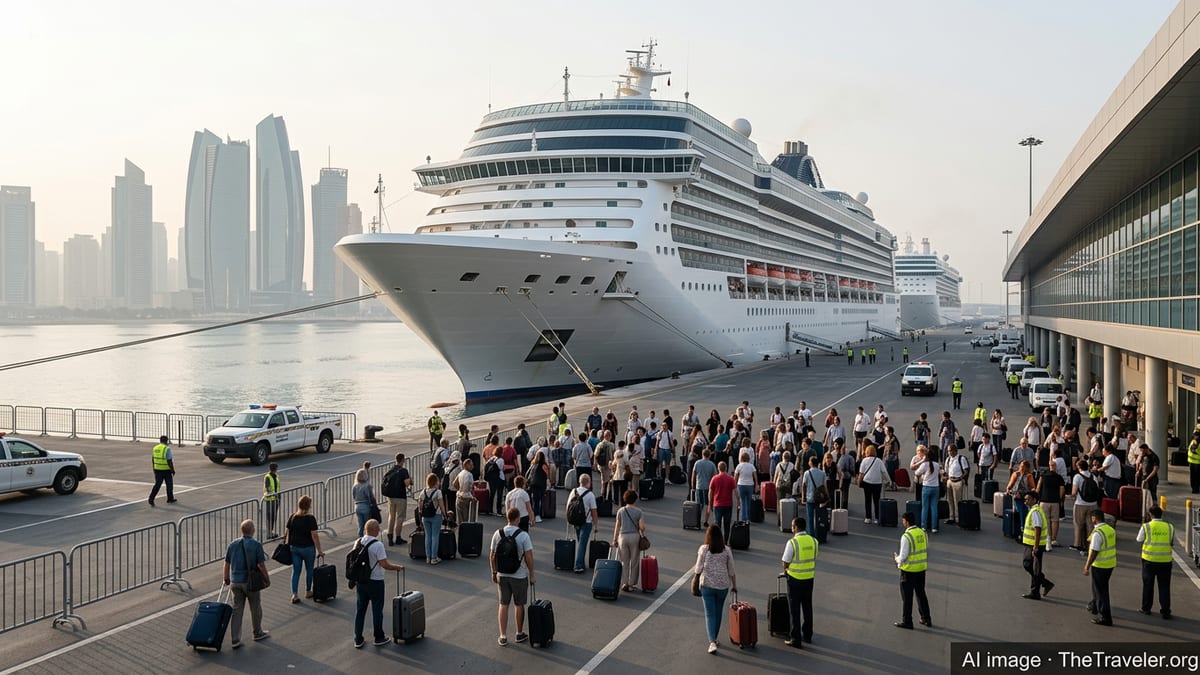
Industry coverage indicates that cruise lines now look closely at port infrastructure, security coordination, and medical and evacuation capabilities before committing to Middle East and Red Sea deployments. As Saudi ports scale up container and energy traffic, they are also investing in dedicated cruise terminals, passenger processing, and shore excursion offerings. These upgrades increase the likelihood that future repositioning cruises between Europe and Asia will use Saudi ports as embarkation or turnaround points when they do return to more regular Red Sea passages.
Travellers booking cruises that once sailed routinely through the Suez Canal are seeing more variability in routes and dates, along with longer ocean segments and added overnight stops in safer regional hubs. Saudi Arabia’s growing role as both a cargo and passenger gateway means more itineraries that start or end in Jeddah or Dammam, opening new combinations such as fly-cruise packages that use Saudi airports as regional aviation connectors.
Air Connectivity And Overland Links Reinforce The Maritime Pivot
The remapping of sea routes has implications in the air as well. While commercial aviation is less directly affected by naval incidents, airlines are adjusting flight plans and network strategies in response to cargo delays, higher fuel costs, and shifting demand across Europe–Asia corridors. Public aviation and tourism data for the Gulf region show that carriers based in Saudi Arabia and neighboring states are expanding point-to-point links that bypass traditional hubs affected by geopolitical risk.
Saudi Arabia’s own plans for a major new international airport in Riyadh and upgrades to Jeddah and Dammam support a multimodal strategy in which seaports, airports, and logistics zones work in tandem. Freight that previously moved in containers through the Red Sea may increasingly be split, with higher-value goods flown from Saudi airports while bulkier shipments continue by sea via safer or more flexible routes.
At the same time, the kingdom is promoting overland connectivity projects that would effectively function as a “land bridge” between its Red Sea and Gulf coasts. While timelines and specifications vary across official announcements and industry analyses, the concept is consistent: rail and road corridors that allow containers disembarked in Jeddah to reach Gulf ports, or vice versa, in a matter of days rather than weeks at sea. For logistics planners, this creates a hedge against prolonged maritime disruption; for travellers, it could translate into new coach tours, rail journeys, and cross-country itineraries built around the same infrastructure.
As these networks mature, travel patterns within Saudi Arabia may begin to mirror its freight flows. Cities such as Jeddah, Dammam, and planned tourism hubs on the Red Sea coast could see increased hotel development, conference business, and stopover tourism, particularly from passengers whose voyages are broken into multimodal segments.
What Travellers And The Industry Should Watch Next
For now, analysts describe the Red Sea and nearby chokepoints as a corridor of chronic, rather than acute, instability. Shipping companies are constantly recalibrating how many vessels they send through the region, what kinds of cargo they are willing to risk, and how to price the uncertainty into freight rates and insurance premiums. This fluid situation means that sailing schedules and cruise deployments for the next few seasons are likely to remain less predictable than before 2023.
Travelers considering itineraries that rely on the Suez Canal or Red Sea crossings should pay attention not only to security headlines but also to how cruise lines and airlines adjust their programmes. Many operators now publish contingency plans or alternative routings when tensions rise, and some have shifted seasonal capacity toward more stable regions, from the western Mediterranean to the Canary Islands or Southeast Asia.
Within this environment, Saudi Arabia’s bet on stronger maritime gateways appears to have both defensive and offensive dimensions. On one side, the kingdom is cushioning itself and its trade partners against supply chain shocks by diversifying ports, services, and inland connections. On the other, it is using the moment to market new tourism products, from Red Sea island resorts to heritage-focused city breaks linked to modern port districts.
How quickly cruise lines return to full-scale Red Sea programmes, and how far cargo traffic rebounds through the Suez corridor, will depend on developments that extend well beyond commercial planning. Yet regardless of the security cycle, Saudi Arabia’s enhanced maritime and logistics footprint is likely to remain a lasting feature of the map, reshaping how people and goods travel between Asia, Europe, and Africa in the years ahead.