


More news on this day
Link light rail service through downtown Seattle was abruptly suspended Sunday after a train derailed near the International District, disrupting north–south travel for thousands of riders and triggering an urgent patchwork of bus shuttles and alternate routes across the region.
Get the latest news straight to your inbox!
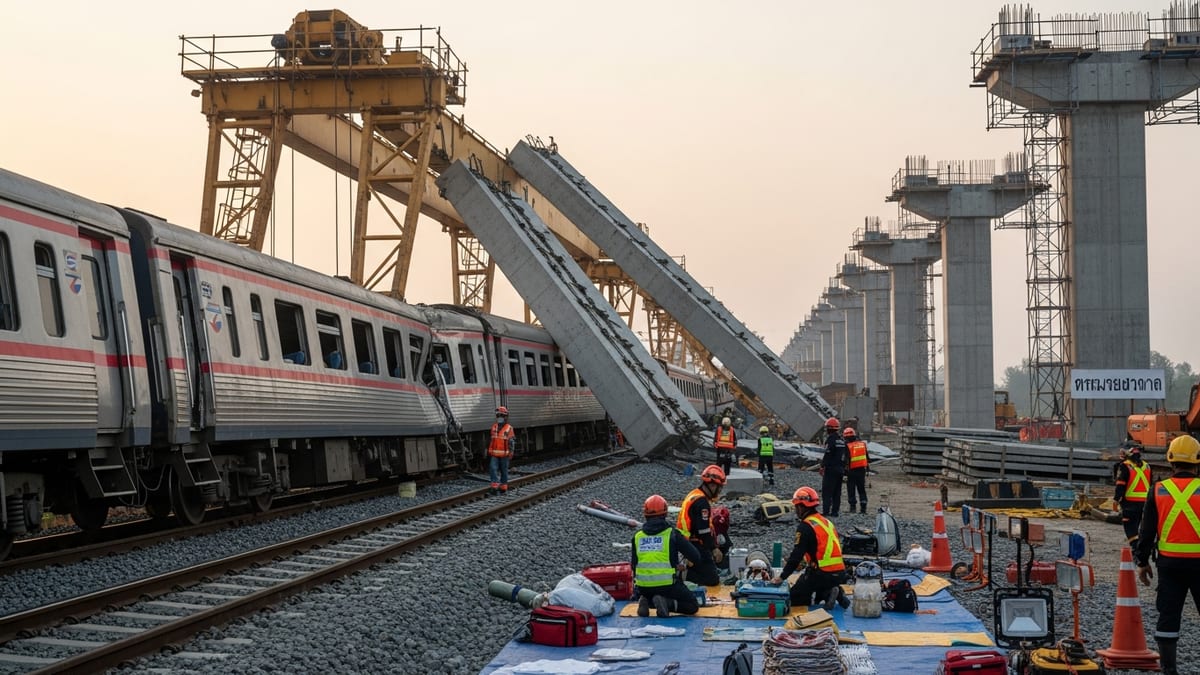
Derailment Near Stadiums Disrupts Core Transit Spine
Reports from riders and publicly available information indicate that the incident occurred near International District/Chinatown Station, one of the system’s most heavily used junctions and a critical gateway to Seattle’s stadium district. Photos and first-hand accounts shared on social platforms described a light rail train that had left the tracks near a track switch, leading to an immediate suspension of service through the area.
Initial descriptions suggest the derailment happened on or near a complex section of track that allows trains to turn back or access the operating base, an area where switches and track geometry are more intricate than on standard mainline segments. While the affected train was not reported to be heavily damaged, the incident created an operational bottleneck that made it impossible to safely move other trains through the corridor.
There were no early reports of life-threatening injuries, but the location and timing of the event magnified its impact. The International District/Chinatown and Stadium area sits at the heart of regional travel between Northgate, downtown Seattle, SeaTac Airport, and Rainier Valley, meaning even a localized derailment can ripple across the entire network.
Past system safety reports for Washington rail transit systems have highlighted that low-speed derailments near yards and switches, while rare, can cause outsized service disruptions compared with their physical severity. Even minor infrastructure damage to rails, ties, or signaling components at a junction can require hours or days of inspection and repair before service is restored.
Full Suspension on Key Segment and Limited Train Movements
Following the derailment, publicly available alerts and rider accounts pointed to a full suspension of Link service through the central segment that connects North Seattle, downtown, and the Rainier Valley. Trains north of downtown were reportedly turned back before reaching the affected area, while south-end service was curtailed to avoid sending additional trains into the blocked zone.
The suspension effectively severed the 1 Line, which serves as the spine of the regional transit network. Even temporary shutdowns in this corridor have previously been shown to result in crowding on parallel bus routes, longer travel times, and missed connections with other services such as commuter rail and regional buses.
Transit planning documents for the Seattle region emphasize that the light rail system has limited redundancy through downtown, with both current lines funneling through the same basic tunnel and surface approaches. When an incident blocks that pinch point, agencies must rely on buses and surface streets that are themselves subject to congestion and delays.
Repair crews now face the dual task of resolving any mechanical issues with the derailed train and conducting detailed inspections of nearby track and signal equipment. Until that work is complete, the operating plan is expected to prioritize worker safety and infrastructure integrity over rapid restoration of through service.
Bus Bridges, Reroutes and Traveler Workarounds
In response to the disruption, agencies moved to establish so-called bus bridges, using buses to shuttle passengers between closed stations and maintain a basic north–south connection. Riders described waiting at downtown and south-end stations for hastily organized shuttle buses, which were attempting to absorb demand that would ordinarily be handled by multi-car trains running every few minutes.
Because bus bridges must share surface streets with regular traffic, riders encountered slower trips and less predictable travel times. Publicly available service plans for the region note that each light rail train can carry far more passengers than a single standard bus, making it difficult for short-notice bus operations to fully replicate rail capacity.
Travelers also turned to existing frequent bus routes as alternatives. Corridor buses running along 3rd Avenue in downtown, routes serving Northgate and the University District, and lines connecting Rainier Valley neighborhoods to the city center and SODO industrial area became crucial backups for passengers who abandoned the rail system altogether for the day.
Guidance from previous disruption scenarios in other cities suggests that riders who can walk or cycle between a pair of open stations, or who can transfer to overlapping bus corridors, often experience shorter delays than those waiting for dedicated shuttle buses. Early rider reports from Seattle indicated a similar pattern, with some travelers choosing to walk between downtown and nearby neighborhoods rather than queue for a crowded shuttle.
Potential Multi-Day Impact and Repair Timeline
Discussion among riders and transit observers on public forums pointed to the possibility that the derailment’s effects could extend beyond a single day. If a switch or section of guideway was damaged, repair work may involve specialized parts, detailed engineering inspections, and multiple test runs before normal operations resume.
Regional planning documents underscore that urban rail systems are designed with stringent safety margins. After any derailment, even at low speed, agencies typically conduct thorough checks not only of the immediately affected track but also of related control systems, overhead power, and adjacent infrastructure to rule out hidden damage.
In past incidents, Sound Transit has used reduced-frequency service or single-tracking through work zones as an intermediate step before full restoration. However, the layout near the International District, where multiple lines and operating tracks converge, may limit the feasibility of partial reopening if key switches remain out of service.
For riders, the operational reality is that even once trains reappear on the line, initial service may be less frequent and more crowded while the system stabilizes. Commuters planning for the coming workweek are being advised by publicly posted alerts and media coverage to check for day-by-day updates rather than assuming a quick return to normal schedules.
Advice for Travelers and Regional Mobility Outlook
Publicly available travel guidance for similar incidents emphasizes that passengers should allow extra time, consider alternate routes, and be prepared to adjust plans on short notice. In Seattle’s case, that means watching for updated rail alerts, verifying whether bus bridges are active, and identifying high-frequency bus routes that parallel the light rail corridor between key hubs such as Northgate, downtown, SODO, and Rainier Valley.
Riders heading to Seattle-Tacoma International Airport face particular challenges when light rail is suspended, as the train is normally a reliable, traffic-free connection to the terminals. Alternate options include express and local buses linking downtown to the airport area and, for some travelers, shared-ride services or taxis, though those alternatives can quickly become congested or costly during major disruptions.
Transportation research on unplanned rail outages notes that cities with overlapping bus and rail networks tend to recover more quickly, as passenger demand can be spread across multiple modes. Seattle’s expanding bus network and pending rail extensions are intended to provide more redundancy in the long term, though the current derailment underscores that the system remains vulnerable at key chokepoints today.
As repairs progress, the incident is likely to fuel ongoing debates about system resilience, emergency planning, and investment priorities for future light rail projects in the Seattle region. For now, travelers are navigating a patchwork of buses, shuttles, and improvised routes while the city’s main rail artery remains out of service.