


Flying into or out of the Seattle area no longer automatically means heading to sprawling Seattle–Tacoma International Airport. For many travelers, especially those based north of the city, compact Seattle Paine Field International Airport in Everett has become a tempting alternative. Choosing between the two can save you hours on the road, cut stress at security, or open up far more flight options. The right answer depends on where you live, where you are flying, and how you plan to get to the airport.
Get the latest updates straight to your inbox!
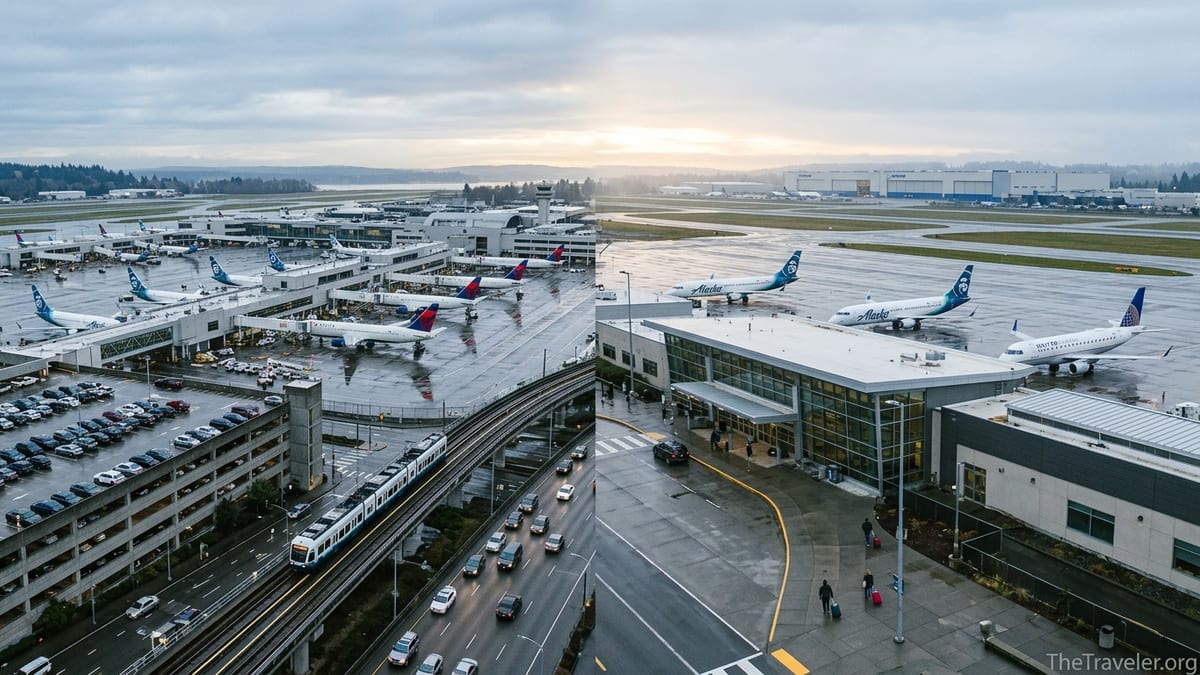
Big hub vs boutique terminal: what each airport actually offers
Seattle–Tacoma International Airport, usually called Sea-Tac or simply SEA, is the region’s primary hub. Located in the city of SeaTac, about 14 to 15 miles south of downtown Seattle, it handles tens of millions of passengers each year and connects to around 140 destinations in more than 20 countries. Alaska Airlines, Delta, and other major carriers operate extensive domestic and international networks from here, including long-haul flights to places such as Singapore and Doha. For most itineraries, especially anything overseas or to smaller U.S. cities, SEA will be the default option simply because there are far more flights and airlines to choose from.
Paine Field, officially Seattle Paine Field International Airport, sits about 25 miles north of downtown Seattle in Everett. Historically known as the airfield next to Boeing’s massive Everett factory, it opened a dedicated passenger terminal in 2019 and has been gradually building a niche as the region’s “small and easy” airport. Commercial service here focuses on domestic routes to major hubs and popular leisure destinations rather than global connectivity. The atmosphere feels closer to a private terminal than a typical crowded U.S. airport, with a single compact building, a handful of gates, and a deliberate emphasis on comfort.
In practical terms, this means that if you live in or near Everett, Mukilteo, Lynnwood, Edmonds, or on parts of Whidbey Island, Paine Field can dramatically cut your travel time to the airport while still offering useful nonstop options to cities such as Phoenix, Las Vegas, or hub airports in California and the Mountain West via carriers like Alaska or their regional partners. If you are in Tacoma, Federal Way, or most of south King County, SEA will almost always make more sense.
Think of SEA as the all-purpose, go-almost-anywhere gateway and Paine Field as the boutique alternative for a smaller set of destinations. The trade-off is between breadth of service on one side and ease of use and proximity for northern communities on the other.
Where you are staying: Seattle, Everett, Tacoma and beyond
Your starting point in the region is usually the most important factor in choosing between SEA and Paine Field. SEA sits south of downtown and is roughly 20 minutes’ drive to central Seattle in light traffic, but closer to 40 minutes or more in rush hour. It is also significantly nearer to Tacoma, which lies to the south, and to cities like Federal Way and Kent. Travelers staying in downtown Seattle hotels commonly choose SEA because it is a straightforward trip by light rail or taxi, and because almost every airline serves it.
Paine Field, by contrast, is highly convenient for those based in Everett, Lynnwood, Mukilteo, and nearby suburbs. Driving from Everett’s waterfront to the Paine Field terminal can take as little as 15 to 20 minutes in normal conditions. That same trip to SEA can easily be an hour or longer, especially during morning or afternoon commute times when congestion on Interstate 5 can be heavy. A business traveler who lives in Edmonds and is catching a 7 am flight to Los Angeles, for instance, might spend 25 to 30 minutes driving north to Paine Field instead of budgeting 60 to 90 minutes to reach SEA.
Travelers from north of Everett, such as those from Marysville, Mount Vernon, or Bellingham, often weigh whether to drive south to Paine Field or all the way to SEA. In many cases, Paine Field sits roughly 30 to 45 minutes closer. A traveler from Bellingham heading to Phoenix may find that Alaska offers a convenient nonstop from Paine Field with a total drive of around 90 minutes to Everett, compared with a two-plus-hour push to SEA, plus the hassle of navigating a much larger airport. On the other hand, if schedules out of Paine Field do not line up or if ticket prices are markedly higher on your dates, SEA might still be worth the extra distance.
If you are staying in downtown Seattle and spot a good fare from Paine Field, remember that you will be traveling opposite the main commuting pattern when you head north in the early afternoon, but you could face heavier southbound traffic when returning during evening peak hours. For a weekend getaway to California, many locals consider Paine Field worth the extra 20 to 30 minutes of driving from central Seattle simply to avoid the lines and crowds at SEA.
Getting to the airport: light rail, buses, shuttles and rideshares
Seattle–Tacoma Airport is the clear winner for public transportation. The SeaTac/Airport station on the region’s 1Line light rail sits a short walk from the terminal. Trains run frequently throughout the day, connecting the airport to downtown Seattle, the University District, and, as line extensions open, north to Lynnwood and south toward Federal Way. A ride between the airport and downtown typically takes around 35 minutes, with fares priced competitively against bus options and far cheaper than a taxi or rideshare. Visitors staying near a downtown light rail stop often simply roll their suitcase to the station and ride straight to the airport.
Multiple express bus routes also connect SEA with suburban hubs. For instance, travelers coming from Tacoma can ride regional buses or airport shuttles to SEA without transferring through downtown Seattle. Hotel shuttles cluster around the airport, and rideshare pickup zones are clearly marked in the parking garage. For a family of four staying in a SeaTac hotel, it is usually easiest to take a short hotel shuttle ride rather than pay for parking at the terminal itself.
Paine Field’s transit picture is more limited but improving. Everett Transit’s Route 8 bus serves the airport and runs between Paine Field and Everett Station, where riders can connect to other local and regional buses or to intercity services toward Skagit County and Bellingham. Community Transit routes provide additional service in the broader Snohomish County area. In practice, however, many Paine Field passengers still arrive by private car or rideshare, as bus service can be infrequent outside peak commuting times and may require multiple transfers from communities further afield.
Shuttle services and private transfers operate between Paine Field and destinations such as north Seattle, the Tulalip Resort Casino area, or Whidbey Island ferry terminals. Prices can be comparable to or slightly higher than a typical airport shuttle from SEA, in part because the service is still a niche market. Rideshare fares between downtown Seattle and Paine Field vary with traffic and demand, but travelers commonly see quotes that are higher than the equivalent trip to SEA simply because of the extra distance. If you are traveling solo from central Seattle without a car, SEA’s combination of light rail and bus options will almost always be cheaper and more straightforward.
Parking, rental cars and on-the-ground logistics
Parking at SEA can be both convenient and expensive. The on-site parking garage, attached directly to the terminal by walkways, is one of the largest in the country and offers hourly, daily, and long-term options. Rates change periodically, but it is common to see daily prices significantly higher than what regional travelers are used to paying at smaller airports. Many locals instead use off-airport lots along International Boulevard that run frequent shuttle buses to the terminal. These private lots often undercut the official garage rates by a noticeable margin, especially if you book ahead or use coupons, though you must add extra time for the shuttle ride.
Paine Field’s parking environment is simpler and typically cheaper on a per-day basis. The airport offers a surface lot directly in front of the terminal, so most travelers can park and walk to check-in in under five minutes, even with luggage. Long-term parking rates have historically been in the modest range per day, appealing to travelers leaving their car for three to five days. Some passengers report using Everett Station’s parking, where certain areas allow multi-day parking, then finishing the trip by bus or rideshare, though this requires careful attention to local rules and may not be officially endorsed as airport parking.
Valet parking is a notable perk at Paine Field. Travelers can drive up to the terminal entrance, hand over their keys, and head straight inside, a convenience more commonly associated with private aviation than a commercial terminal. This is especially attractive for business travelers on short one or two day trips. SEA offers premium parking options closer to the terminal, but they tend to be aimed at frequent fliers and come at a correspondingly high price.
Rental car options illustrate another contrast. SEA hosts the full roster of national brands in a dedicated consolidated rental car facility reached by frequent shuttle buses. If you need a car for a road trip across Washington or are a visitor planning to tour Mount Rainier, the Olympic Peninsula, or Eastern Washington, you will find plenty of choice and competitive pricing. Paine Field has a more limited set of on-site rental options, with some travelers instead arranging pickups in nearby Everett or Lynnwood. If your plan is to stay mostly in north Seattle or Snohomish County, renting from Paine Field can be perfectly adequate, but for more complex itineraries SEA provides more flexibility.
Inside the terminals: check-in, security and overall experience
The different personalities of the two airports become most obvious once you step inside. SEA, as a major hub, is busy at almost any time of day. Security lines can be lengthy during early morning banks of flights and evening international departures. On peak travel days around holidays, wait times can stretch even if you have TSA PreCheck. The payoff for this scale is a broad range of amenities: multiple airline lounges from Alaska, Delta, and others, dozens of restaurants and coffee shops, and a wide selection of retail from local brands to national chains. If you like having options while you wait, SEA delivers them.
Paine Field’s passenger terminal was designed from the outset to feel calm and upscale. Travelers enter a bright, modern building with high ceilings, comfortable seating, and touches like living room style furniture and waiter service in the lounge area. Security screening covers only a handful of gates, which usually translates into short lines. Regular Paine Field users often report arriving 45 to 60 minutes before departure and still having time to grab a coffee after clearing security. During very early morning or Sunday evening peaks things can back up, but the overall pace remains gentler than at SEA.
For a nervous or infrequent flyer, Paine Field can dramatically reduce the stress that some associate with big airports. A parent flying alone with children, for example, might appreciate how easy it is to park, walk into the terminal, and pass through a single checkpoint in a relatively quiet environment. On the other hand, frequent business travelers with lounge memberships or elite status might miss some of the perks at SEA, such as multiple lounge choices, priority security lanes, and a wide variety of food options tailored to quick preflight meals.
When disruptions occur, SEA’s size cuts both ways. The airport can often rebook passengers via alternative connections if a flight cancels, but crowds can build quickly, and hotel rooms near the airport can sell out on major storm days. At Paine Field, your options are more limited. If one of the few daily flights to your destination is cancelled, you might be rebooked through SEA or shifted to a later day, depending on schedules. For travelers with rigid timelines or important meetings, this is worth bearing in mind.
Flight options, destinations and when each airport shines
In terms of pure network size, SEA is in a different league. It provides nonstop service to dozens of U.S. cities across all regions, from large hubs like Chicago, Atlanta, and Dallas to smaller markets in the Mountain West and Midwest. Internationally, you can reach hubs in Europe, Asia, and the Middle East without changing planes, which then opens up onward connections worldwide. If you are flying to London, Tokyo, or to a small city in the Southeast, you will almost certainly be using SEA.
Paine Field’s route map focuses on high-demand domestic destinations and key airline hubs. Think West Coast cities in California, desert destinations like Las Vegas and Phoenix, and select Mountain West or Midwest hubs that feed broader networks. For example, a traveler in Everett heading to San Diego for a long weekend can often find a nonstop from Paine Field operated by Alaska or a regional partner, avoiding any connection at SEA entirely. Similarly, if you are flying to a major hub such as Denver or San Francisco, you may be able to start at Paine Field and then connect onward, though total travel time and fare comparisons should be checked carefully.
One practical way to decide is to run a few sample searches from both airports for your intended travel dates. Compare factors like total travel time, number of connections, and price differences. Sometimes, especially during busy holiday seasons, Paine Field flights can be priced similarly to SEA or even slightly lower because of competition on popular routes. In other cases, limited capacity at Paine Field can push prices higher, and SEA becomes the better value.
For international trips that begin with a domestic leg, such as Everett to Seattle to Europe, consider the risk of misconnecting if your Paine Field flight runs late. Because the schedule is relatively sparse, a delay on your first leg can cascade into missed long-haul flights from SEA, and rebooking can become complicated. Many seasoned travelers in this situation prefer to start their journey directly from SEA, even if it means driving farther, simply to simplify the day of travel.
Costs, convenience and example traveler scenarios
When you factor in ground transportation, parking and your own time, the cheapest ticket does not always translate to the lowest total cost. A family of four from Everett traveling to Phoenix in January might see round-trip fares from both SEA and Paine Field that are roughly similar. However, if they choose SEA, they could pay higher parking charges for a week in the main garage or incur the cost of a long rideshare ride each way. Choosing Paine Field instead might mean paying a bit more per ticket but saving significantly on parking and cutting their round-trip drive by several hours, which is especially valuable when traveling with small children.
Consider a solo traveler living in Capitol Hill in central Seattle heading to Vancouver, British Columbia, for a weekend. From SEA, they might fly on a short nonstop, but given how close Vancouver is, they may also choose to take an intercity bus or train instead. Flying from Paine Field would require a longer, more expensive rideshare ride to Everett, plus dealing with limited frequencies. In this case, SEA’s direct light rail access and closer location make it the obvious choice, or even point towards using ground transport entirely.
Another scenario: a tech worker living in Kirkland often flies to San Jose for business. They find that SEA offers multiple daily nonstops on several airlines, spaced throughout the day. Paine Field might have fewer options or slightly less flexible timings. If their schedule is tight and meetings can shift unexpectedly, the extra backup options from SEA could be worth the added drive time, especially as new light rail connections ease access from the Eastside to SEA.
On the flip side, a retiree living in Mukilteo who takes two or three leisure trips a year to Palm Springs or Southern California might value simplicity over choice. For them, Paine Field’s easy parking, quiet terminal, and smaller crowds make every trip feel less draining. They may happily accept limited schedule options and plan their trips around the flights Paine Field offers, knowing that their door-to-gate time is short and predictable.
The Takeaway
Choosing between Seattle–Tacoma International Airport and Paine Field is less about which airport is “better” overall and more about which one fits your specific trip. SEA is the undisputed heavyweight: more airlines, more destinations, better international connectivity, and strong transit links via light rail and regional buses. If you are coming from downtown Seattle, the Eastside, Tacoma, or flying overseas, SEA will remain your primary gateway in almost every case.
Paine Field, by contrast, excels as a time-saving, low-stress alternative for northern communities. Travelers based in Everett, Lynnwood, Mukilteo, and beyond can swap a long, traffic-prone drive to SEA for a quick hop to a boutique-style terminal with short lines, straightforward parking, and a calmer atmosphere. As long as your destination aligns with the routes on offer, Paine Field can transform the start and end of your trip from a chore into something approaching a pleasure.
Before you book, take a few minutes to compare real-world options on your actual dates. Look at total travel time from your front door, not just flight duration. Factor in whether you will take light rail or need to pay for rideshares, and estimate parking costs. For some trips, a slightly higher airfare out of Paine Field might still win out once you account for time and stress savings. For others, SEA’s deeper flight network and transit access will more than compensate for its crowds and complexity.
With two viable airports now serving the greater Seattle area, travelers have more freedom to shape their journey. By matching the strengths of SEA and Paine Field to the realities of where you live and where you are going, you can choose the option that makes your next trip smoother from start to finish.
FAQ
Q1. Which airport is closer to downtown Seattle, SEA or Paine Field?
SEA is closer in pure distance, roughly 14 to 15 miles south of downtown, and it has a direct light rail connection. Paine Field is about 25 miles north in Everett, so driving can take longer and public transit requires bus connections.
Q2. If I live in Everett or Lynnwood, should I always use Paine Field?
Not always, but it is often the most convenient. Paine Field can cut your drive and parking time significantly, but SEA still offers many more destinations. If your route is available from Paine Field at a reasonable price and schedule, it is usually the easier choice.
Q3. Which airport has better public transportation options?
SEA has better transit. It is connected directly to the regional light rail network and is served by multiple regional bus routes and hotel shuttles. Paine Field currently relies mostly on local buses, shuttles and private cars, so options can be less frequent and require transfers.
Q4. Is parking cheaper at Paine Field than at Seattle–Tacoma Airport?
Parking at Paine Field is generally simpler and often cheaper per day, with a surface lot close to the terminal and valet options. SEA’s on-site garage is convenient but can be expensive, so many travelers use off-airport lots to save money.
Q5. Which airport is better for international flights?
SEA is far better for international travel. It offers nonstop flights to major hubs in Europe, Asia and the Middle East, as well as many Canadian and Mexican destinations. Paine Field’s service focuses on domestic routes and connections through other U.S. hubs.
Q6. Are security lines shorter at Paine Field?
In most cases yes. Paine Field’s small terminal and limited number of flights mean security lines are usually shorter and move quickly. SEA can have long waits at busy times, although programs like TSA PreCheck and CLEAR can help frequent travelers.
Q7. Can I rely on Paine Field if I have tight connections for a long trip?
It depends on your risk tolerance. With fewer daily flights, a delay or cancellation at Paine Field can make it harder to rebook, especially if you are connecting to an overseas flight. For very time-sensitive trips, many travelers prefer starting directly from SEA.
Q8. Do both airports have rental car facilities?
Yes, but SEA has a much larger selection of rental car companies in a dedicated facility served by frequent shuttles. Paine Field offers more limited on-site options, with some travelers arranging rentals in nearby Everett or Lynnwood instead.
Q9. Which airport is better if I am nervous about crowds and big terminals?
Paine Field is usually the better fit for anxious or infrequent flyers. Its small scale, quieter atmosphere and quick security process can make air travel feel far less overwhelming compared with SEA’s busy concourses.
Q10. How should I decide between SEA and Paine Field for my specific trip?
Compare total door-to-door time, including ground transport and parking, along with ticket prices and flight schedules from both airports. If you live north of Seattle and your destination is served from Paine Field at a workable time and cost, it often wins for convenience. If you need more route options, are traveling internationally, or rely on light rail, SEA is likely the better choice.