


I thought I knew Michelangelo’s David before I ever set foot in Florence. I had seen it in coffee table books, in documentaries, in thousands of photos online. Yet when I finally walked into the Galleria dell’Accademia and saw the real marble figure rising above the crowd, the experience landed with a physical jolt. David was larger, more alive and far more moving than I had imagined. It felt less like ticking off a famous masterpiece and more like meeting a person whose story I already knew, but whose presence I had completely underestimated.
Get the latest updates straight to your inbox!
From Familiar Image to Unexpected Emotion
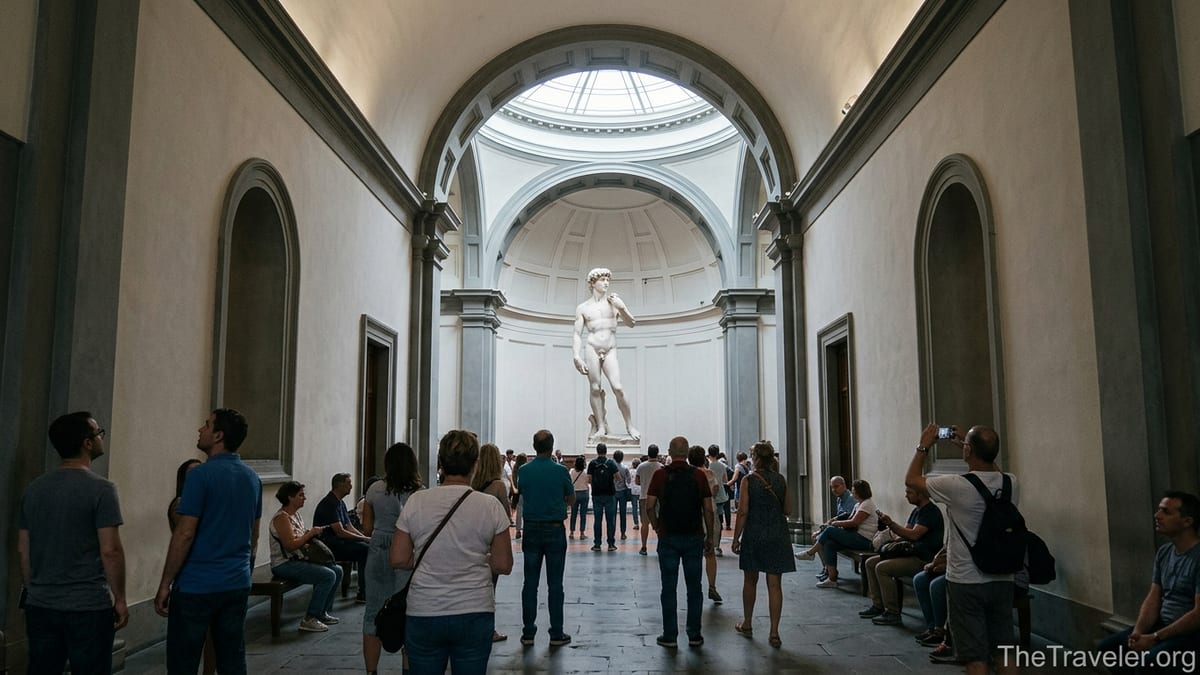
Nothing prepares you for the first glimpse down the long central hall of the Accademia Gallery. After the ticket checks and security scanners, you turn a corner and suddenly the space opens up. At the far end of the hall, under a pale dome of natural light, David stands alone. Even from a distance, the statue reads as a silhouette you recognize immediately, yet it seems to radiate a slow, magnetic pull that photographs never convey.
As I walked closer, I noticed my pace naturally slowing. Around me, conversations dropped to a murmur. This is not a hushed, empty chapel; the gallery is often buzzing with tour groups, school trips and solo travelers. Yet there is a subtle shift in the room, a shared awareness that we are standing before something that has held people’s attention for more than five centuries. You can feel that accumulated history in the air.
The closer you get, the more the statue stops being “an icon” and becomes a body. Veins rise along the forearms, the tendons of the neck are taut, and the gentle turn of the head suggests a living person who has simply paused mid-thought. It is this tension, this sense that David might breathe at any second, that makes seeing him in person so unexpectedly emotional.
Understanding the Scale, Detail and Setting
Most reproductions flatten David into a poster-perfect front view. Standing beneath him inside the Accademia, you encounter something completely different: a towering figure more than five meters high, carved from a single block of Carrara marble in the early 1500s. The pedestal lifts him even higher, so you find yourself looking almost straight up into his face. The slight disproportion of the hands and head, which can look odd in photos, suddenly makes sense here. They are scaled for a viewpoint far below, where those features become expressive anchors rather than quirks.
Walk around the statue and the technical brilliance becomes inescapable. From the front, David is the calm young hero before the battle with Goliath. From the right side, the twist of the torso comes into focus, a spiral of muscle and bone that seems to pivot around the spine. From behind, the curve of the back and the way light catches the shoulder blades are astonishingly natural, like watching an athlete stretching in slow motion. Travelers around me traded quiet observations, comparing notes on the smallest details: the way the right heel barely kisses the ground, the delicate carving of toenails, the faint shadow in the hollow of the collarbone.
The setting amplifies all of this. The central hall of the Accademia was redesigned to showcase David, with a skylight over the dome that bathes the marble in a cool, diffuse glow. Unlike outdoor replicas in Florence, this original is shielded from weather and pollution; you can see subtleties of the surface that the elements would have eroded long ago. To one side, a guard politely ushers visitors to keep moving so everyone can circle the statue. It is busy and controlled, yet the sight of that glowing white figure at the end of the hall feels surprisingly serene.
The Build-Up: Michelangelo’s Unfinished “Prisoners”
The emotional impact of seeing David does not start at the statue itself, but in the corridor that leads to it. As you enter the main axis of the gallery, you first pass Michelangelo’s unfinished works known as the “Prisoners” or “Slaves.” These massive, roughly carved figures appear to struggle out of the marble blocks, their limbs emerging while other parts remain trapped. Cracks, chisel marks and rough planes are fully visible, as if you are standing inside the sculptor’s workshop mid-process.
Walking past these looming fragments on the way to the perfectly finished David sets up a powerful contrast. You move from raw potential to complete realization, from figures literally imprisoned in stone to a young hero who seems entirely freed from it. This transition heightens the sense of drama when David finally appears at the end of the hall. Many visitors, myself included, found that spending a few minutes with the Prisoners first made David feel even more miraculous, because you are freshly aware of just how much work and risk went into coaxing a human form out of a resistant block of rock.
For travelers who might not usually linger in sculpture galleries, this sequence is one of the most effective storytelling devices in Florence. You do not need an art history degree to read the narrative: struggle, emergence, completion. Practical detail matters here too. If you join a small-group tour, a good guide will often pause at each Prisoner and trace the tool marks with a laser pointer, helping you read the stone before you reach David. If you visit independently, consider downloading an audio guide or a reputable app before you arrive, so those unfinished surfaces do not just register as “incomplete statues,” but as the powerful prelude they are.
Planning Your Visit: When, How and How Much
In the past few years, the Galleria dell’Accademia has started feeling less like a quiet school gallery and more like a major world attraction, and planning matters. As of early 2026, a standard adult ticket reserved in advance for the Accademia costs around 20 euros, which includes a small reservation fee. On the ground, that translates into a timed entry slot and a security check similar to what you might encounter at other major Italian museums.
The gallery operates on a schedule that typically runs from Tuesday to Sunday, opening in the morning and closing early evening, with Monday as the main closure day. Exact hours can vary seasonally, but an arrival at opening time or a late-afternoon slot on a weekday tends to offer the most comfortable experience. In peak months such as May, June and September, tacked-on day-trip groups from cruise ships and nearby cities can make mid-morning particularly crowded, with walk-up lines stretching down Via Ricasoli. Timed tickets reserved in advance through official channels significantly shorten that wait and are worth locking in several weeks ahead in high season.
Travelers have several booking options. You can purchase a straightforward timed-entry ticket, which gives you access to the entire gallery and is the most economical choice for independent visitors. There is also a combined ticket that links the Accademia with the Bargello Museum, useful if you plan to spend a full day immersed in Renaissance sculpture. For those who prefer extra context, guided tours ranging from small-group experiences to private visits are widely available and typically cost more than the base ticket but include commentary and sometimes priority entry. Whatever option you choose, bring a physical or digital copy of your confirmation, a valid ID and arrive at the gallery at least ten to fifteen minutes before your slot.
What It’s Really Like Inside: Crowds, Photos and Pace
Expect the Accademia to feel busy. The museum is relatively compact compared to the Uffizi, and visitor numbers are high, which means that even with a cap on the number of people inside at once, the central hall around David can feel crowded. You will likely share the space with school groups, couples on weekend getaways and organized tours speaking multiple languages at once. The key is to manage your expectations: you are not likely to have a private audience with the statue, but you can still find moments of personal connection if you move slowly and choose your vantage points carefully.
Photography is allowed, but without flash, and the marble’s bright surface means your phone camera will usually capture a clear image in the skylight’s even light. That said, many visitors fall into the trap of spending their entire limited time trying to recreate the exact frontal shot they have already seen on countless postcards. Consider instead taking a few quick photos from different angles, then putting your device away for several minutes. One of the most powerful experiences is simply sitting on the benches along the back wall, watching how the play of light changes as clouds shift outside, or how different visitors react when they first look up.
Allocate at least an hour for your visit, even if you think you only care about David. The gallery’s layout encourages a linear path, but it is worth doubling back to earlier rooms, especially during a quieter moment. Galleries near the entrance house gold-ground medieval paintings and religious works that give you a sense of the artistic world that came before Michelangelo. A side section displays historical musical instruments, including early violins and cellos, which often surprise visitors who did not realize they were part of the collection. Pausing in these side rooms not only broadens your experience but also offers a brief respite from the hubbub around the central hall.
Beyond the Statue: Connecting David to Florence Itself
Seeing David in person is not just an encounter with a single artwork; it is also a gateway into understanding Florence more deeply. Originally installed outside the Palazzo Vecchio in 1504 as a symbol of the Florentine Republic, the statue carried political weight long before it became a global tourist magnet. Standing in the piazza today, you can see a full-size replica occupying that original spot, flanked by other sculptures and the heavy stone walls of the city’s old town hall. Walking between the replica in the square and the original in the Accademia creates a sort of mental overlay, helping you imagine how the city once presented its ideals of courage and independence to anyone entering the civic center.
As you leave the gallery and step back into the narrow streets, David stays with you in unexpected ways. You begin to spot his silhouette on posters for local exhibitions, on postcards in stationery shops, in miniature resin reproductions sold at souvenir stands. The image is everywhere, yet after seeing the real statue, these echoes feel different. Travelers often describe a sense of recognition when they stroll along the Arno at sunset or climb up to Piazzale Michelangelo for a panoramic view; the same city that nurtured Michelangelo’s genius is still alive around them, in the rhythm of Vespas crossing the bridges and the warm light on the stone facades.
To deepen the connection, consider pairing your Accademia visit with the Bargello Museum, home to earlier versions of the David story by Donatello and others. Comparing these different interpretations lets you see how radical Michelangelo’s take truly was, with its moment-before-action tension rather than the triumphant aftermath. Alternatively, a stop at the Uffizi Gallery shows you the painterly side of the Renaissance, placing David within a wider visual culture of mythological heroes, saints and civic symbols. In this way, the statue becomes not just a destination on your itinerary, but a thread that weaves through multiple Florentine experiences.
The Takeaway
Standing in front of Michelangelo’s David in Florence, you quickly realize that no digital reproduction can substitute for the physical experience. The statue’s vast scale, the precision of its carving and the charged atmosphere of the Accademia Gallery combine to create a moment that feels both intimate and monumental. It is not solely about admiring technical skill; it is about confronting a human figure that encapsulates ideas of courage, vulnerability and ideal beauty that have resonated across centuries.
For many travelers, what lingers is the memory of looking up into David’s marble eyes and feeling an unexpected surge of emotion, as if the statue were looking back with calm determination. Planning ahead for tickets, choosing your timing wisely and allowing enough time inside the gallery can all help you reach that moment without unnecessary stress. But once you are there, the most important thing you can do is simple: slow down, breathe and let the encounter unfold.
In a city filled with masterpieces, from frescoed chapels to riverfront vistas, David remains one of Florence’s most powerful experiences. If you arrive expecting only a checklist item, you may walk out surprised by how personal it feels. And that, more than the crowds or the ticket price, is what makes this Renaissance sculpture continue to matter to modern travelers.
FAQ
Q1. Where is Michelangelo’s David located now?
Michelangelo’s original David is housed inside the Galleria dell’Accademia in central Florence, Italy. The statue you see in Piazza della Signoria is a full-size outdoor replica.
Q2. How much does it cost to see David at the Accademia?
As of 2026, a standard adult ticket reserved in advance for the Accademia is around 20 euros, including the reservation fee, with reduced and free options for eligible visitors.
Q3. Do I need to book tickets in advance?
Advance booking is strongly recommended, especially from spring through early autumn. Timed-entry tickets help you avoid long walk-up lines that can stretch down the street at busy times.
Q4. How long should I plan for a visit to the Accademia?
Most visitors spend about one to one and a half hours inside. If you like to read wall texts or linger over the Prisoners, musical instruments and painting galleries, allow closer to two hours.
Q5. When is the best time of day to see David?
Early morning slots right after opening, or later afternoon entries on weekdays, tend to be less crowded. Mid-morning and midday, especially in peak season, are usually the busiest.
Q6. Can I take photos of David?
Yes, photography without flash is generally allowed inside the Accademia, including around David. Tripods, selfie sticks and strong lights are not permitted, so plan on handheld photos only.
Q7. Is the Accademia Gallery suitable for children?
Yes, many families visit with school-age children. The museum is compact, which keeps walking distances manageable, though parents should be prepared for crowds and hold younger children’s hands.
Q8. What should I wear to visit the Accademia?
There is no strict dress code, but comfortable walking shoes are essential and layers are helpful. In summer, lightweight clothing and a small, secure bag work best in the warm, crowded galleries.
Q9. Is the Accademia accessible for visitors with limited mobility?
The Accademia has step-free access and elevators to different levels. Visitors with certified disabilities, along with an accompanying person, may qualify for free entry, but should check current policies before visiting.
Q10. What else should I see in Florence if I love David?
If David inspires you, consider visiting the Bargello Museum to see earlier Davids and other sculptures, the Uffizi Gallery for Renaissance painting, and the replica of David outside Palazzo Vecchio to place the statue in its original public context.