


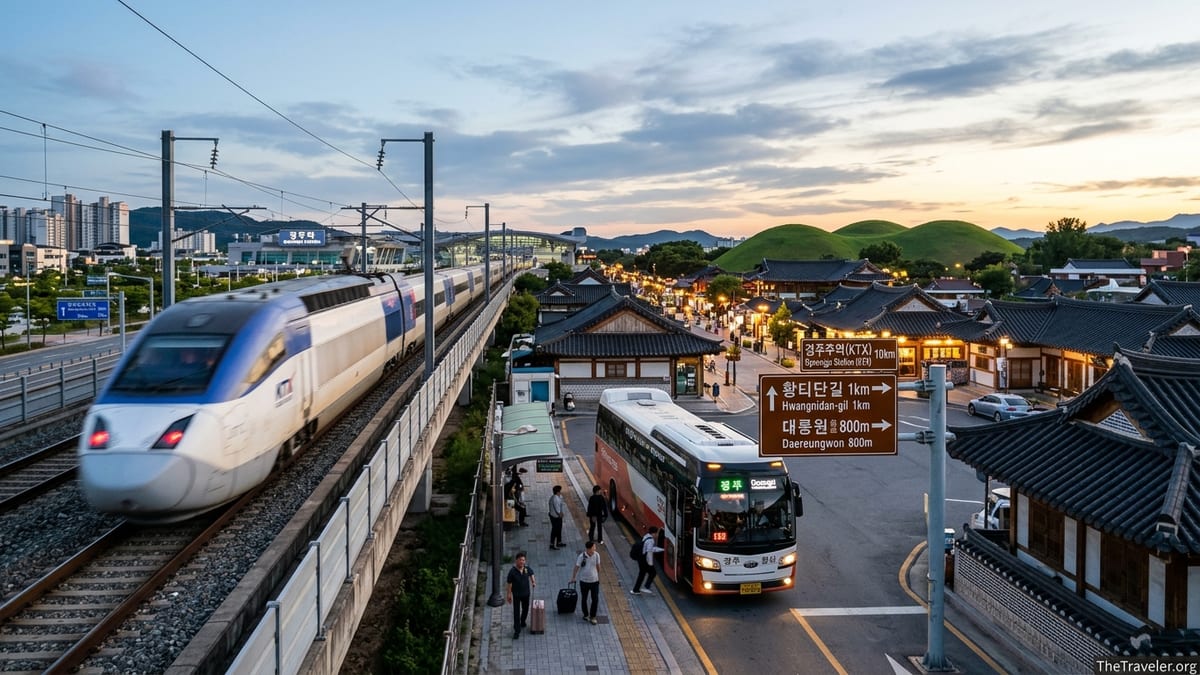
Travelers comparing train and bus from Seoul to Gyeongju quickly notice that the story is more complicated than a simple “KTX is faster” claim. The high speed line delivers you in around two to two and a half hours from Seoul Station to the new Gyeongju Station on the KTX network, but that station sits roughly 10 kilometers outside the historic center. Express and intercity buses, on the other hand, arrive much closer to Hwangnidan gil, Daereungwon and most central hotels. Once you factor in transfers, waiting times and luggage, many visitors find that the bus comes surprisingly close to the train in total journey time, and is often more convenient on the ground.
Get the latest updates straight to your inbox!
Verdict First: Train Speed vs Downtown Convenience
Between station terminals, KTX wins clearly. Recent schedules compiled from KORAIL data show Seoul Station to Gyeongju Station services in the 2 hour to about 2 hour 15 minute range on the fastest departures, with some slower runs closer to 2 hours 30 minutes depending on stops and route. Standard class one way fares after the 2026 KTX fare reductions are typically in the high 40,000 won range for this sector, with slight variation by train and departure time. That is substantially quicker than any road based option in pure vehicle time.
Door to door, the gap narrows. Gyeongju Station on the KTX network, previously signed as Singyeongju, is about 10 kilometers by road from the historic core around Hwangnidan gil and Daereungwon. City buses and taxis connect the station and downtown, but you should typically allow 30 to 40 minutes from arrival to hotel check in, including walking out, waiting for a bus or taxi, and the drive into town. By contrast, express buses from Seoul arrive at Gyeongju Express Bus Terminal and the neighboring intercity terminal, both located within the built up city area a short taxi or even walking distance from many guesthouses and small hotels.
For many itineraries, that means KTX is still the best choice when you prioritize speed, comfort and reliability, especially in peak holiday traffic. However, if your accommodation is near Hwangnidan gil or Daereungwon, and you prefer a single seat journey with minimal transfers, the express bus from Seoul Express Bus Terminal in Gangnam or selected departures from Dong Seoul Terminal can rival the train on total travel time while delivering you closer to where you actually want to be.
In practice, first time visitors with luggage often appreciate the simplicity of boarding one express coach in Seoul, riding for about three and a half hours including any highway rest stop, and stepping off just a short taxi ride from the hanok streets of central Gyeongju.
Understanding Today’s Gyeongju Station and the 10 km Gap
The key to planning this trip is understanding that the classic downtown railway station Gyeongju once used for conventional trains is no longer the main intercity gateway. KORAIL’s high speed services now use the newer Gyeongju Station on the Gyeongbu KTX and Donghae Line, located in a modern new town area roughly 10 kilometers from the traditional historic quarter. Official materials and recent guides still sometimes refer to this station as Singyeongju in brackets, which can confuse visitors comparing older articles and booking sites.
From Gyeongju Station, local buses queue outside the main exit, with routes such as 50, 60 and 61 heading toward central Gyeongju and tourist areas according to updated city transport brochures. Journey times by local bus to stops near Daereungwon Tomb Complex and Hwangnidan gil are generally around 25 to 35 minutes in normal traffic. Fares on city buses remain low, typically around 1,500 won when paying with a transportation card, but you may spend extra time waiting if you arrive just after a departure.
Taxis are a more time efficient but more expensive option. Recent maps and hotel transfer information suggest around 20 to 30 minutes from Gyeongju Station to the central hotel zones in light traffic, and local estimates consistently put the fare in the 15,000 to 20,000 won range for up to four passengers depending on route and congestion. The taxi queue sits just outside the concourse and is usually well organized, but at weekends and on public holidays you may wait ten minutes or more for a car.
This 10 kilometer separation is the main reason that “two hours to Gyeongju” on a timetable often becomes closer to three hours in real life from central Seoul accommodation to your guesthouse door. When comparing options, always add transfer time on both ends of the journey rather than focusing only on the fast section in the middle.
KTX from Central Seoul: Timetables, Costs and Transfers
From a typical central Seoul hotel near City Hall or Myeong dong, expect about 15 to 25 minutes on the subway or taxi to reach Seoul Station depending on your exact location. Line 1 and Line 4 both serve the station, while a short taxi ride might cost in the range of 6,000 to 9,000 won outside rush hour. It is wise to be on the station concourse at least 20 to 30 minutes before departure to navigate ticket checks, find your carriage and pick up snacks.
Recent aggregated timetables based on KORAIL data show roughly 25 to 30 KTX family departures per day on weekdays between Seoul and Gyeongju, with first trains leaving around 05:10 and last trains in the evening around 21:30. Fastest trains complete the Seoul to Gyeongju run in around 2 hours 5 to 2 hours 15 minutes, while some services that share slower sections of track or make extra stops can take closer to 2 hours 30 minutes. Standard class one way fares on this corridor, after the nationwide 10 percent KTX fare cut announced in mid 2026, are typically quoted just under 50,000 won, with a surcharge for first class and occasional discounts on very early or less popular departures.
On board, KTX offers reserved seating, overhead racks and limited luggage space at carriage ends. Larger suitcases that fit in aircraft overhead bins usually fit safely above your seat; very large cases may be harder to store on a crowded departure. Seat reservations include car and seat numbers, so families or groups can sit together if they book early. There is usually a small trolley or kiosk service for drinks and snacks, but many travelers pick up items at convenience stores inside Seoul Station.
Factoring in a 20 minute ride from central Seoul to Seoul Station, a 20 minute buffer at the station, about 2 hours 15 minutes on the KTX and then a 25 minute taxi into central Gyeongju, the realistic door to door time lands close to 3 hours 20 minutes. With a bus instead of a taxi at the Gyeongju end, the journey may stretch to around 3 hours 40 minutes. This is still faster and more predictable than driving at peak times, but not qualitatively different from a well chosen express bus departure for many visitors.
Express Buses from Seoul: When One Seat Beats High Speed
Seoul Express Bus Terminal in Gangnam, sometimes called Gangnam Express Bus Terminal, is the primary hub for express coaches to Gyeongju. Updated terminal route lists confirm regular services on the Gyeongbu corridor to Gyeongju, typically using modern long distance coaches with reclining seats, overhead storage and luggage bays under the floor. A recent timetable compiled from the domestic booking systems shows departures roughly once every one to two hours during the day, with frequencies varying by day of week and season.
From the central Seoul areas north of the river, reaching Seoul Express Bus Terminal usually takes around 25 to 35 minutes on Line 3, Line 7 or Line 9, or a slightly faster taxi ride if traffic is reasonable. Once at the terminal, you check in at your gate and load larger suitcases into the underfloor bay before boarding. Standard express bus fares between Seoul and Gyeongju are currently quoted in the mid 30,000 won range one way, for example around 36,000 to 37,000 won for an adult on an ordinary class coach, while premium or “excellent” class buses with more legroom and 2 1 seat configurations charge a supplement of several thousand won.
Recent journey time guides indicate around 3 hours 30 minutes of running time between Seoul Express Bus Terminal and Gyeongju Express Bus Terminal in light to moderate traffic. Buses often make one highway rest area stop on longer runs, where passengers can use restrooms and pick up snacks. On peak holiday weekends, travel times can extend by an hour or more when congestion around Daejeon and Daegu builds, so departures earlier in the morning or later in the evening are usually safer.
Buses have reserved seating, and tickets are sold with specific departure times. Refund and change conditions are regulated nationally for express services, with partial refunds available if you cancel before departure and sliding penalties closer to departure time. Luggage policies are practical rather than strictly enforced, but a sensible guideline is one large suitcase in the hold plus a small backpack or bag inside the bus; very large or multiple checked bags may be refused on busy services. From Gyeongju Express Bus Terminal, most central hotels in Hwangnidan gil or near Daereungwon are a short 5 to 10 minute taxi ride, commonly costing under 6,000 won in normal traffic, or a 15 to 20 minute walk for those traveling light.
Door to Door Time and Cost Comparisons
To make the comparison concrete, imagine a traveler staying near Myeong dong Station in Seoul and heading to a guesthouse on a side street off Hwangnidan gil in Gyeongju. Option one uses KTX. The traveler takes Line 4 two stops to Seoul Station in about 5 minutes, but sensibly allows 20 minutes total including station walking and waiting. They arrive 25 minutes before departure, board a 2 hour 10 minute KTX, then walk out to the taxi rank in Gyeongju Station and ride 25 minutes to their guesthouse. The total elapsed time is roughly 3 hours 20 to 3 hours 30 minutes door to door, at a cost of around 50,000 won for the train and 15,000 to 20,000 won for the taxi, plus a few thousand for the Seoul subway, resulting in a realistic transport spend close to 70,000 won one way.
Option two uses an express bus. The same traveler rides Line 3 across the river to Express Bus Terminal Station, allowing about 30 minutes including transfer and walking through the large underground complex. They arrive 20 minutes before their scheduled departure, board an express coach and ride for about 3 hours 30 minutes, including a 15 minute highway rest stop. On arrival at Gyeongju Express Bus Terminal, they take a 5 to 10 minute taxi ride for around 5,000 won to their guesthouse near Hwangnidan gil. The total time is approximately 4 hours 15 minutes, perhaps 45 minutes to an hour longer than the KTX route, but with only one transfer and less walking with luggage. The one way transport cost is in the region of 36,000 to 37,000 won for a standard seat plus around 5,000 won in taxi and roughly 1,500 won for the Seoul subway, for a total near 43,000 to 44,000 won.
From central locations south of the river, such as Gangnam or Sinsa, the bus becomes even more competitive. Taxis to Seoul Station at busy times can take 30 minutes or more through downtown traffic, while the express bus terminal sits closer. For travelers who value minimizing transfers, those with heavy or multiple suitcases, and families with small children, the extra 45 to 60 minutes on the highway often feels like a fair trade for reducing staircases and platform navigation.
In budget terms, the express bus usually saves something in the range of 10,000 to 25,000 won per person one way compared with KTX plus taxis, particularly if your accommodation is not walking distance from Gyeongju Station. Over a round trip for two people, that can free up enough money for a mid range dinner or part of a night in a hanok style guesthouse.
A Practical Two Day Gyeongju Itinerary from Central Seoul
With travel times in mind, a concise two day itinerary allows one travel morning, an afternoon and evening in the historic core, then a second full day focused on the temples to the south. Assuming you depart Seoul on a mid morning KTX or express bus, you can realistically check in to your Gyeongju hotel by early afternoon and start exploring the compact cluster of sights around Hwangnidan gil.
On day one, many visitors begin at the Daereungwon Tomb Complex, where grassy Silla era burial mounds create one of Korea’s most distinctive historic landscapes. Entrance fees in recent city publications sit in the low thousands of won per adult, with reduced prices for children and seniors. From Daereungwon, it is a short walk past low tiled walls and traditional houses to Cheomseongdae, the ancient stone observatory rising in the middle of a wide lawn, and then on to Woljeonggyo Bridge or the small hanok cafés of Hwangnidan gil. Because these sites are all within a gentle walking radius, families and older travelers can move at a relaxed pace without needing local transport.
As evening falls, a visit to Donggung Palace and Wolji Pond provides one of Gyeongju’s most atmospheric night views. The reflections of reconstructed palace buildings and pavilions in the still water are lit up after dark, and local transport maps show that several city bus routes stop nearby if you do not want to walk from your hotel. You may need to queue briefly for tickets on weekends and holidays, but the site remains manageable with some patience. After the visit, return on foot or by a short taxi ride to Hwangnidan gil for dinner in one of the many modern Korean or fusion restaurants filling former residential hanok buildings.
Day two focuses on Bulguksa Temple and, time and stamina permitting, Seokguram Grotto. From central Gyeongju, local buses numbered in the 10 or 11 range traditionally head toward Bulguksa, though exact route numbers can change and are best confirmed at the tourist information center or on a transport app before departure. Journey times are generally around 30 to 40 minutes into the forested foothills. Entrance fees for Bulguksa remain modest, again in the low thousands of won per adult, with concessions available. Spread out your visit so you can enjoy the stone bridges, pagodas and views without rushing.
Reaching Bulguksa and Seokguram, and Is Both in One Day Realistic?
The road to Seokguram branches uphill from Bulguksa, and visitors have two main options to link the two. First, infrequent local buses or shuttle services operate between Bulguksa’s parking area and Seokguram’s upper car park, quoting journey times of roughly 20 to 30 minutes on the winding mountain road. Second, taxis waiting near Bulguksa can be hired for a combined round trip to the grotto and back, with local drivers often quoting a package fare that includes waiting time as you explore the site.
Travel time from central Gyeongju to Bulguksa, onward to Seokguram, and then back to the city can easily total two hours or more just in transport. Adding time for entrance queues, walking to the grotto along the forest path from the upper car park, and actually appreciating the national treasure inside, a combined Bulguksa and Seokguram day feels full but achievable, particularly in late spring or autumn when daylight hours are generous. In summer heat or winter cold, or when traveling with young children, many visitors prefer to focus on Bulguksa only, treating Seokguram as an optional extra.
For a short two day visit, a reasonable pattern is to leave central Gyeongju around 09:00, arrive at Bulguksa by 09:45, explore the main temple complex for two to three hours, then decide after lunch whether you still have energy for Seokguram. Returning to town by mid to late afternoon allows time for one more circuit through the historic quarter or a relaxed café stop on Hwangnidan gil before dinner. If your return to Seoul is on day three, you could visit any sites skipped on day two in the morning before catching an afternoon KTX or bus.
Accessibility at these temple sites is mixed. Bulguksa’s lower courtyards are on relatively level ground, but many of the most photogenic viewpoints are reached by staircases. Seokguram involves both a winding road and a slightly uphill walk, which can be challenging for travelers with mobility limitations. In such cases, staying in the historic center and focusing on Daereungwon, Cheomseongdae and Donggung Palace, which have flatter paths, may provide a more comfortable experience.
Where to Stay: Hwangnidan gil, Bus Terminal Area and Beyond
Accommodation clustering in Gyeongju falls into three broad urban zones for independent travelers. Hwangnidan gil and its surrounding streets appeal most to first timers who want to step directly into the café and restaurant scene each evening. Here you will find a mixture of hanok style guesthouses, mid range hotels in low rise buildings and a growing number of boutique properties. Nightlife leans more toward dessert cafés and wine bars than loud clubs, and streets can be busy with domestic tourists until around 22:00 on weekends. Prices for double rooms in this area typically sit higher than equivalent options near the bus terminal, especially in cherry blossom and autumn foliage seasons.
Near the Gyeongju Express Bus Terminal and neighboring intercity terminal, a second accommodation belt offers slightly more utilitarian but convenient stays. Mid range business hotels and simple motels dominate, with competitive rates outside absolute peak dates. Walks into the historic quarter take 15 to 25 minutes depending on your exact location, or you can ride a short city bus or taxi hop. For travelers arriving late at night by bus or leaving early, staying here cuts down on middle of the night transfers, and the flat streets make rolling suitcases to the terminals straightforward.
A third zone lies around Bomun Lake, where resort hotels and family oriented complexes serve domestic holidaymakers. This area is less convenient for Daereungwon and Hwangnidan gil, requiring local buses or taxis for almost every sightseeing trip, but works well for families who want on site facilities such as pools, playgrounds and lake side paths. From Bomun to central Gyeongju, taxi fares quoted in hotel guides tend to run under 15,000 won each way, but the cumulative cost can rise over a multi night stay.
For most short visits focused on history, Hwangnidan gil or the streets between the bus terminals and Daereungwon strike the best balance of walkability and atmosphere. When comparing prices, remember to check whether breakfast is included and whether your guesthouse has an elevator if you are bringing heavy luggage or traveling with older relatives.
Budgets, Seasons, Luggage and Holiday Crowds
Putting numbers together, a realistic budget for a two night, two and a half day Gyeongju trip from Seoul using KTX might look like this for a couple sharing a room. Round trip KTX tickets at roughly 50,000 won each per person per direction equate to around 200,000 won for two people. Add 30,000 to 40,000 won total for taxis between Gyeongju Station and your hotel both ways, and perhaps 20,000 won for Seoul side subway and taxi connections. Accommodation in a mid range double room near Hwangnidan gil can range widely, but a ballpark figure of 90,000 to 150,000 won per night is common outside festival peaks, so two nights may come to 180,000 to 300,000 won. Entrance fees to Daereungwon, Donggung Palace, Bulguksa and possibly Seokguram will likely total under 40,000 won for two adults. Local buses and taxis around Gyeongju might add another 30,000 to 50,000 won, depending on how often you choose taxis over buses.
On an express bus based trip, transport costs fall. Round trip express bus tickets for two people at around 36,000 to 37,000 won each way per person come to roughly 150,000 won in total. Terminal side taxis and local buses on both ends can reasonably be kept under 50,000 won combined, and if you stay near the bus terminal or within walking distance of Daereungwon you may spend very little on intra city transport. Accommodation, food and entrance fees remain similar regardless of mode, so most of the savings arise from the intercity segment itself.
Seasonal factors are important. Gyeongju is extremely popular during cherry blossom weeks in early April and during the main autumn foliage period in late October and early November. On these weekends, both KTX and express buses can sell out days ahead, and highway congestion may extend bus journey times well beyond 4 hours. Major Korean public holidays such as Lunar New Year and Chuseok also see heavy traffic, crowded stations and higher demand for accommodation. During these peaks, booking KTX as soon as reservations open is wise, while buses serve as a backup option if you cannot secure train seats.
Luggage is another point of comparison. KTX has fixed but relatively limited storage areas, and carriages can feel busy near holiday dates, though overhead racks handle normal suitcases well. Express buses offer generous underfloor storage with staff helping load and unload, which can be more comfortable for those carrying large checked style suitcases. However, you will usually need to manage your own bags between bus terminals, city buses and hotels, so packing light still pays off in historic districts with narrow streets and occasional cobbles.
Who Should Choose What: Tailored Recommendations
Families with young children often prioritize minimizing transfers and complicated station navigation. For them, the express bus from Seoul Express Bus Terminal to Gyeongju is often the least stressful choice. They can board once, settle children into their seats, make use of the rest stop for bathroom breaks, and then arrive close to central accommodation with only a short taxi hop at the end. If travel falls on an especially congested holiday weekend, some families may still lean toward KTX for its more predictable timing, but the smoother luggage handling of the bus remains attractive.
Budget travelers and backpackers usually find the express or intercity bus the best value. When every 10,000 won matters, saving 20,000 to 40,000 won on a round trip compared to KTX can cover several meals or an extra night in a hostel. Buses also operate useful late evening departures that may align better with cheap check out times in Seoul hostels. For those staying near bus terminals or well served Seoul subway stations, the overall convenience is high.
First time visitors to Korea who are comfortable navigating large stations and want to experience the country’s flagship high speed rail system may still choose KTX as a highlight in its own right. The smooth, fast journey, rarely impacted by road congestion, makes schedule planning simple. For them, booking an early morning train out of Seoul and returning on an evening train two days later offers a polished, efficient experience, especially if they are staying in hotels with clear taxi instructions for Gyeongju Station.
Travelers focused on speed above all else, including business visitors and those with very tight itineraries, should default to KTX. Even after adding transfers, high speed rail usually beats the bus by around an hour in each direction and remains much more reliable in the face of traffic jams. By contrast, travelers who value doorstep convenience, single seat journeys and the flexibility of bus schedules, particularly those staying in Gangnam or near Seoul Express Bus Terminal, will often have a smoother trip by choosing the express bus despite the slightly longer running time.