


More news on this day
A succession of powerful winter weather systems in January and February 2026 unleashed widespread snow, ice and severe thunderstorms across large parts of the United States, triggering massive flight disruptions at major hub airports and stranding hundreds of thousands of passengers nationwide.
Get the latest news straight to your inbox!
Winter Storm Fern Paralyzes Networks From Texas to the Northeast
The most disruptive episode came between January 23 and January 27, 2026, when a sprawling winter storm system, informally dubbed Winter Storm Fern by some media outlets, swept from northern Mexico through the southern Plains, the Ohio Valley and into the Northeast. Publicly available summaries from the National Weather Service and NOAA describe a historic event that combined Arctic air with a powerful low-pressure system, producing dangerous ice accumulations, heavy snow and blizzard conditions across multiple regions.
According to event reviews from federal meteorological agencies, the storm’s footprint stretched across thousands of miles, with significant snow and ice reported from Texas and Arkansas through Kentucky, the Mid-Atlantic and New England. Travel warnings, winter storm alerts and ice storm advisories covered large swaths of the country as temperatures plunged and road and runway surfaces became treacherous. In parts of the Ohio Valley and Appalachians, bands of heavy snow and gusty winds sharply reduced visibility, complicating airport and ground operations for several consecutive days.
As conditions deteriorated, airline networks struggled to keep aircraft and crews in position. Flight-tracking data compiled in media coverage indicated that more than 16,000 US flights were canceled from Saturday through Monday of the peak storm period, with thousands more delayed as carriers proactively thinned schedules to prevent passengers from becoming stranded on aircraft and at outstations far from the storm’s core.
The disruption rippled far beyond the immediate path of the system. With aircraft and crews out of place, secondary cities across the West Coast, Mountain West and Southeast also experienced cancellations and missed connections, even under clear skies. Industry analysts noted that the scale of Fern’s impact ranked among the most severe national air travel disruptions since the pandemic-era meltdowns of 2022 and 2023.
Major Hubs Bear the Brunt of Cancellations
Hub airports in the central and eastern United States absorbed the heaviest operational strain. Dallas Fort Worth International Airport, one of the world’s busiest connecting hubs, experienced sustained sub-freezing temperatures and freezing precipitation, conditions that sharply limited runway availability and pushed de-icing capacity to its limits. Information published by one major US carrier based at the airport described a “significantly impacted” operation as crews worked to keep at least a portion of the schedule moving.
Further north and east, Chicago, Atlanta, Charlotte and Washington-area airports also reported high volumes of cancellations and diversions tied to snow, ice and low visibility. In the Northeast corridor, where the January storm was followed by additional winter weather in February, airports serving New York and Boston saw waves of scrubbed flights as record or near-record snowfall and strong winds temporarily halted ground movements and reduced airspace capacity over densely trafficked routes.
Even airports that escaped the heaviest snowfall faced operational challenges as the same storm system generated severe thunderstorms along its southern flank. Reports from the Gulf Coast and Southeast documented damaging winds, hail and tornado watches that forced temporary ground stops at airports in Florida and along the Eastern Seaboard. These convective outbreaks limited the routes available to air traffic controllers and forced airlines to refile flight plans around active weather cells.
Because large US hubs are deeply interconnected within airline networks, shutdowns in one region rapidly cascaded into disruptions elsewhere. Aircraft scheduled to depart the West Coast for early-morning connections in the Midwest and East could not depart if their inbound aircraft or crews were stuck in storm-affected areas, leading to cancellation chains that extended over several days.
Passengers Face Days of Backlogs and Rebookings
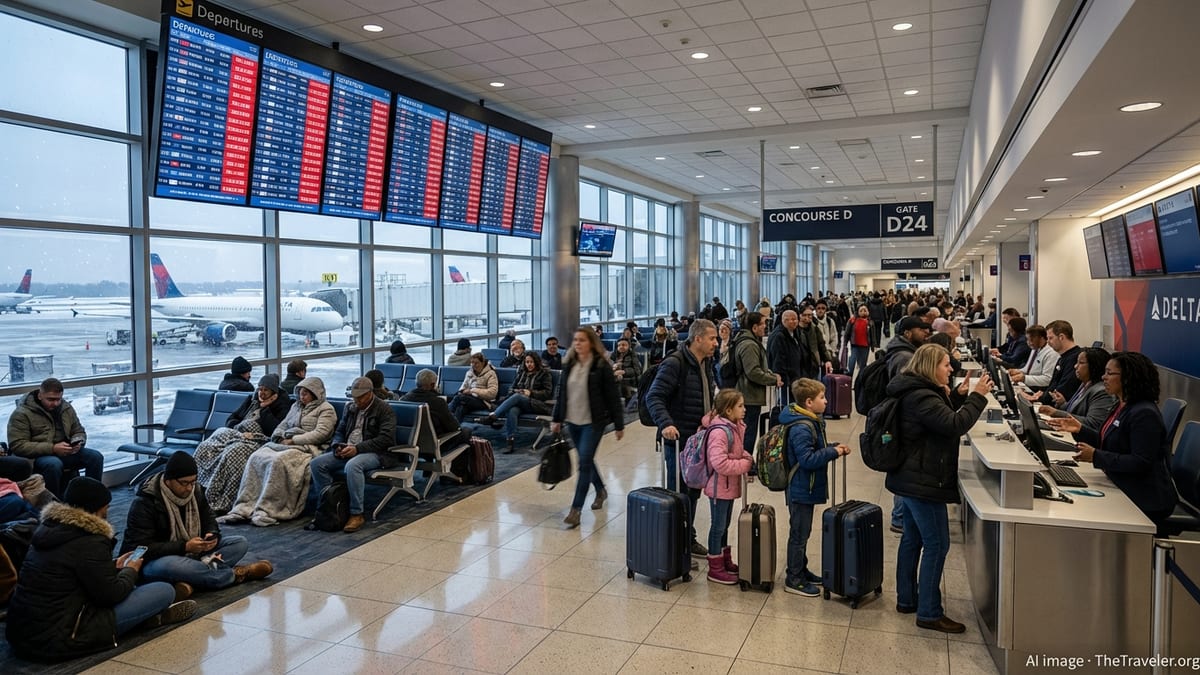
For travelers, the most visible effect of the 2026 storms was the sheer volume of cancellations concentrated over a short period. Media outlets drawing on FlightAware data reported that some major airlines canceled more than half of their scheduled flights at the height of the January event, overwhelming rebooking systems and customer-service channels. Passengers encountered long lines at airport help desks and crowded gate areas as they tried to secure alternate itineraries.
In many cities, hotel inventory near airports tightened as stranded travelers sought overnight accommodation. Social media posts and local coverage showed passengers sleeping in terminal seating and on the floor while they waited for new departure times, particularly at key hubs where connecting banks were heavily disrupted. With aircraft and crews scattered across the country, some customers were rebooked several days later or rerouted through multiple alternative hubs to reach their destinations.
Airlines responded by extending travel waivers that allowed customers to change flights without additional fees and, in many cases, fare differences, if they shifted trips away from the storm window. Publicly available notices from at least one large carrier show waivers being expanded through January 26 as it became clear that the storm’s impacts would persist longer than initially forecast. Travelers were urged to use mobile apps and websites to monitor flight status and rebook without visiting an airport counter.
Because many disruptions were preemptive, some passengers questioned why flights were canceled before any snow or ice was visible at their departure airports. Aviation experts cited the need to minimize the risk of passengers and crews becoming stranded on aircraft during rapidly worsening conditions and emphasized that runway contamination, de-icing bottlenecks and air traffic flow restrictions can all require schedule cuts well before a storm’s peak.
Storm Impacts Extend into February Blizzard and Severe Weather Season
The January disruptions were followed by additional weather-related interruptions in February 2026, when a powerful blizzard swept across parts of the Northeast. National and regional summaries describe hurricane-force wind gusts in coastal New England and record-breaking two-day snowfall totals in Rhode Island, with several major cities experiencing temporary shutdowns of normal transport services, including commercial air travel.
In New York and the broader mid-Atlantic region, thousands of flights were canceled or delayed as the blizzard’s heavy snow bands crossed key approach paths and wind gusts exceeded safe thresholds for ramp operations. Local transit systems struggled to keep up with drifting snow, forcing many passengers to abandon travel plans or rely on rebookings later in the week. Airlines once again thinned schedules in advance in an effort to control the disruption.
Beyond winter storms, severe convective outbreaks in early 2026 also contributed to air travel volatility. Reports from the Southeast highlighted fast-moving lines of thunderstorms and tornado-producing systems that swept across parts of Georgia, Alabama and the Florida Panhandle in February, leading to temporary ground stops and diversions at airports in the region. In the Midwest, subsequent springlike storm systems brought flooding rains and damaging winds that periodically constrained operations at Chicago and other central hubs.
These overlapping events underscored how closely the national aviation system is tied to seasonal weather patterns. Historical FAA data show that weather has accounted for the clear majority of system-impacting delays in recent years, and 2026’s early storm season aligned with that broader pattern by generating bottlenecks wherever major jet routes intersected active storm corridors.
What Airlines and Travelers Can Expect Next
The 2026 disruptions have renewed attention on how airlines and infrastructure managers plan for increasingly volatile weather. Federal summaries of the January winter storm note that forecasting tools, satellite monitoring and probabilistic impact models were widely used to anticipate where the worst conditions would develop, allowing airlines and airports to shift resources and adjust schedules in advance. Analysts suggest that such preemptive strategies, although disruptive in the short term, can shorten recovery times once storms clear.
Industry observers also highlight the role of hub concentration in amplifying weather shocks. When storms target large connecting airports like Dallas Fort Worth, Chicago O’Hare or Atlanta, the effects reach passengers across an entire network, including those traveling between regions unaffected by the weather itself. Some experts argue that adding more point-to-point capacity and diversifying hub structures could help absorb future disruptions, though such changes would require long-term fleet and network planning.
For travelers, the 2026 storm season has reinforced several practical lessons. Flexible tickets or loyalty status can simplify rebooking during widespread disruptions, and monitoring forecasts along an entire route, not just at origin and destination, can provide early warning of potential issues. Many carriers now encourage customers to shift travel dates in advance when large-scale winter storms or severe weather outbreaks become likely, offering fee waivers as an incentive to reduce peak-day demand.
With climate assessments indicating that some forms of extreme weather may become more frequent or intense in coming decades, aviation planners anticipate that large-scale storm-related disruptions will remain a recurring feature of US air travel. The January and February 2026 storms provided a vivid demonstration of how quickly conditions can overwhelm even highly optimized hub networks, and how closely smooth air travel depends on a relatively narrow window of cooperative weather across vast distances.
Sources: NOAA NESDIS winter storm overview; NOAA Weather Prediction Center January 2026 storm review; NWS Louisville January 24–26, 2026 event summary; American Airlines Winter Storm Fern update; FlightAware flight disruption data as cited in 2026 media coverage