


Piazza del Risorgimento is the last big urban threshold before you enter the orbit of the Vatican Museums and St Peter’s Basilica. For most visitors arriving by metro, tram, or bus, this busy square is the funnel through which tour groups, commuters, pilgrims, and souvenir vendors all converge. Time it right and you stroll through in ten relaxed minutes, grabbing a coffee and reaching security with almost no wait. Time it wrong and you are shoulder to shoulder with tour flags, touts, and a seething queue that can already wrap along the Vatican walls. Understanding when and how to pass through Piazza del Risorgimento can make the difference between a calm approach to the Vatican and starting your visit tired, stressed, and overheated.
Get the latest updates straight to your inbox!
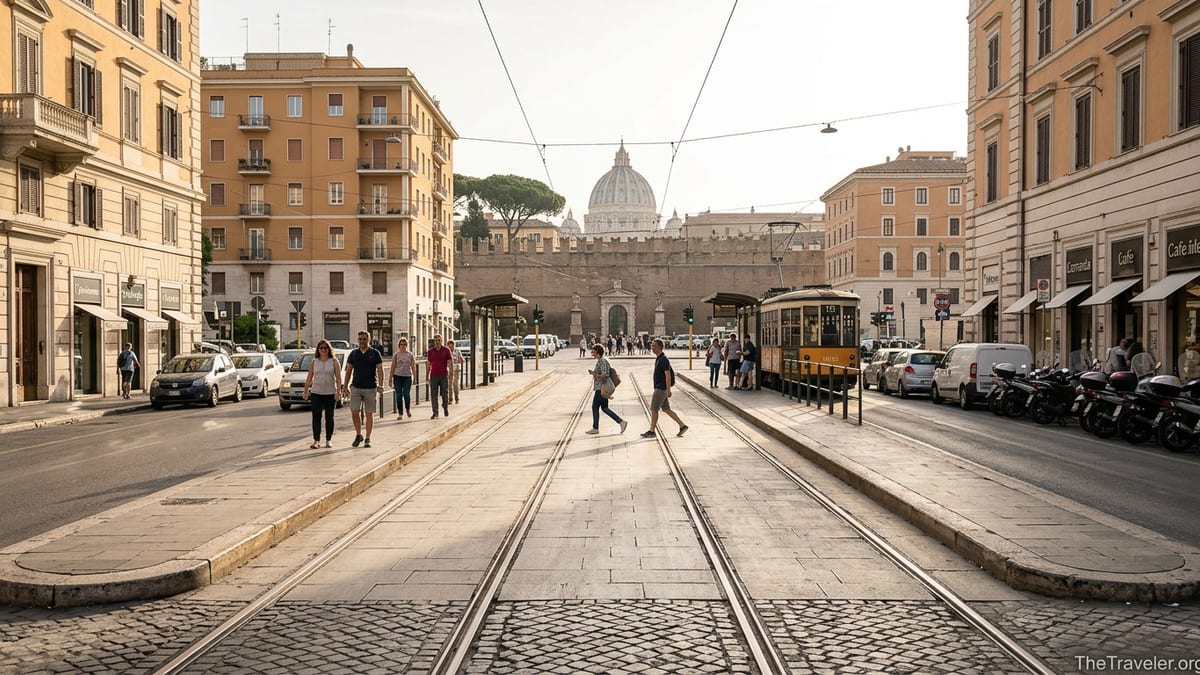
Why Piazza del Risorgimento Matters for Vatican Access
Piazza del Risorgimento sits just outside the Vatican walls, a few minutes’ walk from both the Vatican Museums entrance and St Peter’s Square. It is where tram 19 stops, several key bus routes terminate or pass through, and where many visitors arrive after getting off metro line A at Ottaviano station and following the crowds. Because of this, the square effectively works as a warm-up zone for Vatican security lines and a pressure gauge for crowds. When the piazza feels calm, odds are good that the lines up at Viale Vaticano or St Peter’s Square are still manageable. When it is jammed with tour groups at 10 in the morning, you can assume the worst.
For independent travelers, Risorgimento is also where you make quick tactical decisions. If you emerge here around midday and already see long, static lines stretching along the walls, you might decide to delay the museums to late afternoon, head instead to Castel Sant’Angelo via Via Cola di Rienzo, or break for lunch away from the Vatican cluster. Many recent visitor reports in 2024 and 2025 describe arriving at the square around 10 or 11 in the morning only to face security lines that were already 60 to 90 minutes long for St Peter’s Basilica, even with prepaid tickets for other Vatican sites.
The square is also a hotspot for ticket touts and unofficial guides, precisely because people pause here to get their bearings. When the area is crowded, it is much easier for them to approach confused visitors and hard for you to step aside and check your phone or map. Passing through at quieter times of day does not just reduce your waiting time at monuments; it also reduces the number of unsolicited offers, pickpocket risks, and general “herd effect” you have to deal with before you even enter Vatican territory.
Because of planned Jubilee Year events in 2025 and the continued popularity of Rome in every season, local advice has shifted away from assuming that winter and shoulder months will always be quiet. Instead, the focus is on the micro-timing of your movements. Piazza del Risorgimento may be crowded in February on a Saturday late morning and relatively empty on a June Tuesday at 7 in the morning. Learning the daily rhythm of this square is now more important than fixating only on the month of your visit.
Best Time of Day for Crossing: Early Morning Advantages
The single most reliable way to experience Piazza del Risorgimento with fewer crowds is to cross it as early as possible in the morning. On most days, the square begins to wake up with commuters around 7, but Vatican-focused tour groups do not normally flood in until after 8.30. If you step out of Ottaviano metro or off tram 19 between 7 and 8, you will usually share the pavement with office workers, a few early independent travelers, and residents walking dogs, rather than organized groups.
Consider a concrete example. A traveler staying near Termini station takes metro line A at 7.10, reaching Ottaviano at roughly 7.25. By 7.35 they are walking across Piazza del Risorgimento. At that hour, they can often grab a quick espresso at a bar on Via Ottaviano, cross the square in minutes, and be in the security queue for St Peter’s Basilica before 8. By the time organized tour buses from hotels and cruise ships start dropping people closer to 9, that same traveler is already exiting the basilica or heading up to the dome. The difference in crowd experience between entering the square at 7.30 and at 9.30 can easily be the difference between a 10-minute and a 60-minute security wait.
Early morning also mitigates the Roman heat, which has become increasingly intense. Experienced guides caution against standing in outdoor security lines in summer after about 10.30 in the morning, when temperatures and direct sun turn queues into endurance tests. Passing through Risorgimento before 8.30 lets you complete most of the outdoor waiting before the heat builds, especially between June and September, when midday highs regularly approach the mid-30s Celsius and beyond. Even in cooler months, early morning means calmer streets, better light for photographs of St Peter’s dome framed above the rooftops, and a less stressful start to your day.
From a safety and comfort perspective, early hours are also when pickpocket activity in the square tends to be lower. While incidents can happen at any time, petty thieves generally prefer dense, distracted crowds. When the pavements are still half-empty, it is easier to keep track of your bag and move purposefully to your destination. Combine that with a small cross-body bag worn in front, and you significantly reduce the odds of a bad experience before breakfast.
Late Afternoon and Evening: A Second Sweet Spot
For travelers who are not morning people, late afternoon can be an excellent second-best time to pass through Piazza del Risorgimento. As day-trippers and cruise passengers begin heading back to coaches around 3.30 or 4 in the afternoon, group density in the square and around the Vatican Museums entrance gradually thins. By 4.30 or 5 in the shoulder seasons, you will often find the queues much shorter than they were at midday, and the low, warm light makes the approach along the Vatican walls far more pleasant than under a midday sun.
Take a real-world scenario: a couple with timed Vatican Museums tickets for 3.30 in the afternoon exits the galleries around 6. They follow the crowd out toward Viale Vaticano, then walk the short distance downhill toward Piazza del Risorgimento. By this time, many organized tours have finished, and office workers are drifting home along Via Cola di Rienzo. The square feels busy but not compressed. The couple can cross the piazza in a few minutes and catch tram 19 toward the northern neighborhoods or walk back toward the center without fighting through walls of people queuing or clustering.
Evening crossings, especially after 7, often feel almost local. Bars and gelato shops around the square catch a dinner crowd, but the tour flags have mostly disappeared. In late spring and early autumn, you might choose to plan a relaxed evening stroll from Castel Sant’Angelo to Piazza del Risorgimento, then up to Prati’s streets for dinner. You still get the monumental backdrop of the Vatican walls, but the frantic energy has faded. Visitors who entered the square for the first time at 11 in the morning are frequently surprised by how human-scaled it feels after sunset.
Do keep in mind that metro line A can be packed at classic Roman rush hours, roughly 8 to 9.30 in the morning and 5 to 7 in the evening. Even if Piazza del Risorgimento itself is relatively calm at 5.30, the Ottaviano-San Pietro station may be crowded with commuters. If you are nervous about very tight subway conditions, consider timing your evening crossing of the piazza for just after 7, when many office workers are already home and the Vatican area has shifted back into residential mode.
Days of the Week, Seasons, and Special Events
Not all days are created equal around Piazza del Risorgimento. On Wednesdays, the papal audience in the morning attracts tens of thousands of pilgrims to St Peter’s Square. Even though the event formally focuses on the square, the ripple effect often reaches Risorgimento. Buses and trams deliver groups earlier than usual, and security for the basilica remains busy into the early afternoon as audiences finish and people decide to join the line to visit the interior. If you must cross the piazza on a Wednesday, aim for before 8 in the morning or after 3 in the afternoon to reduce your exposure to the heaviest flows.
Weekends see similar crowd surges. Saturdays in particular can feel intense, as visitors arriving for short breaks stack up with coach tours and regional day-trippers. Travelers who recently visited in high season report walking out of Ottaviano station on a Saturday late morning to find Piazza del Risorgimento full of held-up tour flags and groups already queuing in thick clusters along the walls. If your schedule is flexible, treat Tuesday and Thursday as your prime Vatican approach days, with Friday as a backup. On those midweek days, you are more likely to find moderate flows through the square in both early morning and late afternoon.
Seasonality still plays a role, but less than it once did. Summer months, especially June to August, pack the square from midmorning through midafternoon, and the combination of heat, crowds, and lack of shade can make the approach quite punishing. However, recent reports from February and November note surprisingly heavy weekend crowds, particularly around special religious events and long weekends when European travelers take city breaks. The upcoming Jubilee Year in 2025 is expected to add sustained surges of pilgrims, meaning that even so-called off-season periods may see consistent crowd pressure around the Vatican approaches.
Public holidays and major Catholic celebrations, such as Easter, Christmas, and canonization ceremonies, can turn Piazza del Risorgimento into a continuous flow zone, with police barriers and redirected bus routes. In these cases, the square itself might be less comfortable to cross at any time of day. If you are traveling during big events and only need to pass near the Vatican, consider routing your walk via Lepanto station and Via Cola di Rienzo, skirting the densest crowd funnels while still reaching the Prati neighborhood or the Tiber riverfront.
Approaching from Metro, Tram, or On Foot: Practical Tactics
Most visitors who find themselves overwhelmed in Piazza del Risorgimento make the same mistake: they simply follow the visible crowds without pausing to think. With a small amount of planning, your transit through the square can be quick and relatively calm. If you arrive by metro, get off at Ottaviano-San Pietro, but resist the instinct to join the thickest stream of people leaving the station. Instead, take a moment just outside the exit to orient yourself. The Vatican walls and St Peter’s dome give you a clear sense of direction, and from there it is a straightforward 8 to 10-minute walk to the museums entrance or the square.
For tram users on line 19, which stops right in Piazza del Risorgimento, the key is to step away from the tram stop itself before consulting your map or ticket details. This reduces the risk of blocking the sidewalk and being caught in a knot of other riders doing the same. Walk 30 or 40 meters toward the quieter corners of the piazza, then set your course. In many cases you can bypass the densest mass in the center of the square by using the pavements on the outer edge, near the surrounding streets, before turning toward the Vatican.
Walking from central Rome, such as from Piazza Navona or Campo de’ Fiori, you will likely arrive via Via Cola di Rienzo or one of the side streets of Prati. As you approach Piazza del Risorgimento, look ahead for signs of congestion. If you see large groups already forming near the tram stop or along the side toward the Vatican walls, consider pausing for a coffee or water on a side street and letting one wave of groups pass. Often, tour groups move in pulses; waiting five or ten minutes can leave the square noticeably calmer, saving you energy for the heavy sightseeing ahead.
From a safety standpoint, keep bags closed and in front of your body when you step into crowded sections of the piazza or the streets leading out of Ottaviano station. Organized pickpocket teams watch for distracted visitors slowing down at corners or checking their phones. Passing through at calmer hours, such as before 8 in the morning or after 6 in the evening, naturally reduces your exposure to this, but basic awareness and secure bags are still essential.
Using Piazza del Risorgimento as a Planning Barometer
Piazza del Risorgimento is not just a space you cross; it is a live indicator of what awaits you at the Vatican entry points. If you emerge into a half-empty square at 7.45 on a Tuesday, you can be cautiously optimistic that security for St Peter’s or the Vatican Museums will still be relatively short. If at 9.30 you already see multiple groups clustered with guides and flags, and a visible line extending along Viale Vaticano, you should adjust your plan in real time.
Imagine you have Vatican Museums tickets for a flexible morning slot and dream of a quiet Sistine Chapel experience. You reach Piazza del Risorgimento at 9.45 and see the square already crowded, with groups guided toward the walls and touts waving laminated cards. At that point, rather than joining the thickest flow, you could backtrack a few minutes to Via Cola di Rienzo, enjoy an early lunch on a side street, and then return to the square around 1.30 or 2, when some of the morning wave has subsided. Several recent travelers report that entering the museums after 2 in the afternoon gave them denser lines at the beginning but noticeably calmer galleries in the later hours, particularly in shoulder seasons.
Similarly, Risorgimento helps you decide how to tackle St Peter’s Basilica. If you cross the square around 8 in the morning and see only a modest stream moving toward the basilica, it makes sense to proceed straight to the security line in the square and visit the church first, possibly combining it with an early dome climb. If you arrive closer to 11 and the square is already packed, it may be better to use that time for exploring Prati or Castel Sant’Angelo, then return for basilica security after 4, when some visitors have moved on and late-afternoon light is at its most beautiful inside the church.
Travelers with limited mobility or small children should especially respect what the square tells them. If Piazza del Risorgimento already feels overwhelming, assume that any outdoor queue that follows will be at least as demanding. In high season, a smart move might be to cross the square early in the day just to pick up reserved tickets or confirm meeting points for guided tours on another day. Short reconnaissance walks through the piazza in the evening before your Vatican day can also give you a sense of signage, curb heights, and rest spots, making the actual transit the next morning much less stressful.
Finally, the square can function as an ad-hoc meeting point when you are splitting your time between the Vatican and other neighborhoods. Because so many buses and trams cross here, it is easy for one half of a group coming from the Spanish Steps and another from Trastevere to rendezvous at a specific landmark in Risorgimento at a named hour. Choosing quieter windows, like 8 in the morning or 6.30 in the evening, makes regrouping among friends or family more straightforward than trying to spot one another in a Saturday midday crowd.
The Takeaway
Passing through Piazza del Risorgimento efficiently is not about memorizing a single magic hour; it is about understanding the rhythms of the Vatican neighborhood and pairing them with your own habits. Early mornings between 7 and 8 remain the gold standard for a calm crossing, cooler temperatures, and minimal tout activity. Late afternoons from roughly 4.30 to early evening offer a second window, especially in shoulder seasons, when many day-trippers have left and the light softens around the dome.
Midweek days, particularly Tuesday and Thursday, generally give you better odds of lighter flows through the square than Saturdays, Sundays, or Wednesdays with papal events. Watching the square as a barometer and staying flexible can help you pivot, whether that means delaying a museum visit, shifting your focus to St Peter’s, or detouring into Prati for a break before tackling queues. In a city that increasingly feels busy year-round, mastering this small but strategic piazza can quietly transform your entire Vatican experience.
In practice, that means setting an alarm a little earlier, checking your route to Ottaviano or the tram stop the night before, and being ready to read what the square shows you the moment you emerge into it. If Piazza del Risorgimento feels calm, walk with confidence toward the walls. If it already churns with crowds, be prepared to change your timing. Travelers who respect these patterns tend to report smoother entries, less time wasted in standing lines, and more energy left over to actually enjoy the marvels waiting inside the Vatican.
FAQ
Q1. What is the absolute best time of day to pass through Piazza del Risorgimento?
The most consistently calm window is between about 7 and 8 in the morning, when commuters are present but large Vatican tour groups have not yet arrived in force.
Q2. Are evenings around Piazza del Risorgimento safe and less crowded?
Evenings are generally safe and feel more local, with fewer tour groups and touts. After about 7 the square is still active but noticeably less crowded than midday.
Q3. Which metro station should I use to reach Piazza del Risorgimento?
Ottaviano-San Pietro on line A is the most convenient metro stop. From there it is roughly an 8 to 10-minute walk following the crowds and signs toward the Vatican walls and the square.
Q4. Is there a better day of the week to cross the piazza for Vatican visits?
Tuesday and Thursday typically see slightly lighter flows than weekends or Wednesdays, when papal audiences can swell crowds throughout the Vatican area.
Q5. How long does it usually take to walk across Piazza del Risorgimento?
When it is quiet, you can cross the square in two or three minutes. At peak times with dense crowds and tour groups, it may take 10 minutes or more just to weave through.
Q6. What should I do if I arrive and find the square already packed with crowds?
Consider pausing on a nearby side street for 10 to 15 minutes to let a wave of tour groups move on, or adjust your plan by visiting Prati or Castel Sant’Angelo before returning later.
Q7. Are there good places near the piazza to wait out crowds?
Yes, the surrounding Prati streets offer many cafes and bars where you can sit with a coffee or snack while watching crowd levels in the square gradually ease.
Q8. Does bad weather reduce crowds in Piazza del Risorgimento?
Heavy rain or strong wind can thin crowds slightly, but popular Vatican days still draw many visitors. Weather helps, but timing early or late in the day remains more important.
Q9. Is Piazza del Risorgimento a good meeting point for groups?
It can work well if you choose a clear landmark and meet at a quieter time such as early morning or early evening, when it is easier to spot each other in the square.
Q10. Can I avoid Piazza del Risorgimento entirely when visiting the Vatican?
Yes, you can approach via other routes, such as walking from Castel Sant’Angelo or using nearby streets in Prati, but most public transport links naturally funnel through or near the piazza.